Pnp npn explained for everyday electronics lovers
Pnp npn transistors explained: See how these switches power your electronics, their differences, and why both types matter in daily devices.
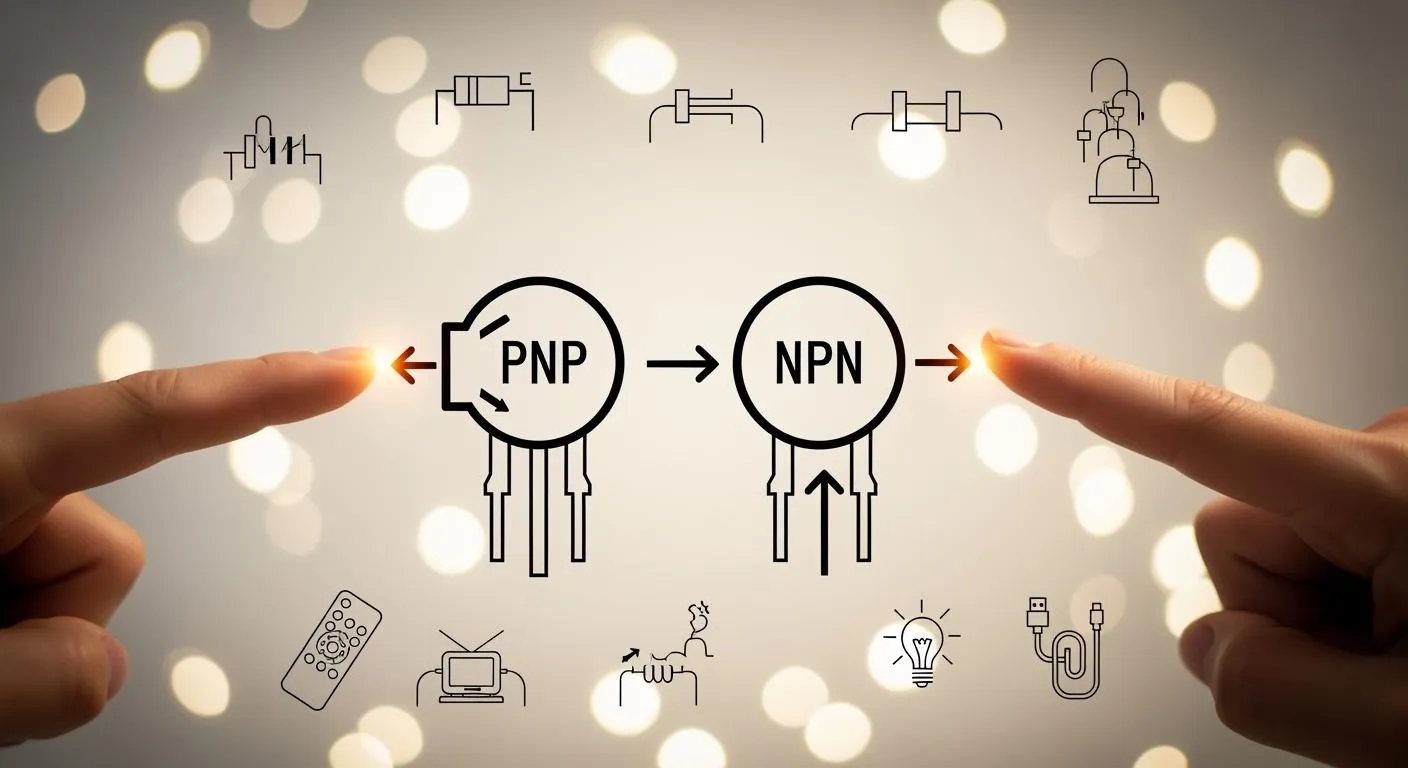
You probably use your smartphone every day, but have you ever wondered what makes it tick? The terms pnp npn refer to two types of tiny switches called transistors inside your device. These switches help control signals and power. Most electronics, like remotes and tablets, rely on NPN transistors because they handle ground-referenced signals easily—about 80–90% of devices use them. If you know how these switches work, you can spot problems faster, fix gadgets, or even build your own projects.
Key Takeaways
- Transistors, like NPN and PNP, act as tiny switches or amplifiers in electronics, controlling signals and power flow.
- NPN transistors are faster and handle higher currents, making them ideal for digital circuits and amplifiers, while PNP transistors are better for high-side switching and reducing noise.
- Understanding the differences between NPN and PNP transistors helps in troubleshooting, fixing gadgets, and designing DIY electronics projects.
- NPN transistors are commonly used in phones, home appliances, and cars due to their speed and efficiency, while PNP transistors are used for specific tasks like power management and audio amplification.
- Learning to read circuit diagrams and choosing the right transistor type can simplify electronics projects and improve device performance.
Pnp npn basics

What is a transistor?
You see transistors everywhere in electronics, but what do they actually do? Think of a transistor as a tiny electronic gatekeeper. It has three legs, called terminals: emitter, base, and collector. You use these terminals to control how electricity flows through a circuit.
- Transistors can act as amplifiers. They take a small signal and make it bigger.
- They also work as switches. A small current at the base can turn a much larger current on or off between the collector and emitter.
When you press a button on your remote, a transistor might amplify the signal or switch the power to another part of the device. This simple action happens millions of times in your phone, TV, or even your car.
PNP vs NPN: Key differences
You often hear about pnp npn when talking about transistors. These are two main types of bipolar junction transistor. The difference comes from how they are built and how they move electrical charges.
| Feature | NPN Transistor | PNP Transistor |
|---|---|---|
| Structure | Negative-Positive-Negative (N-P-N) | Positive-Negative-Positive (P-N-P) |
| Internal Structure | P-layer between two N-layers | N-layer between two P-layers |
| Majority Charge Carriers | Electrons | Holes |
| Current Direction | Collector → Emitter | Emitter → Collector |
You use an npn transistor when you want current to flow from the collector to the emitter. You turn it on by giving the base a positive voltage. For a pnp transistor, current flows from the emitter to the collector, and you activate it with a negative voltage at the base.
Let’s break it down even more:
- NPN transistors need a positive voltage at the base to turn on. Current flows from collector to emitter.
- PNP transistors need a negative voltage at the base to turn on. Current flows from emitter to collector.
- NPN is great for low-side switching (connecting the load to ground). PNP is better for high-side switching (connecting the load to the positive supply).
Why pnp npn types matter
You might wonder why you need both types. The answer is flexibility and performance. Using both pnp npn transistors lets you design circuits that can handle signals in both directions. This is important for things like amplifiers, motor controllers, and even computers.
- NPN transistors work well with positive signals. They are fast and stable, so you see them in digital logic and amplification circuits.
- PNP transistors are good for sourcing current and audio amplification. You often find them paired with npn transistors for balanced designs.
- Together, they give you precise control over electrical signals and power management.
The complementary nature of npn and pnp transistors allows for symmetrical performance in applications like power amplifiers and switching regulators, which are critical for efficient circuit design.
You also see pnp npn transistors in automotive electronics, where durability matters. High-quality pnp transistors can survive tough conditions, which means fewer replacements and less electronic waste.
How pnp npn work
Current flow explained
Imagine a transistor as a tiny faucet for electricity. You control how much current flows through it by turning the handle, which is the base terminal. In an npn transistor, current moves from the collector to the emitter. You turn it on by giving the base a positive voltage. For a pnp transistor, current flows from the emitter to the collector, and you activate it by applying a lower voltage to the base. This difference in current direction changes how you design circuits and how each transistor manages bigger currents using a small base current.
You can picture the npn as a slide where electrons rush down when you push the button. The pnp works like a slide in reverse—current flows up when you pull the lever. This simple difference lets you build circuits that handle signals in both directions.
Switching and amplification
You use transistors in two main ways: as switches and as amplifiers. When you use a transistor as a switch, it acts like a light switch for electricity. If you send a small current to the base, the transistor lets a much larger current flow between the collector and emitter (npn) or emitter and collector (pnp). This is how your devices turn on and off so quickly.
- npn: Current flows from collector to emitter when you apply a positive voltage to the base.
- pnp: Current flows from emitter to collector when you apply a lower voltage to the base.
- In the "on" state (saturation), the transistor acts like a closed switch, letting maximum current pass.
As an amplifier, the transistor takes a tiny signal and makes it much bigger. This is how your phone boosts your voice or music.
Tip: If you want to build a simple amplifier or switch, start with an npn transistor. It’s easier to control with positive signals.
Speed and efficiency
You might wonder why npn transistors show up more often in your gadgets. The answer is speed and efficiency. npn transistors switch faster because electrons move more quickly than the "holes" in pnp transistors. This means npn types work better in digital circuits, high-speed switches, and amplifiers.
- npn transistors have higher switching speeds, thanks to fast-moving electrons.
- They handle higher currents and voltages, making them great for power-hungry devices.
- npn transistors also stay stable across different temperatures, so your devices work reliably.
- pnp transistors create less noise, which helps in sensitive audio circuits.
- pnp types have higher input impedance, which can be useful in special designs.
You’ll find npn transistors in places where speed matters, like computers, signal processors, and anything that needs quick on-off action. pnp transistors still play a role, especially when you need to connect to the positive side of a circuit or reduce noise.
Pnp npn in daily devices

Phones and tablets
You probably use your phone or tablet every day, but you might not realize how many times a transistor helps your device work. Inside your phone, npn and pnp transistors handle everything from touchscreens to audio. When you tap the screen, a sensor uses a transistor to detect your touch. The npn type often acts as a fast amplifier, boosting weak signals from the microphone or antenna. The pnp transistor can help manage power, making sure your device stays efficient and cool. You also find these transistors in the charging circuit, where they control how much current flows into the battery. If you ever wondered why your phone responds so quickly, thank the npn transistor for its speed.
Home appliances
Transistors play a huge role in your home appliances. You see them in washing machines, microwaves, and even smart thermostats. Here’s how npn and pnp transistors work in some common devices:
- Microwave ovens use transistors to control power and timing, making sure your food heats evenly.
- Washing machines rely on transistors for motor control and to manage wash cycles.
- Smart thermostats use npn and pnp transistors to switch heating or cooling systems on and off.
The npn transistor usually handles fast switching tasks, while the pnp transistor manages current flow from the positive supply. This teamwork keeps your appliances running smoothly and safely.
Automotive and wearables
Modern cars and wearables depend on transistors for almost every function. In cars, npn and pnp transistors control everything from headlights to engine sensors. The automotive industry uses thousands of transistors in each vehicle, especially as electric vehicles become more popular. Here’s a quick look at how these transistors work in cars:
| Role in Automotive Electronics | Description |
|---|---|
| High-side Switching | pnp transistors are used in high-side switching applications, which are crucial for controlling power to various automotive systems. |
| Analog Signal Conditioning | pnp transistors help with analog signal conditioning, ensuring reliable performance in tough environments. |
| Support for Electrification | pnp transistors support control circuits in hybrid and electric vehicles, adapting to complex automotive electronics. |
Npn transistors are key for power management in electric vehicles. They help regulate battery performance and monitor energy use. As cars become more electrified, you will see even more transistors at work.
Wearable devices like smartwatches use npn and pnp transistors to manage sensors, displays, and wireless connections. These transistors keep your wearable running longer and responding faster.
The output type of a sensor—positive for pnp, negative for npn—decides how it connects to other parts of a device. Npn sensors sink current and connect the load to ground, while pnp sensors source current and provide positive voltage. If you mix up these types, you might damage your device or cause it to malfunction.
If you’re interested in chip-level solutions and system integration, companies like Nova Technology Company (HK) Limited stand out as HiSilicon-designated partners. They specialize in advanced transistor applications for the IC industry, supporting everything from automotive electronics to smart wearables.
Why pnp npn knowledge matters
Troubleshooting tips
You can save time and frustration when you know how to troubleshoot a transistor. If your device stops working, you might find a faulty npn or pnp transistor inside. Here’s a simple checklist you can follow:
- Make sure you have the correct type and orientation for the transistor in your circuit.
- Use a multimeter in diode mode. For an npn transistor, check for a voltage drop of 0.6–0.7V from base to emitter. For a pnp transistor, you’ll see this drop in reverse.
- Measure the voltage drop across the transistor while the circuit is powered. If you see a big drop in the off state, the transistor could be faulty.
- Try swapping the transistor with a known good one to confirm the issue.
- Replace the transistor carefully, making sure you install it with the right orientation.
Tip: Check the base-emitter voltage. It should be around 0.7V for an npn transistor and reversed for a pnp transistor. If the collector-emitter voltage looks strange, you might have a problem.
You can also look at the collector-emitter voltage. In a switch, 0.3V means the transistor is working. For amplifiers, the voltage should be between 25% and 75% of the supply. If it matches the supply voltage, you probably have an open circuit.
DIY and hobby projects
If you love building your own gadgets, understanding pnp npn transistors makes your life easier. You can design circuits for automatic lights, alarms, or even simple robots. Knowing how an npn transistor works helps you understand a pnp transistor, since their operation is similar but reversed. You can create systems that turn on when it gets dark or amplify signals for sensors.
- You simplify circuit design for your DIY projects.
- You build automatic systems, like lights that switch on in the dark.
- You gain confidence working with both npn and pnp transistors.
Understanding device design
When you look inside a device, you’ll see many transistors. Knowing how pnp and npn transistors operate helps you understand why designers chose them for certain tasks. Their differences in current flow and biasing affect how circuits perform. You can spot which transistor works as a switch or amplifier and why it matters for efficiency.
- You interpret device design by understanding transistor operation in switching and amplification.
- You see how current flow and biasing requirements impact circuit choices.
- You select the right transistor for performance, making your circuits more efficient.
If you want to dive deeper into electronics, learning about bipolar junction transistor types gives you a solid foundation for troubleshooting, building, and appreciating device design.
Identifying and using pnp npn
Reading schematics
You might feel nervous when you first look at a circuit diagram, but reading transistor symbols gets easier with practice. The standard symbol for a bipolar junction transistor looks like a T with two diagonal lines. One line has an arrow. For an npn transistor, the arrow points out. For a pnp transistor, the arrow points in. This arrow shows the direction of current flow.
Here’s a quick reference:
| Schematic Symbol | Symbol Identification | Description |
|---|---|---|
| NPN Transistor | NPN Bipolar Transistor | Arrow points out (emitter), shows current flows out. |
| PNP Transistor | PNP Bipolar Transistor | Arrow points in (emitter), shows current flows in. |
When you see these symbols, check the arrow direction. That tells you if you’re working with npn or pnp. If you want to double-check, look for the part number on the transistor and search online for its type.
Choosing the right type
Picking the right transistor for your circuit depends on what you want to do. Do you need to switch something on the ground side? Go with npn. Need to control power from the positive side? Choose pnp. Here’s a table to help you decide:
| Criteria | NPN Transistors | PNP Transistors |
|---|---|---|
| Current Directionality | Sinks current (low-side switching) | Sources current (high-side switching) |
| Load Configuration | Load between collector and ground | Load between emitter and positive supply |
| Applications | Amplifiers, digital circuits, LED drivers | High-voltage, battery-powered designs |
| Switching Performance | Fast switching, quick response | Smooth current regulation |
If you’re just starting out, npn transistors are easier to use in most circuits. They handle fast switching and work well in digital projects.
Common mistakes
Everyone makes mistakes when learning about transistors. Here are some common ones to watch out for:
- Mixing up npn and pnp types. They are not interchangeable.
- Reading the emitter arrow the wrong way. Always check the symbol.
- Wiring errors. Loose or wrong connections can stop your circuit from working.
- Not giving enough base current. The transistor won’t switch if the base current is too low.
- Overheating. Too much current can make the transistor hot and damage it.
- Leaving the base floating. This can cause random switching and noise.
Tip: Always check your connections and use a multimeter to test voltages. Practice with simple circuits to build your confidence.
If you follow these steps, you’ll avoid most problems and get your projects working faster. Happy building! 😊
When you understand pnp npn, you unlock new skills for fixing, building, and enjoying electronics. Here’s what you gain:
- Faster performance in your projects
- Easier circuit design with standardized negative grounding
- Lower costs for DIY builds
| Function | Description |
|---|---|
| Switch | Control big currents with small signals |
| Amplifier | Boost weak signals for better sound or data |
| Pinout | Learn the basics of collector, base, and emitter |
Try spotting transistors in your gadgets or build a simple switch. Want to learn more? Check out beginner guides on NPN and PNP transistors—they break down the basics and help you get started.
FAQ
What’s the main difference between NPN and PNP transistors?
You activate NPN transistors with a positive voltage at the base. PNP transistors need a negative voltage. NPN types usually switch faster and handle higher currents. PNP types work well for high-side switching.
Can I use NPN and PNP transistors interchangeably?
No, you can’t swap them directly. Each type has a unique current direction and activation method. If you mix them up, your circuit won’t work as expected.
How do I identify a transistor in a circuit diagram?
Look for the arrow on the symbol.
- NPN: Arrow points out
- PNP: Arrow points in
You can also check the part number and search online.
Why do most devices use NPN transistors?
NPN transistors switch faster because electrons move quickly. You see them in digital circuits, amplifiers, and devices that need reliable performance.
What happens if I connect a transistor the wrong way?
You risk damaging your circuit or the transistor. Always check the symbol and orientation before soldering.
Tip: Use a multimeter to test before powering up.