Comparing NE555 and LM555 Timers: Which One to Choose?
Understanding the NE555 and LM555 Timers The NE555 and LM555 timers have become essential components in the electronics industry since their intr
Understanding the NE555 and LM555 Timers
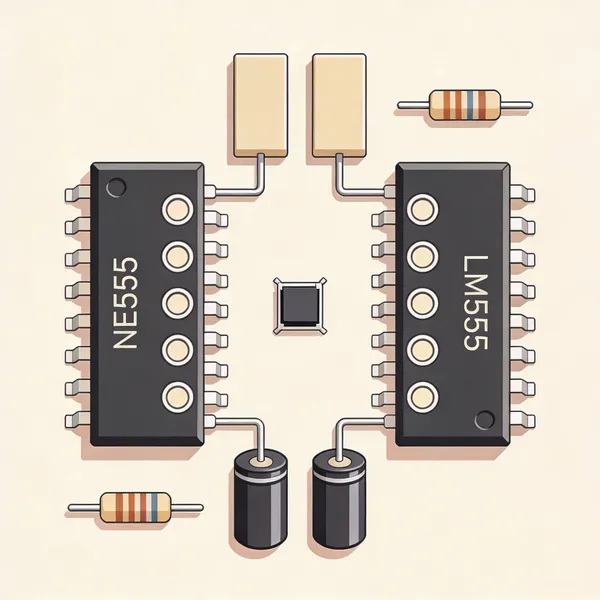
The NE555 and LM555 timers have become essential components in the electronics industry since their introduction. The NE555 was developed in 1972 by Hans R. Camenzind, while the LM555, produced by Texas Instruments, emerged later with enhanced features. Both timers serve as versatile tools for generating precise time delays and oscillations in various applications.
Functionally, both timers can operate in astable, monostable, and bistable modes, making them suitable for a wide range of applications, including pulse width modulation, timers, and oscillators. Common uses include alarm systems, light flashers, and tone generators, showcasing their adaptability in different electronic circuits.
Key Differences Between NE555 and LM555
When comparing the NE555 and LM555, several key differences arise in terms of electrical specifications. The NE555 typically operates at a voltage range of 4.5V to 15V, while the LM555 can extend up to 18V. This voltage range gives the LM555 a slight edge for applications requiring higher voltage levels.
Current consumption is another critical factor; the LM555 generally exhibits lower power consumption compared to the NE555, making it more suitable for battery-operated devices. Additionally, package types vary between the two, with the NE555 often found in DIP configurations, while the LM555 is available in both DIP and SMT formats. SMT (Surface Mount Technology) is increasingly favored in modern designs due to its compact size and ease of integration into printed circuit board assemblies (PCBA).
Thermal performance is essential for reliability. The LM555 tends to have better thermal stability, which can be crucial in applications where temperature fluctuations are expected.
When to Choose NE555 or LM555
The decision to use either the NE555 or LM555 often depends on specific project needs. For projects with stringent power constraints, the LM555 is generally the preferred choice due to its lower power consumption and improved performance at higher voltages.
Cost considerations are also vital. The NE555 is typically less expensive, making it an attractive option for budget-conscious projects. However, when sourcing components, it’s essential to reference the Bill of Materials (BOM) to ensure that the right part is selected for the application.
Specific use cases can also dictate the choice between these two timers. For instance, if a project requires a timer with a high level of precision, the LM555 would be the better option. Conversely, for simple timing circuits or educational purposes, the NE555 remains a popular choice.
Sourcing NE555 and LM555: Where to Buy
When sourcing NE555 and LM555 timers, it is crucial to consider reputable suppliers. nova offers a wide selection of both timers, ensuring quality and reliability. Additionally, platforms like digikey and mouser provide extensive inventories and competitive pricing for these components.
Before making a purchase, checking the Electronic Resellers Association International (ERAI) for component availability and reliability is a wise step. This can prevent potential delays in project timelines and ensure that the components are sourced from trustworthy vendors.
Creating an accurate BOM for your project is essential. This document should include all necessary components, including the selected timer, to streamline the procurement process and avoid last-minute surprises.
Datasheet Insights for NE555 and LM555
Understanding how to read and interpret datasheets is vital when comparing the NE555 and LM555. Key parameters to focus on include operating voltage, current consumption, timing accuracy, and thermal characteristics. These specifications will guide you in selecting the appropriate timer for your specific application.
Both the NE555 and LM555 datasheets provide critical information, such as timing diagrams and example circuits, which can aid in the design process. Links to the datasheets for the NE555 and LM555 can be found on their respective product pages: ne555 and LM555.
Practical Applications and Examples
Real-world applications of the NE555 and LM555 timers highlight their versatility and effectiveness in various circuits. For example, the NE555 is often used in educational projects to demonstrate basic timing concepts, while the LM555 is frequently utilized in more advanced applications requiring precise timing and stability.
One example project using the NE555 could involve creating a simple LED flasher circuit. By configuring the timer in astable mode, users can achieve a blinking effect with adjustable frequency. On the other hand, the LM555 can be employed in a tone generator circuit, producing audio signals for alarms or alerts.
In modern designs, the use of SMT is becoming increasingly prevalent. SMT components allow for more compact PCB layouts, which is essential for space-constrained applications. Integrating SMT components can also enhance manufacturing efficiency in the PCBA process, reducing assembly time and costs.
People Also Ask
What are the main features of the NE555 timer?
Versatile timing capabilities, widely used in oscillators and pulse generators, and available in various package types including SMT.
How does the LM555 differ from the NE555?
Higher precision and stability in timing applications, different current consumption characteristics, and a variety of package options compared to NE555.
Which timer is better for low-power applications?
The LM555 generally offers lower power consumption, while the NE555 may be suitable for simpler, less demanding applications. Evaluate based on specific project requirements.
Can I use NE555 and LM555 interchangeably?
They are similar but not identical; check specifications. Interchangeability depends on the application context, so always refer to the datasheet for compatibility.
What should I consider when sourcing these timers?
Check for availability on platforms like DigiKey and Mouser, consider potential lead times and stock levels, and use ERAI to confirm component reliability.
What are common applications for the NE555 timer?
Used in timer circuits, pulse generation, and time delays. Popular in educational projects and prototypes, and can be found in alarm systems and light flashers.
FAQ
What is the maximum operating voltage for the LM555?
The LM555 typically operates up to 18V, allowing for greater flexibility in high-voltage applications.
Is the NE555 suitable for high-frequency applications?
While it can handle moderate frequencies, the LM555 is generally preferred for applications requiring high-frequency operation.
Can I use both timers in the same circuit?
Yes, as long as their specifications align with the circuit requirements and they are configured correctly.
What is the typical power consumption of the LM555?
The LM555 typically consumes less power than the NE555, making it ideal for battery-powered applications.
Are NE555 and LM555 timers available in surface mount packages?
Yes, both timers are available in SMT configurations, which are advantageous for modern PCB designs.
How do I determine the timing interval in a NE555 circuit?
The timing interval can be calculated using external resistors and capacitors, as detailed in the datasheet for the NE555.