Pnp vs Npn Transistor Choices That Shape Modern Life
Pnp vs npn transistor differences shape device efficiency, speed, and reliability, explaining their widespread use in modern electronics and everyday gadgets.
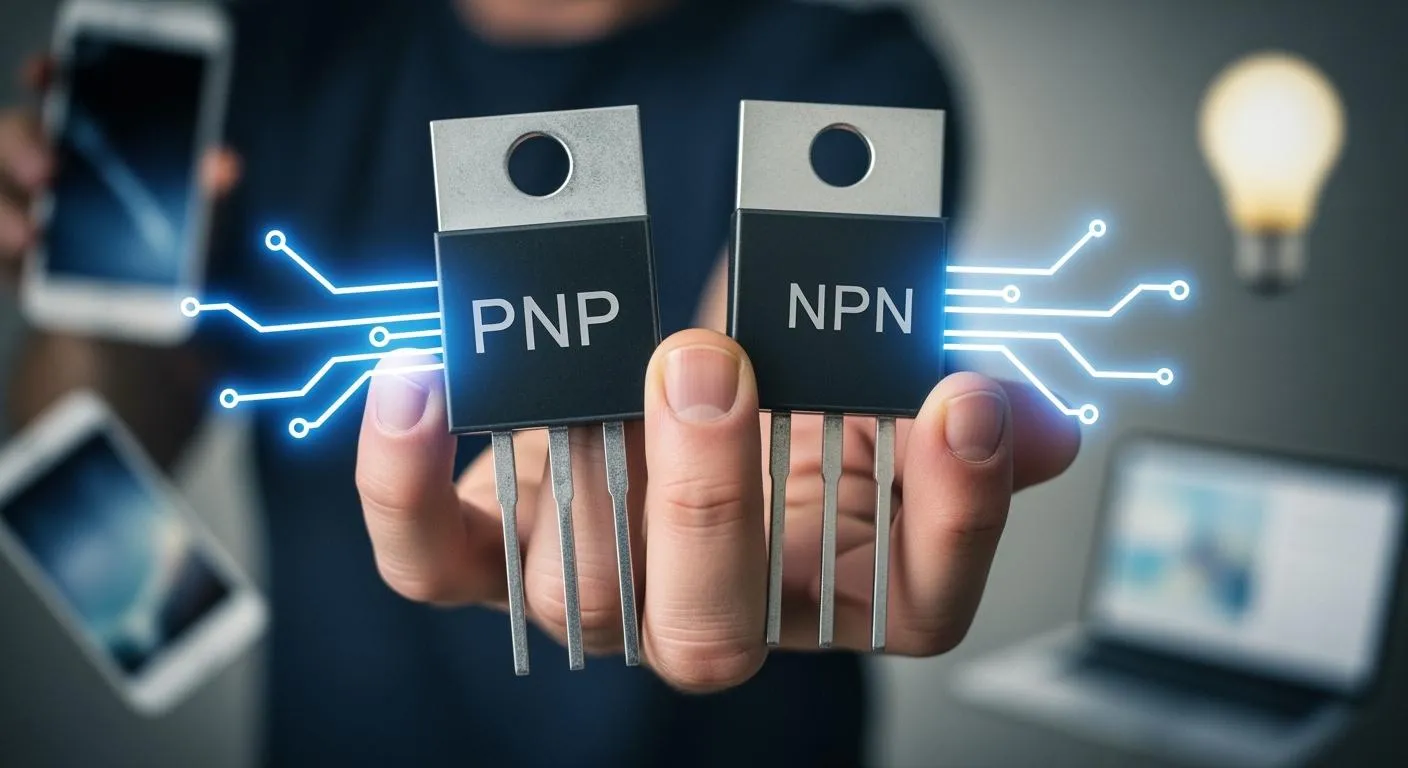
You interact with technology every day, but have you ever wondered what makes your smartphone or car so reliable? The answer often lies in the tiny but powerful transistor. When you explore the topic of pnp vs npn transistor, you unlock the secrets behind how these devices manage energy, speed, and performance. In your phone or vehicle, the transistor impacts how efficiently circuits work and how long your battery lasts.
- PNP transistors now offer lower noise and better thermal stability, making them ideal for high-frequency uses.
- These transistors use less power and dissipate heat more effectively, which matters for energy-efficient gadgets.
- Their small size helps create compact, advanced electronics.
Your understanding of these differences shapes how you see the electronics that power your life.
Key Takeaways
- Understand the basic structure of PNP and NPN transistors. PNP has two P-type layers with one N-type layer, while NPN has two N-type layers with one P-type layer.
- Recognize the importance of current flow. NPN transistors use electrons and require a positive base voltage, while PNP transistors use holes and need a negative base voltage.
- Choose the right transistor for your circuit. Use NPN for negative ground systems and high-speed applications. Opt for PNP in positive ground configurations and for current sourcing.
- Leverage the strengths of both types. NPN transistors excel in digital circuits, while PNP transistors are ideal for audio amplification and balanced designs.
- Stay informed about advancements in transistor technology. Understanding these components enhances your ability to troubleshoot and innovate in modern electronics.
PNP vs NPN Transistor Basics
Structure & Operation
When you look inside any electronic device, you find transistors at the heart of its circuits. The most common types are PNP and NPN transistors. Both belong to the family of bipolar junction transistors. You can think of them as tiny switches or amplifiers that control the flow of electricity in your gadgets.
A transistor has three main parts: the emitter, the base, and the collector. These three leads connect to different layers of semiconductor material. The arrangement of these layers makes the difference between npn vs pnp transistors.
Here is a table that shows the structural differences:
| Transistor Type | Structure Description | Doping Configuration |
|---|---|---|
| PNP | Two P-type layers sandwiching one N-type layer | P-type (emitter, collector), N-type (base) |
| NPN | Two N-type layers sandwiching one P-type layer | N-type (emitter, collector), P-type (base) |
You see that a PNP transistor has an N-type semiconductor layer between two P-type layers. An NPN transistor has a P-type layer between two N-type layers. This arrangement decides how each transistor works and how you use them in circuits.
The operation of npn vs pnp transistors depends on the movement of charge carriers. In an NPN transistor, electrons act as the main charge carriers. In a PNP transistor, holes (which are spaces where electrons are missing) carry the charge. This difference affects how fast and efficiently each transistor can switch or amplify signals.
You often hear about current gain when you study transistors. This term means how much a transistor can amplify a small input current at the base to produce a larger output current at the collector. Both NPN and PNP types offer current gain, but their efficiency depends on their structure and the type of charge carrier.
Current Flow & Polarity
Understanding current flow helps you see why npn vs pnp matters in real circuits. In an NPN transistor, current flows from the emitter to the collector through the base. Electrons move from the emitter, pass through the base, and reach the collector. In a PNP transistor, holes move from the emitter to the collector through the base.
Here is a table that summarizes the charge carriers and current flow:
| Transistor Type | Charge Carriers | Current Flow |
|---|---|---|
| NPN | Electrons | From emitter to collector through the base |
| PNP | Holes | From emitter to collector through the base |
You also need to pay attention to voltage polarity. NPN transistors require a positive voltage at the base compared to the emitter to turn on. PNP transistors need a negative voltage at the base compared to the emitter. This difference in biasing changes how you design circuits with each type.
Tip: In a PNP transistor, the emitter current flows into the transistor, while the base and collector currents flow outwards. In an NPN transistor, the emitter current flows out of the transistor, while the base and collector currents flow in.
When you compare pnp vs npn transistor, you see that the direction of current flow and the type of charge carrier make a big impact on circuit design. NPN transistors conduct when the base is more positive than the emitter. PNP transistors conduct when the base is more negative than the emitter. This is why you often see NPN transistors in circuits with a negative ground, while PNP transistors work well in positive ground systems.
You now have a clear view of the basics behind npn vs pnp transistors. This knowledge helps you understand why engineers choose one type over the other in different applications. The structure, operation, and current flow all shape how modern electronics function.
NPN vs PNP in Circuits
Circuit Roles & Compatibility
When you explore npn vs pnp in real-world circuits, you see that each transistor type serves a unique purpose. Npn transistors often act as low-side switches. You connect the emitter to ground, which lets you control the base directly from a microcontroller. This setup makes npn transistors ideal for negative-ground systems, which you find in most modern electronics. You do not need extra level shifting, so your circuit design becomes simpler and more efficient.
Pnp transistors, on the other hand, work well as high-side switches. You connect the emitter to the positive supply. This configuration allows you to source current to a load. In audio and analog applications, you often see pnp transistors paired with npn transistors. This pairing improves signal amplification and keeps the output signal true to the input. You get less distortion and better fidelity, which is important for high-quality sound and precise signal processing.
Npn transistors handle positive signals efficiently, making them common in digital logic and amplification. Pnp transistors excel at sourcing current and supporting balanced circuit designs. When you combine both types, you enhance signal processing and power management in your devices.
Switching Speed & Performance
You notice a clear difference in switching speed when you compare npn vs pnp. Npn transistors use electrons as their main charge carriers. Electrons move faster than holes, which are the carriers in pnp transistors. This higher electron mobility means npn transistors switch on and off more quickly. You see this advantage in high-frequency and high-speed digital circuits, where fast switching boosts overall performance.
Npn transistors dominate in applications that demand rapid switching and precise signal control. Pnp transistors, while slower, still play a key role in high-voltage and analog circuits. The choice between npn and pnp transistors shapes the performance and efficiency of your electronic systems. When you understand the strengths of each, you can optimize circuit performance and meet the demands of modern technology.
Tip: For high-speed or high-frequency applications, choose npn transistors to maximize switching performance. Use pnp transistors when you need reliable current sourcing or balanced signal amplification.
NPN Transistors vs PNP Transistors Applications
Device Examples
You see npn vs pnp transistors in almost every area of modern electronics. These bipolar junction transistors play a central role in both simple and complex electronic devices. When you look at real-world applications, you notice that npn transistors often appear in digital circuits, logic gates, and microcontroller outputs. They handle fast switching and signal processing in computers, televisions, and LED drivers.
Pnp transistors support many key functions in consumer electronics. You find them in:
- Audio amplifiers, where they help with signal amplification and reduce noise.
- Voltage regulators, which keep your devices running smoothly.
- Automotive systems, such as control modules and safety circuits.
- Smartphones, tablets, and laptops, where they manage power and signal flow.
You also see npn vs pnp transistors working together in push-pull amplifier circuits. This combination improves current amplification and signal fidelity. In switching power supplies, npn transistors provide fast switching, while pnp transistors help with current sourcing.
Impact on Modern Electronics
The choice between npn vs pnp transistors shapes the performance and reliability of electronic applications. Npn transistors offer high-speed switching and efficient signal control. This makes them ideal for high-frequency circuits and digital systems. Pnp transistors excel in sourcing current and supporting balanced signal paths. You rely on them for stable amplification and low-noise operation.
In automotive electronics, pnp transistors meet strict AEC-Q100 standards. They ensure reliability in harsh environments. You see them in safety systems like braking, where they help achieve low failure rates according to IEC 61508. The growing demand for advanced safety features and electrification in vehicles drives innovation in transistor design.
Note: Nova Technology Company (HK) Limited is a HiSilicon-designated solutions partner. They specialize in chip-level solutions and system integration for the integrated circuit industry. Their expertise supports advanced electronic applications in consumer, automotive, and industrial sectors.
When you compare pnp vs npn transistor choices, you see how they affect device efficiency, reliability, and innovation. Your understanding of npn vs pnp transistors helps you appreciate the hidden technology that powers modern electronics.
Choosing the Right Transistor
Selection Factors
When you select between pnp and npn transistors for your next project, you need to consider several important factors. The choice between pnp vs npn transistor types shapes how you control current, manage amplification, and achieve the desired performance in modern electronics. You should always start by looking at the circuit design and the specific requirements of your application.
- Npn transistors work best in circuits with a negative ground. You often use them for high-speed switching and digital logic because they handle positive signals efficiently.
- Pnp transistors suit circuits with a positive ground. You find them valuable for high-side switch configurations and balanced designs.
- The direction of current flow matters. Npn transistors allow current to flow from emitter to collector, while pnp transistors control current from collector to emitter.
- Voltage and current levels play a key role. You must match the transistor type to the voltage polarity and current needed for reliable control.
- For amplification, npn transistors excel in digital circuits, while pnp transistors often support analog signal processing and audio amplification.
You also need to consider how the construction of each transistor affects its behavior. Npn transistors use electrons for conduction, which leads to faster operation. Pnp transistors rely on holes, making them better for smoother current flow in some analog applications.
Design Trade-Offs
You face several trade-offs when choosing between npn and pnp transistors. Performance, cost, and application needs all influence your decision.
- Npn transistors offer faster switching speeds and better performance in high-frequency circuits. You benefit from their efficiency in digital systems and amplification tasks.
- Pnp transistors provide advantages in complementary switching and balanced amplification. You often pair them with npn transistors to achieve stable and accurate signal control.
- Cost can affect your choice. Npn transistors are usually more accessible and cost-effective, especially in large-scale manufacturing. This makes them a popular option for high-volume production.
- In some cases, you may need both npn and pnp transistors in the same circuit design to optimize control and amplification.
You must weigh these factors to achieve the best balance between performance, reliability, and cost. Your understanding of pnp vs npn transistor options helps you create efficient and innovative solutions in modern electronics.
You now see why understanding pnp vs npn transistor choices matters in your daily life. When you know how each transistor works, you can troubleshoot devices more easily:
- NPN transistors use electrons and need a positive base voltage.
- PNP transistors use holes and need a negative base voltage.
- Current flows differently in each type, which affects circuit design.
| Transistor Type | Advantages | Applications |
|---|---|---|
| NPN | High-speed, low-side switching | Digital circuits, general-purpose |
| PNP | High-voltage, positive ground | High-voltage, special configurations |
Advancements in transistor technology will keep improving performance and efficiency. Your awareness of these tiny components helps you appreciate how they shape modern electronics and drive innovation.
FAQ
What is the main difference between NPN and PNP transistors?
You see the main difference in the direction of current flow and the type of charge carrier. NPN transistors use electrons, while PNP transistors use holes. This affects how you connect them in a circuit.
Can you use NPN and PNP transistors together?
Yes, you can combine both types in one circuit. You often see this in push-pull amplifiers or H-bridge motor drivers. Using both helps you achieve balanced signal control and efficient power management.
Why do most modern devices use NPN transistors?
You find NPN transistors in many devices because electrons move faster than holes. This gives you higher switching speeds and better performance, especially in digital circuits and high-frequency applications.
How do you know which transistor type to choose?
You should check your circuit’s ground reference and voltage needs. Use NPN for negative ground systems and fast switching. Choose PNP for positive ground or high-side switching. Always match the transistor to your application’s requirements.
What does a transistor do in a smartphone?
A transistor acts as a switch or amplifier. It controls signals, manages power, and helps your smartphone process information quickly and efficiently.