2N5551 Transistor Explained: Pinout, Equivalents, and Practical Uses
You can often see the 2n5551 transistor in circuits that need strong high-voltage amplification or good switching. This NPN bipolar device can handle up to 160V and 600mA.
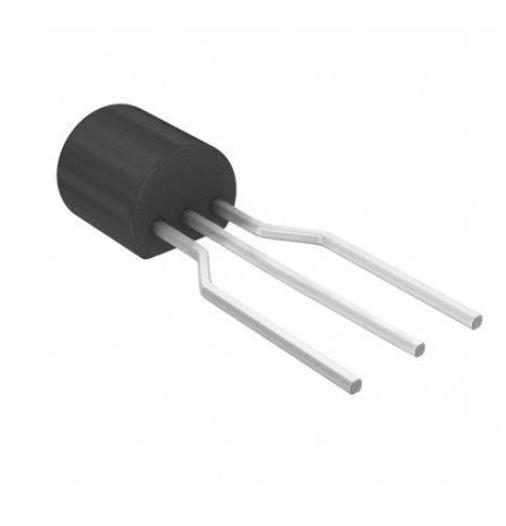
You can often see the 2n5551 transistor in circuits that need strong high-voltage amplification or good switching. This NPN bipolar device can handle up to 160V and 600mA. It works well for both audio and RF jobs. Many engineers pick the 2n5551 transistor for preamplifier stages, radio frequency amplifiers, and buffer circuits. Its TO-92 package makes it easy to use in many projects. You can trust this NPN transistor for sensor interfaces, relay drivers, and signal conditioning when you need a strong bipolar transistor.
Key Takeaways
-
The 2N5551 transistor has three pins. They are emitter, base, and collector. On the flat side of the TO-92 package, they go from left to right.
-
It can handle high voltage up to 160V. It can also handle current up to 600mA. This makes it good for audio and RF amplification. It is also good for switching circuits.
-
Use the 2N5551 with the right base resistors. Keep voltage and current below the maximum ratings. This helps protect the transistor and your circuit.
-
The transistor works well in amplifiers and relay drivers. It is also good for sensor interfaces and signal boosters. This is because it has high gain and fast switching.
-
Always check the datasheet before you use it. Make sure to manage heat with good airflow or heat sinks. This helps the transistor last longer and work well.
2N5551 Pinout

Pin Configuration
When you work with the 2N5551 transistor, understanding the 2n5551 pinout is essential. The 2n5551 pin configuration follows a standard layout for the TO-92 package. You will see three pins on the flat side of the transistor. Each pin has a specific function. The table below shows the correct order:
|
Pin Number |
Terminal |
|---|---|
|
1 |
Emitter |
|
2 |
Base |
|
3 |
Collector |
You can use this table to match each pin to its terminal. The emitter, base, and collector each play a unique role in how the transistor works. The emitter releases electrons, the base controls the flow, and the collector receives the electrons. Knowing the pin configuration helps you connect the transistor correctly in your circuit.
Tip: Always double-check the 2n5551 pinout before soldering. A wrong connection can damage your transistor or the entire circuit.
Identifying Pins
You can easily identify the pins on a 2N5551 transistor by looking at the flat side of the TO-92 package. Hold the transistor so the flat side faces you and the pins point downward. From left to right, you will see the emitter as pin 1, the base as pin 2, and the collector as pin 3. This layout matches the standard 2n5551 pin configuration.
If you ever feel unsure, compare your transistor to the table above. Many datasheets also show a diagram of the 2n5551 pinout. You can use a multimeter to test the pins if you want extra confirmation. Place the probes on two pins at a time and check for the expected voltage drops. This method helps you verify the base, emitter, and collector positions.
You will find that knowing the correct pinout makes building and troubleshooting circuits much easier. The 2n5551 pinout is simple, but it is important to get it right every time.
Features
2N5551 NPN Amplifier Transistor
The 2n5551 npn amplifier transistor is used in many circuits. It helps make weak signals stronger. This transistor has an npn structure. When you put a small current into the base, it lets current flow from collector to emitter. The 2n5551 transistor is special because it can handle high voltages. It works well in both audio and RF circuits. You can use it for making signals bigger, switching, or boosting weak signals. The npn design makes it simple to use in common-emitter amplifiers. Many engineers like the 2n5551 npn amplifier transistor because it has high dc current gain and works well.
Note: The 2n5551 transistor is great for making small signals bigger. It is often used in preamplifier and buffer stages.
Maximum Ratings
You should always look at the maximum ratings before using a transistor. The 2n5551 transistor has strong features for tough jobs. Here is a table with the main electrical features:
|
Parameter |
Value |
|---|---|
|
Collector-Emitter Voltage (Vce) |
|
|
Collector Current (Ic) |
|
|
DC Current Gain (hFE) |
80 to 400 |
|
Power Dissipation (Pc) |
625 mW |
|
Transition Frequency (ft) |
100 MHz |
|
Maximum Base Current |
200 mA |
The 2n5551 npn amplifier transistor can handle high voltages and medium currents. Its dc current gain helps you make signals stronger. The transition frequency is 100 MHz, so you can use it for RF and fast circuits.
Package Type
The 2n5551 transistor comes in a TO-92 package. This is a small plastic case. It is easy to hold and solder onto a board. The TO-92 package helps with heat for low-power uses. You can find the pins easily and put the transistor into breadboards or PCBs.
Key features of the 2n5551 transistor include:
-
NPN type for easy use
-
High collector-emitter voltage (up to 160V)
-
Medium collector current (up to 600 mA)
-
High dc current gain for making signals bigger
-
TO-92 package for easy mounting
You will see the 2n5551 transistor used in these ways:
-
Switching circuits
-
Signal boosters
-
Interface and muting circuits
The 2n5551 npn amplifier transistor is a good choice for high-voltage and signal amplification in many projects.
2N5551 Datasheet
If you want to use the 2N5551 transistor, check the 2n5551 datasheet first. The datasheet gives you important information for your project. It lists things like voltage, current, power, gain, and frequency response. These details help you know if the 2N5551 fits your needs.
Electrical Specs
The table below shows the main electrical specs for the 2N5551 transistor. These numbers come from the official 2n5551 datasheet:
|
Specification |
Value |
|---|---|
|
Collector-to-Emitter Voltage |
160 V |
|
Collector-to-Base Voltage |
180 V |
|
Emitter-to-Base Voltage |
6 V |
|
Continuous Collector Current |
600 mA |
|
Maximum Collector Current |
600 mA |
|
Power Dissipation |
625 mW |
|
DC Gain (hFE) |
80 to 250 (typical 80 at IC=10 mA) |
|
Transition Frequency (fT) |
100 MHz |
|
Package Type |
TO-92 |
|
Operating Temperature Range |
-55°C to +150°C |
Use these specs to make sure your circuit stays safe. The 2n5551 datasheet shows the transistor works for both audio and RF signals. This is because it has a high transition frequency.
Tip: Always check your circuit’s needs with the 2n5551 datasheet before building. This helps you avoid problems and get good results.
Thermal Ratings
Thermal ratings tell you how much heat the transistor can take. The 2n5551 datasheet says the highest junction temperature is 175°C. The thermal resistance from junction to air is 200°C/W. Keep the transistor cool so it does not get too hot. If your circuit uses lots of power, you might need extra cooling or a heat sink.
You can trust the 2n5551 datasheet from ON Semiconductor for the best information. ON Semiconductor is the main source for this datasheet. Other places, like DigiKey, also show these specs.
Equivalents
Equivalent Transistors
If you need a 2n5551 equivalent, you have choices. There are many transistors that can replace the 2N5551. You must check their specs first. Some common 2n5551 equivalents are 2N5551K, BC637, NTE194, BC639, 2N5833, BC487, and 2N5551G. These transistors have close voltage and current ratings. But always look at the datasheets before you swap them.
Here is a table that shows how the 2N5551 compares to its common equivalents:
|
Parameter |
2N5551 (NPN) |
Common Equivalents (Mixed Types) |
|---|---|---|
|
Transistor Type |
NPN |
NPN (NTE194, 2N5833, 2N5088, 2N3055), PNP (BC557, BC556, 2N5401, BC327) |
|
DC Current Gain (hFE) |
~80 at IC=10mA |
Similar but changes; check datasheets |
|
Collector Current (IC) |
600mA |
Close but not always the same |
|
Collector-Emitter Voltage |
160 V |
Usually close; check before using |
|
Collector-Base Voltage |
180 V |
In the same range |
|
Transition Frequency (fT) |
~100 MHz |
Can be different; 2N5551 is good for RF |
|
Notes |
High voltage, high gain, NPN |
Some are PNP, so check the type |
Tip: Always check the type and ratings of any 2n5551 equivalent before you use it. Some are PNP, so they will not work in every circuit.
You might want to see how the 2N5551 compares to other BJTs. The chart below shows how the BC547 and 2N2222 compare in voltage, current, and gain:
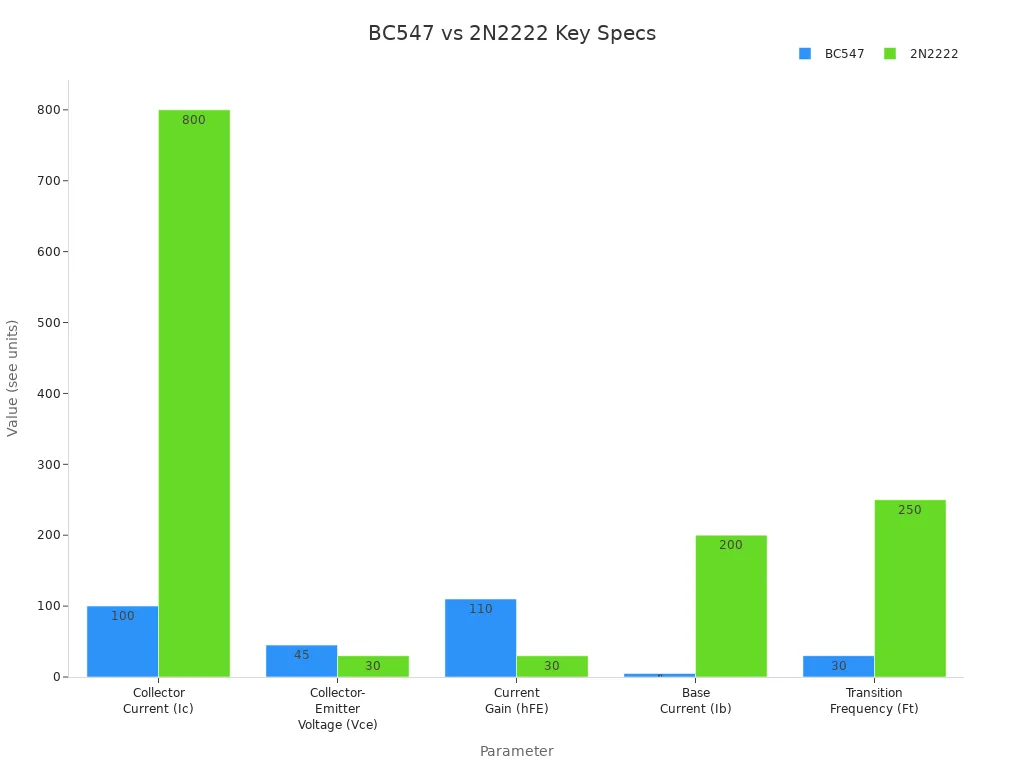
The 2N5551 is special because it can handle high voltage. The BC547 can only handle 45V. The 2N5551 can handle up to 160V. This makes the 2N5551 better for high-voltage circuits.
Complementary PNP Types
Sometimes you need a complementary PNP transistor for push-pull amplifiers or switching circuits. The main complementary PNP types for the 2N5551 are the 2N5400 and 2N5401. These transistors have similar voltage and current ratings as the 2N5551. You can use them together in many projects.
-
Audio amplifier driver stages
-
RF amplifiers
-
General-purpose switching circuits
-
Low-power amplifiers
-
Darlington pair setups
-
Display drivers for gas discharge displays
Using the 2N5551 with a 2N5401 lets you handle both halves of a signal. This is important in circuits that need to boost or switch both positive and negative parts of a waveform.
Note: Always use a complementary PNP transistor with ratings close to the 2N5551. This keeps your circuit safe and working well.
Applications

The 2n5551 transistor is used in many projects. It can handle high voltage and switches quickly. It also makes weak signals stronger. You can use this npn device for switching or amplifying. Here are some common ways to use the 2n5551 transistor.
Amplifiers
The 2n5551 transistor is often found in amplifier circuits. It makes weak signals bigger for audio or RF systems. Most amplifiers use a small-signal setup. This setup has biasing resistors, a load resistor, and sometimes an emitter resistor. With this design, a small input like an 8mV sine wave becomes a larger output, such as a 50mV sine wave.
|
Parameter |
Value/Description |
|---|---|
|
Transistor Type |
NPN Bipolar Junction Transistor |
|
Package |
TO-92 Plastic |
|
Common Circuit Design |
Small-signal amplifier with biasing and load resistors |
|
Input Signal Example |
8mV sine wave |
|
Output Signal Example |
50mV sine wave |
|
Collector Current (Ic) |
Up to 600mA |
|
Collector-Emitter Voltage (Vce) |
Up to 160V |
|
DC Current Gain (hFE) |
80 to 250 (typical 80 at 10mA) |
|
Transition Frequency (fT) |
Up to 100MHz |
|
Applications |
Audio, RF, small-signal amplification |
|
Performance Notes |
Good linearity, low distortion, needs proper biasing |
You can use the 2n5551 transistor in preamplifiers and buffer stages. It also works in push-pull amplifiers with a PNP transistor like the 2N5401. This gives you good sound and less distortion. If you want more gain, use two transistors in a Darlington pair. This lets you drive bigger loads and get better results in audio driver circuits.
Tip: Always use the right biasing resistors. Check your circuit for heat to keep it safe.
Switching Circuits
The 2n5551 transistor is good for switching jobs. It can turn things on and off, control relays, or light up LEDs. Its high voltage and fast switching make it reliable for many uses.
|
Application Area |
Description |
|---|---|
|
LED Driving |
Turns LEDs on and off or controls brightness |
|
IC Driving |
Gives enough power to run integrated circuits |
|
Controlling Electronic Circuits |
Switches circuits quickly and accurately |
|
Darlington Pairs and Driver Stages |
Gives high current gain for big loads and audio drivers |
|
Display Drivers for Gas Discharge |
Switches high voltage for control panels |
|
Relay Driving |
Turns relays on and off in control circuits |
|
Sensor Interfacing |
Connects sensors to control systems, helps with switching and amplifying |
|
High-Frequency Inverters |
Works in fast inverter circuits |
|
Recommended Operating Parameters |
Values and Notes |
|---|---|
|
Collector-Emitter Voltage (Vce) |
Up to 160 V (stay about 20% below max for safety) |
|
Collector Current (Ic) |
Max 600 mA (use about 25 mA for longer life) |
|
Power Dissipation (Pd) |
625 mW |
|
DC Gain (hFE) |
~80 at 10 mA |
|
Transition Frequency (fT) |
|
|
Operating Temperature Range |
-55°C to +150°C |
You can use the 2n5551 transistor in relay drivers and sensor interfaces. It also works in display drivers and high-frequency inverters. Always add a base resistor to protect the transistor.
Note: Keep voltage and current below the maximum ratings. This keeps your circuit safe when switching.
Signal Boosters
The 2n5551 transistor can boost signals in many circuits. It takes a weak signal and makes it strong for the next part. This is important in audio and RF systems.
-
The 2n5551 transistor boosts current, voltage, or power for audio and RF signals.
-
It works well in circuits that need to make small signals bigger, like microphones or antennas.
-
Its high current gain and voltage rating help give a strong, clear output.
-
You can use filter circuits with the transistor to remove noise and make the signal better.
-
In RF amplifiers, the 2n5551 transistor helps send signals farther and makes receivers more sensitive.
-
In audio amplifiers, it makes weak sounds loud enough for speakers or other devices.
You will find the 2n5551 transistor in signal boosters for radios and audio preamps. It is also used in communication devices. Its fast switching and low voltage drop help keep signals clear.
Other Uses
The 2n5551 transistor has many other uses. You can use it in relay drivers, sensor interfaces, and display drivers for gas discharge displays. It also works in phone circuits and industrial control systems.
|
Characteristic |
Specification / Description |
|---|---|
|
Collector-Emitter Voltage (Vce) |
Up to 160 V, good for high voltage relay driving |
|
Continuous Collector Current |
600 mA, supports relays and sensors |
|
Power Dissipation |
625 mW, enough for most control circuits |
|
DC Current Gain (hFE) |
80 to 250, helps with switching and amplification |
|
Transition Frequency (fT) |
100 MHz, allows fast switching and signal conditioning |
|
Operating Temperature Range |
-55°C to +150°C, works in many environments |
|
Switching Speed |
Fast, important for relay drivers and sensor interfaces |
|
Usage Notes |
Use base resistors for biasing and stable operation |
You can use the 2n5551 transistor to switch LEDs, small motors, and other loads. It is popular in hobby and industrial electronics because it is strong and easy to use. If you want to use the 2n5551 transistor in your project, check the datasheet and use the right resistors.
Tip: For more gain, use the 2n5551 transistor in a Darlington pair. This lets you drive bigger loads and get better amplification.
Now you know how to use the 2n5551 transistor for switching and amplifying. The 2n5551 transistor is a good choice for many jobs. Try it in your next project to see how well it works.
Safety
Operating Limits
You must keep the 2N5551 transistor safe to make it work well. The collector-emitter voltage can go up to 160V, but you should use less. Try to stay at least 5V to 10V below the top value. This extra space helps stop damage and makes the transistor last longer. The collector current should not go over 600mA. Using a base resistor helps control the current and stops too much heat. Always keep the transistor’s temperature between -55°C and +150°C. If you use the transistor too close to its limits, it might break or stop working.
Tip: For best results, use the 2N5551 about 20% below its highest voltage and current.
Heat Management
Heat can hurt your transistor. If the 2N5551 gets too hot, it might stop working or lose power. You should use good ways to keep it cool. Put the transistor where air can move around it. For circuits that use more power, add a small heat sink or a fan. This helps take heat away from the transistor. Always check how much power the transistor uses. The 2N5551 can handle up to 625mW, but using less keeps it cool and safe. Do not let the transistor run in quasi-saturation with high current, as this makes more heat and can cause harm.
-
Add a heat sink for hard-working circuits.
-
Keep the transistor away from things that make heat.
-
Make sure the soldering is good so heat does not build up at the pins.
Reliability Tips
You want your circuit to last a long time. Follow these tips to help your 2N5551 work well:
-
Use the 2N5551 at least 20% below its top voltage and current.
-
Add base resistors to control the collector current and stop overheating.
-
Keep the transistor’s temperature in the safe range.
-
Use heat sinks or fans if your circuit gets hot.
-
Do not push the transistor into quasi-saturation with high current.
-
Make sure your circuit does not put too much load on the transistor.
-
Test your circuit with a curve tracer to see how the transistor acts.
Good planning and careful use help your 2N5551 transistor work well for a long time.
You have learned about the 2n5551 transistor and its pinout. You also know its features and which transistors are similar. This transistor works in many projects, like amplifiers and switching circuits.
-
Always look at the datasheet before picking a transistor for your project.
-
Pick the right base resistor and keep voltage and current under the limits.
To keep your circuit safe, follow the datasheet and test your circuit before using it for real.
FAQ
What is the maximum voltage you can apply to a 2N5551 transistor?
You can apply up to 160V between the collector and emitter. Always keep the voltage below this limit for safe operation. Check your circuit’s voltage before connecting the transistor.
Can you use the 2N5551 transistor for audio amplifiers?
Yes, you can use the 2N5551 in audio amplifiers. It works well in preamplifier and buffer stages. Its high voltage rating helps you handle strong audio signals without distortion.
How do you identify the pins on a 2N5551 transistor?
Hold the flat side of the TO-92 package facing you. From left to right, the pins are emitter, base, and collector. You can also check the datasheet for a pinout diagram.
What is the difference between 2N5551 and BC547 transistors?
|
Feature |
2N5551 |
BC547 |
|---|---|---|
|
Max Voltage |
160V |
45V |
|
Max Current |
600mA |
100mA |
You should choose the 2N5551 for higher voltage circuits.
Do you need a heat sink for the 2N5551 transistor?
Most low-power circuits do not need a heat sink. If your circuit uses more than 300mW, you should add a small heat sink or improve airflow to keep the transistor cool.