How NOVA Ensures Quality Standards in Aerospace PCB Assembly
NOVA sets a high benchmark for quality and reliability in aerospace PCB assembly. Their expertise ensures that critical applications meet stringent performance demands, safeguarding the functionality of advanced aerospace systems. By prioritizing trusted PCB assembly techniques and adhering to rigorous quality standards, NOVA delivers solutions designed for long-term reliability. Their innovative approach addresses the unique challenges of aerospace environments, ensuring consistent performance across diverse applications.
NOVA sets a high benchmark for quality and reliability in aerospace PCB assembly. Their expertise ensures that critical applications meet stringent performance demands, safeguarding the functionality of advanced aerospace systems. By prioritizing trusted PCB assembly techniques and adhering to rigorous quality standards, NOVA delivers solutions designed for long-term reliability. Their innovative approach addresses the unique challenges of aerospace environments, ensuring consistent performance across diverse applications.
Key Takeaways
-
NOVA uses strict rules like AS9100 and IPC Class 3 to make sure aerospace PCBs are high quality.
-
Special materials and smart designs help NOVA handle heat better, making PCBs work well in tough conditions.
-
Regular checks and tough tests make sure NOVA's PCBs are safe and work properly.
-
NOVA uses new tech, like 3D printing and layered designs, to create strong and accurate PCBs.
-
Tracking systems and live monitoring improve quality checks and follow aerospace rules.
Adherence to Industry Quality Standards
AS9100 Certification and Its Importance
AS9100 certification represents the gold standard for quality management in the aerospace industry. This certification ensures that every process, from design to production, adheres to stringent requirements tailored for mission-critical applications. By implementing AS9100, NOVA demonstrates its commitment to delivering products that meet the highest safety and reliability benchmarks.
The certification emphasizes continuous improvement, risk mitigation, and customer satisfaction. It also aligns with international standards, ensuring that aerospace PCB assembly processes meet global expectations. For NOVA, AS9100 serves as a framework to maintain consistency, enhance performance, and address the unique challenges of aerospace environments.
|
Standard |
Description |
|
Quality management standard for the aerospace industry, emphasizing continuous improvement and risk mitigation. |
|
|
Nadcap |
Accreditation program for suppliers, ensuring stringent quality controls in PCB assembly. |
Compliance with IPC Class 3 and Aerospace-Specific Standards
Compliance with IPC Class 3 standards is essential for aerospace PCB assembly. These standards focus on high-reliability electronic products designed for critical applications where failure is not an option. NOVA ensures that every PCB meets these stringent industry standards, guaranteeing durability and performance under extreme conditions.
Adhering to IPC Class 3 involves extensive testing and inspection, which enhances the reliability of aerospace systems. The additional time and cost invested in meeting these standards are justified by the critical nature of aerospace applications. NOVA also complies with IPC-6012 and IPC-WHMA-A-620, further solidifying its reputation for quality and reliability standards.
-
Key benefits of IPC Class 3 compliance:
-
Prevents critical failures during aerospace missions.
-
Ensures durability and reliability in harsh environments.
-
Justifies additional inspections due to the high stakes involved.
-
|
Standard |
Description |
|---|---|
|
IPC Class 3 |
High-reliability electronic products designed for critical applications, such as aerospace, where failure is not an option. Must undergo extensive testing and inspection to ensure reliability under extreme conditions. |
|
IPC-A-610 Class 3 |
Industry-wide standard for electronics assembly acceptance, focusing on high soldering criteria. |
|
IPC-6012 |
Qualification and performance requirements for rigid printed boards. |
|
IPC-WHMA-A-620 |
Requirements for acceptance of electronic assemblies. |
Continuous Quality Audits and Assurance
NOVA employs continuous quality audits to ensure adherence to stringent industry standards. These audits involve rigorous evaluations of processes, materials, and finished products. By conducting internal audits using ISO Aerospace Standards checklists, NOVA verifies compliance with quality control and testing practices.
Statistical tools, such as QSE charts, play a crucial role in meeting OEM customers' requirements. Comprehensive documentation under ASQMS provides evidence of compliance, while real-time monitoring ensures that every step of the assembly process aligns with industry benchmarks. This proactive approach minimizes risks and enhances system redundancy, ensuring the safety and reliability of aerospace PCB assembly.
|
Evidence Description |
Purpose |
|---|---|
|
QSE helps in preparing charts to ensure compliance with OEM customers’ requirements. |
This illustrates the use of statistical tools to meet specific quality standards. |
|
QSE prepares comprehensive documentation under ASQMS to create evidence. |
This shows the importance of documentation in demonstrating compliance with quality standards. |
|
QSE conducts internal audits using ISO Aerospace Standards checklists. |
This highlights the role of audits in verifying adherence to industry quality standards. |
Managing Thermal Stress for Reliability

Thermal stress poses a significant challenge in aerospace PCB assembly, where extreme temperature fluctuations can compromise performance and reliability. NOVA employs advanced strategies to mitigate these effects, ensuring that PCBs maintain their integrity in high-stakes applications.
Material Selection for Heat Resistance
Selecting the right materials is critical for managing thermal stress in aerospace PCBs. High-temperature laminates, such as FR4-II Cu, offer enhanced thermal stability, reducing mass loss and slowing degradation rates under elevated temperatures. These materials ensure that PCBs can withstand the harsh conditions of aerospace environments without compromising performance.
In addition to laminates, copper alloys and carbon fiber/aluminum composites are frequently chosen for their superior thermal conductivity and minimal distortion. These materials effectively dissipate heat, preventing hotspots and ensuring consistent functionality. By prioritizing materials with proven thermal properties, NOVA enhances the durability and reliability of its PCB assemblies.
Note: Studies on thermal degradation highlight the importance of understanding material behavior under stress. This knowledge enables engineers to select substrates and components that optimize heat resistance and long-term performance.
Design Techniques to Mitigate Thermal Stress
Effective design techniques play a pivotal role in managing thermal stress. NOVA integrates advanced methods to ensure that PCBs operate reliably in aerospace applications. Key strategies include:
-
Thermal Vias: These are strategically placed to conduct heat away from high-power components, minimizing the risk of localized overheating. For instance, Mars rover PCBs utilize thermal vias to maintain operational temperatures.
-
Passive Cooling: Techniques like heat pipes and thermal radiators dissipate heat without relying on active systems, making them ideal for space applications where convection is unavailable.
-
Onboard Heaters: These maintain optimal temperatures during cold orbits, as seen in spacecraft like Juno.
Engineers also leverage simulation tools such as ANSYS and Altair HyperWorks to model thermal conditions. These tools predict heat flow and identify potential hotspots, enabling design optimization before production. By addressing thermal challenges at the design stage, NOVA ensures that its PCBs deliver consistent performance in demanding environments.
Thermal Testing and Validation
Comprehensive thermal testing validates the reliability of aerospace PCBs under varying stresses. NOVA employs rigorous protocols to assess material stability, component reliability, and interconnect integrity. Key testing methods include:
-
Thermal Cycling: Evaluates PCB performance under repeated temperature fluctuations.
-
Thermal Shock Tests: Measures the impact of rapid temperature changes on assembly integrity.
-
HALT/HASS Tests: Identifies potential failure points through accelerated stress testing.
-
Environmental Exposure Tests: Simulates real-world conditions to ensure durability.
Thermal aging tests are particularly critical. These tests measure electrical performance, mechanical properties, and microstructural changes over time. In one case study, implementing thermal aging tests in a military communication system reduced maintenance costs by 25%, underscoring their value in aerospace applications.
By combining advanced materials, innovative design techniques, and stringent testing protocols, NOVA ensures that its PCB assemblies meet the highest standards of quality and reliability. These efforts safeguard the performance of aerospace systems, even in the most challenging conditions.
Addressing Complex Aerospace PCB Designs
Advanced Manufacturing Technologies
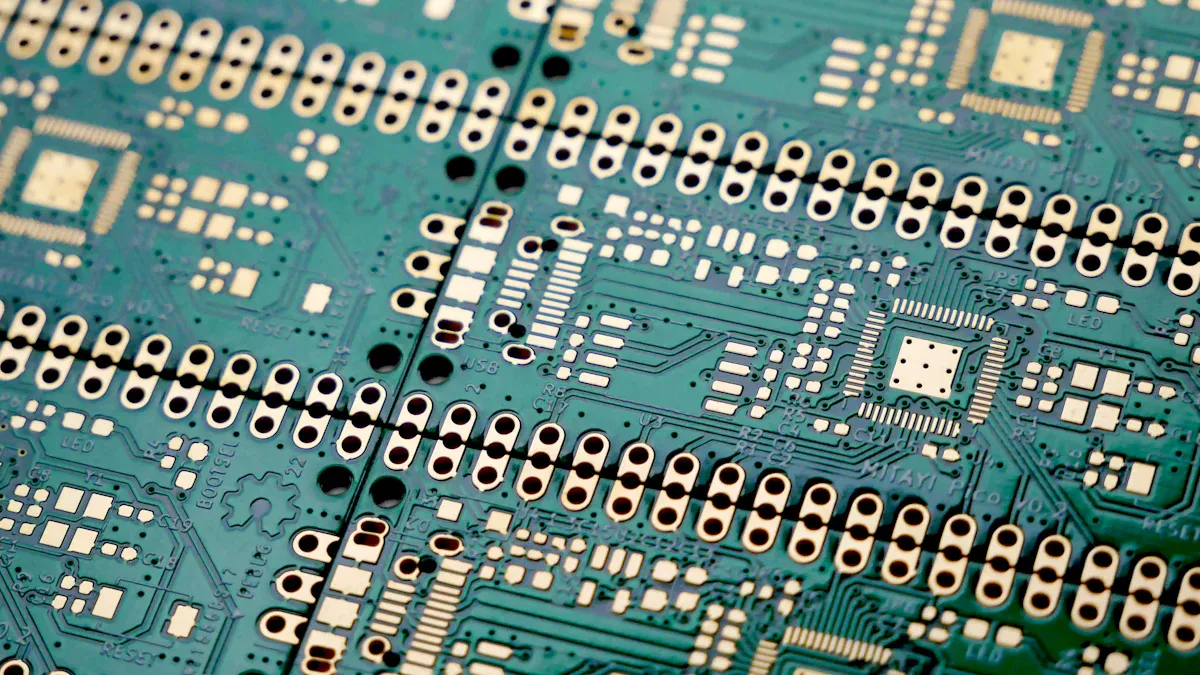
NOVA employs advanced manufacturing technologies to tackle the intricate demands of aerospace PCB designs. These technologies enable the production of high-performance aerospace PCB assemblies that meet stringent standards for mission-critical applications. Rapid prototyping accelerates development cycles, allowing engineers to refine designs and address potential challenges early in the process. This approach ensures precision and reliability in every assembly.
Modern techniques, such as 3D printing, have revolutionized PCB fabrication. By enabling precise layering of materials, 3D printing offers cost-effective solutions while maintaining the durability required for aerospace applications. Additionally, NOVA integrates cutting-edge methods like copper plating and high-temperature laminates to enhance heat dissipation and withstand extreme conditions. These innovations ensure that durable PCB assemblies deliver consistent performance in demanding environments.
|
Technique |
Benefit |
|---|---|
|
Copper Plating |
Enhances heat dissipation |
|
High-Temperature Laminates |
Withstand extreme heat exposure |
|
Component Miniaturization |
Reduces weight while maintaining durability |
Expertise in Multi-Layer and HDI Designs
NOVA’s expertise in multi-layer and high-density interconnect (HDI) designs ensures precision-engineered aerospace assemblies. These designs support up to 40 layers in a single PCB, enabling complex circuitry within a compact footprint. Engineers prioritize signal integrity, achieving up to a 20% reduction in signal loss, which is critical for aerospace applications requiring high-speed data transmission.
Thermal vias, a key feature in HDI designs, enhance heat dissipation and improve thermal performance. This ensures that assemblies maintain their reliability under extreme conditions. By leveraging advanced simulation tools, NOVA optimizes multi-layer designs to meet the unique requirements of aerospace systems. This expertise guarantees that each assembly adheres to the highest quality standards.
Custom Solutions Through Collaboration
Collaboration plays a pivotal role in addressing the complexities of aerospace PCB designs. NOVA works closely with clients to develop custom solutions tailored to specific project needs. This collaborative approach ensures that every assembly aligns with the client’s performance goals and timelines.
By engaging with customers during the design phase, NOVA identifies potential challenges and implements solutions that enhance precision and reliability. For example, the integration of component miniaturization reduces weight while maintaining durability, a critical factor in aerospace systems. This partnership-driven model not only streamlines production but also ensures that assemblies meet the exacting demands of aerospace applications.
Tip: Collaborative design processes foster innovation, enabling the development of high-performance aerospace PCB assemblies that exceed industry expectations.
Ensuring Electromagnetic Compatibility
Electromagnetic compatibility (EMC) is a critical factor in aerospace PCB assembly. Ensuring that electronic systems operate without causing or being affected by electromagnetic interference (EMI) is essential for safety and reliability in aerospace applications. NOVA employs advanced techniques and rigorous protocols to address EMC challenges, ensuring optimal performance in mission-critical environments.
EMC Testing Protocols
NOVA follows stringent EMC testing protocols to verify that its PCB assemblies meet global regulatory standards. The EU’s EMC Directive 2014/30/EU mandates that all electronic equipment minimize interference with other devices. Similarly, FCC regulations in North America require electronic systems to avoid harmful interference. To comply with these standards, NOVA conducts extensive testing in ISO/IEC 17025-accredited laboratories, ensuring quality assurance throughout the process.
The growing demand for EMC testing reflects its importance across industries, including aerospace. The global EMC-RFI tester market is projected to grow at over 8% CAGR, driven by increasing compliance mandates. This trend highlights the need for sophisticated testing solutions to enhance product reliability. By adhering to these protocols, NOVA ensures that its PCB assemblies meet the highest safety and performance benchmarks.
Shielding and Grounding Techniques
Effective shielding and grounding techniques are essential for reducing EMI in aerospace PCB assemblies. NOVA incorporates shielding enclosures to confine radiated emissions from sensitive components. These enclosures prevent external interference from compromising system performance. Additionally, low-impedance ground planes are utilized to enhance signal integrity and minimize noise.
Grounding strategies also play a pivotal role in ensuring electromagnetic compatibility. By creating a robust grounding framework, NOVA reduces the risk of signal distortion and enhances the reliability of its PCB assemblies. These techniques ensure that aerospace systems operate seamlessly, even in environments with high electromagnetic activity.
Design Optimization for Reduced Interference
NOVA employs advanced design optimization strategies to minimize electromagnetic interference in its PCB assemblies. Engineers focus on reducing loop areas in signal traces, which decreases radiation and interference. Pre-compliance testing with tools like spectrum analyzers and near-field probes helps identify potential issues early in the design phase. This proactive approach ensures that interference is mitigated before production begins.
Additional design measures include the use of thermal vias and optimized trace layouts to improve signal integrity. Shielding materials and strategic component placement further enhance the electromagnetic compatibility of aerospace PCBs. These efforts result in assemblies that deliver consistent performance and reliability in demanding aerospace applications.
By combining rigorous testing protocols, innovative shielding techniques, and optimized designs, NOVA ensures that its PCB assemblies meet the highest standards of electromagnetic compatibility. These measures safeguard the safety and functionality of aerospace systems, reinforcing NOVA’s commitment to quality and reliability.
Maintaining Traceability and Documentation
Traceability is a cornerstone of aerospace PCB assembly, ensuring that every component and process is meticulously tracked to uphold quality and reliability. NOVA employs advanced systems and tools to achieve complete traceability, safeguarding the integrity of its assemblies for mission-critical applications.
Component Tracking Systems
NOVA’s component tracking systems provide complete traceability throughout the supply chain. These systems monitor components from procurement to final assembly, ensuring that only authentic and high-quality parts are used. By documenting every step, NOVA enhances transparency and builds customer confidence in its aerospace PCB solutions.
Key benefits of component tracking include:
-
Documentation that ensures compliance in high-reliability sectors like aerospace.
-
Increased customer trust through transparency in sourcing.
-
Targeted recalls that minimize disruptions during product failures.
-
Early defect identification, improving overall product reliability.
-
Efficient warranty and recall management by pinpointing faulty batches.
Additionally, NOVA’s paperless tracking system streamlines operations, reducing paperwork and increasing efficiency. Real-time process control ensures compliance with assembly and inspection criteria, while integrated training records limit access to qualified personnel, further enhancing quality assurance.
Regulatory Compliance Documentation
Regulatory compliance is vital in aerospace PCB assembly, where stringent standards govern every aspect of production. NOVA maintains detailed documentation to demonstrate adherence to industry regulations, including IPC and AS9100 standards. This documentation serves as a critical tool for audits, ensuring that every assembly meets global benchmarks for safety and reliability.
By systematically recording manufacturing processes, NOVA supports quality control and facilitates root cause analysis in the event of defects. These records also play a pivotal role in preventing counterfeit components, safeguarding the integrity of aerospace applications. NOVA’s commitment to regulatory compliance underscores its dedication to delivering reliable and high-quality PCB assemblies.
Real-Time Monitoring with Digital Tools
Real-time monitoring enhances traceability by providing continuous oversight of the assembly process. NOVA leverages advanced digital tools, including digital twins, to track and manage each stage of production. These tools collect and organize data from diverse sources, ensuring structured monitoring and control.
This approach improves efficiency and reliability, enabling NOVA to address potential issues proactively. By integrating real-time monitoring into its traceability systems, NOVA ensures that every PCB assembly meets the highest standards of quality and performance. These efforts reinforce NOVA’s position as a leader in aerospace PCB solutions.
Note: Real-time monitoring not only enhances traceability but also supports ongoing improvements in digital tools, ensuring that NOVA remains at the forefront of innovation in aerospace PCB assembly.
NOVA exemplifies a comprehensive approach to quality and reliability in aerospace PCB assembly. Their commitment to industry standards, innovative design, and rigorous testing ensures that every PCB meets the highest performance benchmarks. With a focus on continuous improvement, NOVA reinforces its expertise and dedication to advancing aerospace technology. Industry professionals seeking reliable aerospace solutions should consider collaborating with NOVA to enhance their PCB assembly needs.
FAQ
What makes NOVA’s aerospace PCB assemblies unique?
NOVA’s aerospace PCB assemblies stand out due to their adherence to stringent industry standards, advanced manufacturing techniques, and innovative design solutions. These factors ensure reliability, durability, and performance in mission-critical applications.
How does NOVA ensure the reliability of its PCB assemblies?
NOVA employs rigorous testing protocols, including thermal cycling, HALT/HASS, and EMC testing. These methods validate the durability and performance of PCB assemblies under extreme conditions, ensuring they meet aerospace requirements.
Why is traceability important in aerospace PCB assembly?
Traceability ensures every component and process is documented, enhancing quality control and regulatory compliance. It also enables defect identification and targeted recalls, safeguarding the integrity of aerospace systems.
What role does collaboration play in NOVA’s design process?
Collaboration allows NOVA to develop custom solutions tailored to client needs. By engaging with clients during the design phase, NOVA identifies challenges early and implements precise solutions, ensuring assemblies meet performance goals.
How does NOVA address electromagnetic interference in aerospace PCBs?
NOVA uses advanced shielding and grounding techniques, along with optimized design strategies, to minimize electromagnetic interference. These measures ensure the safety and reliability of aerospace systems.