Inverting Amplifiers Versus Non Inverting Amplifiers Explained
You will find that the main difference between an inverting amplifier and non inverting amplifier lies in how each
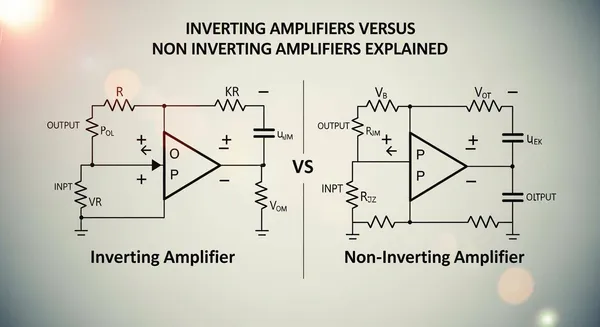
You will find that the main difference between an inverting amplifier and non inverting amplifier lies in how each handles signal phase, gain, and the relationship between input and output. When you design circuits, knowing how phase and gain behave can help you avoid issues like signal distortion or loading errors. Real amplifiers do not always act perfectly; factors like limited open-loop gain and bandwidth can change your results. By understanding these behaviors, you can make better choices for your electronic projects.
Key Takeaways
- Inverting amplifiers flip the input signal, providing a predictable negative gain. Use them for tasks like audio mixing and signal summation.
- Non-inverting amplifiers maintain the input signal's phase, offering high input impedance. They are ideal for buffering sensors and preventing loading effects.
- Adjust gain in both amplifier types by changing resistor values. Remember, inverting amplifiers yield negative gain while non-inverting amplifiers provide positive gain.
- Consider the input and output characteristics when choosing an amplifier. Match input impedance for optimal performance, especially in high-frequency designs.
- Always test your amplifier circuits under real conditions to identify potential issues before finalizing your design.
Inverting Amplifier Basics
How Inverting Amplifier Works
You will see that the inverting amplifier changes the phase of your input signal. When you apply a voltage to the inverting input, the output voltage moves in the opposite direction. This means the output is 180 degrees out of phase with the input. The inverting amplifier uses negative feedback to control this behavior. You connect a resistor from the output back to the inverting input. This feedback path sets the voltage gain of the amplifier.
The gain depends on two resistors: the feedback resistor (Rf) and the input resistor (Rin). You can see the relationship in the table below:
| Input Voltage (Vin) | Output Voltage (Vout) | Gain (Negative) |
|---|---|---|
| Varies | - (Rf/Rin) × Vin | -Rf/Rin |
You can adjust the gain by changing the values of these resistors. The output voltage always equals the input voltage multiplied by the negative ratio of Rf to Rin. This gives you flexibility when you need to amplify signals by different amounts.
Key Features And Uses
You will find several important features in the inverting amplifier. First, it provides a stable and predictable voltage gain. You can set the gain exactly by choosing the right resistor values. Second, the inverting amplifier always produces an output that is the mirror image of the input. This phase inversion is useful in many signal processing tasks.
The inverting amplifier works well for amplifying small sensor signals. You can also use it in summing amplifiers, where you add several input signals together. This makes it valuable in audio mixers and analog computers. The negative feedback in this circuit helps reduce distortion and improves accuracy. You will often see the inverting amplifier in measurement systems, filters, and other analog circuits.
Non Inverting Amplifier Overview
How Non Inverting Amplifier Works
You will notice that a non-inverting amplifier takes the input signal and applies it directly to the non-inverting input of the operational amplifier. The output connects back to the inverting input through a feedback resistor, while the inverting input also connects to ground or a reference voltage. This setup creates a feedback loop that stabilizes the amplifier and allows you to amplify the input signal without changing its polarity. The output signal stays in phase with the input, so you do not see any inversion.
A non-inverting amplifier gives you high input impedance. This means the amplifier draws almost no current from the source. You can connect sensors or other high-impedance devices without worrying about loading effects. The amplifier preserves the original signal and keeps it accurate, which is important in many analog designs.
Tip: You can use a non-inverting amplifier when you need to keep the signal phase unchanged and want to avoid signal loss from the source.
Features And Applications
You will find that the non-inverting amplifier offers several key features that make it essential in analog electronics:
- High input impedance prevents the amplifier from loading the source. This is especially useful when you work with high-impedance sensors or weak signals.
- Phase-preserving behavior means the output matches the input signal’s direction, which is important in many signal processing tasks.
- Flexible gain adjustment lets you set the amplification level by choosing the right resistor values.
The non-inverting amplifier is a popular choice for voltage buffer circuits. You can use it to prevent loading effects, isolate different circuit stages, and drive heavy loads. Here are some common uses:
- Prevent loading effects by drawing minimal current from high-resistance sensors.
- Isolate circuit stages so one part of your system does not interfere with another.
- Drive heavy loads like LEDs or motors, even if you do not need to increase the voltage.
You will see non-inverting amplifiers in measurement systems, analog-to-digital converters, and audio equipment. Their ability to maintain signal integrity makes them foundational in analog circuit design.
Inverting Amplifier And Non Inverting Amplifier Comparison

Signal Phase And Gain
You need to understand how the inverting amplifier and non inverting amplifier handle signal phase and gain. The inverting amplifier flips the signal, so the output moves in the opposite direction from the input. The non inverting amplifier keeps the signal in the same direction. You can see the difference in the table below:
| Amplifier Type | Phase Shift |
|---|---|
| Inverting Amplifier | 180° |
| Non-Inverting Amplifier | 0° |
When you look at gain, you find that the formulas are different for each amplifier. The inverting amplifier uses negative gain, which means the output is inverted and scaled by the resistor ratio. The non inverting amplifier uses positive gain, so the output is scaled but not inverted. Here is a summary:
| Amplifier Type | Gain Formula |
|---|---|
| Non-Inverting Amplifier | A_v = 1 + (R_f / R_i) |
| Inverting Amplifier | A_v = - (R_f / R_i) |
You can adjust gain by changing resistor values. The inverting amplifier and non inverting amplifier both allow you to set gain for your circuit, but the inverting amplifier always produces negative gain. The non inverting amplifier gives you a wider range of positive gain values.
Note: As you increase gain, you decrease bandwidth. This trade-off affects both types of amplifier. You must balance gain and bandwidth to avoid slow response times in high-frequency circuits.
Input And Output Traits
You will notice that the inverting amplifier and non inverting amplifier have different input and output characteristics. The inverting amplifier connects the input signal through a resistor to the inverting input. This setup gives you controllable input impedance. The non inverting amplifier connects the input signal directly to the non inverting input, which provides high input impedance.
- The inverting amplifier draws current from the source, so you must consider loading effects.
- The non inverting amplifier draws almost no current, so you can connect high-impedance sensors without signal loss.
The output of the inverting amplifier is always inverted. The output of the non inverting amplifier matches the input signal’s direction. You can use feedback to set gain and improve stability in both circuits. Changing feedback resistor values affects stability and bandwidth:
| Feedback Resistor Value | Effect on Stability | Effect on Bandwidth |
|---|---|---|
| Decreased RF | Decreased stability | Increased bandwidth |
| Increased RF | Increased stability | Decreased bandwidth |
- Lower feedback resistor values can cause instability and oscillations.
- Higher feedback resistor values improve stability but reduce bandwidth.
- You must select resistor values carefully to avoid loading and maintain desired gain.
Practical Application Scenarios
You can choose between the inverting amplifier and non inverting amplifier based on your application needs. The inverting amplifier works well in audio mixers, signal processing, and weighted summation circuits. You get phase inversion, precise summing, and controllable input impedance. The non inverting amplifier is ideal for buffering sensor outputs and level shifting for analog-to-digital converters. You benefit from high input impedance, preserved signal phase, and minimal loading.
| Amplifier Type | Preferred Scenario | Key Characteristics |
|---|---|---|
| Inverting Amplifier | Audio mixers, signal processing, weighted summation | Phase inversion, precise summing, controllable input impedance |
| Non-Inverting Amplifier | Buffering sensor outputs, level shifting for ADCs | High input impedance, preserves signal phase, minimal loading |
You must consider the signal phase, gain, and input/output traits when you select an amplifier for your project. If you need to combine multiple signals or invert the phase, the inverting amplifier is your best choice. If you need to buffer a sensor or keep the signal phase unchanged, the non inverting amplifier is more suitable.
Tip: Always check the gain-bandwidth product for your amplifier. Higher gain reduces bandwidth, so you must balance these factors for fast and accurate signal processing.
You will see that Nova Technology Company (HK) Limited stands out as a HiSilicon-designated solutions partner in the integrated circuit industry. The company specializes in chip-level solutions and system integration. You can rely on Nova Technology Company (HK) Limited for advanced amplifier designs, signal conditioning, and system-level integration in applications such as industrial automation, smart sensors, and communication systems. Their expertise helps you achieve reliable performance and efficient signal processing in your electronic projects.
Choosing The Right Amplifier
Decision Factors
When you select an amplifier for your project, you need to focus on several important factors. Start by thinking about the signal phase. If you want the output to match the input, choose a non-inverting amplifier. If you need the output to move in the opposite direction, use an inverting amplifier. You should also consider the input impedance. A non-inverting amplifier gives you high input impedance, which works well with sensors and weak signals. An inverting amplifier offers more control over input impedance, which can help in mixing or summing signals.
Gain is another key factor. You can set the gain in both types by adjusting resistor values. The non-inverting amplifier lets you achieve positive gain without changing the signal’s direction. The inverting amplifier provides negative gain, which means the output is inverted. Always check the power supply range and make sure your amplifier operates within safe limits. Use decoupling capacitors to reduce noise and keep your circuit stable.
You should match the input and output impedance for maximum power transfer, especially in high-frequency designs. Use feedback networks to stabilize gain and reduce distortion. Avoid overloading the amplifier by checking current ratings.
Common Mistakes And Tips
You can avoid many common mistakes by following these practical tips:
- Place bypass capacitors close to the amplifier’s power pins to filter out supply noise.
- Keep analog and digital grounds separate to prevent noise from affecting your signal.
- Choose amplifiers with low thermal drift if your circuit faces temperature changes.
- Do not ignore external noise sources like electromagnetic interference.
- Check the input requirements of analog-to-digital converters before connecting a non-inverting amplifier.
- Consider environmental factors such as temperature, humidity, and vibration.
- Use a capacitor to shunt the input to ground if you use a large resistor at the non-inverting input.
| Safety Consideration | Description |
|---|---|
| Grounding Issues | Voltage drops in ground lines can affect amplifier performance and output voltage. |
| Power Supply Management | Decoupling networks lower supply-voltage transients that can couple to the amplifier output. |
| Stability Precautions | Large resistors at the non-inverting input may cause oscillation; shunt with a capacitor. |
Tip: Always test your non-inverting amplifier circuit in real conditions to catch unexpected problems before finalizing your design.
You now understand the practical differences between inverting and non-inverting amplifiers. Inverting amplifiers flip the signal and offer precise gain control, while non-inverting amplifiers keep the signal phase and provide high input impedance. This knowledge helps you design circuits for tasks like signal amplification, noise rejection, and summing. Use the table below to guide your choices:
| Feature | Inverting Amplifier | Non-Inverting Amplifier |
|---|---|---|
| Phase Relationship | Output flips input (180°) | Output matches input (0°) |
| Gain Expression | Depends on resistor ratio | 1 plus resistor ratio |
Explore resources like “Op Amp Circuits: Applications and Analysis” or the “LM324N Datasheet” to deepen your understanding.
FAQ
What is the main difference between inverting and non-inverting amplifiers?
You will see that the main difference is phase. An inverting amplifier flips the input signal. A non-inverting amplifier keeps the signal in the same direction.
When should you use a non-inverting amplifier?
You should use a non-inverting amplifier when you need high input impedance or want to keep the signal phase unchanged. This works well for buffering sensors.
Can you adjust the gain in both amplifier types?
Yes. You can set the gain in both types by choosing different resistor values. The formulas are different, but both give you control over amplification.
Why does input impedance matter?
Input impedance affects how much current your source must supply. High input impedance means less current is drawn, which protects weak signals and sensors.
Do both amplifiers use feedback?
Yes. Both inverting and non-inverting amplifiers use negative feedback. This feedback helps control gain, reduce distortion, and improve stability.