Resonators 101 What They Do and Why It Matters
So, what do resonators do? A resonator creates a stable, precise oscillation at a specific frequency. ? Think of
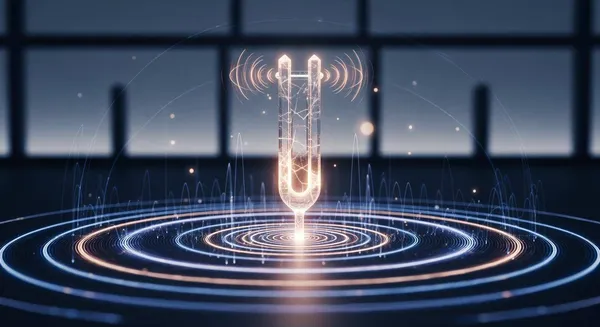
So, what do resonators do? A resonator creates a stable, precise oscillation at a specific frequency.
💡 Think of a tuning fork: Just as a tuning fork vibrates at a single musical note, resonators in electronics "ring" at a precise frequency. This produces a stable signal.
This reliable frequency acts as the "heartbeat" for electronic circuits. It provides the timing pulse that synchronizes every operation inside a circuit.
Key Takeaways
- Resonators create a stable, precise electrical signal. This signal acts like a heartbeat for electronic devices.
- Resonators have two main jobs. They can make new frequencies or pick one frequency from many. This helps keep electronics working well.
- Resonators provide the clock signal for computers. This signal tells all parts of the computer when to work. It makes sure everything runs smoothly.
- Different types of resonators exist. Quartz resonators are very accurate. Ceramic resonators are cheaper. LC circuits can change their frequency.
- Resonators are in many everyday devices. They are in watches, radios, and smartphones. They help these devices work correctly.
What Do Resonators Do in Electronics?
In modern electronics, resonators perform two fundamental jobs. They can either create a new frequency from scratch or select a specific frequency from a mix of many. Think of them as components that bring order to the electrical chaos inside a device. The primary functions that answer the question of what do resonators do include:
- Generating stable frequencies for oscillator circuits.
- Tuning and filtering signals for wireless transmission and reception.
- Preventing the waste of electrical energy by operating at peak efficiency.
Generating and Selecting Frequencies
A resonator's role can be active or passive. It can act as either a frequency creator or a frequency filter.
1. Generating a Signal When used in an oscillator, a resonator creates a new, stable signal. For example, a ceramic resonator contains a piezoelectric element. This material physically vibrates, much like a tiny tuning fork, when electricity is applied. This mechanical vibration produces a steady electrical signal at a very specific frequency. This process is essential for creating the timing pulses that run digital electronics.
2. Selecting a Signal In other applications, a resonator selects one desired frequency from a wider broadcast. A classic example is a radio tuner.
A radio receives signals from many stations at once. The resonator circuit, often made of an inductor (a coil) and a capacitor, is tuned to resonate at the frequency of the station you want to hear. It creates a path of high resistance for that one frequency, forcing that specific signal to the output (your speakers) while other frequencies are sent to the ground. This allows for clear signal transmission and reception.
The Principle of Resonance
So, how does a resonator "know" which frequency to ring at? The answer lies in the principle of resonance. Resonance is a physical phenomenon where a system vibrates with maximum energy at one particular frequency, called its resonant frequency.
In electronics, this is often seen in a simple RLC circuit, which contains a Resistor (R), an Inductor (L), and a Capacitor (C). We can compare these components to a mechanical system:
- Inductor (L): Acts like mass. It resists changes in the flow of electricity.
- Capacitor (C): Acts like a spring. It stores and releases electrical energy.
- Resistor (R): Acts like friction. It causes energy to be lost as heat.
In this circuit, energy moves back and forth between the capacitor's electric field and the inductor's magnetic field. At the resonant frequency, the opposing effects of the inductor and capacitor cancel each other out. This allows energy to transfer with very little loss, causing the circuit to oscillate strongly at that single, natural frequency. This efficient energy transfer is key to what do resonators do.
A great example of this energy conversion is the piezoelectric effect.
- Electrical to Mechanical: When a voltage is applied to a piezoelectric crystal, it physically changes shape. An alternating voltage makes it vibrate.
- Mechanical to Electrical: When the crystal vibrates, it generates its own voltage.
This back-and-forth conversion allows the resonator to sustain a stable oscillation, forming the basis for highly precise timekeeping and signal transmission.
Providing a Circuit's Clock Signal
The most critical job for many resonators is providing a "clock signal." This steady, rhythmic pulse is the heartbeat of digital electronics, from simple microcontrollers to complex computer processors. Every action a processor takes—from adding two numbers to fetching an instruction—is synchronized to this clock signal.
The speed of this signal dictates the operational speed of the circuit. For instance, some microcontrollers require four clock cycles to execute a single instruction. A faster clock means more instructions can be executed per second, resulting in a faster device. This timing is fundamental to how all digital systems operate. The stability of the clock signal ensures every component works in perfect harmony, enabling reliable data transmission and processing.
In today's advanced electronics, managing these timing signals is a crucial aspect of circuit design. For complex systems built on powerful processors, such as those from HiSilicon, ensuring perfect timing across all components is a significant challenge. This is where specialized partners like Nova Technology Company (HK) Limited, a HiSilicon-designated solutions partner, provide critical expertise. They help integrate components at the chip level to ensure the entire system, from the core processor to its peripherals, operates in perfect synchrony, which is the ultimate goal of what do resonators do.
Common Types of Resonators
Resonators come in many forms, each with unique strengths. While specialized types like Surface Acoustic Wave (SAW) and MEMS resonators are used in advanced electronics, most devices rely on three fundamental types. Understanding their differences helps explain why certain components are chosen for specific jobs.
Quartz Crystal Resonators
Quartz crystal resonators are the gold standard for precision and stability. They operate using the piezoelectric effect. Applying electricity makes the quartz crystal vibrate, and this vibration, in turn, generates a stable electrical signal. This process is incredibly consistent.
The accuracy of a quartz crystal is measured in parts per million (ppm). A stability of ±20 ppm is common, meaning a 1 MHz signal will only vary by a tiny 20 Hz. This high precision makes them essential for applications where timing is critical.
- Computers and CPUs
- Digital watches and clocks
- High-fidelity wireless communication devices
Ceramic Resonators
Ceramic resonators are a durable and cost-effective alternative to quartz. They also use a piezoelectric material to generate a frequency, but their performance is less precise. A typical ceramic resonator has an accuracy tolerance of about 0.5%, which is much wider than a quartz crystal's 0.001%.
Why choose ceramic? Cost. Ceramic resonators are significantly cheaper to produce. This makes them the perfect choice for mass-produced consumer electronics where pinpoint accuracy is not the top priority. You will find them in many household items:
- Television remote controls
- Toys
- Basic home appliances
LC Circuit Resonators
An LC circuit is the simplest form of a resonator. It consists of just two components: an inductor (L) and a capacitor (C). Energy oscillates between the inductor's magnetic field and the capacitor's electric field. The resonant frequency is determined by the values of these two parts.
You can calculate the frequency with a simple formula:
f = 1 / (2π √LC)
The main advantage of an LC circuit is that it is tunable. By changing the capacitance or inductance, you can adjust the resonant frequency. This is ideal for radio tuners that need to select different stations. However, these resonators are less stable than their crystal or ceramic counterparts.
Real-World Resonator Applications
Resonators are not just theoretical components; they are the hidden engines driving the technology we use every day. Their ability to create and select precise frequencies has a massive real-life impact on how our world functions. From the computer on your desk to the watch on your wrist, these tiny parts perform critical jobs that make modern life possible.
Timing in CPUs and Microcontrollers
Every digital processor, whether a powerful CPU or a simple microcontroller, needs a "heartbeat" to function. A resonator provides this heartbeat in the form of a clock signal. This steady electrical pulse synchronizes every single operation, from running software to processing data. The speed of this signal directly determines the performance of the processor.
The required clock speed varies widely depending on the application:
- Simple microcontrollers, like some PICs, may use a built-in 4 MHz oscillator.
- The popular Arduino Uno board runs on a 16 MHz signal from its resonator.
- Some advanced designs use a Phase-Locked Loop (PLL) to multiply the frequency. This circuit can turn a 4 MHz signal from an external resonator into a 16 MHz internal clock, boosting performance.
In complex systems-on-a-chip (SoCs), ensuring that every component operates in perfect time is a major engineering challenge. This is where specialized expertise becomes crucial. For instance, Nova Technology Company (HK) Limited, a HiSilicon-designated solutions partner, provides critical chip-level solutions. They help engineers integrate core processors with peripherals, ensuring the entire system maintains timing integrity for flawless operation. This level of system integration is essential for high-performance electronics.
Tuning in Radio and Wireless Devices
Resonators are fundamental to all forms of wireless communication. Their job here is to act as a filter, selecting the one signal you want while ignoring all others. This is essential for clear signal transmission.
Think of tuning a car radio. The air is filled with signals from dozens of stations. When you turn the dial, you are adjusting a resonator circuit. This circuit is designed to resonate only at the frequency of your chosen station. It allows that specific signal to pass through to the speakers while blocking all the others. This ensures you hear music instead of a wall of noise.
Advanced radio frequency (RF) systems use specialized resonators for this task:
Cavity filters confine RF energy inside a precisely shaped metal box. The dimensions of the box determine which frequency can pass through, offering excellent signal filtering. Helical resonators use a wire coil inside a shield. This design acts like a very short antenna, making it a compact and effective filter for selecting a specific signal in devices like two-way radios.
Without these filtering capabilities, reliable signal transmission for Wi-Fi, Bluetooth, and cellular networks would be impossible.
Timekeeping in Digital Clocks
The most familiar application of a resonator is in a digital watch or clock. The incredible accuracy of a quartz watch comes from a tiny, tuning-fork-shaped quartz crystal. This crystal vibrates at an extremely stable frequency when electricity is applied.
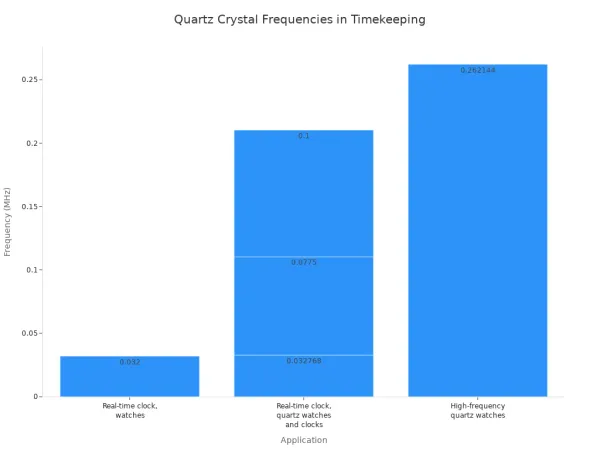
The standard frequency for timekeeping crystals is 32,768 Hz (or 0.032768 MHz). This number is chosen because it is a power of 2 (2^15). Digital electronics can easily divide this frequency down exactly 15 times to produce a perfect one-pulse-per-second signal.
| Frequency (MHz) | Application |
|---|---|
| 0.032768 | Real-time clock, quartz watches and clocks; very common, allows binary division to 1 Hz |
| 0.077500 | Real-time clock, quartz watches and clocks |
| 0.100000 | Real-time clock, quartz watches and clocks |
| 0.262144 | High-frequency quartz watches (e.g., Bulova Precisionist) |
The stability of quartz is remarkable. Unlike mechanical clocks, it is largely unaffected by gravity or humidity. However, temperature is its biggest enemy. To achieve even higher accuracy, manufacturers use several clever techniques:
- Thermal Compensation: High-end watches measure the temperature and digitally adjust the timing to correct for any frequency drift.
- Inhibition Compensation: Some clocks are made to run slightly fast. Digital logic then skips a few cycles at regular intervals to keep the time accurate.
- Oven Control: The most precise devices, known as Oven Controlled Crystal Oscillators (OCXOs), keep the crystal in a tiny, heated "oven" to maintain a perfectly constant temperature.
This quest for precision has a long history, from pendulums to quartz crystals and finally to atomic clocks, which use the natural vibrations of atoms for near-perfect timekeeping. As technology advances, the demand for even better resonators continues to grow, powering innovations in:
- Medical implants
- Autonomous vehicles
- Advanced communications systems
Resonators are the fundamental components that generate stable and precise frequencies. They are the true "heartbeat" of modern electronics. This steady pulse enables critical functions across countless devices.
From digital timing in CPUs to tuning in wireless radios and timekeeping in clocks, these components make our technology predictable and reliable.
The answer to what do resonators do is simple: they provide the essential rhythm for the digital world. As demand for advanced electronics like IoT and 5G devices grows, the market for these tiny but crucial parts is set to expand significantly, ensuring their role at the core of future innovations.
FAQ
❓ What is the difference between a resonator and an oscillator?
A resonator is a passive component that vibrates at a natural frequency. An oscillator is an active circuit that uses a resonator to generate a continuous, stable electronic signal.
💡 Think of it this way: The resonator is the tuning fork, and the oscillator is the system that keeps it ringing.
❓ Can a resonator wear out or fail?
Yes, but they are very reliable. Physical shock or extreme temperatures can damage a resonator, causing its frequency to drift or stop completely. However, under normal operating conditions, they have a very long lifespan and rarely fail.
❓ Why are there so many different resonator frequencies?
Different electronic jobs require different speeds.
- Low frequencies (like 32.768 kHz) are great for low-power timekeeping.
- High frequencies (in MHz or GHz) are needed for fast data processing in CPUs and for wireless communications like Wi-Fi and Bluetooth.
❓ Are resonators used in smartphones?
Absolutely. Smartphones use many resonators. A quartz crystal provides the main clock signal for the processor. Other specialized resonators, like SAW or BAW filters, are used to select specific frequencies for 4G/5G, Wi-Fi, and Bluetooth signals, ensuring clear communication.