Start Vs Run Capacitor Explained for Everyday Electronics
Start vs run capacitor: Understand their roles, differences, and impact on electronics. Learn how each affects motor performance and device reliability.
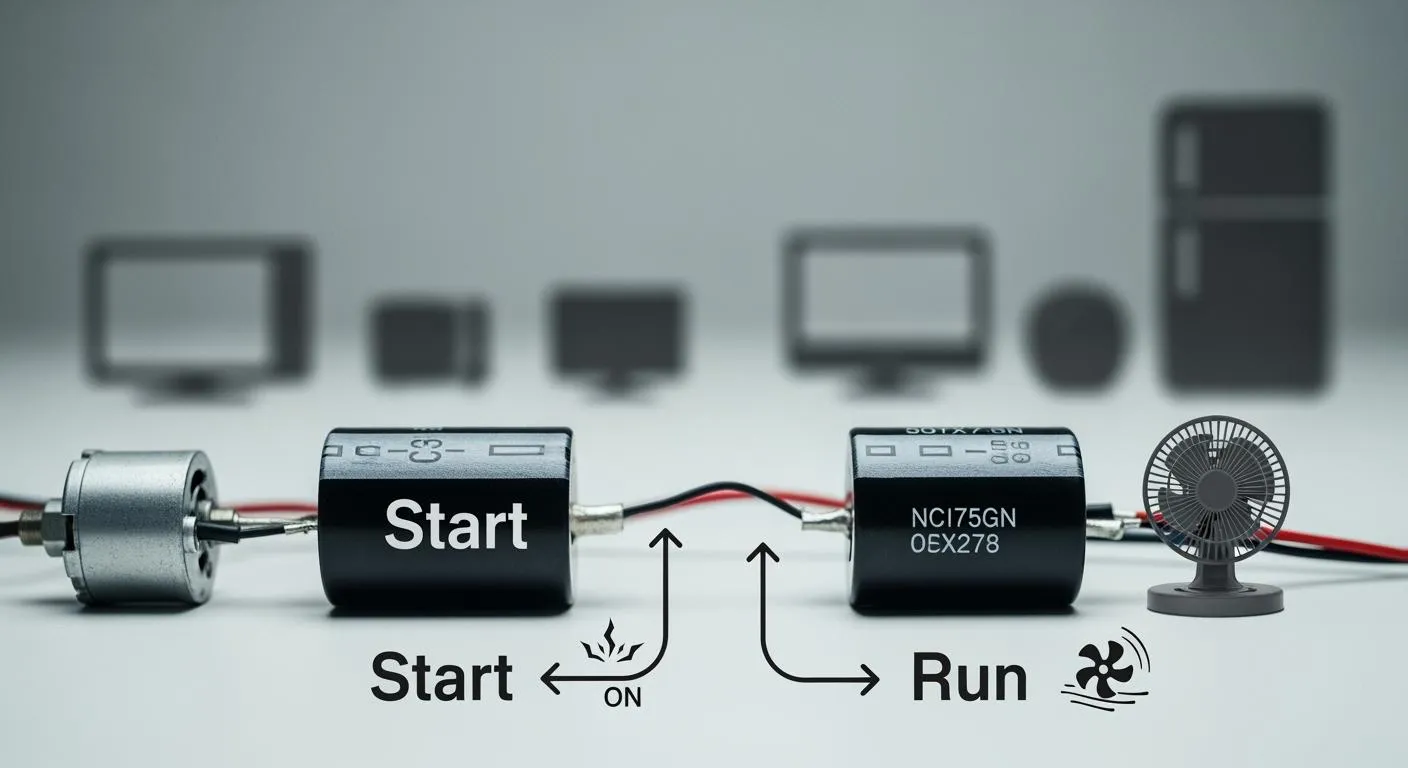
The main difference between a start and run capacitor comes down to when and how each works in your devices. Think of a start capacitor like the starter in your car—it gives the motor a strong push to get going. The run capacitor acts more like the engine itself, keeping things running smoothly and efficiently. You should know this because:
- Start capacitors give motors the boost they need to begin moving, then disconnect.
- Run capacitors stay connected, helping motors run efficiently and use less energy.
- Using the wrong type can cause motor failure or overheating.
Understanding start vs run capacitor can help you troubleshoot and protect your household electronics.
Key Takeaways
- Start capacitors provide a quick energy boost to motors, helping them start efficiently.
- Run capacitors stay connected during operation, ensuring motors run smoothly and use less energy.
- Using the wrong type of capacitor can lead to motor failure or overheating, so always match the capacitor to your device.
- Regularly check capacitors for signs of damage, like bulging or burn marks, to maintain device performance.
- Understanding the differences between start and run capacitors helps you troubleshoot and protect your household electronics.
What Is a Start Capacitor?
Start Capacitor Definition
A start capacitor is a special type of capacitor that helps electric motors begin turning. You will find this capacitor in many devices that need a strong push to start moving. The capacitor stores electrical energy and releases it quickly when the motor starts. This burst of energy gives the motor the extra force it needs to overcome its initial resistance. Start capacitors are larger than many other capacitors because they must deliver a high amount of energy in a short time. You can think of this capacitor as a sprinter, giving a quick and powerful start.
How Start Capacitors Work
When you turn on a device with an electric motor, the start capacitor jumps into action. The capacitor creates a phase shift in the motor’s electrical current. This phase shift produces a strong starting torque, which is the force that gets the motor spinning. The capacitor only stays in the circuit for a short time. Once the motor reaches about 75% of its full speed, the capacitor disconnects automatically. This temporary role means the capacitor does not run all the time. You will notice that start capacitors are designed for short, powerful bursts, not for continuous use. Other capacitors in the system handle the running phase.
Tip: If a motor hums but does not start, the start capacitor might be faulty.
Devices Using Start Capacitors
You will see start capacitors in many household and industrial applications. Some common examples include:
- Air conditioners
- Refrigerators
- Washing machines
- Water pumps
These applications need motors that start under heavy loads. The capacitor gives the motor the boost it needs to get moving. In these devices, the start capacitor works with other capacitors to ensure smooth operation. You may also find start capacitors in power tools and garage door openers. Each application relies on the capacitor’s ability to deliver a quick surge of energy. Without this capacitor, many motors would struggle to start or might not start at all.
What Is a Run Capacitor?
Run Capacitor Definition
You encounter a run capacitor in many electric motors that operate for long periods. This capacitor stays connected to the motor circuit at all times. Unlike a start capacitor, a run capacitor works continuously to keep the motor running efficiently. You find that run capacitors enhance the performance of compressors and motors. They are usually made from metallized film and come in oval or round cans. Each capacitor has a specific microfarad rating designed for a single motor. You rely on these capacitors to reduce motor noise and friction-related heat. They also improve the power factor, which means your motor uses energy more efficiently.
- Run capacitors stay in the circuit during operation.
- They store energy and act as a power source for the motor.
- These capacitors help reduce noise and heat.
- They improve motor efficiency and performance.
How Run Capacitors Work
You see that a run capacitor plays a crucial role in the ongoing operation of electric motors. The capacitor creates a phase shift between the start and run windings. This phase shift is essential for smooth and efficient motor function. The capacitor stabilizes the magnetic field inside the motor, which helps minimize energy consumption. You notice that run capacitors are built for continuous use. They prevent overheating and keep the motor running at a steady speed. When you use a device with a run capacitor, you benefit from quieter operation and longer motor life.
Note: If your motor runs but makes unusual noises or overheats, the run capacitor may need replacement.
Devices Using Run Capacitors
You find run capacitors in many household appliances. These capacitors provide the necessary phase shift for motor operation and enhance energy efficiency. You see them in:
- Washing machines
- Air conditioners
You rely on these capacitors to prolong compressor lifespan and assist in motor control. Run capacitors help your appliances operate smoothly and efficiently. You benefit from lower energy bills and fewer repairs when these capacitors work properly. In air conditioners, run capacitors enhance energy efficiency and keep the compressor running. In washing machines, they assist with motor control and ensure reliable performance.
Start Vs Run Capacitor: Key Differences

When you compare start vs run capacitor, you notice several important differences. These differences affect how your devices work and how you maintain them. Understanding these key points helps you choose the right capacitor for your needs and avoid common problems.
Function and Operation
Start vs run capacitor have different jobs in electric motors. You use a start capacitor to give the motor a strong push at the beginning. This type of capacitor only works for a few seconds. Once the motor reaches speed, the start capacitor disconnects. You rely on run capacitors to keep the motor running smoothly. These capacitors stay connected and help the motor operate efficiently for as long as it runs.
- Start capacitors activate at the beginning of the motor’s operation.
- Run capacitors remain active throughout the motor’s operation.
- The start capacitor is only needed during the initial startup phase.
- The run capacitor continues to function after the motor has started, ensuring smooth operation.
- Start capacitors provide a high burst of energy for a short duration.
- Run capacitors are designed for long-term, continuous support.
Tip: If your motor struggles to start, check the start capacitor. If it runs but overheats or makes noise, the run capacitor may be the issue.
Capacitance and Materials
Capacitance is the ability of a capacitor to store electrical energy. You find that start capacitors have much higher capacitance than run capacitors. This high capacitance lets them deliver a strong surge of energy quickly. In most household electronics, start capacitors range from 430 to 516 microfarads (MFD). Run capacitors usually have a lower capacitance, between 5 and 80 microfarads. This lower capacitance supports steady, continuous operation.
The materials used in these capacitors also differ. Start capacitors often use aluminum electrolytic construction. This design allows for high capacitance but only for short periods. Run capacitors use metallized polypropylene (MPP) film. This material handles continuous duty and provides stable performance over time.
- Start capacitors: High capacitance (430–516 MFD), aluminum electrolytic construction.
- Run capacitors: Lower capacitance (5–80 MFD), metallized polypropylene film.
You also notice differences in voltage ratings and physical size. Start capacitors usually have a higher capacitance but a lower voltage rating and a larger size. Run capacitors have a lower capacitance, a higher voltage rating (often 370 or 440 VAC), and a smaller size.
Comparison Table: Start vs Run Capacitor
You can see the main differences between start vs run capacitor in the table below:
| Feature | Start Capacitor | Run Capacitor |
|---|---|---|
| Purpose | Provides initial boost for motor startup | Maintains continuous flow for efficient operation |
| Duration of Use | Active for a few seconds during startup | Engaged throughout the motor's operation |
| Capacitance Range | 430 to 516 MFD | 5 to 80 MFD |
| Materials | Aluminum electrolytic | Metallized polypropylene (MPP) film |
| Duty Cycle | Intermittent duty | Continuous duty |
| Voltage Rating | Generally lower | 370 or 440 VAC |
| Physical Size | Typically larger | Typically smaller |
| Failure Rate | Higher if energized too long | Lower due to continuous design |
| Applications | Motors needing high starting torque | Motors needing continuous power flow |
When you select a capacitor, always match the capacitance and type to your motor’s requirements. Using the wrong capacitor can lead to overheating, poor performance, or even motor failure. By understanding the differences in start vs run capacitor, you make better choices for your electronics and keep your devices running longer.
Capacitors in Everyday Electronics

Real-World Examples
You encounter capacitors in many household devices every day. These components play a key role in the operation of ceiling fans, refrigerators, and HVAC systems. In ceiling fans, the capacitor creates a phase shift in the circuit, which allows the motor to start and run efficiently. This phase shift ensures stable fan speed and quiet operation. Refrigerators use both start and run capacitors to provide the initial torque and maintain smooth compressor function. HVAC systems rely on capacitors to keep blowers and compressors running with the right capacitance and voltage.
Here is a table showing common examples:
| Example | Description |
|---|---|
| Capacitor-start capacitor-run motor | Single-phase induction motor using both a starting and a running capacitor for efficient operation. |
| Household appliances | Devices like fans, refrigerators, and air conditioners use capacitors for reliable performance. |
Capacitors, though small, have a big impact on energy savings and motor lifespan. A healthy capacitor ensures your devices use less energy and last longer.
Troubleshooting and Testing Capacitors
When a device stops working or makes unusual noises, you may need to check the capacitor. Start by turning off the power to the circuit. Remove the cover and inspect the capacitor for bulging or burn marks. Use a multimeter to measure the capacitance and compare it to the value on the label. If the reading is much lower, the capacitor may need replacement. You can also check resistance to find short or open circuits. For ceiling fans, observe if the blades struggle to start or run at the wrong speed. These signs often point to a faulty capacitor.
- Turn off power at the breaker.
- Inspect the capacitor for damage.
- Discharge the capacitor safely.
- Use a multimeter to test capacitance and voltage.
- Replace with a capacitor matching the original capacitance and voltage.
Always match the new capacitor’s capacitance and voltage rating to the original for safe operation.
Safety Tips
You must follow safety steps when handling capacitors. Always disconnect power before opening any device. Discharge the capacitor using an insulated tool to avoid electric shock. Inspect the housing for bulges or burns. Check that the terminals are clean and secure. Use a meter to verify capacitance and voltage. Select a replacement with the correct capacitance and voltage. After installation, restore power and observe the device for any unusual sounds or vibrations.
Tip: Never touch the terminals of a capacitor until you have discharged it. Even a small capacitor can hold a dangerous charge.
By following these steps, you keep your household electronics safe and running efficiently.
Capacitors and Common Electronics Topics
AC Motors and Capacitors
You see capacitors play a vital role in the operation of AC motors. When you start an AC motor, a start capacitor gives a quick burst of energy. This surge helps the motor overcome inertia and begin turning. Once the motor reaches speed, a run capacitor stays connected to the circuit. This run capacitor keeps the motor running efficiently and reduces noise during operation. In HVAC systems, the start capacitor provides the initial torque for compressor motors. The run capacitor then maintains efficiency and lowers energy consumption. Washing machines use a start capacitor for the initial load and a run capacitor for smooth operation throughout the cycle. Industrial equipment also relies on capacitors to improve starting torque and energy efficiency, especially when handling heavy loads or frequent starts. Some motors, like CSR or CSCR types, require both start and run capacitors, while PSC motors only need a run capacitor to maintain operation.
Energy Storage in Circuits
You use capacitors in many electronic circuits because they store and release energy quickly. When you connect a capacitor to a DC voltage source, it charges almost instantly. If you short the capacitor, it discharges rapidly, especially if resistance is present in the circuit. This ability to charge and discharge makes capacitors useful in oscillators, waveform shapers, and power backup circuits. Unlike batteries, capacitors cannot create new electrons, but they can release their entire charge almost instantly. This feature is why you find capacitors in camera flashes and other devices that need a quick energy burst. Film capacitors help regulate electrical flow and improve energy efficiency in household appliances. They also ensure safety and reliability, especially in smart devices. In refrigerators, capacitors stabilize voltage and help start the motor for efficient cooling. Washing machines use them for motor control and speed changes. Microwave ovens use capacitors to generate high voltage for quick heating. Air conditioners benefit from capacitors by enhancing energy efficiency and extending compressor life. Capacitors can act as temporary batteries, maintaining power supply and preventing data loss during battery changes.
| Function | Description |
|---|---|
| Charging | Capacitors charge almost instantly when connected to a DC voltage source. |
| Discharging | They can discharge quickly if shorted, with exponential rates if resistance is present. |
| Applications | Used in oscillators, waveform shapers, and low-discharge power backup circuits. |
Tip: Always check the capacitance and voltage rating before replacing a capacitor in any circuit.
Learning More About Capacitors
You can deepen your understanding of capacitors by exploring resources that explain their fundamental functions in electronics. Many tutorials introduce you to capacitance, charge, and the role of capacitors in different circuits. These guides help you learn about the characteristics of capacitors and their applications in various electronic systems. If you want to see how capacitors work in real-world scenarios, look for articles that cover their use in household appliances and industrial equipment.
Nova Technology Company (HK) Limited stands out as a HiSilicon-designated solutions partner. The company specializes in chip-level solutions and system integration for advanced electronics. You find their expertise valuable in application scenarios such as smart home devices, industrial automation, and high-performance consumer electronics. Their focus on semiconductor innovation ensures reliable and efficient circuit design for modern electronic products.
Note: Understanding capacitance and voltage ratings helps you select the right capacitor for your project and ensures safe, efficient operation.
You can easily spot the main differences between start and run capacitors by looking at their purpose, duty cycle, and voltage needs:
| Feature | Start Capacitor | Run Capacitor |
|---|---|---|
| Purpose | Boosts motor at startup | Powers motor during operation |
| Duty Cycle | Short | Long |
| Capacitance Rating | Higher | Lower |
| Voltage | Handles high voltage briefly | Manages voltage over long periods |
- Start capacitors give a quick burst of power, while run capacitors keep the motor running smoothly.
- Knowing how voltage and capacitor type affect your devices helps you fix common problems, like motors that hum or overheat.
- If you want to learn more, explore how variable capacitors and voltage control improve circuit performance.
Understanding these basics lets you solve issues and get the most out of your everyday electronics.
FAQ
What happens if you use the wrong capacitor in a motor?
If you use the wrong capacitor, your motor may not start, run poorly, or overheat. This mistake can damage the motor or shorten its lifespan. Always match the capacitor’s type and rating to your device.
How can you tell if a capacitor is bad?
You can spot a bad capacitor by looking for bulging, leaking, or burn marks. If your device hums, fails to start, or runs slowly, test the capacitor with a multimeter to check its capacitance.
Can you replace a start capacitor with a run capacitor?
No, you cannot swap them. Start capacitors provide a quick energy burst, while run capacitors support continuous operation. Using the wrong type can cause motor failure or unsafe conditions.
Why do some devices use both start and run capacitors?
Some motors need extra power to start and steady support to run. You find both capacitors in devices like air conditioners and washing machines to ensure reliable startup and efficient operation.
Is it safe to handle capacitors at home?
Always turn off power and discharge the capacitor before touching it. Even small capacitors can hold a dangerous charge. Use insulated tools and follow safety instructions to protect yourself.