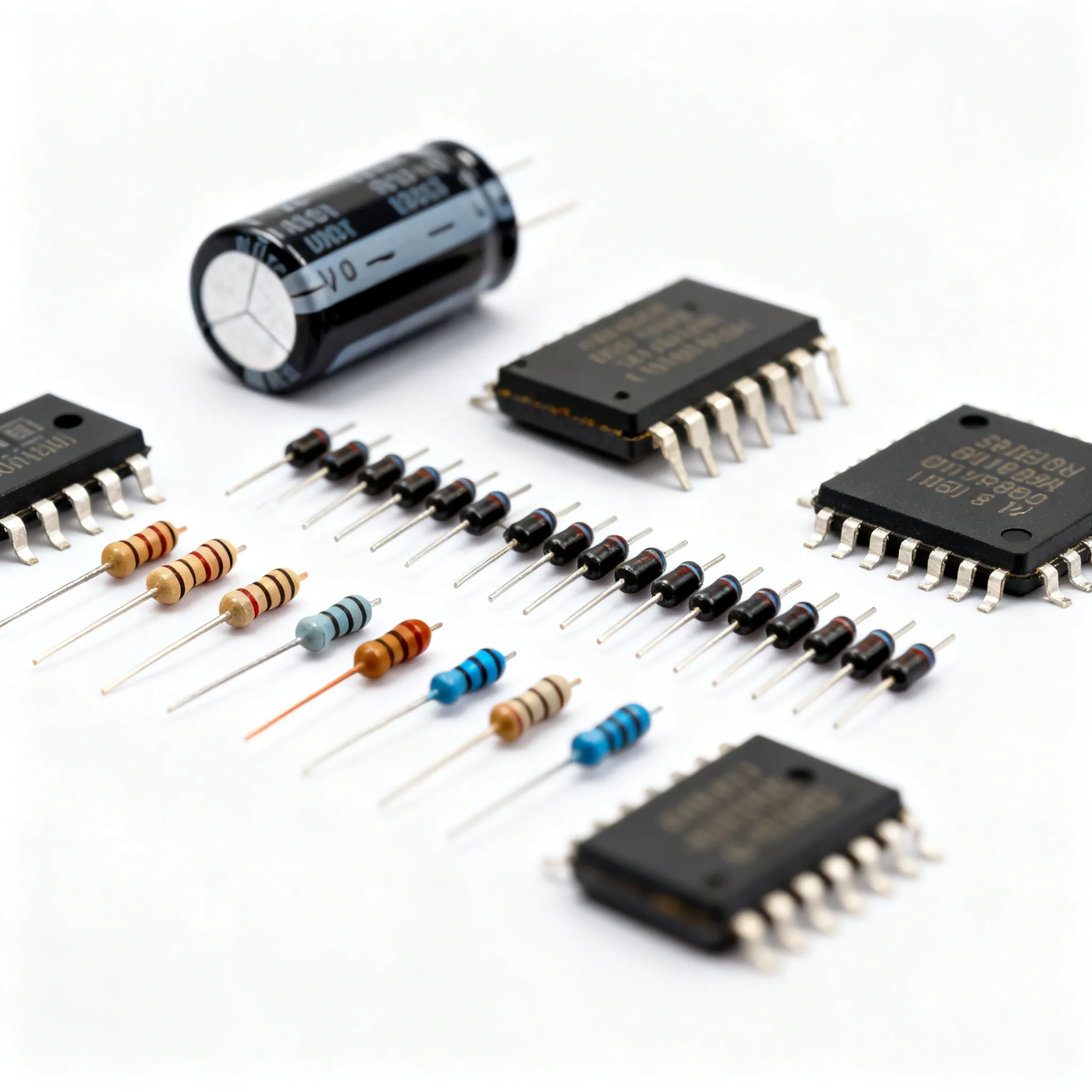
Four band resistor color code made fun and fast
Decode four band resistor color code fast with easy steps, color charts, and mnemonics. Identify resistor values and tolerance for any electronics project.

You pick up a resistor and see a series of colored bands. You wonder, what do these colors mean? Reading a four band resistor color code is easy once you know the trick. You just look at the bands, read them in the correct order, and match each color to a number. With a few simple tips and examples, you can decode any resistor quickly and even make it fun.
Key Takeaways
- Reading a four band resistor is simple. Identify the bands, starting from the end opposite the tolerance band.
- Use a color chart to match each band to its number. The first two bands show significant digits, the third is a multiplier, and the fourth indicates tolerance.
- Practice with real resistors to build confidence. Familiarity with color codes improves speed and accuracy in identifying resistor values.
- Utilize mnemonics to remember the color order easily. This technique helps you recall the sequence quickly when decoding resistors.
- Always double-check your readings. Use a multimeter for accuracy, especially if the bands are faded or hard to see.
What is the four band resistor color code?

The four band resistor color code is a standard method for marking the value of resistors using colored bands. You see these bands on many color-coded resistors in electronics labs and devices. Each band has a specific meaning, and the sequence helps you quickly identify the resistor’s value without needing extra tools.
| Band Position | Meaning |
|---|---|
| 1st | Significant digit 1 |
| 2nd | Significant digit 2 |
| 3rd | Multiplier (power of 10) |
| 4th | Tolerance |
Purpose in electronics
You use the four band resistor color code to read the resistance value and tolerance of a resistor. This system makes it easy to identify the right component for your circuit. The color coding works as follows:
- The first two color bands show the first two digits of the resistance value.
- The third band acts as a multiplier, telling you how many zeros to add.
- The fourth band shows the tolerance, which tells you how much the actual resistance can vary from the stated value.
This logical structure helps you find the right resistor quickly. The electronic color code system is especially helpful for beginners because you can match colors to numbers without memorizing complex formulas.
Where four-band resistors are used
You find four-band resistors in many basic electronic circuits, educational kits, and repair projects. These resistors are larger than surface-mount types, so you can easily see and read the color bands. The four band resistor color code is more accessible for beginners than other systems, such as SMD resistors, which use tiny printed numbers.
| Feature | Color Code Resistor | SMD Resistor |
|---|---|---|
| Marking style | Colored bands | Printed numbers |
| Size | Larger | Very small |
| Common use | Learning, repair, basic circuits | Modern compact electronics |
| Reading method | Color chart | Number code |
| Easy for beginners | Yes | Slightly harder |
You often see color-coded resistors in breadboard experiments, audio equipment, and vintage radios. The four band resistor color code became a standard because it is simple and reliable. The system dates back to the 1920s, when the Radio Manufacturers Association created it to reduce confusion in the growing electronics industry.
Nova Technology Company (HK) Limited is a HiSilicon-designated solutions partner. The company specializes in chip-level solutions, system integration, and advanced application scenarios within the integrated circuit (IC) industry. You can find their expertise in areas such as smart devices, IoT modules, and high-performance embedded systems.
By learning to read the resistor color code, you gain a valuable skill for building and repairing electronic devices.
Four band resistor color code explained
You can decode a resistor quickly when you understand the four band resistor color code. Each band tells you something important about the resistor’s value and tolerance. Let’s break down what each band means and how you read them.
Significant digit bands
The first two bands on a four-band resistor show the significant digits of the resistance value. You start by looking at the end opposite the tolerance band, which is usually gold or silver. The first band gives you the first digit, and the second band gives you the second digit. This method helps you build the base value for the resistor.
- The first band represents the first significant digit.
- The second band represents the second significant digit.
You can use the following table to match each color to its number:
| Color | Number |
|---|---|
| Black | 0 |
| Brown | 1 |
| Red | 2 |
| Orange | 3 |
| Yellow | 4 |
| Green | 5 |
| Blue | 6 |
| Violet | 7 |
| Grey | 8 |
| White | 9 |

You see these colors on color-coded resistors in many circuits. The electronic color code makes it easy to identify the digits without memorizing complex formulas.
Multiplier band
The third band on a four band resistor color code acts as the multiplier. You use this band to determine how many zeros to add to the base value. For example, if the first two bands are brown and black, you get 10. If the third band is red, you multiply by 100, so the resistor value is 1,000 ohms.
The multiplier band uses the same color coding as the significant digit bands. Each color represents a power of ten:
- Black: ×1
- Brown: ×10
- Red: ×100
- Orange: ×1,000
- Yellow: ×10,000
- Green: ×100,000
- Blue: ×1,000,000
- Gold: ×0.1
- Silver: ×0.01
You can quickly calculate the resistance by combining the digits and the multiplier. This process helps you select the right resistor for your project.
Tolerance band
The fourth band on a four-band resistor shows the tolerance. Tolerance tells you how much the actual resistance can vary from the stated value. You usually see gold or silver for this band.
- Gold means ±5% tolerance.
- Silver means ±10% tolerance.
If you see a gold band, the resistor can vary by 5% from its stated value. If you see silver, the variation is 10%. You always read the bands starting from the end opposite the tolerance band. If the tolerance band is missing, look for the largest gap between bands to find the correct reading direction.
Tip: Always check the reading direction. Start from the end opposite the tolerance band to avoid mistakes.
The four band resistor color code follows international standards. You can trust this system to give you accurate information about your resistor. You use color coding to make quick decisions in electronics, and it saves time during circuit design and troubleshooting.
Decoding four band resistor color code
Step-by-step guide
You can decode a four band resistor color code quickly if you follow a simple process. Start by holding the resistor so the tolerance band (usually gold or silver) is on the right. This helps you read the bands in the correct order. Each band gives you a piece of information about the resistor.
Here is a step-by-step guide:
-
Identify the bands
Look for four colored bands on the resistor. The first two bands show the significant digits. The third band is the multiplier. The fourth band is the tolerance. -
Read the first two bands
Use a color chart to match each color to a number. The first band gives you the first digit. The second band gives you the second digit. -
Find the multiplier
The third band tells you how many zeros to add. For example, red means you multiply by 100. -
Check the tolerance
The last band shows the tolerance. Gold means ±5%. Silver means ±10%. -
Calculate the resistance
Combine the first two digits. Multiply by the value from the third band. Add the tolerance from the fourth band.
Example:
You have a resistor with these bands: yellow, violet, red, gold.
- First band (yellow): 4
- Second band (violet): 7
- Third band (red): ×100
- Fourth band (gold): ±5%
The value is 47 × 100 = 4,700 ohms (4.7kΩ) with a tolerance of ±5%.
You can use this method for all color-coded resistors. The process stays the same, even if the colors change.
Mnemonics and shortcuts
You can remember the electronic color code sequence with a mnemonic. This makes it easier to recall the order of colors when you decode a resistor. Many electronics educators suggest using a phrase where each word starts with the same letter as the color.
Here are some popular mnemonics:
- Bad Boys Run Over Yellow Gardenias Behind Victory Garden Walls.
- Better Be Right Or Your Great Big Plan Goes Wrong.
- Black Bears Raid Our Yellow Green Bins Violently Grabbing Whatever Goodies Smell Nice.
- Bright Boys Rave Over Young Girls But Veto Getting Wed.
- Black Bananas Really Offend Your Girlfriend But Violets Get Welcomed.
Each word in the phrase stands for a color in the resistor color code:
| Color | First Letter | Order |
|---|---|---|
| Black | B | 0 |
| Brown | B | 1 |
| Red | R | 2 |
| Orange | O | 3 |
| Yellow | Y | 4 |
| Green | G | 5 |
| Blue | B | 6 |
| Violet | V | 7 |
| Grey | G | 8 |
| White | W | 9 |
Tip: Pick the mnemonic that you find easiest to remember. Repeat it a few times, and you will recall the color coding order without effort.
You can also use a shortcut for fast decoding:
- Read the first two bands for the digits.
- Use the third band for the multiplier.
- Check the fourth band for tolerance.
If you forget the order, say your mnemonic out loud. Then match each color to its number. This method works for any four-band resistor you find in a circuit.
You can master the four band resistor color code with practice. Use mnemonics, color charts, and quick steps to decode any resistor in seconds.
Electronic color code chart and practice

Quick-reference chart
You can use a quick-reference chart to decode color-coded resistors in seconds. This chart matches each color to its number, multiplier, and tolerance. Keep this chart handy when you work with resistors.
| Color | Digit | Multiplier | Tolerance |
|---|---|---|---|
| Black | 0 | ×1 | |
| Brown | 1 | ×10 | |
| Red | 2 | ×100 | |
| Orange | 3 | ×1,000 | |
| Yellow | 4 | ×10,000 | |
| Green | 5 | ×100,000 | |
| Blue | 6 | ×1,000,000 | |
| Violet | 7 | ×10,000,000 | |
| Grey | 8 | ×100,000,000 | |
| White | 9 | ×1,000,000,000 | |
| Gold | ×0.1 | ±5% | |
| Silver | ×0.01 | ±10% |
Tip: Start reading from the end opposite the tolerance band. Gold or silver bands usually mark the tolerance.
Practice examples
You can build your skills by decoding real-world resistor color codes. Try these examples to test your understanding:
| Color Combination | Resistance Value |
|---|---|
| Brown, Black, Orange, Gold | 10,000Ω or 10kΩ (±5%) |
| Red, Green, Red, Gold | 2,500Ω or 2.5kΩ (±5%) |
| Brown, Red, Brown, Gold | 120Ω (±5%) |
Let’s walk through one example. If you see a resistor with brown, black, orange, and gold bands, you start with brown (1), black (0), and orange (×1,000). Multiply 10 by 1,000 to get 10,000Ω. The gold band means the resistor has a ±5% tolerance.
You can also use online calculators to check your answers. These tools give you instant results when you enter the color bands. Many calculators support 4-band, 5-band, and 6-band resistors. They are accurate, user-friendly, and work on any device with a web browser. Engineers and technicians trust these calculators for fast, reliable resistor value identification. You can use them as an educational tool to learn color coding and avoid mistakes.
Note: Practice with real resistors and online calculators to master the resistor color code.
Tips for four-band resistor decoding
Memorization hacks
You can make decoding resistor color codes much easier with a few smart memorization tricks. Mnemonic sentences help you remember the color order quickly. For example, you might use, “Better Be Right Or Your Great Big Plan Goes Wrong.” Each word’s first letter matches a color in the code. This method boosts your speed and accuracy when reading resistor values.
Try these additional tips to improve your skills:
- Practice with real resistors to build confidence and speed.
- Keep a color code chart nearby for quick reference.
- Work in good lighting to see colors clearly and avoid confusion.
- Familiarize yourself with each color’s number value.
- Use a multimeter to double-check your readings, especially if the bands look faded.
Tip: Always follow a structured approach—identify the bands, read from the correct end, and verify your answer. This habit improves both speed and reliability.
Common mistakes
Even experienced hobbyists sometimes make errors when decoding four-band resistors. You can avoid these common pitfalls by staying alert:
- Reading the bands backwards, which gives the wrong value.
- Confusing similar colors like red, brown, and orange, especially in poor lighting.
- Ignoring faded or worn bands on older resistors.
- Forgetting to use a color code chart for guidance.
- Overlooking the multiplier band, which is essential for the correct value.
- Measuring resistance with the resistor still in the circuit, which can lead to inaccurate results.
If you misread a resistor, you risk causing problems in your circuit. Here are some possible consequences:
| Consequence | Description |
|---|---|
| Circuit Malfunction | The circuit may not work as intended due to incorrect resistance. |
| Damage to Components | Wrong resistor values can cause overheating or damage to other components. |
| Failure to Operate Properly | The entire circuit might fail to perform its designed function. |
Note: Always orient the resistor so the tolerance band is on the right. Double-check your work to prevent costly mistakes.
You can decode the four band resistor color code in seconds by reading the bands from left to right and matching each color to its value. Practicing with real resistors helps you recognize patterns and makes learning more interactive. Anyone can master this skill quickly, especially with tools like apps that scan resistor values. Sharing your knowledge in DIY electronics communities builds technical skills and encourages continuous learning. Try using this method in your next project and help others discover how easy resistor decoding can be.
- Practicing with real resistors enhances understanding and retention.
- Technology like apps makes decoding faster and easier.
- Sharing knowledge strengthens electronics skills in DIY groups.
FAQ
How do I know which end of the resistor to start reading?
You start reading from the end opposite the gold or silver band. The tolerance band (gold or silver) always sits on the right. This method helps you avoid reading the colors in the wrong order.
What if the colors look faded or hard to see?
You can use a magnifying glass or bright light to see the bands clearly. If you still cannot read them, use a multimeter to measure the resistance directly.
Can I use a four-band resistor in any circuit?
You can use four-band resistors in most basic circuits. Always check the required resistance and tolerance for your project before choosing a resistor.
Why do some resistors have more than four bands?
Some resistors use five or six bands for higher accuracy or extra information. You usually see these in precision circuits. Four-band resistors work well for general use.
Is there a quick way to check my answer?
You can use online resistor color code calculators. Enter the colors, and the tool gives you the value instantly. This method helps you double-check your work.