Optoelectronic Components Market Analysis: Growth Trends, Key Players, and Future Outlook
The global optoelectronics market was very big in 2023. It is still growing fast. Experts think it will grow by 6.7% each year until 2030. Optoelectronic components help make new things in many areas.
The global optoelectronics market was very big in 2023. It is still growing fast. Experts think it will grow by 6.7% each year until 2030. Optoelectronic components help make new things in many areas. These areas include telecommunications, cars, healthcare, and electronics people use every day. These components help with fast data, better pictures, and smart gadgets. New changes in optoelectronics, like using AI and new uses, help the market grow. More people want sensors and LEDs now. The U.S. and China have large markets for these products. Studies show electronics and optoelectronics will change future technology.
|
Sector |
2030 Value / CAGR |
|---|---|
|
Sensors |
|
|
LEDs |
— / 5.0% |
|
U.S. Market |
$12.8B (2024) |
|
China Market |
$14.4B (8.3% CAGR) |
Key Takeaways
-
The optoelectronics market is growing very fast. It may be worth over $100 billion by 2037. This is because more people want lighting, sensors, and smart devices.
-
Important parts like LEDs, sensors, and optoelectronic transistors are growing quickly. These help industries like healthcare, cars, and telecommunications.
-
New technologies like AI, photonics, and energy-saving LEDs help the market grow. They also give more chances for new ideas.
-
Asia-Pacific is the top area for market growth. North America and Europe focus on healthcare, defense, and clean energy uses.
-
Supply chain problems and fast-changing needs make things hard for companies. Companies must stay flexible, spend money on research, and watch for new trends to do well.
Market Overview
Market Size
The optoelectronics market has been getting bigger every year. In 2023, the global market was worth $42.66 billion. Experts think it will be $43.62 billion in 2024. By 2032, it could reach $70.57 billion. In 2037, it might be as high as $106.69 billion. This growth happens because more people use optoelectronic devices. These devices are used for lighting, displays, communication, and solar energy.
Note: The United States has a market size of $12.8 billion in 2024. China’s market could be $14.4 billion by 2030. China is growing at an 8.3% CAGR.
Here is a table that shows the market size for different years:
|
Year |
Global Market Size (USD Billion) |
|---|---|
|
2023 |
42.66 |
|
2024 |
43.62 |
|
2032 |
70.57 |
|
2035 |
~80.0 |
|
2037 |
106.69 |
Many uses help the market grow. Lighting is a big part. Lighting will go from $12.0 billion in 2024 to $20.0 billion in 2035. Solar energy will also get bigger. It will rise from $4.12 billion to $10.0 billion in the same time.
Growth Rate
The optoelectronics market is growing fast. From 2024 to 2032, the CAGR is 5.2%. Some parts of the market grow even faster. Optoelectronic transistors could grow at 19.9% CAGR from 2025 to 2037. The LEDs segment will grow at a 5.0% CAGR during this time.
Many things help the market grow:
-
More people want smartphones and laptops
-
IoT-connected devices will be over 38 billion by 2025
-
Renewable energy and cars are using more optoelectronics
Old data from 2015 to 2024 shows the market keeps growing. Sales go up every year in many places.
Key Segments
The optoelectronics market has several main parts. The biggest parts are:
-
LEDs (Light Emitting Diodes): These make up a large part of the market. LEDs are used in lights, displays, and cars.
-
Sensors: More sensors are needed for phones, factories, and healthcare.
-
Optoelectronic Transistors: This part is growing quickly. It helps with better communication and computers.
-
Solar Cells: Solar cells are important for clean energy.
-
Displays: Displays use optoelectronic parts in electronics and signs.
Here is a table with values and growth rates for each part:
|
Segment |
2024 Value (USD Billion) |
CAGR (2024-2032) |
|---|---|---|
|
LEDs |
— |
5.0% |
|
Sensors |
26.6 |
5.9% |
|
Solar Energy |
4.12 |
— |
|
Lighting |
12.0 |
— |
The market for sensors and LEDs is still growing. New uses in smart devices, car safety, and clean energy help this growth.
Different regions also affect the market. North America, Europe, and Asia-Pacific all play a part. North America leads in 2024 with $15.5 billion. It could reach $26.0 billion by 2035.
This overview shows optoelectronic components are very important today. More research and teamwork help the market keep growing.
Growth Drivers
Technology Advancements
New technology has changed the optoelectronics industry a lot. Companies use special polymers and nano-coatings now. These make optoelectronic diffusers stronger and work better. These materials help make lights that save energy, like LEDs. LEDs are now found in homes, offices, and factories. Making things smaller is also important. Engineers can put more optical parts on one chip. This helps lower costs and saves energy. Photonic integrated circuits help move data faster. They also make telecommunications, medical imaging, and quantum computing work better.
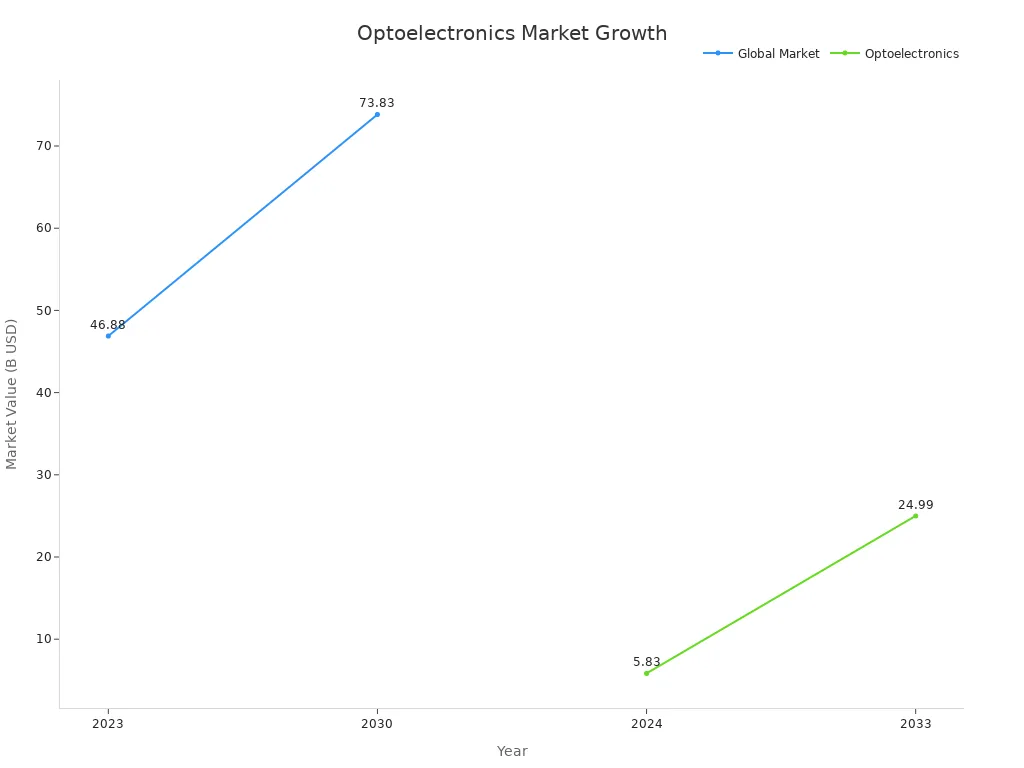
These new ideas have helped the market grow quickly. In 2023, the global optoelectronics market was $46.88 billion. By 2030, it could reach $73.83 billion. The high CAGR means new technology keeps raising demand for these devices. The chart below shows how the market value is expected to go up as technology gets better.
Note: People want to save energy and protect the planet. This makes high-quality optoelectronic components more important than ever.
Industry Demand
Many industries need optoelectronics for their products and services. In 2020, the market was worth over $90 billion. By 2026, it could be more than $150 billion. The CAGR is about 9%. Many things make this demand go up:
-
5G networks need more optical transceivers and fiber optics.
-
LiDAR is used in self-driving cars and robots. This means more lasers and photodetectors are needed.
-
New displays like OLED and MicroLED use optoelectronic components.
-
Data centers and telecom companies use photonic integrated circuits for speed and efficiency.
-
Healthcare uses optoelectronics in medical imaging and wearable tech. This helps doctors care for patients better.
-
People want devices that use less energy. This matches the world’s focus on protecting the environment.
Asia Pacific is the top market. Government plans like 'Made in China 2025' help a lot. North America also spends a lot, especially on medical devices and aerospace. For example, Canada set aside $8 billion for defense projects over five years. Companies like AIM Photonics and Applied Optoelectronics, Inc. keep making new products and services. This shows strong investment in the industry.
New Applications
Every year, people find new ways to use optoelectronics. The car industry is growing fast. In 2018, the automotive optoelectronics market was $3.88 billion. By 2025, it could be $9.80 billion. The CAGR is 14.13%. Passenger cars have the biggest share. Safety features are growing the fastest. LED devices are also rising in value quickly.
The table below shows adoption rates and market impact in new areas:
|
Metric/Segment |
Value/Rate |
Year/Period |
|---|---|---|
|
Automotive optoelectronics market |
$3.88 billion |
2018 |
|
Projected automotive market size |
$9.80 billion |
2025 (forecast) |
|
CAGR (automotive segment) |
14.13% |
2018-2025 |
|
Passenger car segment market share |
Largest |
N/A |
|
LED devices segment growth |
Fastest |
Forecast period |
|
Safety segment growth |
Fastest |
Forecast period |
|
North America market position |
Largest |
2025 (forecast) |
|
Asia Pacific growth rate |
Fastest |
2025 (forecast) |
Other areas are also using more optoelectronics. In 2021, the global market was $42.9 billion. By 2031, it could be $97.8 billion. The CAGR is 9.1%. The LED market share grew from 5% in 2013 to over 50% in 2021. In 2021, private investment in U.S. solar energy was $33 billion. North America had 39% of the market. Asia Pacific had 31%, and Europe had 23%.
Wearable technology, smart cars, and clean energy solutions are growing. These trends help the market get bigger as new uses appear.
Optoelectronic Components Trends
AI and Photonics
AI and photonics are changing optoelectronics today. Companies make smaller and smarter devices using both. These devices are found in electronics, cars, and factories. Many AI tools use optoelectronic components. Security cameras, touch screens, and face scanners use these parts. In 2024, factories use about 65.7% of the market. This is because of more robots and faster networks. Electronics for people lead with $10.1 billion in 2024. This is because of better screens and AR devices. Cars used $6.8 billion in 2023 for LiDAR and infrared sensors. These help drivers stay safe. The U.S. and Germany spend money on chips and photonic research. The world photonic integrated circuit market will grow fast. It could reach $98.6 billion by 2034 with a 20.6% CAGR. Companies like Nvidia and Lightmatter make data centers faster and better.
-
AI and photonics help with real-time data in phones and self-driving cars.
-
Research money is high for new sensors and photonic neural networks.
-
Data centers need to move data faster because of AI and 5g.
Energy Efficiency
Energy efficiency is a big trend in optoelectronics. White LED efficiency went from 5.8% in 2003 to 38.8% in 2020. This is a 33 percentage point jump. Research and new tech made this happen. About 8.5% of the gain came from tech spillovers. This shows R&D is important.
|
Year |
Total LED Efficiency (%) |
Efficiency Increase (percentage points) |
Contribution from Technology Spillovers (%) |
|---|---|---|---|
|
2003 |
5.8 |
N/A |
N/A |
|
2020 |
38.8 |
33.0 |
8.5 |
Companies want to save energy. They use better optoelectronic parts to do this. These changes help lower energy use in lights, screens, and networks.
Government Initiatives
Government rules and money affect optoelectronics trends. Funding helps small companies meet needs in computers and biotech. Even when factories move overseas, U.S. companies still lead in patents and new ideas. After the telecom crash in 2000, big companies moved work to East Asia. By 2005, five U.S. and two Japanese companies made 65% of the money. Most building and making now happens overseas. But U.S. startups get help from programs like SBIR. They work on new ways to put parts together at home. Leaders now talk to experts to make good plans. Simple rules do not work. Careful plans help keep new ideas and competition strong in optoelectronics.
Key Players
Leading Companies
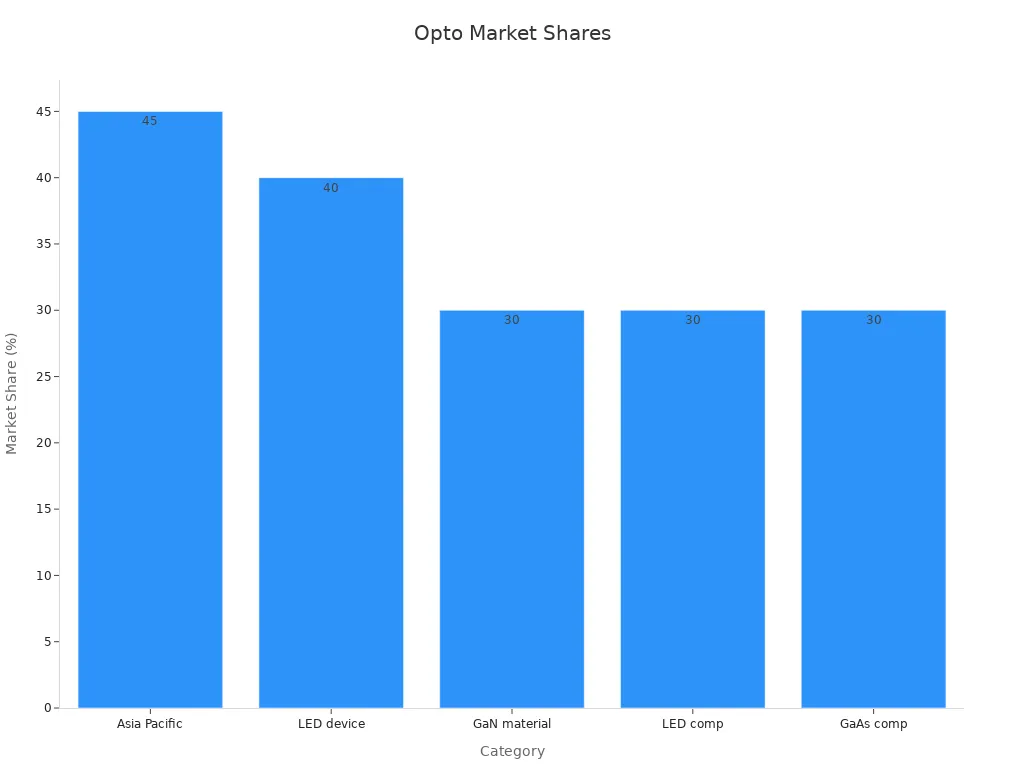
Many companies are important in the optoelectronic components market. These companies help the industry grow with new ideas and many products. Hamamatsu Photonics K.K., Osram GmbH, Nichia, Samsung, Cree, Vishay, and TT Electronics are some of the top companies. Nichia, Samsung, and Cree are strong because they sell many kinds of LEDs and spend money on new technology. IPG and Coherent are big in the industrial laser area. The table below gives facts about the market and these companies’ roles:
|
Category |
Data / Insight |
|---|---|
|
Global Market Value (2023) |
|
|
Projected Market Value (2033) |
USD 112.2 Billion |
|
CAGR (2024-2033) |
9.6% |
|
Regional Market Share |
Asia Pacific: 45% |
|
Device Type Market Share |
LEDs: 40% |
|
Material Market Share |
Gallium Nitride (GaN): 30% |
|
Specific Component Shares |
LEDs and GaAs components each approx. 30% |
|
Key Leading Companies |
Hamamatsu, Osram, Nichia, Samsung, Cree, Vishay, TT Electronics, and others |
Asia Pacific is number one because it makes a lot and has new ideas. North America is good at aerospace and defense. Europe works on cars and clean energy.
R&D and Innovation
Top companies spend a lot on research and development. They make new products and make old ones better. Hamamatsu made a fast photodiode in January 2024. This device made data move 25% faster. Osram bought a laser startup in March 2024. This helped Osram make 30% more products. These actions help companies stay ahead and meet more demand. Nichia, Samsung, and Cree work to make LEDs better and more useful. Their research helps more people use optoelectronic components in new ways.
Strategic Moves
Mergers and acquisitions are important for competition. Companies like Broadcom buy other companies to get stronger. In August 2024, Broadcom bought CA Technologies. This helps Broadcom with software and networking. Now Broadcom is stronger in data centers and optoelectronics. Reports show top companies use mergers, partnerships, and research to get more of the market. These plans help them keep up with changes and what customers want. Tracking these moves shows how they help the industry grow and bring new ideas.
Regional Insights
Asia-Pacific
Asia-Pacific is the top region for optoelectronics. It has the biggest market and grows quickly. In 2023, the market made USD 176,365.4 million. By 2030, it could reach USD 293,216.6 million. This means a 7.5% growth rate each year. The semiconductor segment is the largest and grows the fastest.
|
Metric |
Value |
|---|---|
|
Market revenue in 2023 |
USD 176,365.4 million |
|
Projected revenue in 2030 |
USD 293,216.6 million |
|
CAGR (2024-2030) |
7.5% |
Many countries help this region grow. China makes more electronics and helps the market. Japan works to improve its electronics and car industries. India has more internet users and people can buy more. This means more need for fast data and optoelectronics. South Korea’s car industry also helps the market get bigger.
Asia-Pacific has many factories and government help. This makes it a center for new ideas in optoelectronic components.
North America
North America has about 30% of the world’s optoelectronics market. It grows fast because of new technology and research. The United States uses 70% of the region’s products. Big industries are healthcare, cars, planes, and defense. LED smart lights grew by 40%. Infrared security systems grew by 35%. Canada spent 30% more on medical optoelectronics.
|
Region |
Market Share (%) |
Notable Statistics |
|---|---|---|
|
North America |
30% |
U.S. 70% of demand; LED lighting +40%; IR security +35% |
By 2030, the Americas market could be USD 23.72 billion. The growth rate is 10.3% each year. New areas like virtual reality and self-driving cars help the market keep growing.
Emerging Markets
Emerging regions like Latin America, the Middle East, and Africa are getting stronger in optoelectronics. More people use infrared parts in electronics and cars. Healthcare needs better imaging and sensors, so demand goes up. Countries like Brazil, Argentina, Saudi Arabia, and South Africa see more sales of LEDs and sensors every year.
|
Metric / Region |
Data / Description |
|---|---|
|
Global Market CAGR |
|
|
Key Emerging Regions |
Latin America, Middle East, Africa, South East Asia |
|
Growth Drivers |
Infrared in electronics, automotive, healthcare, sensors |
Gallium nitride is popular because it saves energy. Companies buy others and make new products to grow. These plans help these regions get a bigger part of the world optoelectronics market.
Impact of Global Events
COVID-19 Effects
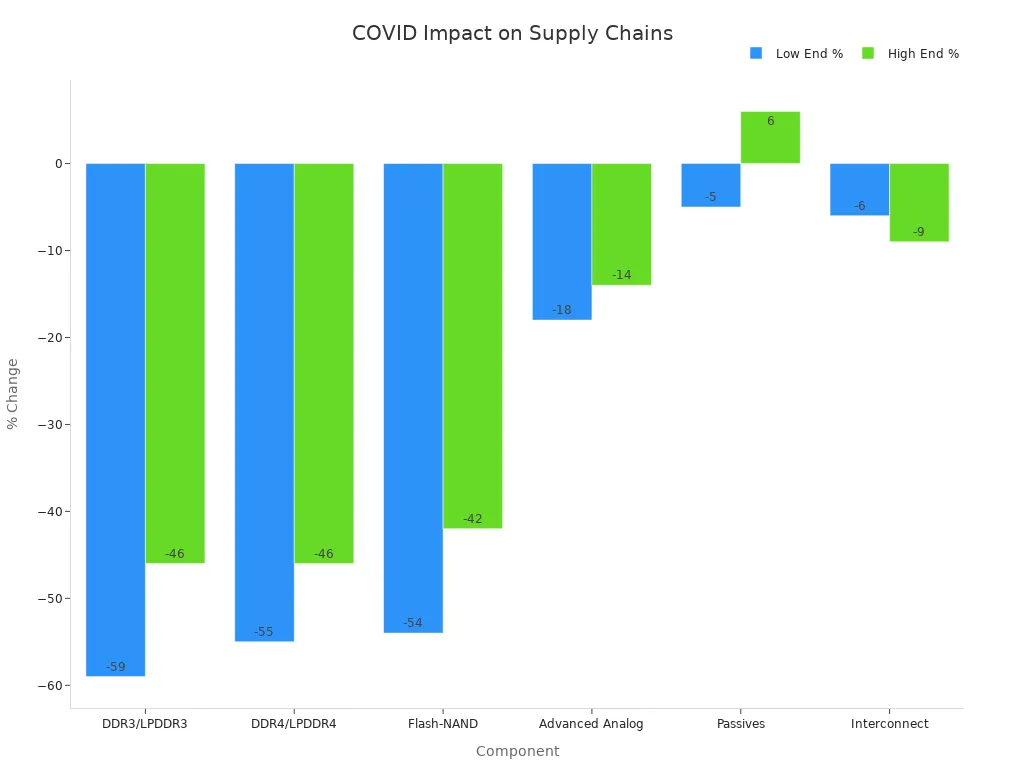
COVID-19 caused big problems for the optoelectronic components market. China had strict lockdowns in 2022. Cities like Shanghai and Suzhou closed factories and ports. The Port of Shanghai’s exports dropped by 40% during two months. This made delays and shortages all over the world. About 94% of Fortune 1000 companies had trouble making and moving products. China is a main maker of optoelectronic technology. Factory shutdowns and stopped transport hurt the market. These problems spread and caused shortages everywhere. The US bought less from China, dropping from 17.5% in 2020 to 15% in 2023. This shows how trade changed during the pandemic.
Supply Chain
Supply chains for optoelectronic components are still weak. Over 60% of advanced chips come from Taiwan. This makes the market risky if problems happen there. Fewer than five companies make most top chips. This can cause slowdowns if one has trouble. The market needs special materials like neon gas from Ukraine and rare earths from China. Events like the Suez Canal blockage and a fire at Renesas in Japan stopped shipments. Car companies like Ford and GM made fewer cars because of chip shortages. Prices for optoelectronic parts went up by 10% to 40%. There was an 11% sales jump because of shortages and higher prices. Companies now use more suppliers and build more factories close by to lower risks.
Note: Wait times for important parts got better in early 2024. But experts say they might go up again if demand rises.
Geopolitics
World conflicts make the market face more problems. The Russia-Ukraine war and Israel-Hamas conflict hurt chip supply chains. Inflation and not enough raw materials like copper make things harder. Over 75% of chips are made in East Asia. This means the market is sensitive to problems there. Companies use forecasts and checks to spot and handle risks. They also plan to use more suppliers and new tech to keep the market steady.
Optoelectronics Market Outlook
Future Opportunities
The future for optoelectronics looks bright. New chances will come as technology gets better. More industries will start using these components. The market is expected to grow fast, with a 13.92% CAGR from 2022 to 2029. This growth happens for many reasons. Cities want LED lighting because it saves energy. 5G networks are spreading, so more lasers and photodetectors are needed. Cars use more optoelectronic parts for LiDAR and driver help systems. Healthcare uses more photonic sensors and imaging tools. Wearable tech and AR devices also need these parts. Solar power projects use more photovoltaic cells now. Governments support energy-saving technology, which helps the market grow.
|
Aspect |
Details |
|---|---|
|
Projected CAGR |
13.92% (2022-2029) |
|
Fastest-Growing Region |
Asia-Pacific |
|
Largest Market Share |
North America |
|
Key Growth Drivers |
LED lighting, 5G, automotive LiDAR/ADAS, healthcare sensors, solar cells, smart devices |
Companies that spend money on research and make new products will have many chances to do well in the future.
Challenges Ahead
The market has some problems that could slow it down. Supply chain problems, like during COVID-19, can cause shortages and higher prices. Companies need to handle these risks to keep making products. Demand changes quickly, as more people use the internet for work and fun. New rules about safety and clean energy make companies build better solar cells and sensors. Technology changes fast, so companies must keep up and meet tough rules. The market is very competitive, with a few big companies leading by doing research, working together, and buying other companies.
-
Supply chain problems can slow down making products and make things cost more.
-
Fast changes in demand and new rules mean companies must act quickly.
-
Keeping up with new technology and strong competition is hard.
Market prediction models use old data and smart analysis to help companies get ready for these problems. These models mix sales numbers, supply and demand trends, and economic facts to show what might happen next.
The optoelectronic components market is growing fast. Experts think it could be worth $16.21 billion by 2030. The growth rate each year is about 13%.
|
Metric |
Value |
|---|---|
|
Market Size (2024) |
USD 7.77 billion |
|
Projected Market Size (2030) |
USD 16.21 billion |
|
CAGR (2024-2030) |
13.03% |
New technology and strong regions help this growth.
-
AI and better digital systems help new ideas and make the market stronger.
-
Checked data and smart tools show these growth reasons are true.
Companies should watch for new tech and changes in regions. This helps them find new chances and avoid problems.
FAQ
What are optoelectronic components?
Optoelectronic components use light to send or get signals. These parts include LEDs, sensors, lasers, and solar cells. Engineers put them in things like phones, cars, and medical devices.
Why do industries use optoelectronics?
Industries use optoelectronics to make things faster and safer. These parts help build better screens, quick networks, and safer cars. Companies pick them because they work well and save energy.
Which regions lead the optoelectronics market?
|
Region |
Market Share (%) |
|---|---|
|
Asia-Pacific |
45 |
|
North America |
30 |
|
Europe |
20 |
Asia-Pacific is first because it has many factories. It also spends a lot on new technology.
How did COVID-19 affect the optoelectronics market?
COVID-19 made factories close and slowed shipping. Many companies had trouble getting parts and paid more. The market got better when factories opened and shipping improved.