100k color code powers your favorite gadgets
100k colour code lets you quickly identify resistors, ensuring reliable performance in modern electronics and preventing costly circuit errors.

You see the 100k color code on tiny components inside your favorite gadgets every day. This code helps you identify a resistor that controls how much current flows through a circuit. When you can read these color bands, you unlock the power to understand and build electronic devices.
As a teenager, my first breakthrough came when I picked up a resistor and said to myself: “this is a 1K resistor because it looks like one I was using in another circuit and I remember its value.”
Whether you work as an engineer or enjoy tinkering at home, knowing these color codes saves time and prevents mistakes.
Key Takeaways
- Understanding the 100k resistor color code helps you identify resistor values quickly, saving time and preventing mistakes in electronic projects.
- The 100k ohm resistor is essential in many devices, including smartphones and computers, as it regulates current flow and ensures stable operation.
- Practicing how to read resistor color codes with real components boosts your confidence and accuracy in building and repairing circuits.
- Using the correct resistor value is crucial; the wrong choice can lead to device malfunction or damage, so always double-check the color bands.
- Mastering the 100k color code empowers you to tackle DIY electronics projects and professional designs with greater ease and reliability.
Understanding the 100k color code

A 100k ohm resistor is a common component used in many electronic circuits. It provides a fixed resistance of 100,000 ohms (or 100 kilo-ohms, often written as 100kΩ). This resistor helps control current flow and voltage levels within a circuit. Its applications include voltage dividers, signal biasing, and limiting current in low-power devices. The resistor's tolerance, which indicates how much its actual resistance can vary, typically ranges from ±0.1% to ±5%. Power ratings usually include 1/8W or 1/4W, depending on the circuit's power dissipation needs.
Understanding how to read a 100k resistor involves knowing its resistor color coding. The resistor color code system uses colored bands painted on the component to indicate its resistance value. For a 100k ohm resistor, the color bands encode the significant digits and the multiplier. This system helps technicians and hobbyists quickly identify resistor values without needing to measure each one.
What is a 100k ohm resistor?
A 100k ohm resistor is classified as a fixed resistor with a resistance of 100,000 ohms. It is designed to provide a precise and stable resistance in electronic circuits. These resistors are often used in low-current applications such as voltage dividers, biasing transistors, or signal filtering. They are available in various tolerance levels, with precision resistors offering tighter tolerances like ±1% or even ±0.1%. The power rating of a 100k resistor typically ranges from 1/8W to 1/4W, making it suitable for most general-purpose electronic projects.
100k resistor color code basics
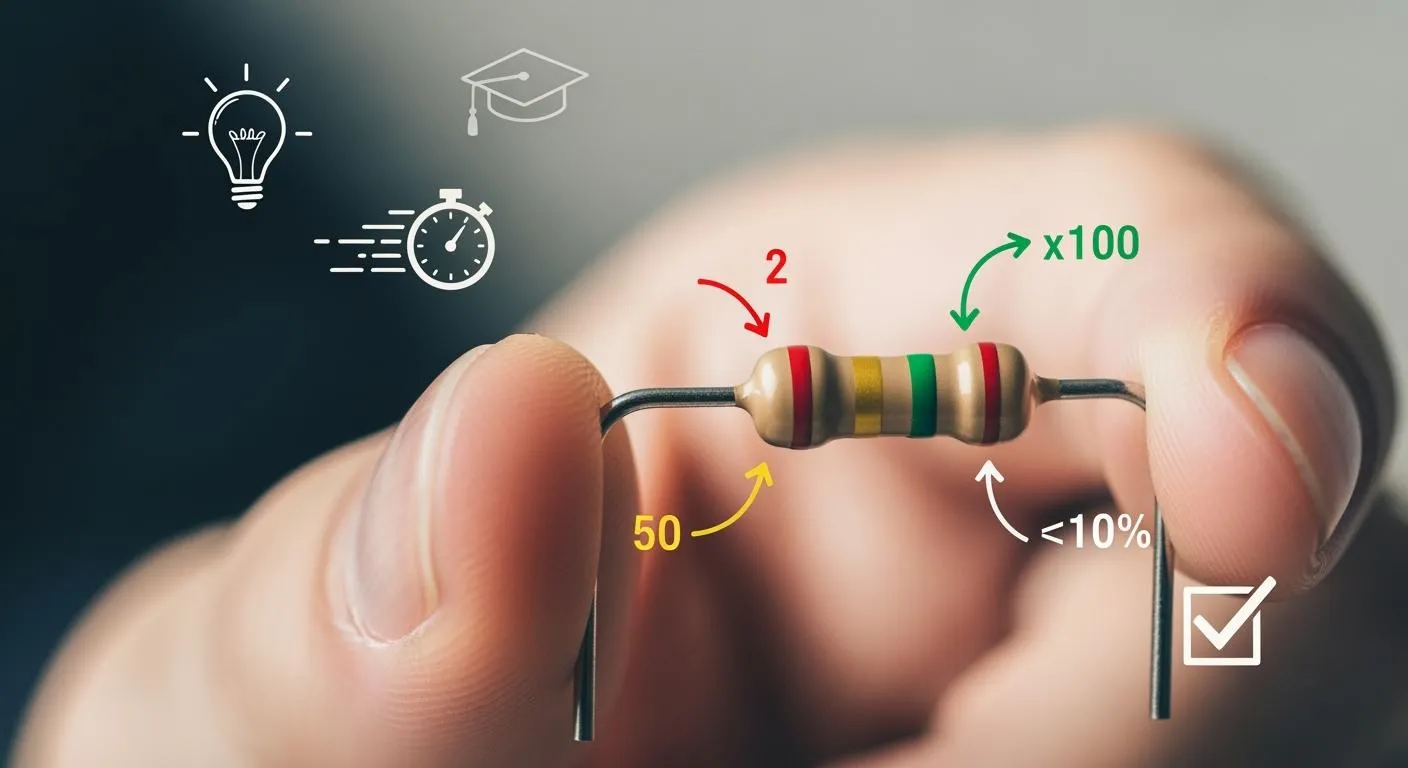
The resistor color code system simplifies identifying resistor values through color bands. For a 100k ohm resistor, the color bands encode the significant digits and the multiplier. In the most common 4-band system, the first two bands represent the first two digits, the third band indicates the multiplier, and the fourth band shows the tolerance.
| Band Number | Function | Color | Value |
|---|---|---|---|
| 1 | 1st Digit | Brown | 1 |
| 2 | 2nd Digit | Black | 0 |
| 3 | Multiplier | Orange | x 1000 |
| 4 | Tolerance | Gold | ± 5% |
In a 5-band resistor, the first three bands represent significant digits, the fourth is the multiplier, and the fifth indicates tolerance:
- 1st Band: Brown (1)
- 2nd Band: Black (0)
- 3rd Band: Black (0)
- 4th Band: Orange (x 1000)
- 5th Band: Gold or Silver (± 5% or ± 10%)
This color coding system allows quick identification of resistor values, especially in manufacturing and repair scenarios.
4-band vs 5-band color code
The main difference between 4-band and 5-band resistor color codes lies in their precision and application. A 4-band resistor uses two significant digits, a multiplier, and a tolerance. It is suitable for most general-purpose applications where high accuracy is not critical. Conversely, a 5-band resistor includes three significant digits, providing higher precision, making it ideal for sensitive circuits like audio equipment or measurement systems.
| Feature | 4-Band Resistor | 5-Band Resistor |
|---|---|---|
| Significant Digits | 2 | 3 |
| Multiplier | Yes | Yes |
| Tolerance | Standard (e.g., ±5%) | Tighter (e.g., ±1%) |
| Common Applications | General use | High-precision tasks |
| Accuracy | Lower | Higher |
Both systems follow industry standards set by organizations like IEC and EIA, ensuring consistency worldwide. Knowing how to measure a 100k resistor or interpret its color code is essential for engineers and hobbyists alike. Whether you're designing a new gadget or troubleshooting an existing device, understanding resistor color coding helps you identify components quickly and accurately.
About Nova Technology Company (HK) Limited
Nova Technology Company (HK) Limited is a leading provider in the integrated circuit industry. As a HiSilicon-designated solutions partner, they specialize in chip-level solutions, system integration, and advanced application scenarios. Their expertise ensures that electronic devices operate efficiently, reliably, and at optimal performance levels. Recognizing the importance of resistor color coding and component identification, Nova Technology supports engineers and manufacturers in developing cutting-edge electronic products.
Role of the 100k resistor in electronics
The 100k resistor plays a key role in many electronic circuits you use every day. You find this resistor inside smartphones, computers, smart home devices, and audio equipment. You rely on it to keep your gadgets running smoothly and safely. When you understand how this resistor works, you can design, build, or repair electronic devices with confidence.
Regulating current flow
You use a 100k resistor to control the amount of current that moves through a circuit. This helps protect sensitive components from too much current, which can cause damage. You see this resistor in many types of circuits:
- Voltage dividers split voltage between different parts of a circuit.
- Timing circuits, such as those using a 555 timer, depend on this resistor to set precise time intervals.
- Transistor biasing uses a 100k resistor to set the base voltage for proper operation.
- Current limitation protects LEDs and other parts by keeping current at safe levels.
- Oscillator circuits use this resistor with capacitors to create signals at specific frequencies.
You must identify the correct resistor value to make sure your circuit works as planned. If you use the wrong resistor, your device might not function or could even break.
Applications in voltage dividers
You often use a 100k ohm resistor in voltage divider circuits. This setup lets you create lower voltages from a higher voltage source. You need this when you want to power sensors or other components that cannot handle the full voltage. The 100k resistor is perfect for circuits that need less current, such as analog input scaling or reference pins. You also find it in high-impedance inputs and low-power sensing circuits. Audio filters often use this resistor to shape sound signals.
- A voltage divider with a 100k resistor can provide a stable reference voltage.
- You can adjust the output voltage by changing the values of the resistors in the divider.
- The voltage range depends on the input voltage and the resistor values you choose.
When you select the right resistor, you ensure your circuit delivers the correct voltage to each part.
Signal processing and amplifier biasing
You see the 100k ohm resistor in many signal processing and amplifier circuits. It helps set the gain, reduce noise, and keep power use low. You find this resistor in operational amplifier circuits, transistor biasing, and voltage dividers for level shifting. The table below shows how you use a 100k resistor in these applications:
| Application Type | Description |
|---|---|
| Operational Amplifier Circuits | You use a 100k resistor in feedback and gain-setting networks to minimize power use and avoid noise. |
| BJT Transistor Biasing | You set a predictable operating point by placing a 100k ohm resistor at the base, limiting current and ensuring proper function. |
| Voltage Divider | You create a stable reference for shifting signal levels with minimal current drain using a 100k resistor. |
You must always check the color code to identify the correct resistor. If you use the wrong value, your amplifier might distort signals or your sensor might not work. Accurate identification keeps your circuits reliable and safe.
Tip: Always double-check the color bands on your resistor before placing it in your circuit. This simple step can prevent hours of troubleshooting later.
You see the applications of 100k resistor in almost every modern electronic device. When you know how to use and identify this resistor, you gain control over your projects and repairs.
Relevance of the 100k resistor color code today
You see the 100k resistor color code in almost every modern electronic device. This color code system remains crucial because it allows you to quickly identify resistor values during design, assembly, and repair. You can avoid costly mistakes and keep your devices running smoothly. The 100k resistor plays a vital role in many applications, from smartphones to smart home devices.
Impact on manufacturing and design
You rely on the 100k color code to streamline manufacturing and product design. When you work in electronics, you need to identify resistors quickly and accurately. The color code helps you do this without extra tools. In factories, engineers use automated systems to check resistor values before assembly. This process reduces errors and improves quality.
Recent advancements in manufacturing have made the process even more reliable. You can see how each step matters in the table below:
| Aspect | Description |
|---|---|
| Solder Paste Application | Accurate stencil printing is crucial to avoid weak joints or shorts in SMD resistors. |
| Component Sourcing | Ensuring genuine components are sourced prevents issues with incorrect values or stability. |
| Reflow Profiling | Correct temperature profiles are necessary to avoid thermal shock and component damage. |
| Inspection and Testing | Automated Optical Inspection (AOI) and electrical testing help catch errors before shipping. |
You also benefit from new recognition tools. For example, you can use a resistor color code recognition tool that uses OpenCV for color detection and value calculation. You can try an Android app that scans a line of pixels with your camera to identify resistor values. These tools make it easier to handle multiple resistors at once.
Nova Technology Company (HK) Limited stands out as a HiSilicon-designated solutions partner. You can trust their expertise in chip-level solutions, system integration, and advanced application scenarios in the integrated circuit industry. Their support helps you achieve reliable and efficient electronic designs.
Troubleshooting and repairs
You often need to repair or troubleshoot electronic devices. The 100k resistor color code helps you identify the correct resistor quickly. You can replace faulty resistors without guessing their values. This skill saves you time and prevents further damage to your device.
When you use the right 100k ohm resistor, you restore the original function of the circuit. You avoid problems like overheating, noise, or signal loss. You also improve the safety and reliability of your repairs. Many technicians and hobbyists rely on the color code system every day.
Essential for engineers and hobbyists
You need to understand the 100k resistor color code if you work as an engineer or enjoy electronics as a hobby. This knowledge helps you select the right resistor for your projects. You can design circuits with confidence and avoid common mistakes.
You find the 100k ohm resistor in many applications, such as voltage dividers, signal processing, and amplifier biasing. You use this resistor to control current, set voltage levels, and filter signals. When you read the color code, you make sure your circuit works as planned.
Tip: Practice reading resistor color codes with real components. This hands-on experience will help you recognize values faster and improve your troubleshooting skills.
Practical uses of the 100k color code

Smartphones and computers
You interact with smartphones and computers every day, but you might not realize how often you rely on the 100k resistor. This component appears in many essential circuits inside these devices. You find the 100k ohm resistor in voltage divider and timer circuits, which help manage voltage levels and timing functions. You also see it in biasing transistors, where it sets the correct voltage for transistors to work properly. The 100k resistor limits current to protect LEDs from burning out. It works with capacitors in oscillator circuits to generate signals and helps set output voltages in voltage regulator circuits. These uses show how the 100k color code helps you identify the right resistor quickly, making repairs and upgrades easier.
- Voltage divider and timer circuits
- Biasing transistors for stable operation
- Current limiting for LED protection
- Oscillator circuits for signal generation
- Voltage regulators for steady output
Smart home devices
You use smart home devices like thermostats, security cameras, and smart speakers. These gadgets depend on precise electronic control. The 100k resistor helps manage signals and power in these systems. It ensures sensors receive the correct voltage and keeps microcontrollers running smoothly. When you identify the 100k ohm resistor using the color code, you can troubleshoot or upgrade your smart devices with confidence. The color code system remains reliable, even as devices become smaller and more advanced.
Note: The resistor color code system has stayed the same for decades. Even with new technology and miniaturization, you still use this method to identify resistors in modern electronics.
DIY electronics projects
You often use the 100k resistor in personal projects, such as building audio circuits, light sensors, or simple timers. Knowing how to read the 100k color code helps you select the right resistor for your design. Here is a quick guide to identifying 100k ohm resistors:
| Band | Color | Meaning |
|---|---|---|
| 1st | Brown | First digit (1) |
| 2nd | Black | Second digit (0) |
| 3rd | Yellow | Multiplier (×10,000) |
| 4th | Gold | Tolerance (±5%) |
| Band | Color | Meaning |
|---|---|---|
| 1st | Brown | First digit (1) |
| 2nd | Black | Second digit (0) |
| 3rd | Black | Third digit (0) |
| 4th | Orange | Multiplier (×1,000) |
| 5th | Brown | Tolerance (±1%) |
To identify a 100k resistor in your project:
- Find the terminal band, usually gold or silver, for tolerance.
- Look at the first two bands for the base value.
- Use the third band as the multiplier.
Tip: Practice reading resistor color codes on real components. This skill helps you avoid mistakes and build better circuits.
The 100k color code remains vital in powering today’s gadgets. Recognizing resistor values helps you avoid costly errors and ensures your circuits work correctly. Mastering resistor color codes offers a universal language that simplifies component identification, boosting your confidence in DIY or professional projects. Nova Technology Company (HK) Limited, a HiSilicon-designated solutions partner, supports engineers with advanced chip-level solutions and system integration. By understanding resistor color codes, you empower yourself to build reliable electronics and troubleshoot efficiently.
Whether you’re designing new devices or repairing existing ones, knowing how to read resistor color codes makes a real difference. Keep practicing, and let this knowledge guide your next project to success!
FAQ
What colors represent a 100k ohm resistor in the 4-band code?
You see brown, black, yellow, and gold bands. Brown means 1, black means 0, yellow means ×10,000, and gold shows ±5% tolerance.
Tip: Remember “BBYG” (Brown, Black, Yellow, Gold) for quick identification!
Why do you use a 100k resistor in circuits?
You use a 100k resistor to control current, set voltage levels, and filter signals. It helps protect sensitive parts and ensures stable operation in devices like computers, phones, and smart home gadgets.
How do you check if a resistor is 100k without a color code?
You can use a digital multimeter. Set it to measure resistance, then touch the probes to each end of the resistor. The display should read close to 100,000 ohms (100kΩ).
Can you replace a 100k resistor with a different value?
You should not swap a 100k resistor for a different value unless you know the circuit will work safely. Using the wrong value can cause devices to malfunction or even break.
What is the difference between 4-band and 5-band color codes?
A 4-band resistor uses two digits, a multiplier, and a tolerance band. A 5-band resistor adds a third digit for higher accuracy.
| Bands | Digits | Multiplier | Tolerance |
|-------|--------|------------|-----------|
| 4 | 2 | Yes | Yes |
| 5 | 3 | Yes | Yes |