How does electronic operation of a Zener voltage regulator ensure protection
A zener voltage regulator maintains stable output and protects circuits by clamping excess voltage, ensuring safe operation for sensitive electronics.
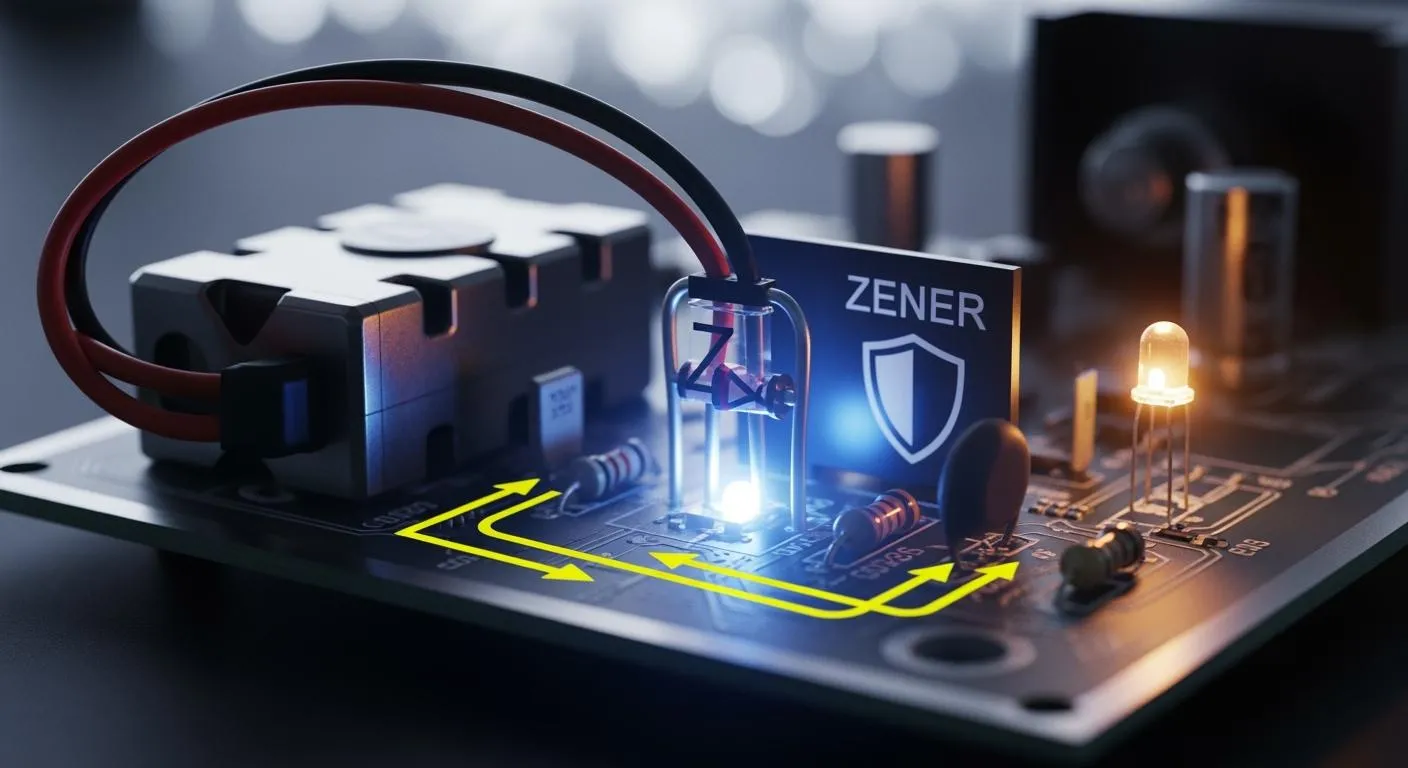
You rely on a zener voltage regulator to protect electronic circuits by keeping the output voltage stable and preventing overvoltage damage. When the input voltage rises above a certain level, the zener diode conducts in reverse and limits the voltage, which ensures that sensitive devices receive a consistent supply. This stable voltage drop remains nearly unchanged even if the current varies, making it essential for applications where voltage fluctuations could cause malfunction or failure.
Key Takeaways
- Zener voltage regulators maintain a stable output voltage, protecting sensitive devices from overvoltage damage.
- The zener diode operates in reverse bias to clamp voltage, ensuring safe levels during spikes.
- Selecting the right zener voltage and series resistor is crucial for effective circuit protection.
- Zener diodes are affordable and simple to integrate into designs, making them ideal for steady-state applications.
- Understanding zener diode limitations helps in designing safer and more reliable electronic circuits.
Zener Voltage Regulator Operation
Reverse Bias and Breakdown
You see the basic structure of a zener voltage regulator in many electronic circuits. The circuit uses a series resistor and a zener diode connected in reverse bias. The resistor limits the current, while the zener diode maintains a constant voltage across its terminals. The output voltage is taken across the zener diode, which equals its breakdown voltage. The load connects in parallel with the zener diode, so the voltage across the load stays stable. The supply voltage must be higher than the zener voltage for the regulator to work properly.
- The zener diode is connected in reverse bias to maintain a constant output voltage.
- A series resistor (RS) limits the current flowing through the zener diode.
- The output voltage (Vout) is taken across the zener diode, equal to its breakdown voltage (VZ).
- The load (RL) connects in parallel with the zener diode, ensuring stable voltage across the load.
- The supply voltage (VS) must be greater than the zener voltage (VZ) for proper operation.
When you apply a voltage in reverse bias, the zener diode exhibits a breakdown phenomenon at a specific voltage called the zener voltage. This voltage is crucial because it allows the diode to maintain a constant voltage across its terminals. The current through the diode increases sharply once this voltage is reached. The breakdown can happen through zener breakdown for lower voltages or avalanche breakdown for higher voltages.
Stable Output Voltage
You depend on the zener voltage regulator to keep the output voltage steady even when the input voltage changes. The zener diode enters reverse breakdown mode when the input voltage exceeds the zener voltage. It maintains a fixed voltage across its terminals, preventing the output from rising above a certain value. This action ensures a constant voltage for sensitive electronic devices.
Zener diodes stabilize voltage output with low ripple under varying load conditions. They conduct enough current to maintain a voltage drop of Vout when the input voltage exceeds the zener voltage. This guarantees a constant DC output voltage across the load, even if the input voltage fluctuates.
The series resistor drops excess voltage between the input supply and the regulated output. It determines the total supply current and sets the operating point of the zener diode. You must select the resistor value carefully to control the current through the zener diode and prevent exceeding its maximum power dissipation. The formula Rs = (Vin(min) - Vz) / (Iz(min) + IL(max)) helps you choose the right resistor. This ensures the zener operates within its limits and provides reliable voltage regulation.
Protection Mechanisms
Voltage Clamping Action
You rely on the voltage regulator to protect your circuit from dangerous voltage spikes. The zener voltage regulator uses a zener diode to clamp the voltage at a safe level. When the input voltage stays below the zener voltage, the diode remains inactive and allows normal operation. If the input voltage rises above the zener voltage, the diode conducts in reverse and clamps the voltage to its breakdown value. This action prevents the output from exceeding the safe threshold.
- The zener diode operates in reverse breakdown mode and maintains a constant voltage across itself when the supply voltage exceeds the zener voltage.
- When the supply voltage is below the zener voltage, the diode presents high resistance and allows normal current flow.
- If the supply voltage rises above the zener voltage, the diode's resistance drops sharply and shunts excess voltage to ground.
- The series resistor limits the current through the zener, ensuring circuit safety while absorbing excess voltage.
You see this voltage clamping action in real-world applications. Zener diodes protect electronic circuits from transient voltage spikes caused by power surges or lightning strikes. When the voltage exceeds the zener voltage, the diode conducts excess current to ground and prevents damage to sensitive components. The regulator absorbs the surge energy and keeps the output voltage stable.
The voltage regulator acts as a shield for your circuit. It clamps the voltage at the zener rating and rapidly adjusts the output to prevent overvoltage conditions. This mechanism ensures reliable operation and protects your devices from sudden spikes.
The effectiveness of the voltage clamping action depends on the proper selection of the zener voltage and the series resistor. You must choose values that match the requirements of your circuit and the maximum allowable output voltage. This careful design guarantees that the regulator responds quickly to overvoltage events and maintains safe operation.
Circuit Protection
You depend on the voltage regulator to safeguard sensitive components like microcontrollers and integrated circuits. The zener voltage regulator activates when a voltage spike surpasses the zener voltage. The diode conducts and limits the circuit voltage to the zener voltage, absorbing the surge energy. This mechanism protects your devices from damage and ensures stable performance.
Zener diodes are specifically designed to function safely in reverse breakdown mode. When the reverse voltage reaches the zener voltage, the diode conducts and maintains a nearly constant voltage. This characteristic makes zener voltage regulators ideal for protecting circuits from voltage spikes and fluctuations.
You can see how the voltage regulator prevents voltage fluctuations in power supply circuits:
- The zener diode maintains a constant voltage across itself when the supply voltage exceeds the zener voltage.
- If the supply voltage is below the zener voltage, the diode allows normal current flow.
- When the supply voltage rises above the zener voltage, the diode shunts excess voltage to ground.
- The regulator rapidly adjusts the voltage and stabilizes it at the zener rating.
You often compare zener voltage regulators with transient voltage suppressor (TVS) diodes. The table below shows the differences:
| Feature | Zener Diodes | TVS Diodes |
|---|---|---|
| Voltage Clamping | Clamps at breakdown voltage (VZ) | Designed for rapid response to transients |
| Application | Effective for steady-state DC supplies | More suitable for AC applications |
| Circuit Complexity | Simple circuit with series resistor | Built-in bidirectional protection in one device |
| Heat Generation | May generate heat and require overcurrent protection | Handles higher surge currents efficiently |
| Impedance Characteristics | High impedance below VZ, low impedance above VZ | Instantaneous low impedance during transients |
| Surge Current Capability | Limited to low power and voltage levels | Designed for higher surge currents |
| Bidirectionality | Requires two back-to-back diodes for AC | Bidirectional in a single device |
Tip: You should use zener voltage regulators for steady-state DC applications and TVS diodes for circuits exposed to frequent or high-energy transients.
Nova Technology Company (HK) Limited stands as a HiSilicon-designated solutions partner in the integrated circuit industry. You benefit from their expertise in chip-level solutions, system integration, and advanced protection for microcontrollers and power management systems. Their professional approach ensures reliable voltage regulator designs for semiconductor applications, supporting robust circuit protection and stable output performance.
You achieve circuit protection by using the zener voltage regulator to absorb excess voltage and maintain a constant output. This approach prevents voltage fluctuations and shields sensitive devices from harm. You ensure safe operation and extend the lifespan of your electronic systems.
Practical Example and Limitations
Overvoltage Scenario
You often encounter situations where a sudden voltage spike threatens your circuit. Imagine you connect a microcontroller to a regulated voltage supply. If the input voltage jumps above the safe threshold, the zener diode springs into action. The diode, placed in parallel with the microcontroller, conducts excess current and clamps the voltage at its breakdown value. The series resistor limits the current, preventing the diode from overheating. This step-by-step process protects your microcontroller and ensures stable operation.
When you design a circuit for chip-level solutions or system integration in the IC industry, you need reliable protection. Nova Technology Company (HK) Limited, a HiSilicon-designated solutions partner, specializes in advanced semiconductor applications. Their expertise covers microcontroller protection, power management, and robust voltage regulation for integrated circuits.
You see the zener diode absorb the surge energy and maintain a constant output. This action prevents damage and extends the lifespan of sensitive components. You rely on this mechanism for everyday electronics, especially in environments prone to electrical noise or transient spikes.
Best Practices
You maximize protection by following several best practices when selecting and designing with zener voltage regulators:
- Determine the appropriate zener voltage for your application. For example, choose 5.1 V for microcontrollers or 3.3 V for low-voltage logic.
- Calculate load and bias current to ensure the diode operates within safe limits.
- Select a zener diode with a power rating higher than the calculated dissipation.
- Compute the value of the current-limiting resistor using Ohm's Law.
- Integrate the zener diode in parallel with the component and use a series resistor to control current flow.
You must also consider limitations:
- Zener diodes handle only low to moderate power. High-power scenarios may cause overheating and failure.
- Temperature variations affect performance. Zener voltage can drift, requiring compensation mechanisms.
- Electrical noise may interfere with sensitive components in high-current applications.
- Environmental factors like thermal resistance and repeated electrical stress can reduce reliability.
You notice that zener diodes have different temperature coefficients. Diodes below 5V decrease voltage as temperature rises, while those above 5V increase voltage. You mitigate these effects by using heat sinks or selecting diodes with minimal temperature coefficients.
| Feature | Zener Diodes | Three-Terminal Regulators |
|---|---|---|
| Cost | Under $0.50 | $0.50 - $2.00 |
| Efficiency | 15-40% | 40-60% |
| Load Regulation | 1-5% | 0.01-0.1% |
| Quiescent Current | Zero beyond regulation | 3-10 mA |
| Complexity | Simple (2 components) | More complex (additional components) |
| Best Use Case | Non-critical applications | Applications needing precision |
| Decision Point | Below 50 mA | Above 50 mA |

Tip: You achieve reliable voltage regulation by matching the zener diode's voltage and power rating to your circuit's needs. Always check the manufacturer's datasheet for temperature coefficients and power limits.
You gain reliable circuit protection when you use a zener voltage regulator. The electronic operation keeps the output voltage stable, even if the input changes. Zener diodes work safely within their rated limits and protect sensitive components. You benefit from these key points:
- Zener diodes provide steady voltage regulation and overvoltage protection.
- They are affordable and simple to add to your designs.
- You must manage heat and energy loss for the best results.
Understanding these basics helps you design safer circuits. For advanced protection, explore three-terminal regulators or transient voltage suppressors.
FAQ
What is the main purpose of a zener voltage regulator?
You use a zener voltage regulator to keep the output voltage steady. It protects your circuit from overvoltage and ensures sensitive components receive a safe supply.
How do you select the right zener diode for your circuit?
You check the required output voltage and power rating. Choose a zener diode with a breakdown voltage that matches your needs and a power rating higher than your calculated load.
Can a zener voltage regulator handle large voltage spikes?
You rely on zener diodes for small to moderate spikes. For bigger surges, you use devices like TVS diodes or three-terminal regulators for better protection.
Why do you need a series resistor with a zener diode?
You add a series resistor to limit current through the zener diode. This prevents overheating and keeps the diode working safely within its rated limits.
What happens if the zener diode gets too hot?
You risk damaging the diode and losing voltage regulation. You prevent this by choosing the right power rating and using heat sinks or proper cooling.