How to Implement Advanced Quality Control Inspection for Electronics
Putting advanced quality control inspection in electronics needs a smart plan. This plan uses new technology and strong steps.
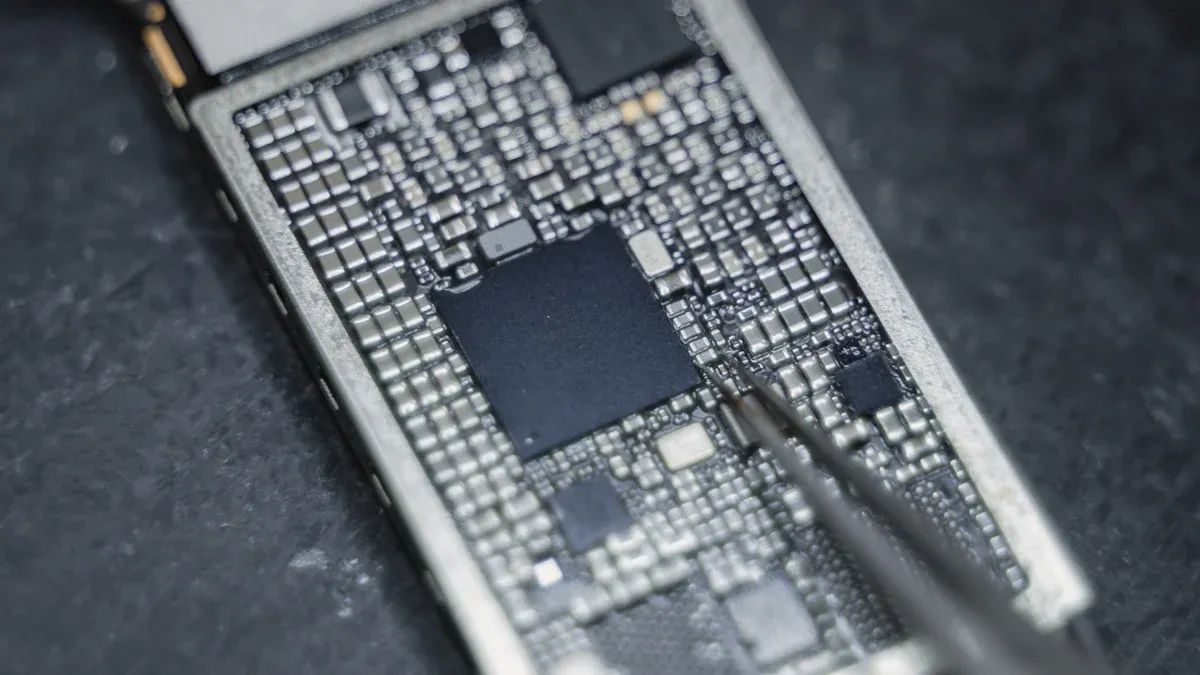
Putting advanced quality control inspection in electronics needs a smart plan. This plan uses new technology and strong steps. Studies show AI-powered inspection systems are very accurate. They can find tiny defects with up to 95% accuracy. These systems also help find 30% more defects that people might miss.
|
Metric |
Impact |
|---|---|
|
Missed defects |
|
|
Inspection cycle time |
40% less time needed |
|
Defect detection accuracy |
Up to 95% accuracy |
|
Yield improvement |
15% more good products |
Electronics that must work well need regular checks. They also need ways to stop problems before they happen. Companies should look at what they can do now. They should see if they are ready for advanced quality control.
Key Takeaways
-
Advanced quality control uses new tools like AI and automated inspection. These tools help find more problems and make products better.
-
Following rules like IPC, ISO, and JEDEC makes sure products are safe and work well.
-
Using both visual and automated inspections helps find normal and rare problems fast and correctly.
-
Good record-keeping lets companies track parts and stop fake ones. It also helps fix problems faster.
-
Training often, having clear rules, and always trying to improve help companies keep high standards and avoid expensive mistakes.
Identifying Inspection Needs
High-Reliability Requirements
Electronics in aerospace and medical devices must be very safe. These fields need parts that work in tough places. They might face heat, shaking, or even radiation. Makers use special materials like polyamide and Teflon. These help the parts last longer and stay strong. Every piece goes through hard tests. These include automated optical inspection, X-ray checks, and thermal stress tests. Traceability is very important. Companies keep track of each part from start to finish. This helps them find and fix problems fast. Good records help with quality and managing the product’s life.
Key things needed for high-reliability electronics are:
-
Using materials and coatings that resist radiation.
-
Doing electrical tests and checking for cleanliness every time.
-
Managing suppliers well and getting parts from trusted places.
-
Keeping full records for every part.
Benefits of Advanced Quality Control
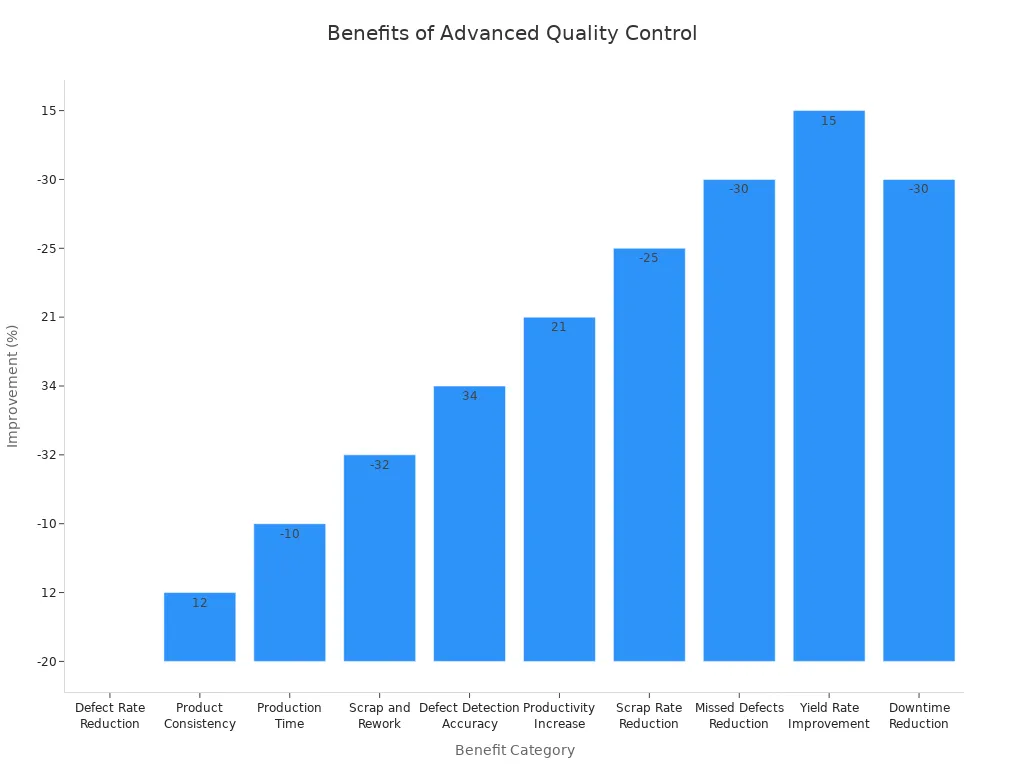
Advanced Quality Control helps electronics makers a lot. They find fewer mistakes and make better products. They also finish work faster. Automated systems like AOI and AI-driven inspections help find more defects. Accuracy can go from 63% up to 97%. Real-time checks and data help teams see problems early. The table below shows some benefits companies have seen:
|
Benefit Category |
Measurable Improvement |
Example / Detail |
|---|---|---|
|
Defect Rate Reduction |
20% reduction |
General industry improvement after implementing advanced quality control |
|
Product Consistency |
12% boost |
Improved uniformity in product quality |
|
Production Time |
10% reduction |
Faster manufacturing cycles |
|
Scrap and Rework |
32% reduction |
Trane Technologies saved millions in warranty costs |
|
Defect Detection Accuracy |
Improved from 63% to 97% |
Automated Optical Inspection (AOI) technology |
|
Productivity Increase |
21% increase |
Automotive supplier using AI-driven system |
|
Scrap Rate Reduction |
25% reduction |
Same automotive supplier example |
|
Missed Defects Reduction |
30% reduction |
Electronics manufacturer saved over $2 million annually with AI-enabled QC |
|
Yield Rate Improvement |
15% increase |
Semiconductor manufacturer with 95% defect detection accuracy |
|
Downtime Reduction |
30% reduction |
IoT systems in automotive industry, saving millions in maintenance costs |
|
Brand Protection |
Avoidance of costly recalls affecting 759 million units in 2023 |
General industry benefit from maintaining high quality standards |
When moving to advanced systems, makers see new inspection needs:
-
Check raw materials and parts when they arrive.
-
Make rules for controlling the process.
-
Do checks during the making of products.
-
Test finished products to make sure they work.
-
Keep records for tracking and following rules.
-
Teach workers about quality steps.
-
Watch and study quality numbers to keep getting better.
Tip: Companies using advanced quality control often miss 30% fewer defects and save a lot of money on warranties.
Advanced Quality Control Standards
Industry Standards
Electronics makers must follow strict industry standards. These rules help make sure products work well and last long. Standards guide each step, from design to the last check. The most used standards are:
-
IPC Standards: IPC-A-610 is the main standard for checking electronic assemblies. It shows what good products should look like. It also puts products into groups by how reliable they need to be. Class 1 is for basic electronics. Class 2 is for things that need to work most of the time. Class 3 is for things that must always work, like in planes or hospitals. Other important IPC standards are IPC-7711 for fixing parts, IPC-J-STD-001 for soldering, and IPC-2221 for making PCBs.
-
ISO Standards: ISO 9001 checks if companies have good ways to manage quality. It helps them make products the same way every time. ISO 17025 checks if labs test things the right way and get correct results.
-
JEDEC Standards: JEDEC rules, like J-STD-002 and J-STD-033, tell how to test for soldering and moisture problems. These rules help keep parts good while making and storing them.
-
Regulatory Requirements: Rules like RoHS stop dangerous stuff from being used in electronics. This keeps people and the planet safe.
Note: IPC standards are the main rules for quality control in electronics. ISO and JEDEC help by setting rules for how to manage and test things.
Using these standards helps everyone talk about quality the same way. This makes it easier to work together, find fewer mistakes, and make sure products are safe and meet the rules.
|
Standard |
Focus Area |
Key Benefit |
|---|---|---|
|
IPC-A-610 |
Assembly acceptability |
Visual criteria for inspection |
|
IPC-J-STD-001 |
Soldering processes |
High-quality soldered connections |
|
IPC-2221 |
PCB design requirements |
Manufacturability and reliability |
|
ISO 9001 |
Quality management systems |
Consistency and continual improvement |
|
ISO 17025 |
Testing laboratory competence |
Reliable and accurate testing |
|
JEDEC J-STD-002/033 |
Solderability, moisture sensitivity |
Component quality during storage and assembly |
|
RoHS |
Hazardous substance restriction |
Environmental and user safety |
Compliance and Traceability
Following industry standards means more than just knowing the rules. Makers must show proof with good records and traceability. Traceability tracks every part and step, from start to finish.
-
Bidirectional Traceability: Makers connect what is needed to designs, tests, and finished products. This makes sure every part does what it should.
-
Up-to-Date Records: Teams write down all checks, tests, and changes. They look at these records often to find problems early.
-
Traceability Matrices: These tools show which needs match which parts and tests. They help teams see if everything meets the rules.
-
Audit Trails: Traceability helps with audits by keeping clear records. Some industries, like cars, planes, and medical devices, need this level of detail.
-
Project Alignment: Traceability makes sure all parts and features match the first plan. This stops missing features and saves money on fixes.
-
Modern Tools: Software like Altium helps keep all records in one place. It tracks changes and lets teams work together. This lowers mistakes and makes following rules easier.
Tip: Good traceability helps stop fake parts from getting into products. By tracking every part, makers can find and remove bad items fast.
When companies keep good records and trace parts, they find fewer mistakes. They fix problems faster and help customers better. These steps are key for Advanced Quality Control in electronics.
Inspection Process

Visual and Automated Inspection
Electronics makers use two ways to find defects. One way is visual inspection. Trained inspectors look for problems they can see. They search for things like parts that are not straight, solder bridges, or missing pieces. Inspectors use magnifiers and microscopes to see tiny details. They look for scratches, cracks, and other marks. These problems can change how a product works or looks.
The other way is automated inspection. Machines use cameras, sensors, and special lights. These machines scan products very fast. They take clear pictures of each item. Algorithms check these pictures for defects people might miss. Automated inspection finds things like microcracks, bad solder joints, and parts in the wrong place. It is good for making lots of products because it is quick and does the same thing every time.
Using both visual and automated inspection works best. Visual inspection finds new or strange problems. Automated systems are fast and spot common issues with high accuracy.
Companies use both methods at different times. Visual inspection is good for first samples or tricky builds. Automated inspection checks every item when making many products. This helps companies meet tough quality rules and lowers mistakes from people.
AOI, X-ray, and ICT
Three main tools help with advanced inspection. These are Automated Optical Inspection (AOI), X-ray inspection, and In-Circuit Test (ICT).
-
AOI uses cameras and software to check for missing parts, wrong placement, polarity, and solder defects. AOI works fast and gathers data for checking quality. It helps companies find problems early and make better products.
-
X-ray inspection looks inside products to find hidden problems. It can see empty spots in solder joints, cracks, and issues in tricky parts like BGAs. X-ray uses 2D and 3D pictures to show what is inside a board.
-
ICT tests if circuits work right. It checks for missing or broken parts, open or short circuits, and other issues. ICT is quick and fits big production runs.
|
Technology |
Main Advantages |
|---|---|
|
AOI |
Fast programming, flexible, rapid defect detection, collects quality data |
|
X-ray |
High defect coverage (up to 97%), finds hidden solder joint issues, clear 2D/3D images |
|
ICT |
High-speed electrical testing, finds missing/misplaced parts, good for mass production |
Makers use these tools together to find all kinds of defects. AOI checks the outside, X-ray finds inside problems, and ICT makes sure circuits work. Using all three makes products more reliable and stops expensive mistakes.
AI and Counterfeit Detection
Fake parts are a big problem in electronics. Old ways to find fakes need special tools and take a long time. They can miss smart tricks used by counterfeiters. AI-based systems now help with this issue.
AI uses smart programs to look for odd things in parts and packaging. These systems scan logos, serial numbers, and even small color changes. AI can find fakes that look real to people. It works much faster than people and can check thousands of parts each day.
A medical device company in the UK used AI to remove over 3,000 suspect chips after finding fake FPGAs. AI systems learn from new data and keep up with new tricks. They also link with supply chain systems to track parts from suppliers to finished products. This saves money and keeps products safe.
AI-powered inspection helps companies keep fake parts out and protects their name.
Material Failure Analysis
Material failure analysis finds out why products break. The process starts by collecting facts about the failure, like when and how it happened. Inspectors use non-destructive tests like visual checks and X-rays to look for cracks, empty spots, or other problems. If needed, they use destructive tests in labs to study the material’s inside.
Common failure types include:
-
Open circuits from broken traces or bad soldering
-
Short circuits from solder bridges or dirt
-
Component failures from too much electricity or old age
-
Signal problems in fast PCBs
Inspectors use microscopes, chemical tests, and mechanical tests to find the main cause. They check for dirt, rust, and changes in grain size or coating. By knowing why a part failed, companies can fix the problem and stop it from happening again.
A strong Advanced Quality Control process includes regular failure analysis. This helps companies make better products and avoid expensive recalls.
Quality Assurance Integration
Protocols and Checkpoints
Top electronics companies use strong rules to stop defects early. Quality Assurance sets rules for how teams work together. It also checks suppliers and handles materials the right way. These rules include checking suppliers, clear steps for work, and training workers often. Companies match their quality systems with big standards like ISO 9001 and IPC. They use robots and cameras to check products at every step.
Important checkpoints in the process are:
1. Checking raw materials before making products. 2. Watching important steps like soldering and putting parts on. 3. Testing electrical connections to make sure they work. 4. Using AOI and X-ray machines to find hidden problems. 5. Doing tests to see if products last in tough places. 6. Testing finished products before sending them out. 7. Teaching workers to find and fix problems early.
Regular checks and fixing machines keep things working well. Training workers can make products up to 20% better.
Corrective Actions
When teams find a problem, they follow clear steps to fix it. First, they find the problem and see how bad it is. Then, they look for the main reason using special tools. After that, they plan and give out jobs to fix the problem. This could mean changing a design, using new materials, or updating how things are made. Teams then make these changes and watch to see if they work.
Common steps are:
-
Checking how serious it is.
-
Looking for the main cause.
-
Planning and giving out fixes.
-
Making changes and writing down what happens.
-
Checking if the fix worked and making more changes if needed.
Companies use computer systems to help with these steps. This stops the same problem from happening again.
Continuous Improvement
Electronics makers always try to get better by using smart ways. The PDCA cycle helps teams plan, try, check, and improve things. Inside checks find small problems before they get big. A good work culture helps everyone share ideas and join training.
|
Methodology |
Description |
Role in Maintaining High-Quality Standards |
|---|---|---|
|
Teams plan, try, check, and act again and again. |
Helps keep making things better and supports big standards like AS9100. |
|
|
Internal Quality Audits |
Outside experts look for mistakes and problems. |
Finds and fixes issues early, keeps up with ISO and AS9100 rules. |
Advanced Quality Control uses these steps to keep products good and reliable.
Overcoming Challenges
Common Obstacles
Electronics makers face many problems with advanced quality control. These problems can slow them down and hurt product quality. Some common issues are:
-
Soldering defects like cold joints, bridging, and tombstoning
-
Component misalignment from machine errors or board warping
-
PCB delamination or warping due to heat or poor materials
-
Electrostatic discharge (ESD) damage from improper handling
-
Counterfeit components entering the supply chain
-
Inadequate documentation and unclear instructions
-
Difficulty maintaining consistent quality in high-volume production
-
Workforce skills gaps and training deficiencies
-
Human factors such as operator fatigue
-
Equipment maintenance and supply chain complexity
Many companies also have trouble keeping up with new technology. They also find it hard to keep process records correct.
Solutions and Best Practices
Top companies use smart ways to solve these problems. They use tools like Statistical Process Control, Six Sigma, and automated inspection systems. These tools help lower mistakes and make work faster. Using IoT, AI, and data analytics gives teams quick updates and helps them predict problems.
Best ways to do this include:
-
Conducting regular inspections at multiple production stages
-
Managing supplier quality with audits and open communication
-
Training employees through hands-on sessions and continuous learning
-
Leveraging automation, AI, and real-time dashboards for defect detection
-
Building a culture of quality with leadership support and teamwork
-
Using customer feedback and continuous improvement processes
These steps help companies deal with not enough resources, supply chain changes, and new technology.
Measuring Success
Makers watch key numbers to see if quality control works. These numbers are called KPIs. Some common KPIs are:
|
KPI Name |
Description |
Target/Benchmark |
|---|---|---|
|
Quality Control Inspection Pass Rate |
Percentage of inspections passing without rework |
>95% |
|
Combines availability, performance, and quality |
Higher % is better |
|
|
Yield (First Time Through) |
Ratio of error-free products to total produced |
N/A |
|
Scrap Rate |
Amount of material discarded in production |
Lower is better |
|
Customer Return Rate |
Percentage of goods returned by customers |
Lower is better |
|
Maintenance Cost |
Cost per operating hour for machinery |
Lower is better |
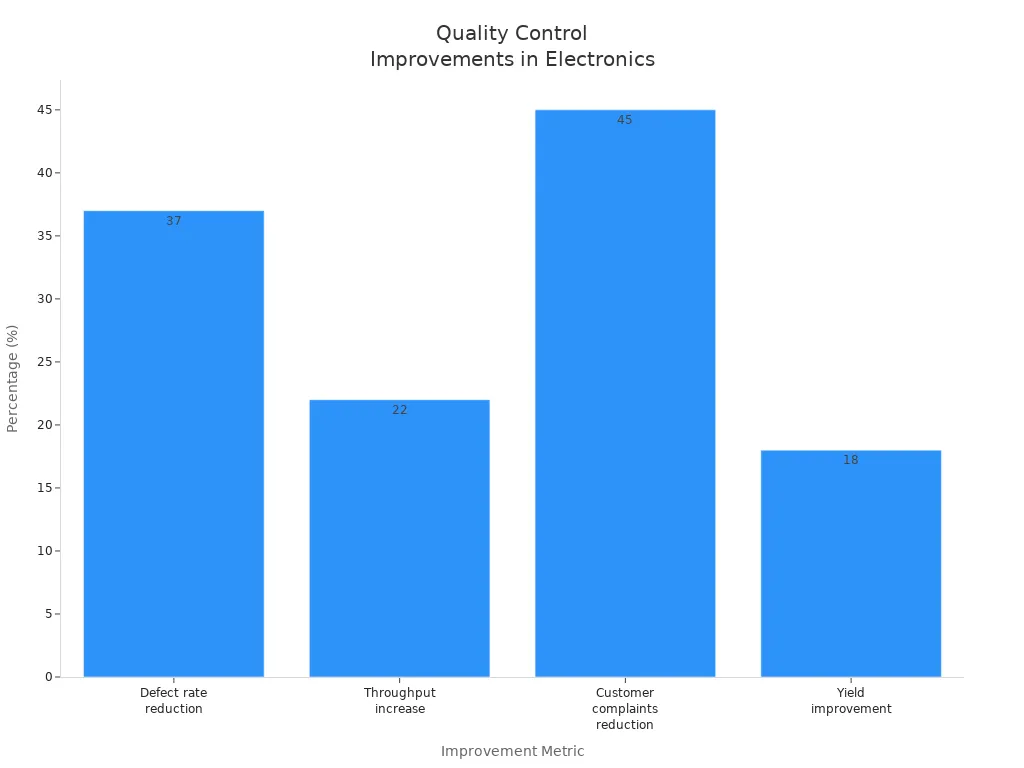
One company used training and data analytics to get better results. Their pass rate went from 88% to 95%. Other companies saw up to 37% fewer defects and 18% more good products after using advanced quality control.
Even small gains in yield can save a lot of money. They also make customers happier.
Electronics makers do well for a long time by using Advanced Quality Control. They make clear rules and use new inspection tools. They always try to get better at what they do. Some important things are teaching workers often, checking suppliers, and watching data as it happens.
-
Standards and QMS help companies follow rules and make fewer mistakes
-
Tools like AI and AOI help find more defects
-
Always improving helps keep quality high when new problems come up
|
Next Step |
Benefit |
|---|---|
|
Check current systems |
Find what works and what needs fixing |
|
Train workers more |
Fewer mistakes, better skills |
|
Change how things are done |
Keep up with new tools and rules |
Companies that learn new tools and rules fast become the best in quality and trust.
FAQ
What is the first step in implementing advanced quality control for electronics?
Companies should look at how they check products now. They need to find what is missing and set clear goals. This helps teams pick the best tools and rules for their work.
How does AI improve defect detection in electronics manufacturing?
AI checks pictures and data much faster than people. It finds small problems and patterns that people might not see. This means more accuracy and fewer missed defects.
Which standards are most important for electronics quality control?
|
Standard |
Purpose |
|---|---|
|
IPC-A-610 |
Assembly acceptability |
|
ISO 9001 |
Quality management |
|
JEDEC |
Component reliability |
These standards help with checking, testing, and keeping records.
Why is traceability critical in electronics inspection?
Traceability follows each part from the supplier to the final product. This helps companies find issues fast, stop fake parts, and follow the rules.
How often should companies train employees on quality control procedures?
Companies should teach workers about quality often. Many leaders plan training every six months. Regular lessons help teams learn about new tools and rules.