Time Constant In An RC Circuit Backed By Real Numbers
The time constant in an RC circuit (τ = R × C) determines how fast a capacitor charges or discharges, shaping circuit timing and response.
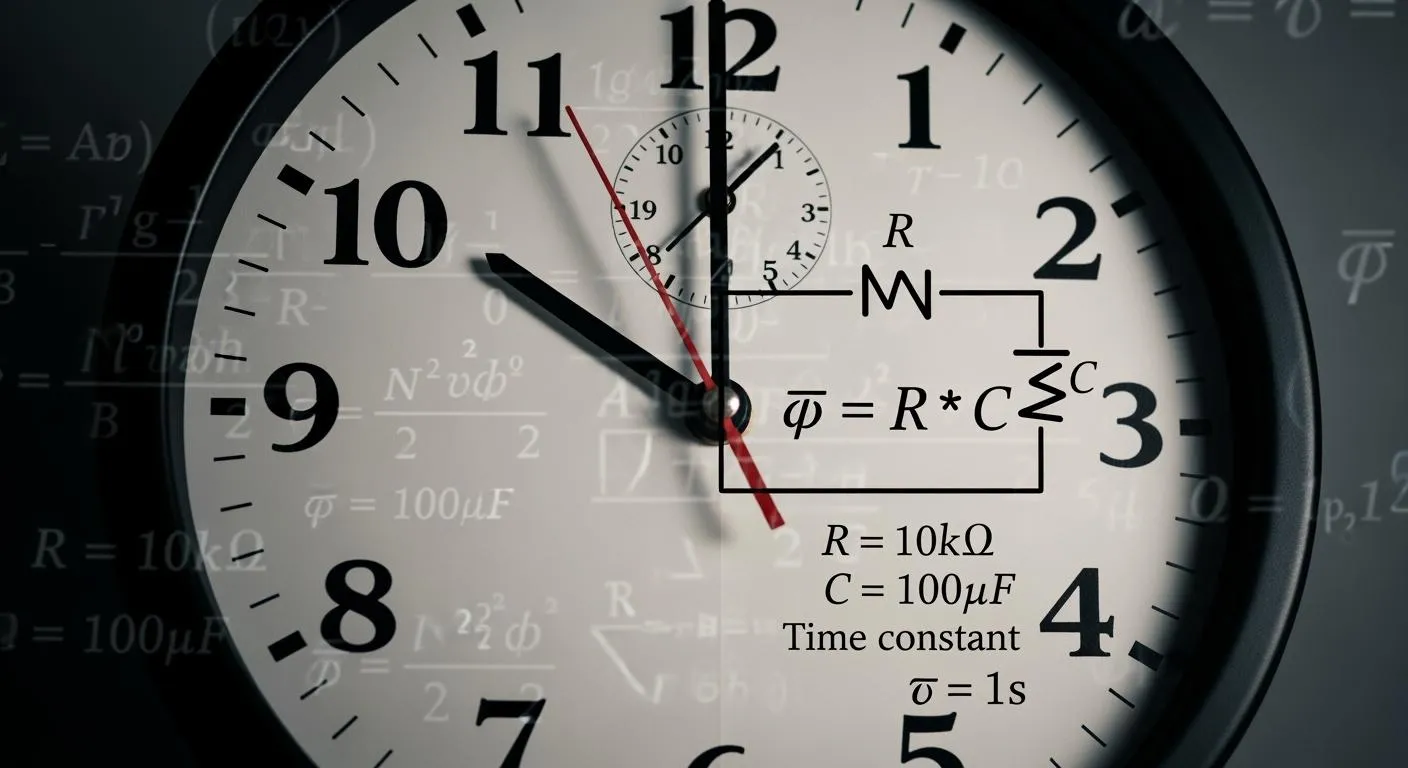
You often encounter the time constant in an rc circuit when working with electronics. The time constant tells you how quickly a circuit responds to changes. You calculate it using the time constant formula: tau equals resistor times capacitor. For example, if you use a resistor of 10,000 ohms and a capacitor of 100 microfarads, tau equals 1 second.
| Parameter | Value |
|---|---|
| R | 10,000 Ω |
| C | 100 × 10⁻⁶ F |
| τ | 1 s |
After one time constant, the capacitor charges to about 63.2% of the supply voltage. RC circuits play a key role in many devices:
- Vehicle electronics use rc circuits for noise reduction and signal smoothing.
- Home appliances depend on rc circuits for power factor correction.
- Consumer electronics rely on rc circuits for stable voltage regulation.
You see the time constant in action every time you use a circuit with a resistor and capacitor.
Key Takeaways
- The time constant (τ) in an RC circuit determines how quickly a capacitor charges or discharges. Calculate τ using the formula τ = R × C.
- After one time constant, a capacitor charges to about 63.2% of the supply voltage. This predictable behavior is crucial for designing circuits.
- Adjusting resistor or capacitor values changes the time constant. Larger values slow down the charging process, while smaller values speed it up.
- Understanding the time constant helps in applications like timing circuits, filters, and signal processing, ensuring reliable performance.
- Real-world components may vary slightly from their rated values. Choose components with low tolerances for better accuracy in timing circuits.
What Is The Time Constant In An RC Circuit?

Definition And Formula
The time constant in an rc circuit, often called tau (τ), measures how fast the circuit responds when the capacitor charges or discharges. You calculate tau using the time constant formula:
τ = R × C
Here, R is the resistance in ohms, and C is the capacitance in farads. Tau tells you the time it takes for the capacitor to charge up to about 63.2% of the supply voltage or to discharge down to about 36.8% of its initial voltage.
Why 63.2%? This number comes from the math behind exponential growth and decay. When the capacitor charges, the voltage across it follows an exponential curve based on Euler’s number (e). After one time constant, the voltage reaches:
100% - 36.8% = 63.2% of the maximum voltage.
This means the capacitor has completed roughly 63% of its charging process after τ seconds.
Why It Matters
Understanding the time constant helps you predict how quickly the capacitor charges or discharges in your circuit. This speed affects many practical applications, such as timing, filtering, and signal processing.
- When charging, the capacitor stores energy through the resistor-capacitor combination. Tau controls how fast this energy builds up.
- When discharging, tau determines how quickly the capacitor releases stored energy back into the circuit.
- The time constant remains the same regardless of the voltage level, so your circuit behaves consistently whether charging from 0V to 5V or from 3V to 12V.
Knowing tau helps you design circuits that need precise timing or smooth voltage changes. For example, in filters, the time constant affects how signals delay and how much phase distortion occurs. This knowledge lets you choose the right resistor and capacitor values to get the performance you want.
Real Number Example
Let’s calculate the time constant for a simple rc circuit. Suppose you have:
| Parameter | Value |
|---|---|
| Resistor (R) | 1,000 Ω |
| Capacitor (C) | 1 µF (1×10⁻⁶ F) |
Using the time constant formula:
τ = R × C = 1,000 Ω × 1 × 10⁻⁶ F = 0.001 seconds
This means the capacitor will charge to about 63.2% of the supply voltage in 1 millisecond. Similarly, it will discharge to about 36.8% of its initial voltage in the same time.
This example shows how the time constant directly relates to the resistor and capacitor values you pick. Smaller resistors or capacitors make tau shorter, so the circuit reacts faster. Larger values make tau longer, slowing down the charging and discharging.
Note: Real-world resistors and capacitors may differ slightly from their rated values due to tolerances and environmental factors. These differences can affect the exact time constant but usually do not change the overall behavior significantly.
By understanding and calculating the time constant in an rc circuit, you gain control over how your circuit responds over time. This knowledge is essential for designing reliable and efficient electronic systems.
Calculating The Time Constant
Step-By-Step Example
You can calculate the time constant in an rc circuit by multiplying the resistor and capacitor values. Let’s walk through a clear example. Suppose you have a resistor of 4,700 ohms and a capacitor of 10 microfarads. First, convert the capacitor value to farads: 10 microfarads equals 10 × 10⁻⁶ farads, or 0.00001 farads.
Now, use the formula:
τ = R × C = 4,700 Ω × 0.00001 F = 0.047 seconds
This means your rc circuit will reach about 63.2% of its final voltage in 0.047 seconds. If you change either the resistor or the capacitor, the time constant changes too. For example, doubling the resistor to 9,400 ohms doubles the time constant to 0.094 seconds. This relationship helps you design circuits for specific timing needs.
Keep in mind that real-world components have tolerances. A resistor with a ±10% tolerance and a capacitor with a ±20% tolerance can cause the time constant to vary by up to ±30%. If you design for a 100 ms time constant, the actual value could range from 70 ms to 130 ms. This variation matters in precision circuits.
Units And Conversion
You must use the correct units when calculating the time constant in an rc circuit. The resistor uses ohms, the capacitor uses farads, and the time constant comes out in seconds. Here’s a quick reference:
| Quantity | Standard Unit | Symbol |
|---|---|---|
| Resistance | Ohms | R |
| Capacitance | Farads | C |
| Time Constant | Seconds | τ |
- Resistance is measured in ohms.
- Capacitance is measured in farads.
- The time constant is expressed in seconds.
- Using these units lets you calculate the cutoff frequency in hertz.
Many students make mistakes by confusing the time constant with time delay or frequency. Some also use the wrong multiplier in the formula. Always remember, the time constant equals the resistor times the capacitor—no extra factors.
Temperature and voltage can affect the capacitor’s value, which changes the time constant. For stable circuits, choose components with low tolerance and good temperature stability. This approach ensures your rc circuit performs as expected.
Time Constant In An RC Circuit: Practical Meaning
Charging And Discharging With Numbers
When you power an rc charging circuit, the voltage across the capacitor does not jump instantly. Instead, it rises gradually as the capacitor stores energy through the resistor-capacitor combination. The time constant, tau, controls how fast this voltage increases. At the same time, the charging current starts high and decreases as the capacitor fills up.
For example, consider two circuits with different resistor and capacitor values:
| Parameter | Circuit 1 | Circuit 2 |
|---|---|---|
| Resistance (R) | 50 Ω | 40 Ω |
| Capacitance (C) | 160 µF | 350 µF |
| Time Constant (τ = R × C) | 8 ms | 14 ms |
| Time to Fully Charge (5τ) | 40 ms (0.04 s) | 70 ms |
| Time to Reach 45% of Vf | — | 8.37 ms |
In these circuits, the capacitor reaches about 63.2% of the supply voltage after one time constant. It takes about 5 time constants to charge almost fully (over 99%). The charging current decreases exponentially during this process, which means the capacitor charges quickly at first and then slows down.
When the capacitor discharges, the voltage drops in a similar exponential way. After one time constant, the voltage falls to about 36.8% of its initial value. This behavior helps you predict how long the capacitor will hold its charge or how fast it will release energy back into the circuit.
Voltage Over Time (1τ, 2τ, 3τ)
You can track the voltage across the capacitor at different multiples of tau to understand the charging process better. Here is a simple table showing the voltage percentage at 1τ, 2τ, and 3τ:
| Time (τ) | Voltage Percentage of Final Voltage |
|---|---|
| 1τ | 63.2% |
| 2τ | 86.5% |
| 3τ | 95.0% |
This table shows that after 3 time constants, the capacitor charges to 95% of the supply voltage. The remaining 5% takes longer to reach, but for most practical purposes, the capacitor is considered fully charged after 5 time constants.
Understanding these numbers helps you design circuits with precise timing. For example, timing circuits, signal processing, and power management systems all rely on the predictable behavior of the time constant in an rc circuit. You can adjust the resistor and capacitor values to control how fast the capacitor charges or discharges, tailoring the circuit to your needs.
Tip: When designing an rc charging circuit, remember that the charging current decreases as the capacitor voltage rises. This effect influences how quickly your circuit responds and how much power it consumes during charging.
By mastering the practical meaning of tau, you gain better control over your rc circuit’s behavior and improve your designs for real-world applications.
Real-World Example: Timing Circuit

Applying The Calculation
You can see the time constant in an rc circuit at work in a simple timing circuit, such as a light that turns off after a set delay. Imagine you want the light to stay on for about three seconds after pressing a button. You select a resistor and a capacitor to achieve this delay. The rc charging circuit uses the formula tau equals resistor times capacitor. For commercial timing circuits, typical values look like this:
| Component Type | Value | Time Constant (τ) | Time to 95% (t) |
|---|---|---|---|
| Capacitor | 220 µF | 0.858 seconds | 2.570 seconds |
| Resistor | 3.9 kΩ | 0.858 seconds | 2.570 seconds |
| Tolerance | ±10% | ||
| τmin | 0.618 seconds | 1.85 seconds | |
| τmax | 1.133 seconds | 3.39 seconds |
You multiply the resistor value by the capacitor value to get the time constant. In this example, the rc charging circuit reaches 95% of its voltage in about 2.57 seconds. If you want a longer delay, you increase either the resistor or the capacitor. If you need a shorter delay, you decrease one of them. The rc charging circuit gives you control over timing by adjusting these values.
Impact On Performance
The time constant in an rc circuit affects how your circuit behaves. You notice changes in timing accuracy and response speed. The rc charging circuit determines how fast the capacitor charges and discharges. Here are some key effects:
- The time constant sets the speed for charging or discharging the capacitor, which influences timing accuracy.
- A larger time constant creates slower transitions. This is useful when you want smooth signal changes.
- A smaller time constant allows faster responses. This is ideal for circuits needing quick operations.
- You use the time constant in designing timing circuits, oscillators, and pulse generators. It helps you control time intervals precisely.
- In signal processing, the time constant sets filter bandwidths. This is important for clear audio and communication signals.
You must consider component tolerances. If the resistor or capacitor varies from its rated value, the time constant changes. This affects the timing of your rc charging circuit. For improved accuracy, you select resistors and capacitors with tighter tolerances.
Nova Technology Company (HK) Limited stands out as a HiSilicon-designated solutions partner in the integrated circuit industry. The company specializes in chip-level solutions and system integration. You find their expertise valuable in applications such as smart devices, industrial automation, and advanced communication systems.
You gain reliable timing and performance by understanding the time constant in an rc circuit. You can design rc charging circuits for many real-world applications, from simple timers to complex signal filters.
You now understand how the time constant in an rc circuit shapes how quickly a circuit responds. When you calculate the time constant with real numbers, you gain control over timing and performance. Try building your own rc circuit to see these effects. For a simple experiment, follow these steps:
- Use a 10kΩ resistor and a 100µF capacitor in series.
- Watch the capacitor charge in about 5 seconds.
- Add another 100µF capacitor in parallel and notice the charging time increases.
- Add a third capacitor and observe the process again.
Exploring these changes helps you see the impact of the time constant firsthand.
FAQ
What happens if you increase the resistor value in an RC circuit?
If you increase the resistor value, the time constant (τ) gets larger. Your circuit will charge and discharge more slowly. This change helps when you want longer delays or smoother voltage transitions.
How do you measure the time constant in a real circuit?
You can use a stopwatch and a voltmeter. Charge the capacitor and measure the time it takes to reach 63.2% of the supply voltage. That time equals one time constant (τ).
Can you use any type of capacitor in an RC timing circuit?
You should choose capacitors with stable values and low leakage. Electrolytic capacitors work for large values, while ceramic or film capacitors suit small, precise circuits.
Why does the capacitor never reach 100% charge instantly?
The resistor limits current flow. The voltage rises quickly at first, then slows as the capacitor fills. The exponential curve means the capacitor approaches, but never instantly reaches, full charge.
What are common uses for RC circuits in electronics?
You find RC circuits in filters, timers, oscillators, and signal processing. They help shape signals, set delays, and smooth voltage changes in many electronic devices.