What Is Flux Soldering and Its Role in Electronics Manufacturing
Learn what is flux soldering, how chemical flux removes metal oxides to lower surface tension, and why it ensures reliable joints in electronics manufacturing.
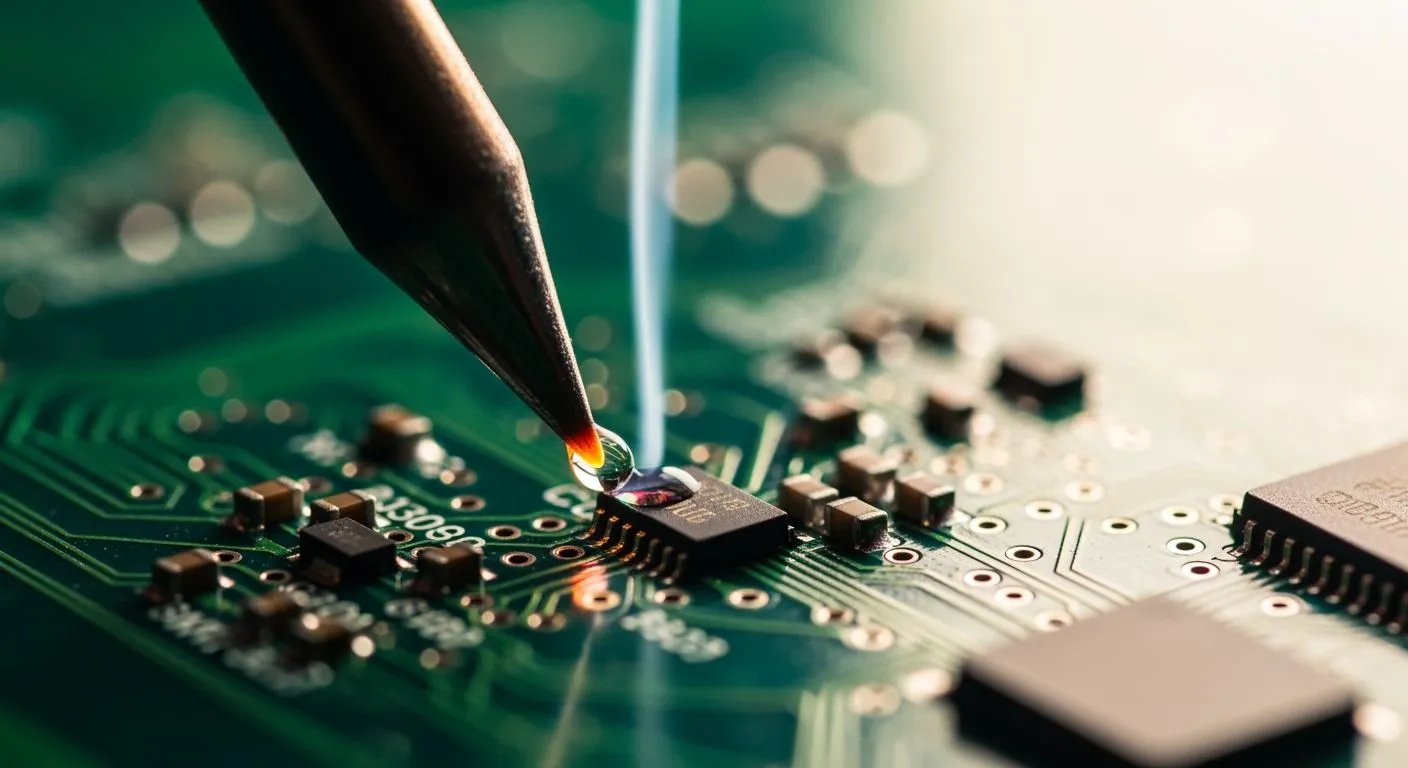
You discover what is flux soldering when building modern microelectronic assemblies.
This standard soldering process applies an active chemical agent during heating to clear metal oxides. Molten solder usually beads up on oxidized PCB pads and component leads. However, chemical flux dissolves surface oxides and lowers surface tension instantly. Liquid flux cleans target contacts so the liquid solder wets pads uniformly. Active flux chemistry protects clean metal surfaces from oxygen during manual soldering. Applying proper flux ensures you achieve robust, low-resistance electrical joints throughout automated soldering.
Key Takeaways
- Flux cleans metal oxides from circuit board surfaces to help liquid solder stick smoothly.
- Engineers choose specific flux types like rosin, water-soluble, or no-clean based on cleaning needs.
- Proper temperature control during heating prevents flux from burning out before the solder melts.
- Cleaning active flux residue protects electronic circuits from long-term corrosion and short circuits.
What Is Flux Soldering?
You need to understand what is flux soldering to build reliable electronic hardware. In advanced chip packaging and surface-mount technology, what is flux soldering forms the fundamental chemical process behind every secure interconnect.
The Chemical Role of Flux
Metal surfaces naturally form oxide layers when exposed to atmospheric oxygen. Copper traces on printed circuit boards develop copper oxide films quickly. Active chemical flux removes oxides during heating to expose bare metal.
During high-temperature assembly, acidic activators in the chemistry break down these tough surface films through two primary chemical reactions:
- Water Formation: Hydrogen ions provided by the acid bond with oxygen atoms extracted from the oxide layer to produce water vapor.
- Salt Formation: Remaining ionic compounds of the acid react directly with bare metal to generate metallic salts.
Without proper flux chemistry, oxides block direct contact between metals. The chemical action dissolves these contaminants and floats them away from the reaction zone.
Surface Wetting and Deoxidation
High surface tension forces molten alloy into tight spheres. Liquid metal beads up on oxidized copper pads rather than spreading out smoothly. The flux lowers surface tension instantly to promote uniform surface wetting.
Engineers measure this behavior by checking the wetting contact angle between liquid alloy and bare copper. Lower contact angles indicate superior chemical cleaning and higher bond strength.
| Contact Angle | Solder Surface Behavior | Result |
|---|---|---|
| Less than 30° | Liquid solder spreads cleanly across pads | Ideal wetting condition under IPC-A-610 |
| 30° to 70° | Standard equilibrium state | Typical acceptable solderability range |
| Greater than 90° | Alloy beads up into droplets | Poor wetting, leads to weak joints |
When liquid solder covers the bare copper pad completely, atom diffusion occurs across the interface. This atomic reaction builds a strong intermetallic compound layer. Proper wetting creates low-resistance solder joints that withstand mechanical stress over time.
Preventing Oxidation During Heating
High processing temperatures accelerate oxidation on clean substrates. A liquid flux layer shields clean copper from ambient air throughout thermal cycles. The flux barrier prevents oxygen contact while the assembly reaches peak processing temperature.
💡 Assembly Tip: Thermal profile control directly affects chemical activity during reflow processing.
Controlling thermal ramp rates protects active ingredients from burning out too early:
- Slow Heating Rate: Extended exposure to heat during a slow ramp depletes the flux chemistry prematurely.
- Loss of Protection: Exhausted active agents fail to shield metal surfaces from oxygen.
- Assembly Defects: Improper heating triggers defects like graping and non-wetting during reflow soldering.
Maintaining a precise thermal ramp preserves active ingredients until the alloy melts completely. Reliable flux action ensures perfect metallurgical bonds across fast wave soldering lines and high-density reflow ovens. Choosing the right chemistry format gives you total control over defect formation in automated soldering operations.
Main Flux Types and IPC Standards
You must choose the correct chemical formulations to build high-yield microelectronic assemblies. Electronics manufacturers select materials based on their cleaning ability, activation temperature, and post-assembly residue behavior.
Rosin-Based Formulations
Natural pine tree resins form the base of traditional rosin chemistry. The primary component, abietic acid, reacts with copper oxides during thermal processing to clean the target surface. Engineers group rosin flux into three primary categories depending on activator strength and total halide content.
| Flux Category | Chemical / Activator Composition | Activation & Thermal Characteristics |
|---|---|---|
| Type R (Rosin) | Pure natural resin derived from pine trees (formula approx. C19H29COOH, containing 70–85% abietic acid and 10–15% pimaric acids); non-activated and zero halide. | Melts between 172°C and 175°C to become active just below the solder melting point (183°C). |
| Type RMA (Mildly Activated) | Rosin base with a low concentration of mild activators (organic acids, halogenated compounds, amides) containing 0.5% to 2.0% halide content or zero chlorides. | Becomes active when heated slightly below soldering temperatures; typically applied within 200–260°C liquid range or 120–400°C paste range. |
| Type RA (Fully Activated) | Rosin base with higher concentrations of high-activity activators (halides, organic acids, or organic salts) for stronger oxide removal. | Thermally active below soldering temperature; suited for standard (200–260°C) and high-temperature (up to 450°C) applications. |
Commercial chemical suppliers offer various product grades tailored to specific activation ranges and temperature requirements:
| Superior Flux Product | Flux Type / Spec | Recommended Operating / Activation Temperature Range |
|---|---|---|
| No. 97 | Type R (ROL0) - Completely free of activators | 200–260°C (390–500°F) |
| No. 99 | Type RMA Liquid (ROM1) - Contains mild activators | 200–260°C (390–500°F) |
| 9000 | Type RMA Paste (ROM0) - Mildly activated paste | 120–400°C (250–750°F) |
| No. 100 | Type RA Liquid (ROH1) - High activity flux | 200–260°C (390–500°F) |
| No. 100HT | Type RA High-Temp Liquid (ROH1) - High activity flux | 200–450°C (390–840°F) |
Water-Soluble Organic Chemistry
Water-soluble options use organic acids like citric, lactic, or carboxylic acids to drive high-density metal oxide removal. These active compounds provide fast wetting for molten solder on heavily oxidized leads during automated assembly.
However, aggressive organic acids leave highly corrosive ionic residues on the circuit board after heating. These ionic contaminants absorb atmospheric moisture and cause stray electrical leakage currents. Therefore, hardware technicians must thoroughly wash assemblies with warm deionized water to remove all corrosive residues immediately after assembly.
Modern No-Clean Options
Modern semiconductor packaging heavily relies on no-clean flux formulations to eliminate post-reflow aqueous washing steps. You can apply no-clean liquid flux directly onto copper bond pads during die attach procedures. These advanced materials contain low concentrations of mild organic acids that fully decompose under standard thermal reflow profiles.
💡 Quality Standard: Passing the Surface Insulation Resistance (SIR) test under IPC J-STD-004B requires a minimum electrical resistance of 1 x 10^8 ohms (100 mega-ohms). Technicians perform this test inside an environmental chamber at 40°C and 90% relative humidity with an applied electrical bias.
The benign residue left behind remains inert at room temperature. It seals microscopic surface areas without causing corrosion or electrical short circuits across fine-pitch chip contacts.
IPC J-STD Classifications
The industry standard IPC J-STD-004 categorizes flux chemistry by four basic composition categories: Rosin (RO), Resin (RE), Organic (OR), and Inorganic (IN). Combined with activity levels (L, M, H) and halide presence (0 or 1), these codes help engineers select materials safely. Understanding each flux rating protects microelectronic devices from premature field failures.
| Composition Category | Activity Designation | Halide Content Threshold (% by weight) | Corrosion Risk & Testing Considerations |
|---|---|---|---|
| RO (Rosin) | L0 / M0 / H0 | < 0.05% (Halide-Free) | Inert at room temperature; minimal corrosion risk requiring little to no cleaning. Tested via SIR and copper mirror tests. |
| RE (Resin) | L1 | < 0.5% | Low ionic contamination risk; requires standard activity testing. |
| OR (Organic) | M1 | 0.5% to 2.0% | Moderate activity; residual acidic compounds may pose corrosion risks if uncleaned. |
| IN (Inorganic) | H1 | > 2.0% | High activity and ionic potential; severe corrosion risk requiring mandatory post-soldering cleaning. Not used in electronics. |
Common Formats in PCB Soldering
You can select chemical materials in various physical delivery formats. Choosing the right material format streamlines assembly and protects delicate integrated circuits.
Flux-Core Solder Wire
Manufacturing plants store chemical activators directly inside flux-core solder wire. You use this wire for manual assembly and component installation. The internal core cleans metal contacts during heating.
Liquid Flux and Solder Paste
Pure liquid flux cleans surface pads during board fabrication. Solder paste blends metal particles into a viscous chemical medium. You can store paste tubes in cold spaces to preserve activation levels. Automated equipment improves soldering output across fast production lines.
Wave and Reflow Soldering
High-volume production equipment applies chemical agents based on your specific soldering process.
| Feature | Automated Wave Soldering | Reflow Solder Paste Printing |
|---|---|---|
| Application Method | Sprayed or foamed onto the PCB | Printed or dispensed onto pads using a stencil |
| Flux Integration | Applied as a standalone liquid prior to wave heating | Pre-mixed directly inside the solder paste formulation |
| Coverage Area | Applied broadly across the entire circuit board | Precisely deposited onto specific pads for accurate dosing |
Precision Flux Pens for Rework
Technicians rely on precision tools during chip rework and manual soldering. Precision flux pens deliver exact chemical amounts onto microelectronic leads.
- Controlled application: Handheld flux pens prevent excess material waste on dense substrates.
- Avoid over-application: Applying excessive flux creates stubborn residues that force extra cleaning steps.
- Reapply for rework: Always add fresh flux during desoldering to enhance wetting and thermal conduction.
Role in Industrial and Consumer Electronics
High-Yield SMD Assembly
You encounter high-density surface-mount devices (SMDs) and traditional through-hole components across modern circuit boards. Advanced chip packaging requires precise chemical control during manufacturing. As a HiSilicon-designated solutions partner, Nova Technology Company (HK) Limited delivers advanced chip-level solutions and system integration for consumer and industrial hardware. You rely on accurate liquid flux placement to process high-count microelectronic packages successfully. Proper chemical application improves automated soldering yields on fast assembly lines. High-grade flux chemistry enables molten solder to bond tiny IC terminals without bridging adjacent contacts.
Preventing Defect Formation
Selecting the wrong chemical agent causes expensive production errors on complex board layouts. You prevent dangerous bridging and cold joints by matching thermal profiles with proper flux activity. Active compounds eliminate micro-scale oxides from copper pads before the metal melts. The liquid flux reduces surface tension instantly. Clean alloy then flows across narrow chip leads without creating shorts. Correct chemistry ensures robust solder joints across harsh automotive and industrial environments. Controlled soldering parameters prevent unreacted flux from trapping pockets of gas inside liquid solder.
Long-Term Interconnect Reliability
Uncleaned ionic contaminants degrade system hardware over extended operating periods. You must evaluate chemical residues to prevent electrochemical migration across sensitive circuit paths. Processed board surfaces undergo a multi-step failure mechanism when active contaminants remain:
- Assembly operations leave behind residual ionic contaminants from flux activators and organic acids.
- High relative humidity and applied DC voltage transform absorbed moisture into an active conductive electrolyte.
- Anodic dissolution oxidizes positive electrode metals into free ions under continuous electrical bias.
- Dissolved metal cations travel through the thin electrolytic solution toward the cathode.
- Cathodic reduction transforms migrating ions back into crystalline metal filaments called dendrites.
- Growing dendrites bridge fine-pitch conductors, causing sudden short circuits during post-soldering field operation.
You select low-residue flux formulations to protect advanced microelectronics from dendritic growth. Robust solder wetting depends on chemical activity. However, uncleaned flux residues degrade high-frequency signals. Modern automated soldering systems require careful post-process inspection. You optimize flux selection to maintain high hardware reliability over long product lifespans. Choosing the ideal flux chemistry ensures stable solder connections for high-performance computing devices.
Now you understand what is flux soldering and its critical role in semiconductor packaging. Chemical flux removes metal oxides during thermal processing. This action enables molten solder to wet surface contacts smoothly.
Choosing the proper flux format directly increases manufacturing yield and joint longevity.
💡 Final Tip: Align your flux selection with IPC standards and specific post-soldering cleaning steps.
Active flux chemistry delivers strong solder joints across complex hardware systems.
FAQ
How does the flux soldering process work in chip packaging?
You apply what is flux soldering to remove metal oxides during thermal processing. Active flux cleans copper pads. Liquid flux lowers surface tension so molten solder covers chip terminals cleanly. Proper flux dosing, accurate flux control, safe flux chemistry, and clean flux removal ensure strong solder joints during automated reflow soldering.
How do different flux formulations impact semiconductor soldering?
Different flux types provide distinct flux benefits across assembly lines:
| Flux Type | Flux Activity | Flux Residue | | : | : | : | | Rosin flux | Mild flux action | Safe flux film | | No-clean flux | Fast flux wetting | Inert flux residue | | Water-soluble flux | Strong flux cleaning | Washable flux salt |
You select each flux chemical grade for board soldering.
Why must you control flux heating during reflow soldering?
Excessive heat burns active flux ingredients early. Unprotected metal oxidizes quickly before solder alloy melts. Controlled flux heating preserves flux activators, maintains flux shielding, enables flux cleaning, boosts flux flow, and improves flux performance. Correct flux dosing allows smooth solder flow during wave soldering.
Which flux delivery formats suit chip rework and manual soldering?
You choose specific flux formats for precise chip rework:
- Flux pens: Dispense liquid flux directly.
- Flux paste: Holds solder balls firmly.
- Flux core wire: Combines solder alloy with flux inside.
Fresh flux placement, optimal flux quantity, and low flux splatter ensure reliable solder bonding during hand soldering.
How does flux residue affect long-term hardware reliability?
Uncleaned flux residue contains active flux ions. Ambient humidity converts flux deposits into acidic flux electrolytes. This corrosive flux layer triggers flux corrosion and flux dendrite growth. You must remove reactive flux residues or use non-corrosive no-clean flux to protect delicate microelectronic circuits from flux hazards.