The Role of Voltage Buffers Today
Voltage buffer circuits maintain signal integrity by isolating stages, preventing loss, and ensuring reliable performance in modern electronics.
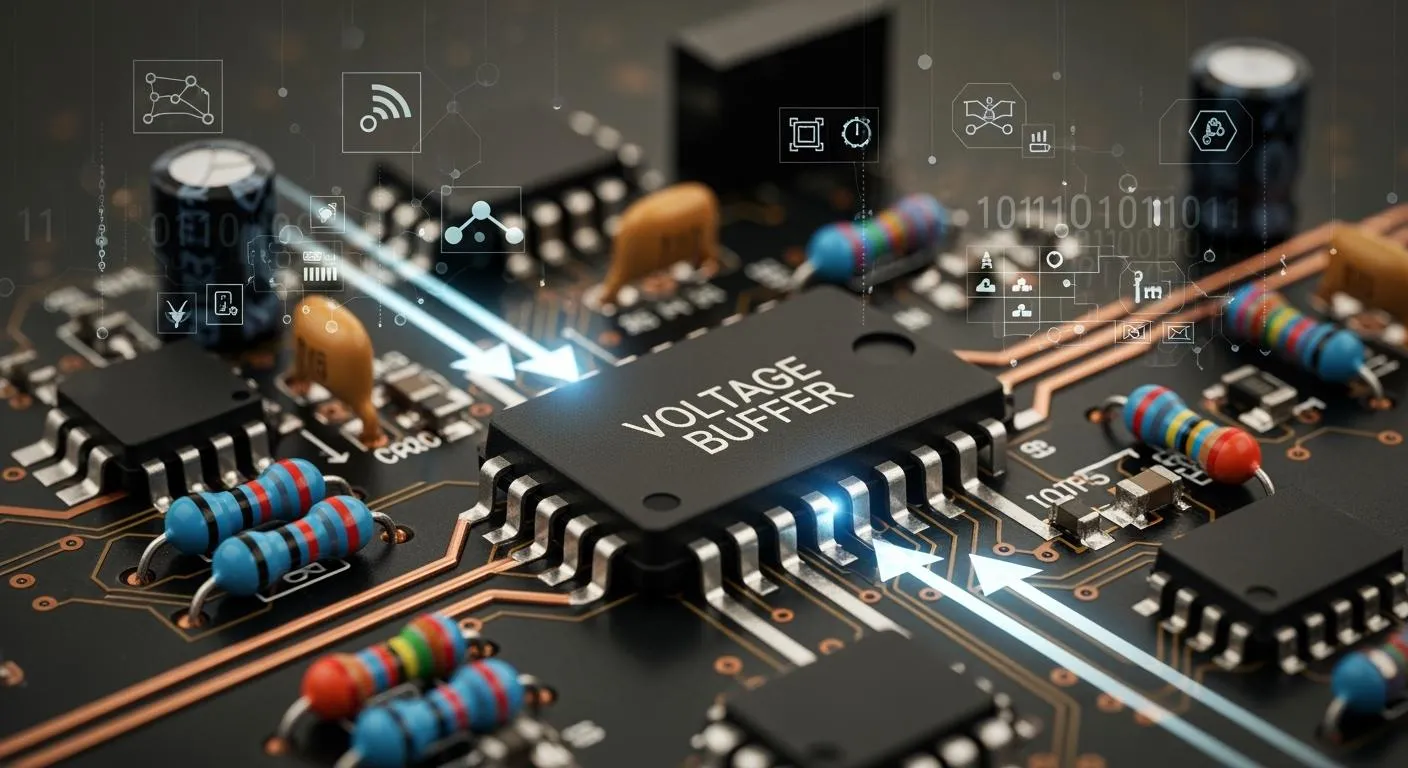
You rely on voltage buffer circuits every day, often without noticing. These components keep your devices running smoothly by making sure signals stay strong and clear. When you connect different parts of a system, a buffer stops one section from interfering with another. Take a look at how a voltage buffer protects your signals:
| Mechanism | Effect on Signal Degradation |
|---|---|
| Isolation between stages | Reduces unwanted effects at high frequencies |
| Load isolation | Stops problems in oscillator performance |
| High input impedance | Keeps the signal’s shape and strength |
In modern electronics, a buffer also helps your phone or wearable last longer by adjusting to changing loads, so you get reliable performance and longer battery life.
Key Takeaways
- Voltage buffers keep signals strong and clear by isolating different parts of a circuit, preventing interference.
- Using an op-amp voltage buffer allows you to connect high-impedance sources to low-impedance loads without losing signal quality.
- Voltage buffers do not amplify voltage; they replicate it, ensuring reliable performance while driving heavier loads.
- High input impedance and low output impedance in buffers help maintain signal integrity, crucial for accurate measurements.
- Voltage buffers are essential in modern electronics, found in devices like smartphones, medical equipment, and audio systems.
What Is a Voltage Buffer?

Definition and Core Function
You often hear the term voltage buffer in electronics, but you might also see it called a voltage follower, unity gain amplifier, or even a unity-gain buffer. These names describe circuits that play a simple but powerful role: they keep your signals strong and steady as they move from one part of a system to another.
Here is a quick look at some alternative names and their definitions:
| Alternative Names | Definition |
|---|---|
| Current amplifier | A circuit that amplifies current. |
| Voltage follower | A circuit that transfers voltage without change in amplitude, also known as unity gain voltage buffer. |
| Current follower | A circuit that follows the input current. |
| Voltage buffer | A circuit that connects a high output impedance circuit to a low input impedance circuit, preventing loading. |
| Current buffer | A circuit that buffers current between two circuits. |
A voltage buffer, especially when built with an op-amp voltage buffer, acts as a bridge between two parts of a circuit. You use it to prevent one stage from affecting another. The main function is to transform a high output impedance signal into a low output impedance signal. This means you can connect sensitive sources, like sensors or signal generators, to heavy loads or other circuit stages without losing signal quality.
Tip: When you use an op-amp voltage buffer, you keep your signal safe from unwanted changes. The buffer maintains the same voltage at its output as at its input, but it can deliver more current to the next stage.
You can think of a voltage buffer as a unity gain amplifier. It does not increase the voltage of your signal. Instead, it copies the input voltage to the output, making sure the signal stays the same but can drive more demanding loads.
Here is a summary of the basic concept:
- A voltage buffer, also called a voltage follower or unity gain amplifier, has a gain of 1.
- It prevents one stage's input impedance from loading the previous stage's output impedance, which can cause signal loss.
- The typical op-amp voltage buffer connects the input signal to the non-inverting input and ties the output directly to the inverting input.
Some people think all buffers amplify signals, but that is not true. A voltage follower does not increase voltage; it only replicates it. Also, not every buffer is a voltage follower. Some buffers provide current gain or even voltage gain, depending on the design.
High and Low Impedance Explained
Impedance is a key idea in electronics. It tells you how much a circuit resists the flow of current. When you connect two circuits, you want to make sure the first circuit does not get overloaded by the second. This is where the op-amp voltage buffer shines.
| Input Impedance | Output Impedance |
|---|---|
| High (ideally infinite) | Low (ideally zero) |
The op-amp voltage buffer has a very high input impedance and a very low output impedance. High input impedance means the buffer draws almost no current from the source. Low output impedance means it can supply enough current to the next stage without dropping the voltage.
This impedance matching is important for signal integrity. If you connect a sensor with high output impedance directly to a load with low input impedance, you risk losing signal strength. The buffer solves this by isolating the two stages.
| Aspect | Description |
|---|---|
| High Input Impedance | Prevents disturbance to the sensor's output voltage, ensuring accurate readings. |
| Low Output Impedance | Allows for effective driving of the load without voltage drop, maintaining signal integrity. |
| Overall Impact | Results in better signal integrity and trustworthy measurements, crucial for accurate sensor data. |
You will find op-amp voltage buffers in many places, such as voltage dividers, sample and hold circuits, and active filters. They help you keep your signals accurate and reliable, especially when you need to connect sensitive sources to demanding loads.
How Op-Amp Voltage Buffers Operate
Circuit Structure and Unity Gain
You often see the op-amp voltage buffer in circuit diagrams. This buffer uses an operational amplifier, or op-amp, with its output connected directly to its inverting input. You connect your signal to the non-inverting input. This setup creates a gain of 1, which means the output voltage matches the input voltage. You do not get any amplification in voltage, but you do get current gain. The buffer lets you drive heavier loads without changing the signal voltage.
When you use a buffer with a gain of 1, you protect your signal from distortion. The op-amp voltage buffer keeps the input voltage steady and delivers it to the output, even if the load demands more current.
The unity gain property is essential for signal transmission. You maintain high input impedance and low output impedance. This minimizes loading effects on your signal source. You preserve signal integrity and prevent unwanted changes during transmission. If you connect a high-impedance source directly to a low-impedance load, you risk signal degradation. The op-amp voltage buffer acts as a bridge, isolating the source from the load. You draw almost no current from the source, but you can drive the load effectively.
Here is a simple code block showing the typical op-amp voltage buffer circuit:
Input Signal ----->|+   Op-Amp   |-----> Output Signal
                  |             |
                  |----|−       |
                       |________|
You find this buffer in many integrated circuits. Nova Technology Company (HK) Limited, a HiSilicon-designated solutions partner, specializes in chip-level solutions for system integration. The company provides advanced op-amp voltage buffer designs for high-performance ICs. These buffers support reliable signal transmission in semiconductor applications, such as sensor interfaces, analog front ends, and mixed-signal systems.
Ideal vs. Real-World Characteristics
You might think every op-amp voltage buffer works perfectly, but real-world devices have limits. An ideal buffer would have infinite input impedance, zero output impedance, and a gain of 1 with no distortion. In practice, you see some differences.
| Characteristic | Ideal Op-Amp | Real Op-Amp |
|---|---|---|
| Input Voltage Range | Unlimited | Limited to power supply voltages |
| Output Voltage Range | Unlimited | Limited to power supply voltages |
| Power Supply Rejection | Perfect | May leak variations |
| Noise | Zero | Adds noise |
| Input Impedance | Infinite | Finite |
| Output Impedance | Zero | Finite |
| Input Offset Voltage | Zero | Non-zero |
| Power Consumption | Zero | Non-zero |
| Slew Rate | Infinite | Finite |
| Bandwidth | Infinite | Limited |
| Open-Loop Gain | Infinite | Finite |
| Linearity | Perfect | Non-linear |
You notice that practical op-amp voltage buffers have finite input impedance, usually in the mega-ohm range. Output impedance is not zero, but it stays low, often between 10 and 100 ohms. The gain of 1 remains, but you may see small voltage offsets or noise. The buffer still isolates your signal source from the load, but you must consider these real-world limits.
- Infinite input impedance in theory means no current flows into the buffer, so you avoid loading the source.
- Zero output impedance in theory means the buffer acts as an ideal voltage source, unaffected by the load.
- In practice, you get high input impedance and low output impedance, but not perfect values.
You also see limits in bandwidth and slew rate. The op-amp voltage buffer cannot respond instantly to fast changes in the input signal. You must check the specifications for your application. If you need high-speed or high-precision performance, choose a buffer with suitable characteristics.
Remember, the gain of 1 in an op-amp voltage buffer gives you reliable signal transmission, but you must account for real-world imperfections. You keep your signal strong and clear, but you need to match the buffer to your circuit requirements.
Buffer Amplifiers in Modern Electronics

Signal Isolation and Load Driving
You see buffer amplifiers everywhere in modern electronics. They play a key role in keeping your signals clean and strong. When you connect a weak signal source to a demanding load, buffer amplifiers step in to prevent signal loss. You often use them to isolate different parts of a circuit, making sure one section does not interfere with another.
Here are some common applications where buffer amplifiers shine:
- Audio and video systems: You prevent signal loss in your home theater or music equipment.
- Telecommunications: You keep signals clear over long distances.
- Data communication: You ensure reliable data transfer between devices.
- Sensor interfaces: You protect sensitive sensors from being overloaded.
- Signal conditioning: You prepare weak signals for accurate measurement.
- Preamplifiers: You boost delicate audio signals before further amplification.
- Speaker protection circuits: You guard power amplifiers from electrical surges.
- Feedback networks: You stabilize gain and impedance in operational amplifiers.
- Antenna matching: You reduce signal reflection in RF circuits.
- Medical devices: You guarantee accurate data in biomedical equipment.
- Logic level conversion: You match voltage levels in microprocessors.
Buffer amplifiers present high input impedance to the source and low output impedance to the load. This means you can connect a weak or high-impedance source to a low-impedance circuit without losing voltage. You also use buffer amplifiers in sensor interfaces, data-acquisition systems, and audio equipment to keep your signals stable and reliable.
In critical industries like aerospace, battery energy storage, and industrial automation, you rely on buffer amplifiers for signal isolation. For example, aerospace systems use buffer amplifiers to protect sensitive electronics from high-voltage risks and harsh environments. In AI data centers and photovoltaic inverters, buffer amplifiers help manage high voltages and maintain system reliability.
Nova Technology Company (HK) Limited, a HiSilicon-designated solutions partner, specializes in chip-level buffer amplifier solutions for system integration. You find their technology in advanced ICs for sensor interfaces, analog front ends, and mixed-signal systems, supporting robust signal transmission in demanding environments.
Common Collector as Voltage Buffer
You often use a common collector amplifier, also called an emitter follower, as a voltage buffer in practical circuits. This type of buffer amplifier features high input impedance and low output impedance. You use it to connect a source with large output impedance to a small load impedance without changing the voltage.
The common collector amplifier's low output impedance allows a source with a large output impedance to drive a small load impedance without changing its voltage. Thus this circuit finds applications as a voltage buffer.
The voltage gain of a common collector amplifier is close to one, but its current gain can be high. This makes it ideal for impedance matching and circuit isolation. You use this configuration when you need to drive low-impedance loads while keeping your signal intact. The common collector amplifier also works well as a current buffer, letting you transfer current efficiently between circuit stages.
You see current buffer circuits in many designs, especially when you need to separate a sensitive signal source from a heavy load. By using a current buffer, you prevent the load from affecting the source. This approach keeps your measurements accurate and your circuits reliable.
Voltage Buffer Performance Factors
Response Time and Frequency Range
You need to consider how quickly a voltage buffer reacts to changes in the input signal. Response time measures how fast the buffer can adjust its output when the input changes. In high-speed applications, such as digital circuits or fast analog systems, a slow response time can cause voltage deviations. For example, digital low-dropout regulators may take up to 2 microseconds to settle during sudden load changes, while high-performance analog designs can respond in less than 100 nanoseconds. If the buffer cannot keep up, your system may experience instability or signal errors.
Frequency range also matters. A buffer must handle the full range of frequencies present in your signal. If the frequency exceeds the buffer’s bandwidth, you may see signal loss or distortion. This is especially important in audio, video, and communication systems. Advanced buffer designs, like second-generation voltage conveyors, offer fast response and wide frequency range, making them ideal for high-frequency and low-noise applications.
| Performance Factor | Impact on Circuit Performance |
|---|---|
| Response Time | Affects stability and accuracy during rapid signal changes |
| Frequency Range | Determines ability to handle high-speed or wideband signals |
| Noise Immunity | Reduces unwanted interference and preserves signal quality |
| Impedance Matching | Prevents signal loss and reflection between circuit stages |
Load Handling Capabilities
You often connect a voltage buffer between a sensitive source and a demanding load. The buffer’s main job is to maintain high input impedance and low output impedance. This design prevents loading effects, which can distort or weaken your signal. The buffer isolates the source from the load, so voltage levels stay consistent even when the load changes.
- A buffer keeps your signal strong by neutralizing voltage deviations with its feedback loop.
- It ensures that the characteristics of the load do not affect the source.
- You avoid signal degradation, even when driving low-impedance loads or multiple devices.
In complex systems, you may face challenges like signal distortion or phase shifts if the buffer operates outside its limits. Always check the buffer’s specifications for maximum load current and output voltage swing. By choosing the right buffer, you protect your circuit from instability and ensure reliable performance in any application.
You depend on voltage buffers for reliable, high-performance electronics. These circuits protect your signals and keep your devices running smoothly. As technology advances, voltage buffers support new applications in IoT, medical devices, and cryogenic systems. You see innovation through inverter-like architectures and deep-subthreshold biasing.
- Low-voltage mixed-signal CMOS designs power smart devices.
- Wearable and implantable medical electronics rely on optimized buffers.
- Cryogenic systems need specialized buffer strategies.
Voltage buffers remain foundational in modern circuit design. You can expect even greater performance as engineers develop new solutions.
FAQ
What does a voltage buffer do in a circuit?
A voltage buffer protects your signal from loss. It connects a high-impedance source to a low-impedance load. You keep your voltage steady and prevent distortion.
Why should you use an op-amp voltage buffer?
You use an op-amp voltage buffer to isolate circuit stages. It maintains signal integrity. You drive heavy loads without changing the input voltage.
Can a voltage buffer increase signal strength?
A voltage buffer does not increase voltage. It copies the input voltage to the output. You get current gain, so you can drive more demanding loads.
Where do you find voltage buffers in everyday devices?
You find voltage buffers in audio equipment, medical devices, and smartphones. They help sensors, amplifiers, and processors work together without signal loss.
How do you choose the right voltage buffer for your project?
You check the input and output impedance, response time, and frequency range. You match these factors to your circuit needs. You ensure reliable performance.