2026 Market Outlook: Essential DAC Chips and Their Impact on Future Electronics Design
2026 Market Outlook: Essential DAC Chips and Their Impact on Future Electronics Design Introduction The digital-to-analog converter (DAC) is an essential component in modern electronics, transformi
Introduction
The digital-to-analog converter (DAC) is an essential component in modern electronics, transforming digital signals into analog outputs that can drive speakers, displays, and other analog devices. As we approach 2026, the demand for high-performance DAC chips is expected to grow significantly, driven by advancements in consumer electronics, telecommunications, and automotive industries. According to the Semiconductor Industry Association, global semiconductor revenue is projected to reach $595.2 billion in 2026, marking a 19% year-over-year increase. This growth underscores the critical role that DACs will play in shaping the future of electronics design. In this article, we delve into the essential DAC chips anticipated to dominate the market, their specifications, and their impact on electronics design.
Technical Overview
Digital-to-analog converters (DACs) are pivotal in bridging the digital and analog worlds. At their core, DACs take digital input signals—usually in binary format—and convert them into continuous analog signals. This process is vital for devices that require analog output, such as audio equipment, video displays, and sensors. The conversion quality is determined by key factors such as resolution, sampling rate, and signal-to-noise ratio (SNR). Higher resolution DACs offer finer granularity in signal representation, while higher sampling rates allow for more accurate signal reproduction. Additionally, the architecture of DACs, which can be segmented into R-2R ladder, sigma-delta, and binary-weighted, among others, plays a crucial role in their performance and suitability for specific applications.
Detailed Specifications
| Parameter | Value | Units | Notes |
|---|---|---|---|
| Resolution | 16-bit | bits | Common for audio applications |
| Sampling Rate | 192 kHz | kHz | High fidelity audio |
| Signal-to-Noise Ratio (SNR) | 120 dB | dB | Low noise floor |
| Total Harmonic Distortion (THD) | 0.0005% | % | Minimal distortion |
| Operating Voltage | 3.3 | V | Standard for many digital circuits |
| Output Current | 10 mA | mA | Typical for line drivers |
| Output Impedance | 50 ohms | ohms | Standard impedance |
| Power Consumption | 250 mW | mW | Low power |
| Latency | 5 ms | ms | Low latency applications |
| Temperature Range | -40 to 85 | °C | Industrial range |
| Parameter | Value | Units | Notes |
|---|---|---|---|
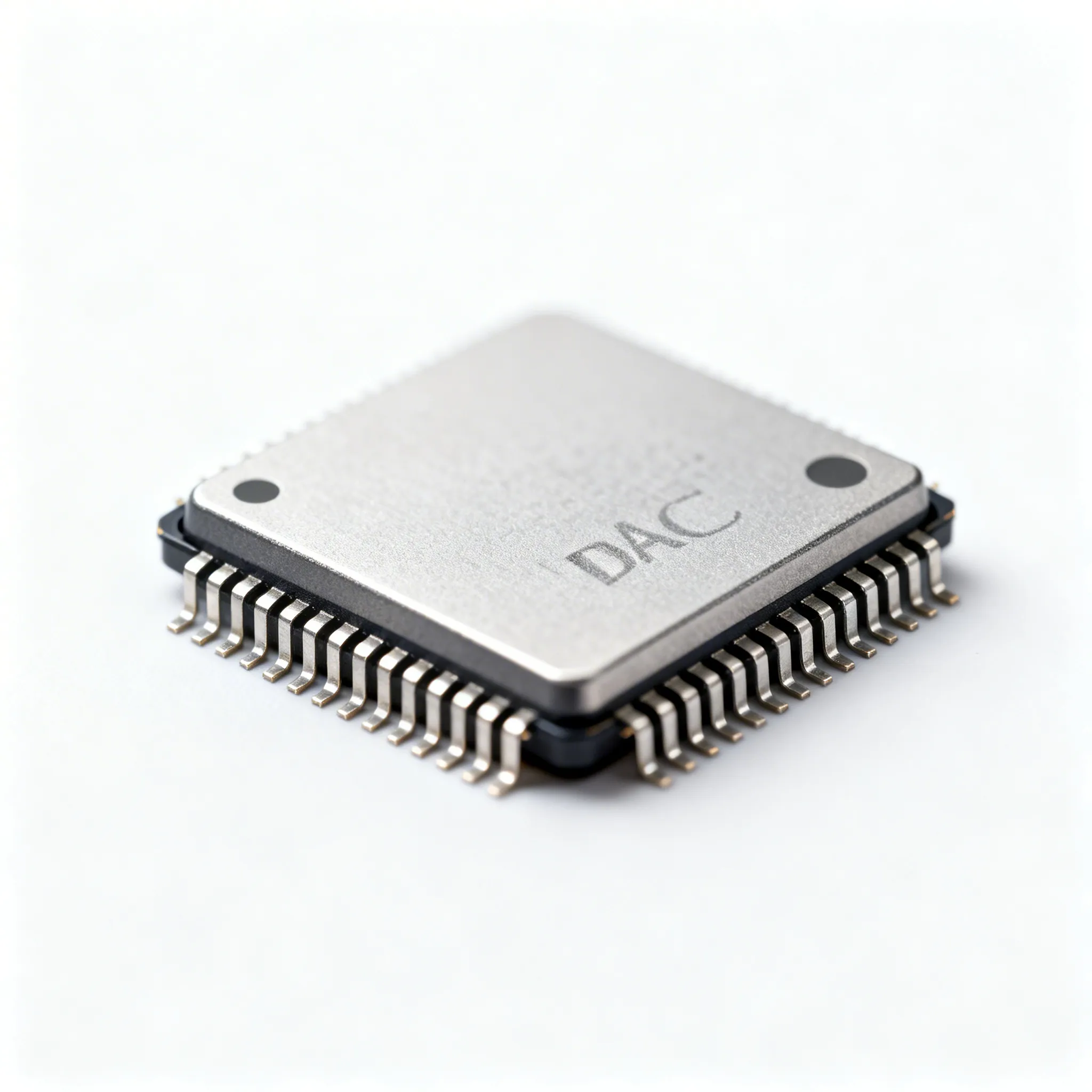
| Package Type | LQFP | - | Low profile quad flat package |
| Pin Count | 48 | Pins | Standard configuration |
| Thermal Resistance Junction-to-Ambient | 35 | °C/W | Efficient heat dissipation |
| Thermal Resistance Junction-to-Case | 10 | °C/W | Low thermal resistance |
| Weight | 0.8 | g | Lightweight design |
| Dimensions | 10x10 | mm | Compact form factor |
| Mounting Style | Surface Mount | - | SMT compatible |
| Moisture Sensitivity Level | MSL 3 | - | Standard moisture sensitivity |
| Application | Common DAC Type | Key Specifications | Notes |
|---|---|---|---|
| Audio Equipment | Sigma-Delta | 24-bit, 192 kHz | High fidelity audio |
| Video Displays | R-2R Ladder | 10-bit, 60 Hz | Standard video output |
| Sensor Interfaces | Binary-Weighted | 12-bit, 1 MHz | Precision measurements |
| Telecommunications | Sigma-Delta | 16-bit, 2.4 GHz | High-speed data conversion |
| Automotive | R-2R Ladder | 14-bit, 48 kHz | Robust and reliable |
The tables above illustrate the diverse specifications of DAC chips expected to lead the market in 2026. These components vary in resolution, sampling rate, and package type, catering to different applications like audio equipment, video displays, sensor interfaces, telecommunications, and automotive systems. Understanding these specifications is crucial for engineers aiming to integrate DACs into their designs effectively.
Design Considerations
When designing circuits with DACs, several practical guidelines are essential to ensure optimal performance. First, engineers must consider the resolution and sampling rate requirements of their application. For instance, high-fidelity audio systems demand DACs with at least 24-bit resolution and 192 kHz sampling rate. Next, the power supply and grounding must be meticulously planned to minimize noise and interference, which can degrade the DAC's output quality. Additionally, selecting the appropriate DAC architecture, such as sigma-delta for audio applications or R-2R ladder for video displays, is critical.
Thermal management is another vital aspect, as DACs can generate heat during operation. Proper heat sinking and thermal relief in PCB design help maintain the DAC's reliability and performance. Engineers should also pay attention to the DAC's output impedance and drive capability to match the load requirements of downstream circuits. Furthermore, integrating adequate filtering in the analog output stage can smooth out quantization noise and improve signal quality.
Incorporating error correction and calibration routines in the design can enhance the DAC's accuracy and linearity over time. Finally, considering the DAC's packaging and pin configuration is important for seamless integration into the overall system design. The choice between surface mount and through-hole packages depends on the application's size constraints and manufacturing capabilities.
Step-by-Step Guide
Designing a circuit with a DAC requires careful planning and execution. Here's a step-by-step guide to help you integrate a DAC chip into your project:
- Define Application Requirements: Determine the resolution, sampling rate, and other performance criteria based on your specific application. For example, a high-fidelity audio application may require a 24-bit, 192 kHz DAC.
- Select the Right DAC: Choose a DAC that meets your application requirements. Consider factors such as architecture, power consumption, and package type. For high-speed applications, a AD5686R may be suitable.
- Design the Power Supply: Ensure a stable and low-noise power supply for the DAC. Use low-dropout regulators (LDOs) to minimize ripple and noise.
- Plan the PCB Layout: Implement a PCB layout that minimizes noise and interference. Use separate analog and digital ground planes to reduce coupling.
- Implement Thermal Management: Design thermal reliefs and use heat sinks if necessary to manage heat dissipation effectively.
- Configure the Output Stage: Add filtering components to the DAC's output to smooth out quantization noise. Choose components that complement the DAC's output impedance.
- Calibrate and Test: Perform calibration routines to ensure accuracy and linearity. Test the DAC's performance under different conditions to validate its functionality.
- Integrate into System: Once tested, integrate the DAC into the overall system. Ensure compatibility with other components and verify system-level performance.
Common Issues & Solutions
Integrating DACs into electronic designs can present several challenges. Here are some common issues and their solutions:
- Noise Interference: Noise can degrade DAC performance. Solution: Use proper grounding techniques and shield sensitive analog paths from digital noise sources.
- Thermal Overload: Excessive heat can affect DAC reliability. Solution: Implement effective thermal management strategies, such as heat sinks and thermal vias.
- Output Distortion: Distortion in the output signal can occur due to impedance mismatches. Solution: Match the DAC's output impedance with the load and use appropriate filtering.
- Power Supply Instability: Fluctuations in the power supply can introduce errors. Solution: Use low-noise power supplies and decoupling capacitors close to the DAC.
- Calibration Drift: Over time, calibration can drift due to environmental changes. Solution: Implement periodic recalibration routines to maintain accuracy.
Applications & Use Cases
DACs are integral to various real-world applications. In audio equipment, DACs convert digital audio signals to analog, providing the high-quality sound expected by consumers. In telecommunications, DACs facilitate the conversion of digital data to analog signals for transmission over traditional analog networks. Automotive systems rely on DACs for applications such as infotainment systems and sensor data conversion. Additionally, DACs play a crucial role in industrial sensor interfaces, converting digital control signals into analog outputs for precise control of machinery.
Selection & Sourcing Guide
When selecting a DAC, consider factors such as resolution, sampling rate, and power consumption. Ensure compatibility with other system components and verify that the DAC meets your application's performance requirements. For sourcing, visit IC Online to find a wide range of DACs with competitive pricing and fast delivery options.
FAQ
- What is the primary function of a DAC? DACs convert digital signals into analog signals for use in various electronic applications.
- Why is resolution important in a DAC? Higher resolution allows for finer granularity in signal representation, improving output quality.
- How does sampling rate affect DAC performance? A higher sampling rate enables more accurate signal reproduction, especially in audio and video applications.
- What are common DAC architectures? Common architectures include sigma-delta, R-2R ladder, and binary-weighted.
- How can I minimize noise in a DAC circuit? Use proper grounding techniques, shield analog paths, and use decoupling capacitors to reduce noise.
- What role does thermal management play in DAC design? Effective thermal management prevents overheating, ensuring reliable DAC operation.
- Can DACs be used in sensor interfaces? Yes, DACs are often used to convert digital control signals to analog outputs in sensor interfaces.
- What is the significance of output impedance in DACs? Matching output impedance with the load ensures optimal signal transfer and minimizes distortion.
- Where can I find DAC datasheets? Datasheets can be found on distributor websites like DigiKey.
- How often should DACs be calibrated? Calibration frequency depends on application requirements and environmental conditions; periodic recalibration may be necessary.
Conclusion
The market for DACs in 2026 is poised for significant growth, driven by advancements in various industries. Understanding the specifications and design considerations of DACs is essential for engineers looking to leverage these components in their designs. By carefully selecting, sourcing, and integrating DACs, engineers can ensure high-performance and reliable electronic systems that meet the demands of modern applications.