2SA1213 Obsolescence Risk Checklist: Confirm Lifecycle Status Before Sourcing
2SA1213 lifecycle and obsolescence risk checklist. What to verify before redesign or last-time-buy — without assuming drop-in replacements.
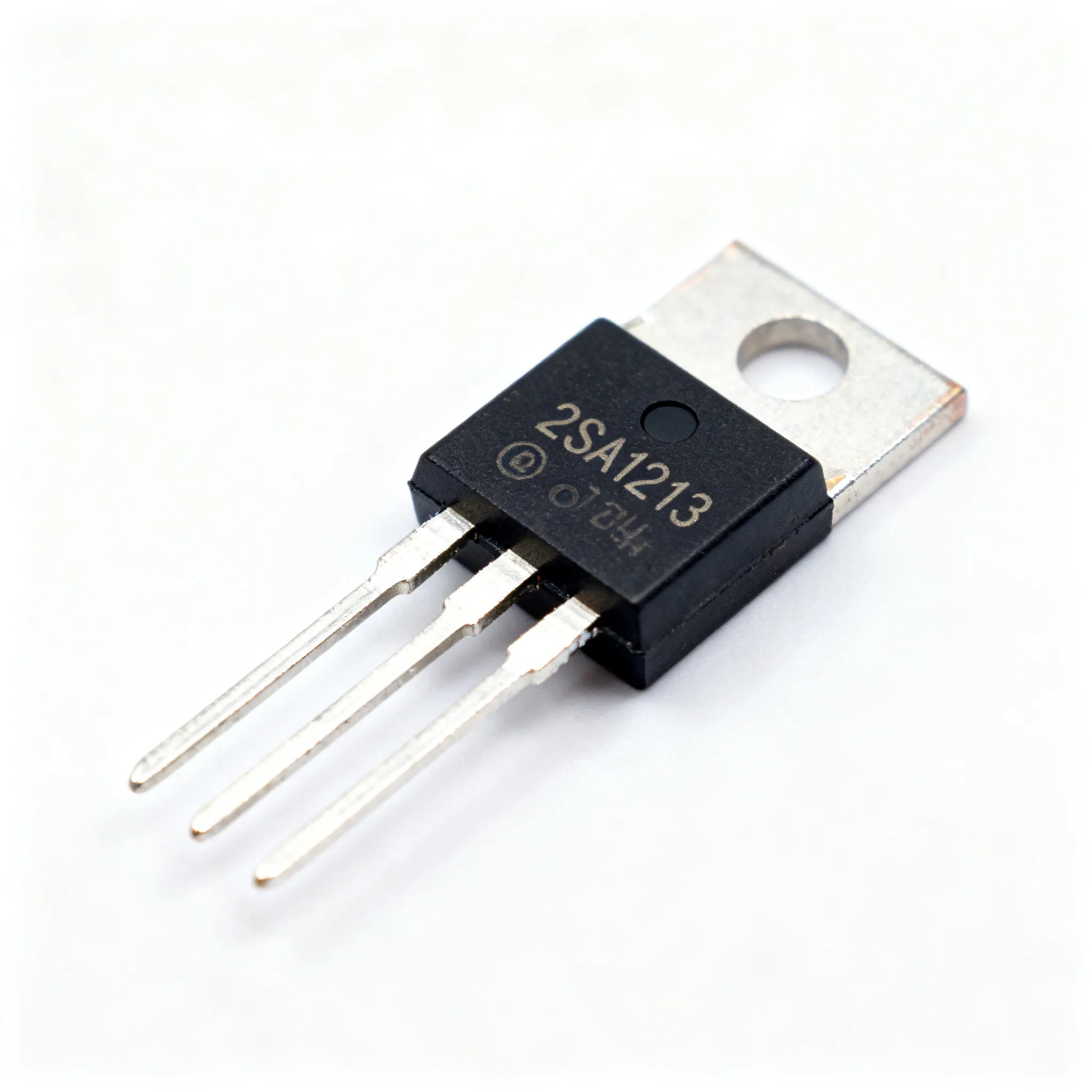
The 2SA1213 Discontinuation Alert: Why 2025's Obsolescence Wave Could Strand Your Production Line
If you're still treating lifecycle verification as a post-design formality, the numbers from 2025 should change your mind. According to lifecycle intelligence firm Z2Data, a record 621,909 electronic components were discontinued or declared obsolete in 2025—roughly one-third more than in 2023. Of those, 52% (323,286 components) had no direct replacement path at the time of discontinuation (Dasenic, 2025). For BOM managers and procurement leads, this isn't a distant trend—it's a production-line risk that compounds with every quarter of inaction.
The 2SA1213 sits squarely in the crosshairs of this rationalization wave. As a PNP epitaxial planar silicon transistor historically sourced from Japanese semiconductor manufacturers, it belongs to a class of mature bipolar junction transistors that face mounting pressure from three directions: shrinking demand for through-hole and legacy surface-mount packages, manufacturer portfolio consolidation, and—critically—new regulatory headwinds. New EU and U.S. PFAS regulations taking effect in 2025 and beyond are already forcing manufacturers to reassess materials, coatings, and subcomponents. In many cases, the cost and complexity of requalification outweigh the value of continued production, pushing perfectly functional parts toward the EOL cliff (Partanalytics, 2025).
The 2SA1213 exemplifies the kind of niche, established transistor that rarely makes headlines when it's active—but can trigger a frantic, costly scramble when it isn't. If your industrial control board, audio amplifier stage, or voltage regulation circuit depends on this part, the time to confirm its lifecycle status isn't after the PDN lands in your inbox. It's before a single purchase order is cut. This checklist walks you through exactly what to verify, where to look, and how to act before the window closes.
Tip: Even if your current distributor shows stock for 2SA1213, that inventory picture can change in weeks once a discontinuance notice triggers a last-time buy surge. Lifecycle status—not shelf stock—is your leading indicator.
Lifecycle Literacy for the 2SA1213: Decoding Active, NRND, and Last-Time Buy Flags
Before you can assess whether 2SA1213 belongs in your next production run, you need to speak the language manufacturers use to signal a part's trajectory. The industry has standardized around five lifecycle stages, though terminology and notice periods vary by supplier. Texas Instruments defines its product life cycle stages as Preview, Active, Not Recommended for New Designs (NRND), Last Time Buy, and Obsolete (TI Product Life Cycle). Analog Devices takes a notably conservative approach, stating that obsolescence should be avoided provided technology and customer demand exist for a product, and when it can't be avoided, customers are notified two years in advance (Analog Devices Product Life Cycle Information).
For the 2SA1213 specifically, your first task is locating the authoritative lifecycle field. Don't rely on a distributor's inventory page alone—those status badges can lag behind the manufacturer's official declaration by weeks or months. Go to the original manufacturer's product page or use the lifecycle lookup tool on an authorized distributor's portal that pulls directly from the manufacturer's database. Look for one of the status codes in the table below, and understand what each one demands of your sourcing strategy for the next 12 months.
| Lifecycle Stage | What It Means for 2SA1213 | Required Procurement Action | Typical Notice Window |
|---|---|---|---|
| Preview / New | Part is announced or sampling; not yet qualified for volume production. | Monitor for qualification progress; do not design into production BOMs. | N/A — pre-release |
| Active | Full production; no known discontinuation plans. New designs can proceed. | Confirm allocation-backed lead time with supplier; set PDN alert. | N/A — stable state |
| NRND (Not Recommended for New Designs) | Still in production, but manufacturer advises against new design-ins. Existing designs may continue. | Begin bridge-buy planning immediately. Evaluate alternatives; do not design into new products. | Varies; may persist months to years before EOL |
| Last Time Buy (LTB) | Final order window is open. After the cutoff date, no further production. | Calculate lifetime demand; place final order; secure inventory plan for long-term storage. | Typically 6–12 months |
| Obsolete / EOL | Production has ceased. No manufacturer supply available. | Source from authorized distributor residual stock or evaluate grey-market with full testing. | N/A — supply is finite |
The critical inflection point for 2SA1213 is the transition from Active to NRND. Once a part reaches NRND, the clock is ticking—but many procurement teams miss this signal because the part is still available. They assume "still shipping equals still safe." That assumption is expensive. A BOM manager who catches the 2SA1213 at NRND has months to plan; one who catches it at Last Time Buy has weeks to react.
Key takeaway: Screen every BOM line against manufacturer lifecycle status (Active, NRND, EOL, Obsolete) before layout freeze, not after (Bigmateph Component Risk Guide). For the 2SA1213, that means verifying its status with the original manufacturer's product page—not a second-tier aggregator—and documenting the result in your BOM health record.
Last-Time Buy, Drop-In Sub, or Redesign: Weighing Your 2SA1213 Options Before the PDN Hits
Once you've confirmed that 2SA1213 is moving toward—or has already reached—a non-Active status, you're facing three paths. None is cost-free, and the wrong choice can lock in years of supply chain pain or unnecessary engineering expense. What follows is a structured comparison of the three post-EOL strategies, drawing on methodologies from SiliconExpert's obsolescence management platform, GlobX's BOM health playbook, and practical lessons from component engineers who've navigated this decision cycle.
Start with a complete, accurate Bill of Materials and attach a lifecycle status, current lead time, number of qualified sources, and on-hand stock to every line (GlobX Obsolescence Management Guide). Without this baseline, any EOL strategy for 2SA1213 is guesswork dressed up as planning.
| Comparison Metric | Last-Time Buy (LTB) | Pin-Compatible Alternative (e.g., Evaluate 2SA1313) | Full Redesign |
|---|---|---|---|
| Upfront Cost | High — single large inventory outlay; warehousing and carrying costs | Moderate — bench testing, requalification, and possibly minor BOM adjustments | Highest — schematic changes, PCB layout revision, firmware updates, full validation cycle |
| Engineering Effort | Minimal — no design change required | Medium — verify pinout, gain (hFE), saturation voltage (VCE(sat)), and thermal performance in-circuit | Maximum — redesign signal path, re-characterize loop stability, redo EMI/thermal testing |
| Supply Longevity | Finite — limited to purchased quantity; once gone, redesign is inevitable | Extended — if alternative is Active and multi-sourced | Extended — but dependent on new component's own lifecycle |
| Risk Profile | Inventory obsolescence; degradation during long-term storage; demand forecast error | Subtle parametric mismatches; thermal derating surprises; mechanical tolerance differences | Schedule slip; new component introduces its own lifecycle risk; requalification cost overruns |
| Best For | Low-volume industrial/medical products with stable demand and long service lives | Products with accessible design files and bench-test capability; moderate production volumes | High-volume products where requalification cost is amortized; products already due for a design refresh |
If you're evaluating a pin-compatible alternative to 2SA1213—such as the 2SA1313, which shares the same package and polarity—approach the substitution with verification rigor, not optimism. Even transistors with matched pinouts and comparable datasheet specs can behave differently in your circuit. Differences in hFE linearity across your operating current range, VCE(sat) at your switching frequency, or thermal resistance (RθJA) on your PCB layout can introduce subtle failures that pass initial bench testing but surface months later in the field. Always bench-test the alternative in your actual circuit and review mechanical tolerances before switching a BOM line.
SiliconExpert's obsolescence management methodology emphasizes that the path you choose should be driven by data, not deadlines: minimize lifecycle costs by planning design refreshes based on forecasted obsolescence dates and technology insertion roadmaps, rather than reacting to each PDN as a crisis (SiliconExpert Manage Obsolescence Risk).
The 2SA1213 Procurement Playbook: 5 Pre-Purchase Checks That Catch EOL Surprises
The difference between a controlled EOL transition and a production-line stoppage often comes down to whether someone ran these five checks before the purchase order was cut—not after. Each step is designed to surface the lifecycle status of 2SA1213 from a different angle, creating redundancy in your verification process so that no single source of stale data can mislead you.
The framework below draws on the Aetrix EOL management methodology, which structures obsolescence response around PDN monitoring, last-time buy planning, replacement validation, and BOM lifecycle control (Aetrix Electronic Component Obsolescence Guide), and on Luminovo's supply chain platform approach, which brings together data, processes, and players in one place for PCB assembly procurement (Luminovo Lifecycle & EOL Management Guide).
| Check # | Action | Tool / Source | Red Flag If… |
|---|---|---|---|
| 1 | Poll the manufacturer's official product life cycle page for 2SA1213. Do not accept a distributor's status field as authoritative—manufacturer portals are the source of truth. | Original manufacturer website; product change notification (PCN) subscription portal | Status field is missing, outdated, or shows NRND/Last Time Buy without a clear transition timeline |
| 2 | Cross-check authorized distributor stock depth and lead time across at least three franchised distributors. Divergence between available stock and quoted lead time can signal an unannounced allocation squeeze. | Authorized distributor portals; direct RFQ to distributor sales desk | One distributor shows zero stock while others quote extended lead times; or all show dwindling inventory with no replenishment date |
| 3 | Set up PDN alerts on a lifecycle monitoring platform. These services aggregate discontinuance notices from multiple manufacturers, often before they propagate through distributor channels. | SiliconExpert, IHS/Accuris, or equivalent BOM intelligence platform | Alert fires for 2SA1213 or its package family; or the manufacturer issues a blanket notice covering the product line |
| 4 | Evaluate non-authorized sourcing risk with industry-standard authenticity tools. If the part is already constrained, grey-market offers will surface—verify before buying. | ERA Inc. (counterfeit reporting), supply chain risk platforms, third-party test labs | Sellers offer 2SA1213 at below-market prices; date codes are inconsistent; seller cannot provide a certificate of conformance |
| 5 | Lock in last-time buy quantities if the part is already marked NRND or Last Time Buy. Calculate lifetime demand including spares, add buffer, and place the order before the cutoff date. | Internal demand forecast; authorized distributor LTB desk | LTB window has already closed; residual stock is insufficient for your forecast; no alternative has been qualified |
These five checks form a closed loop: manufacturer status (Check 1) gives you the official lifecycle declaration; distributor cross-checking (Check 2) tells you whether the physical supply pipeline aligns with that declaration; PDN monitoring (Check 3) catches notices you might otherwise miss; grey-market evaluation (Check 4) sizes up your fallback options if authorized supply dries up; and LTB execution (Check 5) is your final insurance policy. Run them in sequence, and document the result for each 2SA1213 line on every BOM where it appears.
Procurement Tip: When requesting a quote for 2SA1213, require the supplier to confirm—in writing—the manufacturer's current lifecycle status, the date that status was last verified, and whether any PDN has been issued for the part or its package variant. This turns a passive RFQ into an active risk-assessment touchpoint. Buyers should also require that any quoted stock carries date codes within the last 36 months and is supported by a test report issued within 90 days of shipment.
2SA1213 Obsolescence FAQs: What Senior Buyers and Engineers Ask Before Every Order
Below are the six questions that experienced procurement leads and design engineers raise when they see 2SA1213 on a BOM—and the answers that separate a controlled sourcing decision from a reactive one.
Q: Is the 2SA1213 still in active production, and how can I independently confirm its lifecycle status?
Start with the original manufacturer's product page—not a distributor's catalog listing or a third-party aggregator. Look for a lifecycle status field or a product change notification (PCN) section. Authorized distributors often mirror this data, but it can lag. Cross-check by calling the distributor's sales desk and asking them to confirm the status against the manufacturer's current database. If you're seeing conflicting signals—one source says Active, another shows no stock and no restock date—treat the part as allocation-sensitive and escalate verification. Trust only official sources; second-tier stock listings may be outdated.
Q: What's the difference between NRND and EOL for the 2SA1213, and when should I start planning a bridge buy?
NRND (Not Recommended for New Designs) means the manufacturer is still producing 2SA1213 but advises against using it in new products. It's a warning shot, not the final bell. EOL (End of Life) or Last Time Buy means production is ceasing and a final order window has been announced. The mistake procurement teams make is waiting for the EOL notice to act. Start your bridge-buy planning the moment the part moves to NRND, not after it goes EOL. By the time the LTB notice arrives, allocation may already be spoken for by competitors who started planning earlier.
Q: Does a 'pin-compatible' substitute like the 2SA1313 really eliminate requalification, or are there hidden gotchas?
It doesn't eliminate requalification—it reduces it, and the distinction matters. A pin-compatible alternative shares the same footprint and pinout, which spares you a PCB layout revision. But semiconductor parameters that affect circuit behavior—current gain (hFE), collector-emitter saturation voltage (VCE(sat)), collector cutoff current (ICBO), and thermal resistance (RθJA)—can differ enough to shift your amplifier's bias point, alter your switching rise time, or degrade your thermal margin. Always bench-test the alternative in your actual circuit and review mechanical tolerances before switching a BOM line. Even identical-looking datasheet numbers can hide differences in batch-to-batch consistency, gain linearity across temperature, or behavior at the edges of the safe operating area.
Q: Where will I see the official PDN (Product Discontinuance Notice) if the 2SA1213 is being phased out?
Manufacturers typically post PDNs on their own support pages under a "Product Change Notices" or "Discontinuance Notices" section. If you have a registered account with the manufacturer, you may also receive direct email notification—but this isn't guaranteed if your company isn't a direct account holder. You can also aggregate PDNs through lifecycle monitoring services like SiliconExpert, which track notices from multiple suppliers and can alert you to changes affecting 2SA1213 even if you missed the manufacturer's original posting. For BOMs with dozens or hundreds of lines, automated monitoring is far more reliable than manual checking (SiliconExpert Manage Obsolescence Risk).
Q: How much inventory should I buy during a last-time buy for a low-volume industrial product using the 2SA1213?
Calculate your total forecasted demand over the product's remaining service life—including repairs and spares—and add a 15–20% buffer for yield loss and unforeseen repairs. The buffer is not optional: production yield variation, field returns, and calibration spares all consume inventory that pure demand forecasts miss. Resist the temptation to over-buy by decades; inventory carrying costs, storage degradation (especially for parts with exposed lead frames), and the risk of a mid-life redesign rendering your LTB stockpile obsolete are all real. For most low-volume industrial products, a 7–10 year horizon with a 15–20% buffer strikes the right balance between supply security and working capital efficiency.
Q: What are the risks of buying 2SA1213 from non-authorized sources if the lead time is too long?
The risks are substantial and well-documented. Non-authorized sources can supply counterfeit, recycled, or improperly stored components that look correct but fail parametric testing or degrade prematurely in the field. Specific failure modes include parameter drift (hFE out of spec after thermal cycling), missing or forged date codes, and components that have been sanded, re-marked, and sold as higher-grade parts. These parts carry no manufacturer warranty, and if they fail in your product, the cost of rework and reputational damage dwarfs any per-unit savings. Always start with authorized distribution; if forced outside, insist on full test documentation from a reliable third-party lab and require a certificate of conformance that traces the lot back to the original manufacturer.
For any 2SA1213 sourcing decision where lifecycle uncertainty remains after these checks, the safest next step is a formal RFQ that explicitly requests lifecycle confirmation, date code ranges, and test documentation. You'll either get the clarity you need—or a red flag that tells you to look harder.
Conclusion: Don't Let a $0.50 Transistor Stall a $50,000 Production Run
The 2SA1213 is the kind of component that quietly enables a hundred different circuits—audio drivers, voltage regulators, relay control stages—without ever drawing attention to itself. Until it disappears. The 621,909-component obsolescence wave of 2025 is a reminder that no BOM line is too small or too mature to escape rationalization. When a manufacturer decides that the business case for continued production no longer closes, the part transitions from commodity to constrained in the time it takes to issue a PDN.
The five checks outlined in this playbook—manufacturer lifecycle polling, distributor cross-verification, PDN alerting, grey-market risk evaluation, and last-time buy execution—are your pre-purchase insurance policy. Run them before every 2SA1213 order, not just when something feels off. And if the lifecycle status comes back NRND or worse, move immediately: evaluate alternatives, bench-test candidates, and lock in your bridge buy before the allocation window narrows.
Ready to confirm the lifecycle status and current availability of 2SA1213? Request a quote or upload your complete BOM via IC-Online — mixed BOM support, flexible MOQ, and allocation-verified sourcing ensure your procurement decisions are grounded in current data, not last quarter's assumptions.
References & Further Reading
- Obsolete Components in 2026: EOL Notices & Shortage Data — Dasenic
- Component Obsolescence in 2026: Risks, Drivers, and Impact — Partanalytics
- Electronic Component Obsolescence Guide: EOL, Last-Time Buy, Replacement Options — Aetrix
- Manage Obsolescence Risk — SiliconExpert
- Component Obsolescence: Lifecycle & EOL Management Guide — Luminovo
- Electronic Component Obsolescence Management Guide — GlobX
- Product Life Cycle Information — Analog Devices
- Product Life Cycle — Texas Instruments
- Choosing Components for PCB Assembly: Risk Guide — Bigmateph
- IC-Online — Electronic Component Sourcing & BOM Management