5CEFA9F23I7N RFQ Essentials: Supply-Risk Questions for Sourcing Teams
Expert guide on 5CEFA9F23I7N RFQ Essentials: Supply-Risk Questions for Sourcing Teams. Technical specs, applications, sourcing tips for engineers and buyers.
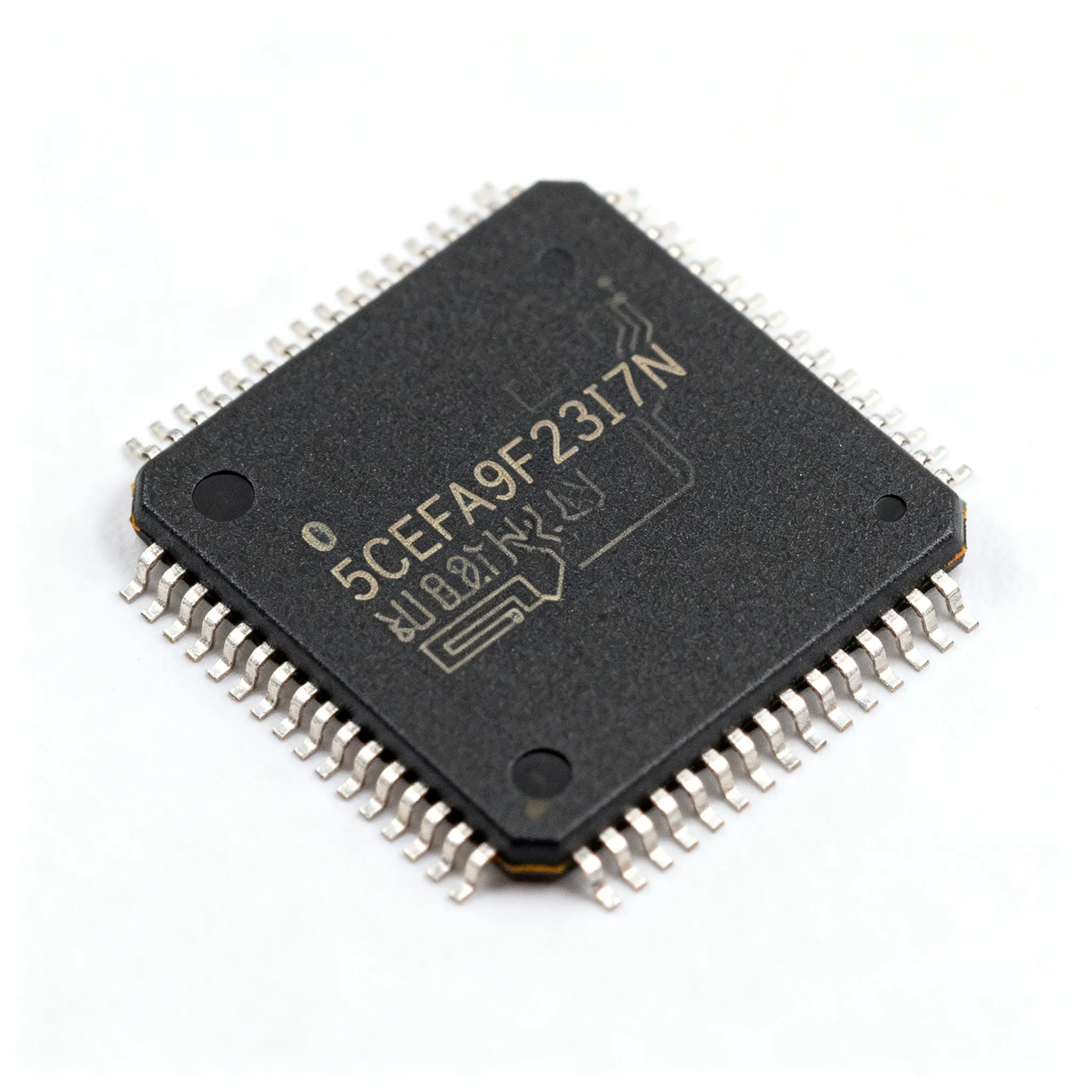
Why FPGA Part Number 5CEFA9F23I7N Can Turn a Routine Buy into a Production Nightmare
The Intel® Altera® Cyclone® V E FPGA you’re about to source — 5CEFA9F23I7N — sits at the heart of industrial control systems, embedded vision pipelines, and defense-grade signal processing. Its 301,000 logic elements, 3.125‑Gbps transceivers, and hardened memory controllers give it a long service life in designs that cannot afford a mid‑life requalification. But the very attributes that make the part indispensable also make its supply chain anything but routine. When a single FPGA SKU gates a $500k production line, a “best price” RFQ is not enough.
Recent industry intelligence confirms that electronic component shortages and delivery delays are among the top supply‑chain risks for 2026 (Strategic Sourcing International). Meanwhile, the true cost of reactive quality — triggered by missed risk signals that often sit unused inside procurement and quality systems — far exceeds the up‑front savings of a price‑only negotiation (Qualifyze). Supply chain disruptions now cost businesses an estimated $184 billion annually (NetSuite), and the fabrication RFQ world has already learned a hard lesson: suppliers who promise “yes” to everything during the quote often hit you with change orders once the order is placed (EVS Metal). Semiconductor procurement is no different.
For 5CEFA9F23I7N sourcing, the question is not whether you can find a line item with a price. The question is whether your RFQ structure forces the supplier to disclose the allocation, traceability, and lifecycle data that separate a stable supply from a hidden production stop. The sections that follow give you the exact supply‑risk questions and RFQ frameworks that senior buyers and engineers are now embedding in their requests for quote.
The Data a 5CEFA9F23I7N RFQ Must Capture That a Price Sheet Won't
A traditional RFQ for this FPGA often stops at unit price and minimum order quantity. That leaves supply risk hiding in the blanks. A supply‑risk RFQ, by contrast, captures structured fields that convert a quote into a verifiable supply commitment. The concept is borrowed from modern direct‑materials procurement: when engineering teams have already defined the exact specification through a Bill of Materials, the RFQ must do more than solicit a number — it must lock in lead‑time tiers, factory origin, obsolescence milestones, and authenticity proofs (LightSource).
An RFQ document template that auto‑fills compliance and technical specifications from connected knowledge sources shows what is possible when quoting moves beyond a spreadsheet (Sifthub RFQ template). For 5CEFA9F23I7N, you need a similar discipline. The table below maps the supply‑risk fields your RFQ must mandate — and the real inventory position each field reveals.
| RFQ Data Field | Why It Exposes Supply Risk | What to Demand in the Response |
|---|---|---|
| Lead time by volume tier (1k, 5k, 10k) | FPGA assembly/test cycles vary; a single lead‑time figure hides tier‑dependent bottlenecks. | Written commitment, not estimate; request a delivery schedule by week. |
| Factory location (assembly/test) | Export controls, logistics disruption, and tariff exposure hinge on the node. | Country and city of backend assembly; ask for ECCN and HTS code. |
| Date code & lot traceability | Narrows the window for counterfeits and aged stock mixed with new builds. | Maximum date code age (e.g., less than 2 years) and full lot ID. |
| Allocation commitment & forecast | Reveals whether the supplier can hold your volume for 12 months. | Monthly allocation forecast and percentage of global supply reserved. |
| Obsolescence roadmap & LTB notice | Avoids a surprise last‑time‑buy after the design is locked. | Written LTB notice period and minimum buy quantity. |
| RoHS/REACH & conflict minerals | Customs delays and compliance violations can halt shipments. | Full material declaration certificate and CMRT. |
| Packaging type & rework history | Repackaged or re‑balled parts introduce latent reliability defects. | Original manufacturer tray/reel; statement of no rework. |
These fields go beyond what a price sheet collects. When you structure the RFQ with custom fields that require suppliers to specify unit price at multiple volume tiers, amortized tooling cost, lead time, and certification package in a single submission, you create an apples‑to‑apples comparison that procurement teams for precision castings and semiconductors alike now rely on (AuraVMS). The next step is to see how a risk‑weighted RFQ changes the nature of the answers you get.
Standard RFQ vs. Supply-Risk RFQ: How the Questions You Ask Change the Answers You Get
A price‑only RFQ for 5CEFA9F23I7N will return a single column: unit cost. A supply‑risk RFQ asks questions that force the supplier to reveal how they manage inventory, factory allocation, and traceability. The fabrication RFQ insight — that asking about design for manufacturability exposes which suppliers truly understand process constraints and which will “yes” their way into a change‑order crisis — applies directly to semiconductors (EVS Metal). The essential RFQ question categories — supplier qualifications, delivery, contractual terms, and project scope — likewise map onto component sourcing, but they must be tailored to the risk profile of an FPGA (CloudEagle).
The table below contrasts the two approaches and shows how the questions you embed in the RFQ template determine whether you receive a price quote or a supply‑risk profile.
| Comparison Metric | Standard RFQ (Price‑Only) | Supply-Risk RFQ (Risk‑Weighted) | Selection Criteria & Failure Boundary |
|---|---|---|---|
| Lead time | “TBD” or single number | Committed lead time by volume tier, with weekly delivery schedule | If the supplier cannot commit in writing, it signals an unallocated backlog. |
| Allocation strategy | Not asked | “What is your allocation strategy for this FPGA over the next 12 months, and what percentage of global supply is reserved for us?” | Suppliers who ration on a first‑come basis will show no forward plan. |
| Origin & traceability | Not required | Factory location, lot ID, date code, and full cert package | Missing origin data masks unauthorized re‑balling and grey‑market risk. |
| Obsolescence | Not discussed | LTB notice period, minimum buy, and alternate drop‑in roadmap | Suppliers that sidestep the question may be planning a silent discontinuation. |
| Counterfeit mitigation | None | Lot traceability, test reports, and statement of conformance to OEM spec | Without these, you cannot distinguish factory‑fresh from aged/repurposed stock. |
When you embed custom quote fields that capture volume tiers, lead time, and certification packages in a structured submission, you move from a price discovery exercise to a supply‑risk benchmark. The ability to compare suppliers on their transparency around allocation, not just their lowest unit cost, is what prevents a procurement win from turning into a line‑down event.
Building Your 5CEFA9F23I7N RFQ: Questions That Expose Lead-Time Traps, Counterfeits, and Single-Source Blind Spots
Start with a structured RFQ that mandates fields for factory location, packaging, date code, full lot traceability, ECCN, and conflict‑minerals reporting. These are not optional; they are the minimum data set that lets you spot a counterfeit, a tarif‑exposed shipment, or a part that is about to go obsolete. Once those fields are in place, go deeper with questions that force the supplier to disclose how they will support the design over its full lifecycle.
Adapting the 47 essential RFP questions for vendor experience, security, and risk to component sourcing gives you a template for probing a supplier’s operational readiness (Sifthub RFP questions). Ask for the supplier’s obsolescence management plan, the notice period for a last‑time‑buy, and the minimum order quantity for the final purchase. Cross‑reference the RFQ deliverables with a contract lifecycle management system to enforce approved language, policy rules, and supplier data, ensuring consistency between what is sourced and what is later contracted (Sirion.ai).
The table below groups the supply‑risk questions you should embed in your 5CEFA9F23I7N RFQ — and what each answer reveals.
| Risk Category | Specific RFQ Question | What the Answer Reveals |
|---|---|---|
| Lead‑time integrity | “Provide a written lead‑time commitment by volume tier, with a weekly delivery schedule and the factory location where the parts will be assembled.” | Separates allocated from unallocated backlog; exposes logistics bottlenecks. |
| Counterfeit avoidance | “Supply lot traceability, date code, country of origin, packaging type, and a statement of conformance to original manufacturer specs. Include proof of purchase from the OEM or authorized channel.” | Flags grey‑market and repackaged parts that would slip through a price‑only quote. |
| Single‑source blind spots | “List any alternate drop‑in replacement part numbers you can supply, and describe your obsolescence management plan including LTB notice period and minimum buy.” | Determines if the supplier has a roadmap or is simply a broker moving inventory. |
| Allocation transparency | “Provide a 12‑month monthly allocation forecast, the percentage of global allocation our order represents, and the criteria used to prioritize customers.” | Shows whether the supplier is rationing stock based on strategic relationships or a first‑come‑first‑served queue. |
| Compliance & trade | “Submit ECCN, HTS code, RoHS/REACH certificate, and full CMRT. Confirm that no rework or re‑balling has been performed.” | Prevents customs holds and uncovers unauthorized process steps that degrade reliability. |
Once these questions are embedded in your RFQ template, you create a benchmark that rewards suppliers who invest in transparency and punishes those who rely on information asymmetry. To make the process actionable, follow these steps:
- Mandate structured fields — do not accept free‑text delivery promises; require a filled‑out template with the fields listed above.
- Require written commitments — lead‑time, allocation, and LTB terms must be captured in the supplier’s official response, not a side email.
- Cross‑check with authorized channel lists — verify the supplier’s status on the manufacturer’s authorized distributor page before evaluating the quote.
- Use the RFQ to trigger a quality review — high‑risk lots should automatically trigger a request for photos, X‑ray, or electrical test reports before acceptance.
- Link the RFQ to contract controls — feed the accepted terms into a CLM system so that the purchase order enforces the same traceability, date code, and allocation commitments.
5CEFA9F23I7N RFQ Supply-Risk Questions: What Senior Buyers and Engineers Actually Ask
Q: What is the real lead time for 5CEFA9F23I7N in 2026 and how can I verify it in an RFQ?
Official lead times for FPGAs in this class can stretch to 30+ weeks during supply‑constrained cycles, and 5CEFA9F23I7N is no exception. To verify the figure, ask for a written commitment with tiered delivery schedules and require the supplier to disclose the factory location and date code. Cross‑check the response with independent distributor inventories and the manufacturer’s authorized channel list. A supplier that cannot commit to a schedule in writing is likely holding unallocated backlog.
Q: Is it safer to buy 5CEFA9F23I7N from authorized distributors or independent brokers?
Authorized sources provide full traceability, manufacturer warranty, and direct access to factory allocation. Independent brokers may offer scarce stock, but the risk of counterfeit, re‑balled, or date‑code‑mixed parts rises sharply. In the RFQ, demand lot traceability, test certificates, and a counterfeit mitigation plan regardless of the source. For high‑risk lots, require photos of the physical parts and verification testing, and always confirm the broker’s proof of purchase from the OEM or authorized distributor.
Q: How do I structure RFQ questions to catch counterfeit FPGAs before they hit my line?
Include fields for date code, country of origin, packaging type, and rework history. Ask for a statement of conformance to original manufacturer specifications and a proof of purchase from the OEM or authorized distributor. Some teams now request X‑ray or electrical test reports for high‑risk lots. The RFQ should also ask about the supplier’s counterfeit mitigation program — if the answer is vague, you have found a red flag.
Q: What minimum data fields should I require in the RFQ to benchmark supplier responses effectively?
At minimum: unit price at 1k, 5k, and 10k volumes; lead time per volume tier; MOQ; factory location; ECCN; RoHS/REACH certs; date code; full lot traceability; and allocation status. Structured custom fields, like those used in platforms such as AuraVMS, make apples‑to‑apples comparison possible without extracting data from emails.
Q: Can I ask for a last‑time‑buy (LTB) commitment in the RFQ for 5CEFA9F23I7N?
Yes, and it is a critical supply‑risk question. Request a written LTB notice period and the minimum order quantity for the final buy. This signals whether the supplier is transparent about the product’s lifecycle and whether they are planning for discontinuation. A supplier that hesitates to answer may be on the verge of ending production without a clear transition plan.
Q: How do I evaluate a supplier’s allocation plan when the FPGA is on allocation?
Ask for a monthly allocation forecast for the next 12 months, the percentage of global allocation your order represents, and the criteria used to prioritize customers. This reveals if the supplier is rationing stock based on strategic relationships or a first‑come‑first‑served queue. A supplier that cannot provide a forecast likely has no committed supply and is simply hoping to find inventory later.
References & Further Reading
- Top Electronic Component Supply Chain Risks in 2026 — Strategic Sourcing International
- The Cost of Reactive Quality — Qualifyze
- The Top 10 Supply Chain Risks of 2026 — NetSuite
- What Procurement Should Ask During a Fabrication RFQ — EVS Metal
- RFQ Process in Manufacturing: How to Get Competitive Supplier Quotes — AuraVMS
- What is RFQ in Direct Materials Procurement? — LightSource
- Essential Questions You Should Include in an RFQ — CloudEagle
- 47 Essential RFP Questions to Ask Vendors — Sifthub
- RFQ Document Template: What to Include & Sample Format — Sifthub
- Request for Quotation: A Complete Guide to RFQ — Sirion.ai
Next step: Put the supply‑risk questions into practice. Request a quote for 5CEFA9F23I7N and your complete Bill of Materials through the IC-Online mixed‑BOM RFQ platform. Structured fields, flex‑MOQ, and a global supplier network help you move from price discovery to a transparent, risk‑weighted supply decision.