AIP1629A Supply‑Risk Assessment: What to Ask in Your RFQ to Secure Sourcing
Expert guide on AIP1629A Supply‑Risk Assessment: What to Ask in Your RFQ to Secure Sourcing. Technical specs, applications, sourcing tips for engineers and buyers.
The AIP1629A Supply Risk Landscape: Why Standard RFQs Fall Short
When a line stops because a single display driver IC can't be sourced, the post-mortem rarely points to a missing procurement process. The paperwork was there—the RFQ went out, quotes came back, and a purchase order was cut. What was missing were the right questions embedded in that RFQ from day one. For a part like AIP1629A, a dedicated LED display driver from Wuxi I-core Elec, the gap between a standard RFQ and a supply-risk-aware RFQ is measured in weeks of downtime and tens of thousands of dollars in rework.
The numbers driving this conversation are sobering. ERAI reported that counterfeit component incidents in the electronics supply chain increased 34% year-over-year in 2025, with independent distribution identified as the entry point in over 70% of cases according to SupplyICs' analysis of ERAI data. That's not a marginal uptick—it's a structural shift in how compromised components enter the supply chain, and it lands hardest on single-source, niche-application parts exactly like the AIP1629A.
Yet most organizations aren't failing at supply chain risk assessment because they don't have one. As Secureframe's 2026 analysis bluntly states, they're failing because their assessment practices haven't kept up with how attacks actually happen Secureframe supply chain risk assessment. The old model—send a one-page RFQ, compare unit prices, place the order—assumes a stable, authorized channel. When that channel thins out for a fabless semiconductor vendor's part, the RFQ itself becomes the primary risk-mitigation tool, or it becomes the root cause of a counterfeit event.
This isn't theoretical. The GSA's Cybersecurity Supply Chain Risk Management (C-SCRM) Acquisition Guide, published in April 2025, explicitly recommends that contract-related documentation—including PWS, RFQ, and SOW—should include appropriate supply-chain risk language GSA C-SCRM acquisition guide. The same principle is trickling down to municipal procurement: the City of San Francisco now issues dedicated RFQs for risk consultation services, recognizing that risk evaluation isn't a post-award activity but a pre-quote requirement City of SF risk consultation RFQ. For electronics buyers, the message is clear: if you're not embedding supply-risk questions directly into your RFQ for a part like AIP1629A, you're effectively outsourcing your risk management to the lowest bidder.
Key Takeaway: The RFQ is no longer just a pricing instrument. For single-source display drivers with limited authorized distribution, it's the first and most consequential line of defense against counterfeit ingress, allocation surprises, and undocumented substitutions.
What Makes the AIP1629A a Tricky Part to Source: Specs and Supply Chain Dynamics
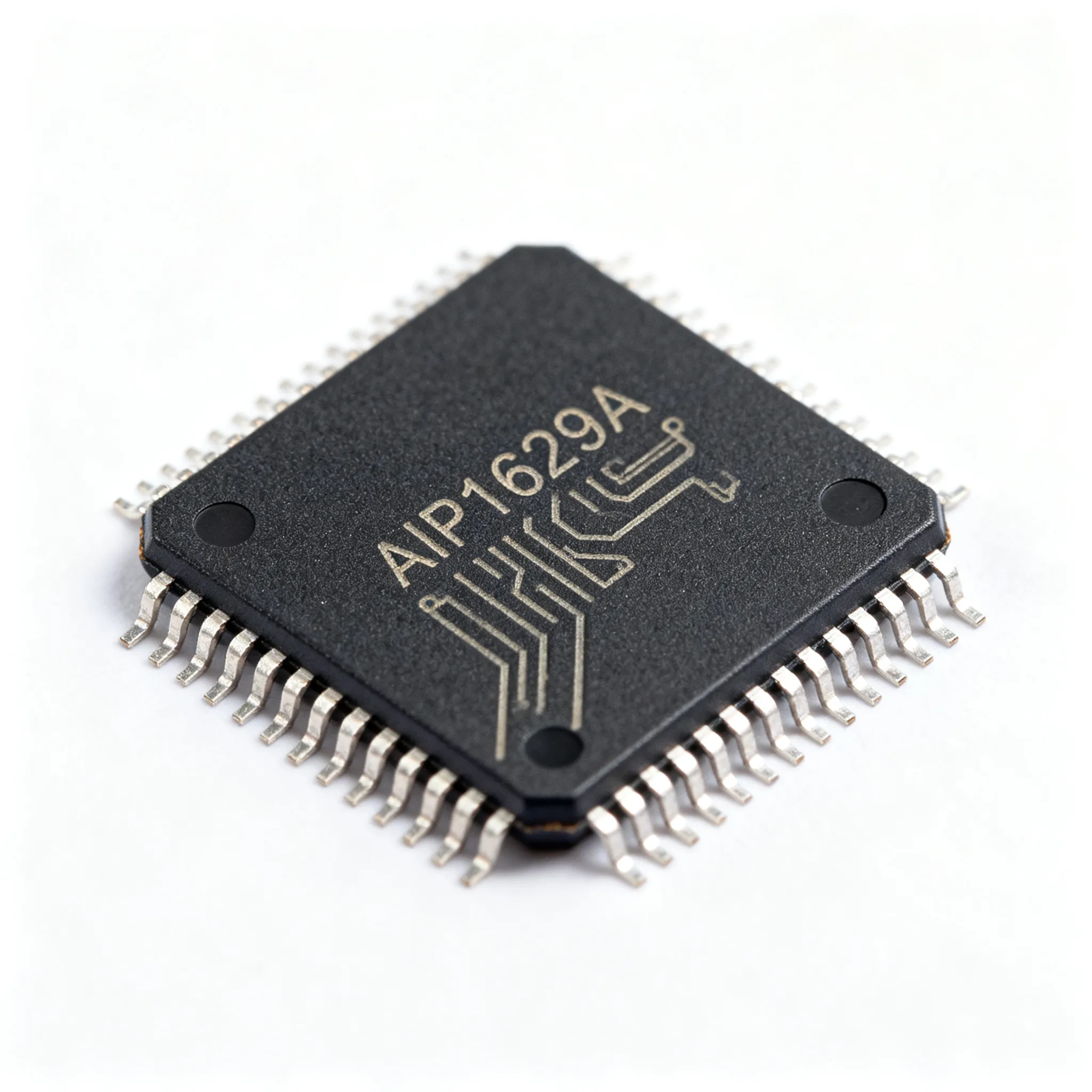
The AIP1629A is, at its core, a dedicated LED display driver IC designed to control multi-segment LED panels in consumer appliances, industrial instrumentation, and digital signage. It handles the multiplexing, constant-current driving, and serial communication with a host microcontroller, offloading the display refresh burden from the main processor. The datasheet available through Utmel Utmel AIP1629A product detail and supporting documentation on Scribd Scribd AIP1629A document provide the baseline electrical parameters. But understanding the specs is only the first layer. The deeper procurement challenge stems from the part's supply-chain architecture.
Wuxi I-core Elec operates as a fabless semiconductor company, meaning wafer fabrication is outsourced to third-party foundries. This introduces several supply-risk vectors that a standard RFQ completely overlooks: wafer allocation priority, single-package-source dependency, and limited visibility into the foundry's customer hierarchy. When demand spikes for a foundry's capacity, a fabless vendor's smaller-run display driver IC is often the first to be de-prioritized in favor of higher-volume, higher-margin wafers from larger customers. The AIP1629A isn't just a part number—it's a proxy for a specific allocation decision made months before you ever see a quote.
Adding to the complexity, there is no widely recognized second-source manufacturer producing a pin-compatible, electrically identical drop-in. This means the part sits in a de facto single-source category, and any supply interruption forces either a board redesign or a risky open-market purchase. The Check Point supply chain risk assessment datasheet Check Point supply chain risk assessment frames this well: identifying and minimizing risk associated with third-party connections is the core of the exercise. For the AIP1629A, those third-party connections include the foundry, the assembly and test house, the authorized distributor network, and any independent resellers that enter the picture when authorized channels run dry.
Below is a datasheet-grounded parameter table that engineering teams should reference when evaluating whether any proposed alternative—or any lot of AIP1629A itself—meets the design requirements. These parameters are the non-negotiable foundation for the RFQ's technical specifications section.
| Parameter | Typical Value / Range | Unit / Notes |
|---|---|---|
| Supply Voltage (VDD) | 4.5 – 5.5 | V; verify tolerance against your rail |
| Maximum Segment Current | 20 – 30 (per segment) | mA; configurable via external resistor |
| Communication Interface | 3-wire serial (CLK, DIO, STB) | Proprietary protocol; not I²C or SPI |
| Display Drive Mode | Multiplexed (1/8 to 1/16 duty) | Depends on grid configuration |
| Package Type | SOP-28 / SSOP-28 | Confirm land pattern compatibility |
| Operating Temperature Range | -40 to +85 | °C; industrial range |
| Grid Scanning Rate | ≥ 500 | Hz; avoids visible flicker |
| Key Scan Function | Up to 16 keys | Integrated key matrix scanning |
| Brightness Control | 8-step digital | PWM-based dimming |
| Manufacturer | Wuxi I-core Elec | Fabless; verify wafer origin in RFQ |
What this table doesn't show—and what your RFQ must surface—is the supply-chain metadata behind each parameter. For instance, the package type (SOP-28 or SSOP-28) determines which assembly subcontractors can handle the part, and whether the lot you're being offered was packaged at the same facility as the original qualification run. A change in assembly site without disclosure can introduce solderability issues, moisture sensitivity level (MSL) discrepancies, or subtle dimensional variations that escape visual inspection but cause field failures months later.
The 3-wire serial interface is another hidden risk vector. Because it's a proprietary protocol rather than a standard I²C or SPI bus, a proposed "equivalent" part that uses a different command set or register map will not function as a drop-in, even if the pin count and package look identical. The RFQ must explicitly require the supplier to confirm register-level compatibility if an alternative is proposed—and to provide a cross-reference test report, not just a parametric comparison table.
Sourcing AIP1629A: Authorized, Independent, or Broker—How to Compare the Risk Profiles
When the AIP1629A disappears from franchised distribution—and for a single-source, fabless display driver, this is a recurring scenario—procurement teams face a three-way fork in the road. Each path carries a distinct risk profile, and the RFQ questions that work for one channel are completely inadequate for another. The table below maps the sourcing options against the criteria that matter most when you're trying to secure authentic, production-ready inventory.
| Comparison Metric | Authorized Franchised Distributor | Qualified Independent Distributor | Open-Market Broker | Selection Criteria & Failure Boundary |
|---|---|---|---|---|
| Traceability to Manufacturer | Full chain of custody; direct ship from manufacturer | Partial; may source from excess inventory or authorized channels | Often none; multiple ownership changes | Require documented lot-level traceability; reject if chain is broken |
| Authenticity Guarantee | Manufacturer warranty; full refund | Independent test report; may offer decapsulation/X-ray | Verbal assurance only; "trust us" | Demand third-party test report for any non-authorized stock |
| Date Code Freshness | Recent production; factory-direct | Variable; may include older date codes | Unpredictable; risk of aged or remarked parts | Specify max 24-month date code in RFQ; reject older without waiver |
| Supply Risk During Allocation | Prioritized; allocation-backed lead time | Moderate; depends on sourcing network | High; stock may be phantom or double-committed | Ask for last shipment date to similar-volume customer |
| Unit Price Stability | Contract pricing; predictable | Market-driven; premium over franchise | Highly volatile; may spike during shortages | Lock in pricing with validity period; avoid spot-market dependency |
| RoHS/REACH Compliance | Full manufacturer certificate supplied | Can provide; verify certificate is shipment-specific | Often generic or outdated certs | Require certificate tied to the specific lot and date code |
The takeaway from this comparison is that the RFQ cannot be a one-size-fits-all document. A franchised distributor RFQ may reasonably focus on allocation-backed lead times and volume pricing. But once you move into independent distribution or broker territory, the RFQ must transform into a forensic instrument—demanding evidence that the stock is authentic, traceable, and hasn't been re-marked or re-packaged through multiple intermediaries.
This lesson cuts across industries. As EVS Metal's fabrication RFQ guide notes, the goal isn't finding the supplier with perfect answers to every question—it's finding the supplier whose capabilities and practices align with your program's actual requirements and risk profile EVS Metal RFQ procurement questions. The 15 minutes invested asking the right questions before the order is placed can prevent a multi-week line-down event. CloudEagle's procurement RFQ analysis reinforces this: vague or incomplete specifications force suppliers to make assumptions, which leads to inconsistent quotes, scope gaps, and unreliable pricing CloudEagle RFQ essential questions. For the AIP1629A, ambiguity in the RFQ is the enemy—it's what allows a broker to quote a "compatible" part that isn't, or to ship a lot with 2018 date codes that have been re-marked as 2024.
Fabcon's contract manufacturing RFQ guide adds another dimension: procurement teams should ask RFQ questions that reveal how suppliers handle nonconformances, support DFM collaboration, maintain revision control, manage tooling ownership, balance in-house versus subcontracted processes, utilize capacity and maintain quality certifications Fabcon contract manufacturing RFQ guide. Translated to component sourcing, this means probing whether the distributor has an in-house inspection capability or subcontracts it to an unknown third party, whether they maintain revision control over their certificate of conformance, and how they handle a nonconformance when a batch of AIP1629A fails incoming inspection. The TWD RFQ template guide sums it up: an RFQ template standardizes the ask—same fields, same units, same deadline, so every quote arrives in one comparable shape TWD RFQ template structure. Without that standardization, you're comparing apples to oranges, and the risk of a counterfeit slipping through multiplies.
Building an RFQ That Exposes AIP1629A Supply Risk: Questions That Surface the Real Story
A procurement RFQ for AIP1629A must go beyond the standard fields—unit price, quoted lead time, and payment terms—and dig into the provenance, testing, and contingency planning that separate a secure supply line from a latent disaster. The Library of Congress's guidance on preparing technical specifications for the RFQ process offers a principle that applies directly here: do not state simply that you require something, but describe how you want it executed, if it is something where there could be variations in how the service is provided LOC tips on RFQ technical specifications. For the AIP1629A, "authentic parts" is not a sufficient specification. The RFQ must define exactly what evidence of authenticity the supplier must provide, in what format, and by what deadline relative to the shipment.
The GSA's C-SCRM acquisition guide GSA C-SCRM guide provides a framework for embedding this language directly into the RFQ document. The core principle is that supply-chain risk language should appear in the statement of work, the evaluation criteria, and the deliverable requirements—not buried in a separate appendix that suppliers can ignore. And the Check Point risk assessment approach Check Point risk assessment datasheet reinforces that third-party connections must be identified and minimized: for every lot of AIP1629A offered, you should know exactly how many ownership transfers occurred between the manufacturer's shipping dock and your receiving bay.
Below is a risk-assessment matrix that maps the categories of supply risk to specific RFQ questions. These aren't theoretical—each question targets a known failure mode in the sourcing of single-source, fabless-semiconductor display drivers.
| Risk Category | RFQ Question to Embed | Acceptable Response | Red Flag |
|---|---|---|---|
| Provenance / Chain of Custody | "Provide a documented chain of custody from the manufacturer's shipping point to your facility, including all intermediate owners, with dates and locations." | Complete, verifiable trail with ≤2 intermediate transfers | "We source from multiple channels" without specifics; refusal to disclose |
| Date Code & Freshness | "Confirm the date code for the offered lot and state the original manufacturer's shelf-life policy. Provide photograph of date code marking on actual devices." | Date code ≤24 months; photo matches certificate | Date code >36 months; reluctance to provide photos; "fresh stock" claim without specifics |
| Authenticity Testing | "For any stock not sourced directly from the manufacturer, provide an independent lab test report (decapsulation, X-ray, or electrical curve-trace) performed within the last 90 days on a sample from this specific lot." | Report from an ISO 17025-accredited lab with lot-specific sample identification | "We visually inspect all parts"; no third-party report; report from >12 months ago |
| RoHS / REACH Compliance | "Provide a RoHS and REACH certificate of compliance that references the specific manufacturer lot number and date code being offered, not a generic corporate statement." | Shipment-specific certificate with lot number cross-reference | Generic corporate RoHS statement; certificate from a different manufacturer |
| Obsolescence Contingency | "Describe your process for notifying customers of last-time-buy or EOL for this part. What is the minimum notice period you commit to?" | Written policy with minimum 90-day notice; proactive EOL monitoring | "We'll let you know when we find out"; no written policy |
| Substitution Policy | "If you cannot supply the exact manufacturer part number, will you propose an alternative? If yes, describe your cross-reference validation process and provide a sample test report." | Cross-reference backed by electrical testing; advance notice before shipment | "We may substitute an equivalent part at our discretion"; no validation process described |
| Counterfeit Warranty | "State your warranty terms for counterfeit parts, including financial responsibility for rework, line-down costs, and third-party testing." | Full refund + rework cost + line-down reimbursement; cites ERAI or IDEA-STD-1010 | "Standard warranty applies"; no mention of counterfeit specifically |
This table is not a bureaucratic exercise. Each row represents a decision point that has, in real-world cases, determined whether a production line received genuine AIP1629A ICs or re-marked, substandard clones. The questions should be embedded directly in the RFQ as line items, not relegated to an appendix. Suppliers who can't or won't answer them are self-selecting out of your qualified vendor pool—which is exactly the filtering function a well-designed RFQ should perform.
Beyond the table, here are four actionable steps to integrate into your RFQ workflow for the AIP1629A:
- Require a lot-specific certificate of conformance (CoC) that references the manufacturer's original certificate. Don't accept a generic CoC that simply states "parts are authentic." The CoC must include the manufacturer's name, the original lot number, the date code, and a signed statement that the parts have been stored in accordance with the manufacturer's moisture sensitivity level (MSL) requirements.
- Mandate high-resolution photographs of the top marking before shipment. Request images showing the date code, lot number, pin-1 indicator, and any logo or country-of-origin marking. Compare these against the manufacturer's known top-marking format. Discrepancies in font, alignment, or missing indicators are often the first visible sign of a counterfeit.
- Include a right-to-audit clause. Reserve the right to send a sample from the received lot to an independent lab for decapsulation or X-ray inspection at your discretion, with the supplier bearing the cost if the parts are found non-conforming. This shifts the testing burden to the party best positioned to prevent counterfeits from entering the supply chain.
- Specify packaging and handling requirements. The AIP1629A in SOP-28 or SSOP-28 format is moisture-sensitive. Require that parts be shipped in sealed moisture-barrier bags with desiccant and a humidity indicator card, and that the bag be labeled with the MSL rating and the date of sealing. Parts shipped in cut-tape or loose in a bag without moisture protection should be rejected on arrival.
Tip: When drafting the RFQ, include a clause that requires the supplier to notify you within 48 hours if they cannot fulfill the order from the originally quoted inventory and must source from a different lot or channel. This prevents the "bait and switch" where a supplier quotes one lot, accepts the order, and then ships from a different, lower-quality source without disclosure.
FAQs from Engineering and Procurement Teams Securing the AIP1629A
Q: What is the typical lead time for AIP1629A from authorized sources, and how should I validate it in the RFQ?
Lead times for the AIP1629A can swing from 4 to 18 weeks depending on wafer allocation at the foundry and the vendor's position in the customer priority queue. In the RFQ, force the supplier to state a confirmed, allocation-backed lead time—not a placeholder estimate. Ask for the date of the last shipment to a customer with a similar volume profile, and require the supplier to disclose whether the quoted lead time is based on existing inventory, work-in-progress at the assembly house, or a future wafer start that hasn't yet been allocated. A supplier who cannot provide these specifics is quoting a hope, not a commitment.
Q: How can I verify the authenticity of AIP1629A without expensive lab equipment?
Start with what you can do at the receiving dock: request high-resolution photographs of the shipment's date code, lot number, and pin-1 indicator, and compare them against the original manufacturer's top marking format. Discrepancies in font weight, laser-marking texture, or the absence of a mold-mark are common counterfeit indicators. In the RFQ, mandate a test report from an independent lab (e.g., decapsulation or X-ray) for any stock that does not come directly from a franchised distributor. The cost of a decapsulation report—typically a few hundred dollars—is negligible compared to the cost of discovering a counterfeit batch after boards are populated.
Q: Is there a pin-compatible or drop-in alternative if AIP1629A becomes unavailable?
No mainstream second-source is a perfect drop-in for the AIP1629A. The TM1629A from Titan Micro may match some register commands at a functional level, but it often differs in pinout, driving current characteristics, or the key-scan implementation. The RFQ should ask the supplier to propose a functionally equivalent alternative with a cross-reference test report, and your engineering team must validate any proposed alternative on the actual board—including display brightness uniformity, flicker performance, and key-scan response—before accepting it. Do not rely on a supplier's parametric comparison alone; the proprietary 3-wire protocol means that register-level differences can break functionality even when voltages and currents match.
Q: What date code and RoHS documentation should I demand in the RFQ?
Specify a minimum date code freshness—no older than 24 months from the date of shipment—and require a full RoHS and REACH compliance certificate tied to that specific lot and date code. A generic RoHS statement covering the manufacturer's entire product line is not sufficient; the certificate must reference the specific lot number being shipped. Additionally, ask for a signed statement of conformity that references the manufacturer's original certificate, not a distributor-generated document that merely parrots the manufacturer's claims. For parts older than 24 months, require a solderability test report to confirm that the leads have not oxidized to the point of compromising joint integrity.
Q: How do I structure a penalty clause for counterfeit parts in my purchase agreement?
Use a clause that entitles the buyer to a full refund plus reimbursement for all rework, line-down, and third-party test costs if a component is proven counterfeit. The clause should also mandate immediate recall and replacement at the supplier's expense, and reference ERAI inspection standards or IDEA-STD-1010 as the accepted methodology for counterfeit verification. Crucially, the clause must define "counterfeit" broadly enough to cover re-marked, re-packaged, or substandard parts that are represented as genuine AIP1629A—not just parts that are electrically non-functional. A part that passes initial electrical test but fails after 500 hours of operation due to inferior die or packaging is still a counterfeit, and your clause should make that explicit.
References & Further Reading
- GSA Cybersecurity Supply Chain Risk Management (C-SCRM) Acquisition Guide, April 2025 — Federal guidance on embedding supply-chain risk language in RFQs, PWS, and SOW documents.
- Secureframe — Supply Chain Risk Assessment: How to Actually Evaluate Third-Party Risk in 2026 — Analysis of why most organizations fail at supply chain risk assessment despite having formal programs.
- SupplyICs — The 2026 Supplier Qualification Framework — ERAI data on 34% year-over-year increase in counterfeit component incidents, with independent distribution as the primary entry point.
- Utmel — AIP1629A Product Detail — Datasheet parameters and product information for the AIP1629A from Wuxi I-core Elec.
- Scribd — AIP1629A I-CORE Document — Supporting technical documentation for the AIP1629A LED display driver.
- Check Point — Supply Chain Risk Assessment Datasheet — Framework for identifying and minimizing risk associated with third-party connections.
- Library of Congress — Tips on Preparing Technical Specifications for the RFQ Process — Guidance on writing RFQ specifications that go beyond generic requirements to describe how services should be executed.
- EVS Metal — What Procurement Should Ask During Fabrication RFQ — Cross-industry perspective on aligning supplier capabilities with program risk profiles.
- CloudEagle — Essential Questions to Include in an RFQ for Procurement — Analysis of how vague specifications lead to inconsistent quotes and unreliable pricing.
- Fabcon — Contract Manufacturing Service Quotes: RFQ Guide — Framework for probing supplier nonconformance handling, revision control, and quality certification practices.
- TWD — RFQ Template: 5 Blocks and a Copy-Ready Format — Guidance on standardizing RFQ structure so every quote arrives in comparable form.
- City of San Francisco — RFQ for Risk Consultation Services, 2024-2026 — Municipal example of RFQs explicitly structured around risk assessment.
Secure your AIP1629A supply with a risk-aware RFQ. When you're ready to source the AIP1629A—or any display driver IC with a single-source risk profile—the quality of your RFQ questions determines the quality of your supply. Don't settle for a quote that only tells you the price. Demand the provenance, the test reports, and the contingency commitments that protect your production line from counterfeit ingress and allocation surprises. For mixed-BOM sourcing with flexible MOQ and a global network of qualified suppliers, request a quote or upload your BOM on IC-Online and let our team match your requirements with vetted, traceable inventory.