BME280 Datasheet and Pinout: Specs for Design and Sourcing
BME280 datasheet essentials, pinout overview, key specs, and design/sourcing checks for engineers and buyers. Request a quote on IC-Online.
Why BME280 Pinout Accuracy and Datasheet Fidelity Are Non-Negotiable for IoT Sensor Nodes
Environmental monitoring in battery‑operated IoT nodes — weather stations, indoor air‑quality loggers, asset trackers — increasingly depends on the BME280. As adoption rises, engineers face a familiar tension: the datasheet promises digital precision, but on‑the‑ground module variations and opportunistic counterfeits can turn a straightforward sensor integration into a debugging marathon. The core risk isn’t just a non‑functional board; it’s data corruption that quietly erodes measurement integrity over months of deployment.
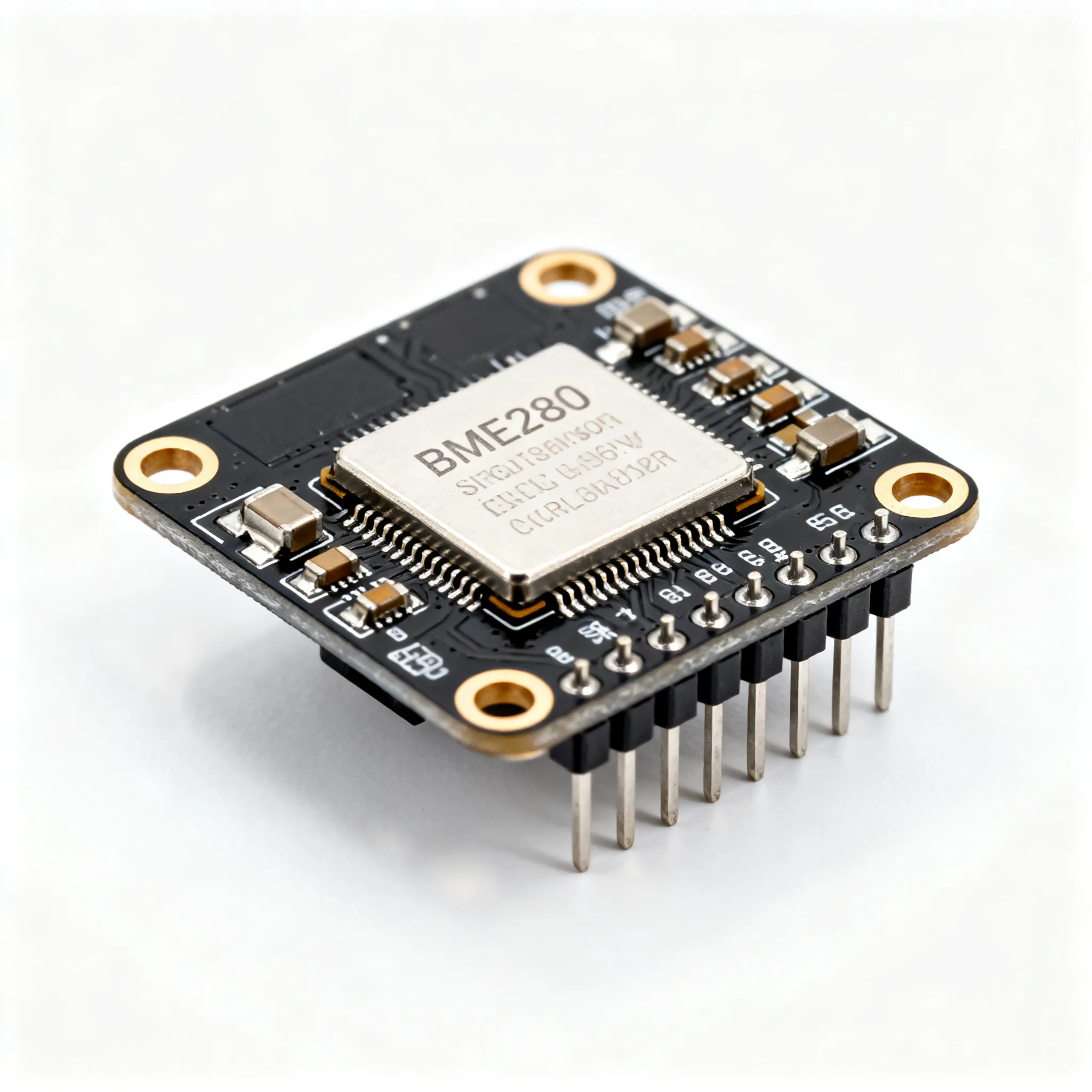
Two signals matter immediately. First, the GY‑BME280 breakout, a staple in prototyping, doesn’t always replicate the exact pin‑mapping of the bare IC or other modules. As noted by community teardowns, certain GY‑BME280 boards omit the CSB pin or tie it internally, assuming I²C mode, while others break out all six signals in a 6‑pin header (Electrocredible pinout analysis). If your firmware expects a specific bus address and the module’s SDO resistor arrangement doesn’t match, your sensor stays silent — and scope traces won’t immediately reveal why.
Second, the immutable chip ID register provides a trust anchor. The BME280 stores a fixed 0x60 in its ID register (address 0xD0), read‑only after power‑up (Bitfoic register overview). Any return other than 0x60 on a bus read indicates a mismatch — either a mislabeled sensor, a counterfeit die, or a hardware fault. This simple check costs a few lines of code and should be the first sanity test in your BSP. When sourcing decisions are driven by allocation pressure, skipping this verification can cost weeks of rework.
These two layers — pinout fidelity and register‑level identity — define whether a design moves from prototype to production reliably. The following sections walk through the interface architecture, a side‑by‑side sensor comparison, and practical procurement checkpoints so that your next BOM includes a BME280 that behaves exactly as the official Bosch datasheet promises.
Reading the BME280: How I²C/SPI Selection, Register Mapping, and Pin Functions Shape Your Design
The BME280 communicates over I²C or SPI, acting as a slave on both buses. Interface selection is purely hardware‑driven: tie the CSB pin high for I²C, pull it low for SPI. There is no auto‑detection and no software override, so a missing pull‑up resistor on CSB when I²C is intended leads to a dead bus. In I²C mode, the SDO pin doubles as the least‑significant‑bit address selector — float it or tie it to VDDIO to set primary address 0x77, or tie it to GND for address 0x76 (Bosch datasheet, Section 5.2). This allows two sensors on a single I²C bus without an address multiplexer, a feature that pays dividends in redundancy or dual‑zone sensor designs.
Register access follows a straightforward pointer‑plus‑data arrangement, but a standout detail is the chip ID register at 0xD0: it always returns 0x60, a fixed value that Bosch reserves for the BME280. You can read it after system power‑on to confirm the sensor is genuine and responsive before configuring oversampling, filter, and standby time in the ctrl_hum, ctrl_meas, and config registers.
The table below distills key electrical and physical specifications drawn directly from the official datasheet and validated community teardowns. Use these as your baseline for schematic review and PCB land‑pattern verification.
| Parameter | Value/Range | Unit / Notes |
|---|---|---|
| Package | 2.5 × 2.0 × 0.93 | mm, metal‑lid LGA |
| Operating voltage (VDD) | 1.71 – 3.6 | V |
| I/O supply voltage (VDDIO) | 1.2 – 3.6 | V; can differ from VDD |
| Interfaces | I²C (up to 3.4 MHz) & SPI (3‑/4‑wire) | Slave only; CSB selects mode |
| Temperature range | ‑40 to +85 | °C |
| Temperature accuracy | ±1.0 (0…65 °C) | °C, typical |
| Pressure range | 300 – 1100 | hPa |
| Pressure absolute accuracy | ±1.0 (0…65 °C) | hPa, typical |
| Humidity measurement range | 0 – 100 | % rH |
| Humidity accuracy | ±3 (20–80 % rH) | % rH, typical |
| I²C address options | 0x76 (SDO to GND), 0x77 (SDO to VDDIO) | Hex; SDO must not float |
| Chip ID register (0xD0) | 0x60 | Fixed hardware ID |
| Current consumption (1 Hz, forced mode) | 0.16 (T only), 0.72 (T+P+H) | µA, typical; ultra‑low power scenario |
Note that the 2.5 × 2.0 mm footprint is the bare LGA package; some early module listings erroneously cite 2.5 × 1.5 mm — a typo that can trip up CAD land‑pattern generation. Always cross‑check with the official Bosch mechanical drawing. Also, the supply voltage headroom to 1.71 V makes the BME280 a strong candidate for coin‑cell designs, especially when paired with aggressive sleep‑wake cycles in forced mode.
BME280 vs. BMP280 vs. BME680: Choosing the Right Environmental Sensor When Humidity or Gas Sensing Counts
Bosch’s trio — BMP280, BME280, and BME680 — share a common interface heritage and package geometry, yet their sensing capabilities diverge sharply. The BMP280 is a pure temperature‑and‑pressure sensor, the BME280 adds relative humidity, and the BME680 brings an integrated gas/VOC sensor alongside the same T/P/H block. For many designers, the choice boils down to whether humidity sensing alone justifies the cost delta, or whether indoor air quality (IAQ) features push the design toward the BME680.
Humidity measurement is not just a “nice to have.” In weather stations and cold‑chain loggers, direct % rH data enables dew‑point calculation and heat‑index estimates that a BMP280 cannot provide without supplementary sensors. Conversely, if your application requires VOC detection for air purification or breath‑alcohol screening, the BME680’s gas sensor becomes the deciding factor. However, the gas sensor adds power consumption and requires proprietary BSEC library integration, increasing firmware complexity.
The comparison table below captures the deciding parameters referenced from component analyst breakdowns and datasheet cross‑analysis (Utmel comparison)(Watelectronics equivalent analysis).
| Comparison Metric | BMP280 | BME280 | BME680 | Selection Criteria & Failure Boundary |
|---|---|---|---|---|
| Humidity sensor | No | Yes | Yes | Needed for dew point / heat index; BMP280 requires external sensor |
| Gas / VOC sensor | No | No | Yes (MOX) | IAQ, air quality, breath analysis; adds BSEC library dependency |
| Temperature accuracy (°C, typ.) | ±1.0 | ±1.0 | ±1.0 | Equivalent for standard ranges |
| Pressure absolute accuracy (hPa) | ±1.0 | ±1.0 | ±1.0 | Equal across family |
| Humidity accuracy (% rH, typ.) | N/A | ±3 | ±3 | Both digital humidity sensors match |
| Package footprint (mm) | 2.0 × 2.5 × 0.95 | 2.5 × 2.0 × 0.93 | 3.0 × 3.0 × 0.93 | BME680 larger; mechanical re‑layout required |
| Typical bill‑of‑materials cost bracket (relative) | Low | Mid | High | BME280 adds humidity for small BOM bump vs BMP280; BME680 step‑up if IAQ needed |
| Library / software effort | Standard I²C/SPI driver | Standard driver + humidity compensation | Requires BSEC library; closed source | Firmware integration time; BME680 non‑trivial calibration |
For most environmental nodes that already plan to report humidity, the BME280 eliminates the need for a separate humidity IC and the associated routing headaches. The BME680, while attractive for IAQ, forces a larger PCB cutout and demands the proprietary BSEC library, which can be a show‑stopper in open‑source firmware projects. Therefore, if you don’t need gas sensing, the BME280 is the practical sweet spot.
Designing and Sourcing BME280 Modules: Decoupling, Address Conflicts, and How to Spot a Fake IC
Getting the BME280 reading correctly on the bench is one thing; making it production‑proof is another. Decades of sensor integration work reveal repeated pitfalls: forgotten I²C pull‑up resistors, floating SDO pins that scramble the bus address, and counterfeit ICs that return 0x00 or 0xFF at the ID register. Begin your schematic checklist with these hard‑earned rules.
I²C pull‑up values: The sensor’s I²C bus can run at 3.4 MHz, but most designs operate at 100 kHz or 400 kHz. A 4.7 kΩ pull‑up to VDDIO works in most cases; if you encounter rise‑time violations at higher speeds, drop to 2.2 kΩ while staying within the sink current limit. Always place pull‑ups on the MCU side — not inside the sensor module, where they may conflict with external resistors.
Interface strap and address: Tie CSB high through a resistor (e.g., 10 kΩ) to VDDIO for I²C mode (Bitfoic interface detail). For the SDO pin, never leave it floating. A floating SDO can pick up noise and randomize the address, causing the device to respond sporadically at 0x76 or 0x77 — a nightmare to debug. Use a 10 kΩ resistor to GND or VDDIO to define the address unambiguously.
Module vs. bare IC trade‑offs: GY‑BME280 modules and similar breakouts include the necessary decoupling caps and level‑shifting. However, their silkscreen and pin‑out arrangement isn’t standardized across all manufacturers (Components101 module pinout). Some modules populate all six header pins (VCC, GND, SCL, SDA, CSB, SDO), while others omit CSB and SDO, hard‑wiring them for I²C and a fixed address. Before integrating a module into a final assembly, verify the actual pin behavior with a multimeter. Relying on a supplier photo can lead to a no‑response condition on the production line.
Anti‑counterfeit check: Counterfeit BME280 dice are known to circulate, especially during supply‑chain squeezes. The simplest gate: read the chip ID register (0xD0). If the return value is not 0x60, the part is not a genuine BME280. Go further by toggling the sensor between forced and normal modes and confirming that the conversion time matches the datasheet formula — clones often exhibit different timing or stuck humidity values. Require full traceability paperwork from your distributor, including batch codes and date codes that align with Bosch shipment records.
The table below maps common integration issues to specific verification steps, keeping your design review concrete rather than theoretical.
| Design / Sourcing Pitfall | Symptom | Verification & Remedy | Risk if Ignored |
|---|---|---|---|
| Missing I²C pull‑up resistors on SCL/SDA | Bus stuck low, NACK on all addresses | Scope SCL/SDA; add 4.7 kΩ to VDDIO | NO communication; board bring‑up blocked |
| SDO pin floating | Address flips between 0x76 and 0x77 | Tie SDO to GND (0x76) or VDDIO (0x77) via 10 kΩ | Intermittent I²C errors, field failures |
| CSB not tied high for I²C | Sensor unresponsive; SPI‑mode expects CS low | Measure CSB voltage; connect CSB to VDDIO | Interface stuck in wrong mode, wasted debug time |
| GY‑BME280 module missing CSB/SDO breakout | Cannot change address or interface | Review module schematic; choose module with full pin‑out | Production BOM locked to single address |
| Counterfeit IC returning 0x00 at ID register | Chip ID mismatch; no valid readings | Read register 0xD0; reject any return ≠ 0x60 | Wasted assembly, reliability hazard |
| Using bare IC without proper reflow profile | Intermittent humidity readings; solder voiding | Follow Bosch land pattern and reflow spec; X‑ray inspection | Sensitivity drift, field returns |
One resource that engineers consistently underestimate is accurate CAD data. The Ultralibrarian BME280 datasheet guide stresses that a verified footprint and symbol — not a community‑contributed library of unknown origin — prevents pad‑to‑pad shorting on the tight LGA pattern. When you download CAD models, ensure they match the Bosch‑official 2.5 × 2.0 mm land pattern with the recommended stencil aperture. A few mils of misalignment can lead to poor wetting and humidity measurement offset.
Before placing a production order, adopt this checklist:
- Verify chip ID (0x60) on a sample batch using a known‑good I²C/SPI driver.
- Confirm that the module or IC footprint matches the Bosch mechanical drawing, not an internet‑scraped library.
- Require from your distributor full lot provenance documentation, including date codes and authorized distribution path.
- Test the device across the full temperature‑humidity profile it will see in the field; a bench‑top sanity check at room conditions isn’t enough.
When you treat the BME280 as a part that needs both electrical and provenance verification, you insulate your final product from the most common silent‑failure modes in environmental sensing.
BME280 Sourcing and Design FAQ: What Senior Engineers and Buyers Ask
Below are the recurring questions we hear from engineering and procurement teams during BOM finalization and qualification of environmental sensor nodes.
Q: How can I verify that a BME280 is an authentic Bosch sensor?
A: Read the chip ID register (0xD0) via I²C or SPI after power‑up. A genuine BME280 always returns 0x60. If you see 0x00, 0xFF, or any other value, the part is not a valid Bosch sensor. Simultaneously inspect the package markings — the metal‑lid LGA should show clean laser etching, not faded ink. Order only from authorized distributors who can provide full traceability back to Bosch Sensortec.
Q: Can the BME280 operate on I²C and SPI at the same time?
A: No. The CSB pin determines the interface: high for I²C, low for SPI. The sensor is a slave on either bus but can serve only one protocol at a time. Design your board with a strap option if you need to switch between interfaces during development.
Q: How do I set two BME280 sensors to different I²C addresses on the same bus?
A: Use the SDO pin. Tie the SDO of the first sensor to GND (address 0x76) and the SDO of the second to VDDIO (address 0x77). Both can then share the same SCL/SDA lines without bus contention. Never leave SDO floating on either device.
Q: What does the BME280 offer over the cheaper BMP280 for a weather station?
A: The BME280 adds a capacitive humidity sensor, enabling direct relative humidity measurements, dew‑point calculation, and heat‑index estimates. The BMP280 provides only temperature and pressure, forcing you to add a separate humidity IC and routing. For full environmental monitoring, the small incremental cost of the BME280 eliminates that extra BOM line and the associated board space.
Q: Are GY‑BME280 modules pin‑compatible across different manufacturers?
A: Most follow a similar 6‑pin header (VCC, GND, SCL, SDA, CSB, SDO), but not all. Some modules leave CSB and SDO unpopulated or tie them internally. Always check the module’s silkscreen and datasheet, and use a multimeter to confirm connectivity before relying on a particular vendor’s module for production (Electrocredible GY‑BME280 notes).
Q: What lead‑time differences should I expect when sourcing BME280 bare ICs versus pre‑assembled modules?
A: Bare ICs from Bosch are allocation‑sensitive and may require longer lead times, typically confirmed through authorized franchised distributors. Pre‑assembled modules from third‑party assemblers often have shorter lead times, but their schedules can fluctuate with spot‑market conditions. Always confirm allocation‑backed lead time and minimum order quantities with your supplier before committing to production volumes, whether you buy the bare IC or a module. Request a quote on IC-Online to compare real‑time availability and supplier terms.
These answers are informed by the Bosch datasheet and the collective experience of engineers who have deployed the BME280 in thousands of connected devices. Treat the ID register and SDO strap not as add‑ons but as contract points between your design and the sensor’s expected behavior, and your sourcing path becomes far less error‑prone.
The environmental sensor market rewards design‑ready engineers who combine specification accuracy with procurement foresight. Starting with the BME280 datasheet essentials — pinout, interface straps, and chip ID — lays a foundation that resists both counterfeit risk and costly re‑spins. Whether you are comparing BMP280 vs. BME280 vs. BME680 or vetting a GY‑BME280 module’s real pinout, the principle remains the same: verify at the register level, confirm the mechanical footprint, and demand full traceability from your supply chain.
When you’re ready to source, use IC-Online’s RFQ platform to submit your full bill of materials. You’ll receive competitive quotes for the BME280 and associated passives, with flexible MOQs that align with both NPI sampling and volume production. Upload your BOM now and let the IC‑Online team connect you with authorized sources that keep your environmental node on schedule and specification‑true.
References & Further Reading
- BME280 Pinout, Specs, Applications – Electrocredible
- BME280 Sensor: Datasheet, Pinout and Applications – Bitfoic
- BME280 Sensor: Datasheet, Pinout and Applications – Utmel
- BME280 Datasheet: Explained – Ultralibrarian
- BME280 IC : PinOut, Datasheet, Equivalents – WatElectronics
- BME280 Sensor Pinout, Datasheet, Equivalent – Components101
- BME280 Data Sheet, Document revision 1.24 – Bosch Sensortec
- IC-Online – Electronic Components Sourcing & RFQ Platform