BOM Cost Reduction and PPV: Optimise RFQ and BOM Upload for OEM/EMS Buyers
BOM and RFQ best practices for electronic component procurement. Upload your BOM or request a quote for mixed lines and flexible MOQ.
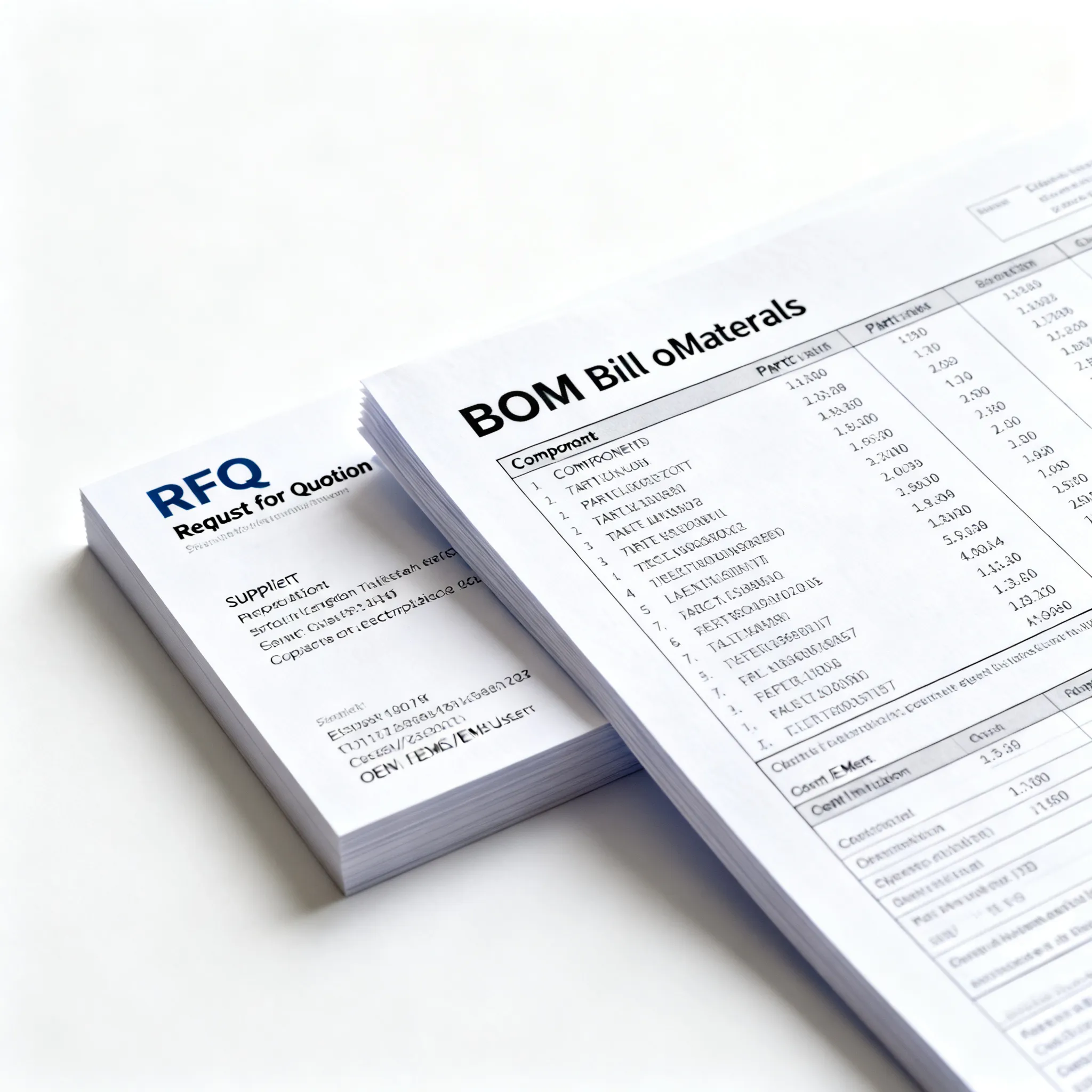
When a bill of materials lands in a procurement inbox, the clock starts ticking. Every hour spent cleaning data, chasing missing manufacturer part numbers, or reconciling conflicting descriptions adds cost before a single component is ordered. Purchase price variance (PPV) — the gap between what you expected to pay and what you actually pay — is rarely driven by raw material indices alone. More often, it tracks directly back to the quality of the RFQ package you send to suppliers. A BOM that arrives with ambiguous references, missing packaging codes, or stale lifecycle data forces distributors and EMS partners to pad their quotes. That padding compounds across hundreds of line items, eroding margins that no amount of post-award negotiation can recover.
Procurement teams that treat BOM upload and RFQ preparation as a single, engineered workflow consistently outperform those that treat them as separate administrative tasks. The difference shows up in quote turnaround times, supplier engagement rates, and — most visibly — in the PPV column of the quarterly review. This article maps the connection between BOM data quality, RFQ precision, and measurable cost reduction, drawing on established procurement frameworks and structured BOM management practices that OEM and EMS buyers can deploy immediately.
Why BOM Upload Quality and RFQ Precision Are Your Fastest Levers to Reduce PPV
When a BOM hits a buyer's inbox, the workflow that follows — validation, supplier selection, quoting, negotiation, and award — is one of procurement's highest-stakes processes. Elisa Industriq's RFQ process analysis frames this clearly: the speed and accuracy of the RFQ workflow directly determines cost competitiveness, lead-time outcomes, and supply resilience. Yet in many OEM and EMS organisations, the BOM that initiates this workflow arrives in a state that virtually guarantees inflated quotes.
The mechanism is straightforward. When a supplier receives an RFQ with incomplete manufacturer part numbers, missing packaging types, or no indication of lifecycle status, the quoting team must make conservative assumptions. They will price for the most expensive packaging variant, assume NRND (Not Recommended for New Design) parts may carry allocation premiums, and build buffer into lead-time commitments. A buyer who submits a BOM with 15% ambiguous line items should expect 15% or more of the quoted total to carry unnecessary margin — and that flows directly into PPV.
Silkbridge's framework for risk-controlled BOM cost reduction reinforces this point from the opposite direction: cost reduction initiatives that ignore data quality introduce supply and quality risk. The fastest, safest lever is not switching to unproven alternative parts — it is giving your existing suppliers the data they need to quote aggressively. A clean BOM with verified lifecycle status, complete packaging information, and accurate manufacturer references signals to the supply base that this is a professional procurement operation worth competing for.
Key Takeaway: PPV reduction begins before the RFQ is sent. The quality of the BOM upload determines whether suppliers quote with confidence or with caution — and the cost difference between the two can be 5–15% on complex assemblies.
Three structural factors make BOM upload quality the highest-ROI activity in procurement cost management:
- Supplier psychology: Distributors and EMS partners allocate their best pricing to buyers who make their job easy. A structured BOM with complete attributes signals low transaction cost and high win probability, inviting sharper quotes.
- Data cascading: One ambiguous MPN in a 200-line BOM can trigger a chain of clarification emails that delays the entire RFQ by days. During that delay, component pricing can shift, and allocation windows can close.
- Negotiation leverage: When you can demonstrate that your BOM data is accurate and complete, you can hold suppliers to firm quotes and push back on post-award price increases with documented evidence.
Demystifying the RFQ‑BOM Handshake: The Data Fields That Make or Break Quote Accuracy
The RFQ and the BOM are not separate documents — they are two views of the same procurement data set. OpenBOM's RFQ process guide defines the essential structure: a well-formed RFQ package includes technical specifications, performance criteria, materials data, and the minimum order quantity (MOQ) that defines the commercial boundary conditions. The BOM is the backbone of that package. When the BOM is incomplete, the RFQ is a request for guesswork.
OpenBOM's analysis of common RFQ mistakes catalogues the data failures that most frequently inflate costs: outdated manufacturer part numbers, missing packaging codes, absent lifecycle status, and inconsistent unit-of-measure conventions. Each of these gaps forces the quoting team to make an assumption, and in procurement, assumptions are always priced conservatively.
The shift from spreadsheet-based BOM management to structured data environments is not merely an IT project — it is a direct cost-reduction activity. OpenBOM's purchasing efficiency narrative illustrates how real-time linkage between CAD, BOM, and RFQ eliminates the manual reconciliation that consumes 30–40% of a buyer's quoting cycle. When engineering changes propagate automatically to the procurement BOM, the RFQ always reflects the current revision — eliminating the costly error of quoting against an obsolete build.
7Setronic's BOM optimisation techniques add another dimension: component standardisation, alternative sourcing, and lifecycle evaluation are not post-RFQ activities. They are data attributes that should be encoded in the BOM before the RFQ is issued, so that suppliers can quote against multiple sourcing scenarios from the start.
The table below maps the BOM data fields that have the greatest impact on quote accuracy and PPV. Each field represents a decision point where missing or incorrect data forces supplier assumptions that inflate cost.
| BOM Data Field | Mechanism of Cost Impact | Procurement Consequence |
|---|---|---|
| Manufacturer Part Number (MPN) | Ambiguous or obsolete MPNs force supplier to identify the correct part, adding labour cost and delay | Quote buffers of 3–8% on affected lines; risk of quoting wrong variant entirely |
| Packaging Type (Tape & Reel, Tray, Tube) | Missing packaging data forces suppliers to assume the highest-cost format; impacts EMS line-loading compatibility | 5–15% cost variance between tape & reel and bulk; production downtime if wrong format arrives |
| Lifecycle Status (Active, NRND, EOL) | NRND parts without lifecycle flags trigger allocation premiums; EOL parts may force last-time-buy pricing | PPV spikes of 20–50% on EOL lines; supply interruption if not flagged early |
| Manufacturer Name | Generic descriptions ("10kΩ 0402 resistor") without manufacturer name prevent supplier consolidation and volume pricing | Missed volume discount opportunities; inability to verify single-source risk |
| RoHS / REACH Compliance | Non-compliant parts in a compliant BOM force re-quoting and re-sourcing mid-cycle | Rework costs; customs delays in regulated markets; PPV impact from rush re-sourcing |
| Minimum Order Quantity (MOQ) | MOQ stated in the RFQ sets the commercial boundary; missing MOQ invites supplier-default MOQ that may not match production needs | Excess inventory carrying cost or line shortage; 10–30% unit price difference between MOQ tiers |
| Alternate / Second Source MPN | Approved alternates listed in the BOM enable competitive quoting and supply resilience | Single-source lines carry 5–12% pricing premium; no fallback if allocation tightens |
| Description Standardisation | Inconsistent descriptions across BOMs prevent cross-reference and supplier consolidation | Duplicate line items; missed aggregation discounts; inflated administrative cost |
Tip: Before issuing any RFQ, run a completeness check on these eight fields for every line item. Lines with missing data should be flagged and resolved with engineering before the BOM reaches a supplier. The cost of internal clarification is a fraction of the PPV impact of a supplier's conservative assumption.
The practical implication is clear: investing in BOM data quality is not a documentation exercise — it is a procurement cost-reduction activity with a direct and measurable ROI. When every line item carries complete, verified attributes, suppliers quote against facts rather than uncertainty, and the aggregate PPV reduction across a year's purchasing volume can be substantial.
Standardisation, Alternative Sourcing, or Lifecycle Redesign? A Side‑by‑Side Look at Cost Reduction Tactics
Once the BOM data foundation is solid, procurement teams can deploy structural cost-reduction strategies that go beyond quote-level negotiation. Four tactics dominate the OEM and EMS procurement playbook: component standardisation, alternative sourcing, lifecycle evaluation, and supplier consolidation. Each carries a different risk-reward profile, and the art of BOM cost reduction lies in applying the right mix to your specific BOM profile.
7Setronic's BOM optimisation framework positions standardisation as the highest-impact, lowest-risk starting point. Reducing the number of unique line items — particularly for passives, connectors, and discrete semiconductors — creates immediate volume aggregation benefits without requiring qualification of new parts. VentureOutsource's manufacturer cost reduction guide adds that standardisation also reduces the administrative burden on EMS partners, which translates into lower assembly costs and fewer setup changes.
Alternative sourcing — evaluating pin-compatible or functionally equivalent parts from different manufacturers — offers higher potential savings but carries qualification risk. Silkbridge's risk-controlled approach stresses that alternatives must be validated through pilot runs, lifecycle checks, and sourcing controls before full rollout. The savings are real, but the cost of a field failure from an inadequately validated alternative can wipe out years of procurement savings.
Altium's procurement specialist techniques introduce the role of AI-driven BOM analysis in identifying cost-reduction opportunities that human review might miss — particularly in cross-referencing part numbers across multiple BOMs to find standardisation opportunities and in flagging parts with long lead times that carry hidden cost premiums.
The comparison table below evaluates these four tactics across the dimensions that matter most to procurement professionals: cost impact, supply risk, implementation effort, and the type of BOM profile where each tactic delivers the strongest return.
| Cost Reduction Tactic | Typical Cost Impact | Supply Risk Profile | Implementation Effort | Best-Fit BOM Profile |
|---|---|---|---|---|
| Component Standardisation | 3–8% on passives and discretes; 1–3% on total BOM | Low — uses existing qualified parts | Low — requires BOM analysis and engineering review | Multi-product OEMs with high passive/connector variety; EMS with fragmented customer BOMs |
| Alternative Sourcing | 5–20% on targeted lines; 2–8% on total BOM | Medium — requires qualification; verify pinout, package, and firmware compatibility | Medium to high — pilot runs, electrical validation, reliability testing | Single-source lines; high-value semiconductors; BOMs with allocation-sensitive MPNs |
| Lifecycle Evaluation | Avoids 20–50% PPV spikes on EOL/NRND parts; 2–5% ongoing savings | Low — proactive rather than reactive | Low — integrate lifecycle data into BOM management | Mature products; industrial and medical equipment with long lifecycles; any BOM over 3 years old |
| Supplier Consolidation | 3–10% through volume aggregation; 1–5% administrative cost reduction | Medium — increases dependency on fewer suppliers | Medium — requires supplier relationship management and performance tracking | High-volume OEMs; EMS with fragmented spend across 20+ distributors; BOMs with high line-item counts |
These tactics are not mutually exclusive. The most effective procurement teams layer them: standardisation first (lowest risk, fastest payback), lifecycle evaluation in parallel (prevent future PPV surprises), then targeted alternative sourcing on the highest-value single-source lines, and finally supplier consolidation to capture the volume benefits of the cleaner BOM structure that the first three tactics create.
Note: Alternative sourcing requires rigorous verification. When evaluating candidates such as GD32, APM32, or CH32-class families as alternatives to established MCU platforms, require the supplier to provide package, pinout, and firmware compatibility documentation. Never assume a "drop-in" replacement — always validate through pilot builds and electrical testing before committing production volumes. The savings from a successful alternative qualification are substantial, but the cost of an unvalidated substitution can be catastrophic.
From RFQ to Purchase Order: Six Steps to a Leaner, Error‑Free BOM Upload Process
Building a procurement workflow that systematically reduces PPV requires more than good intentions — it requires a documented, repeatable process that connects BOM management, RFQ preparation, and supplier engagement. The six steps below are drawn from the practices of procurement teams that consistently achieve lower PPV and faster quote cycles than their industry peers.
OpenBOM's purchasing efficiency model demonstrates that the most impactful change is structural: replacing spreadsheet-based BOM management with a system that maintains live links between engineering data and procurement documents. When a design change in CAD updates the BOM automatically, and the RFQ draws from that same BOM, the reconciliation errors that plague manual processes disappear. Altium's AI-driven BOM analysis adds a layer of intelligence: automated flagging of cost-reduction opportunities, lifecycle risks, and second-source candidates that human review might overlook.
The six steps below form a closed-loop process that starts with BOM template design and ends with post-award PPV analysis. Each step includes specific actions, verification points, and links to the data fields identified in the fundamentals section above.
- Standardise the BOM template with mandatory fields. Define a minimum set of attributes for every line item: manufacturer name, full MPN, packaging type, RoHS status, lifecycle status, and approved alternate MPN (if available). Make these fields mandatory in your BOM management system — not optional. OpenBOM's mistake-avoidance checklist shows that enforced field completeness at the template level eliminates the most common RFQ errors before they reach a supplier.
- Enforce lifecycle and compliance checks at BOM upload. Integrate lifecycle data from manufacturer sources or distributor APIs into your BOM validation workflow. Flag any NRND or EOL part before the BOM reaches the RFQ stage. For compliance, verify RoHS and REACH status against current regulatory requirements. Parts that fail these checks should be escalated to engineering for redesign before procurement spends time quoting them.
- Batch RFQs strategically for volume leverage. Combine demand across product lines and forecast periods before issuing RFQs. A single RFQ covering 12 months of aggregated demand for common passives and discretes will attract sharper pricing than four quarterly RFQs for smaller quantities. VentureOutsource's quote pricing management notes that suppliers price more aggressively when they can see the full volume picture.
- Include approved alternates in the initial RFQ. Rather than negotiating alternates after the primary quote is received, list approved second-source MPNs in the BOM and ask suppliers to quote both. This creates competitive tension on every line and gives you immediate fallback options if the primary source tightens. Verify that alternates have been qualified through engineering review before listing them.
- Pilot alternatives before full production rollout. When a cost-reduction initiative identifies a lower-cost alternative, do not switch production volumes immediately. Run a pilot build — 50 to 200 units depending on product complexity — with full electrical, functional, and reliability testing. Silkbridge's validation methodology emphasises that the pilot phase is where hidden incompatibilities surface, and the cost of catching them here is orders of magnitude lower than a field recall.
- Close the loop with PPV tracking and root-cause analysis. After each procurement cycle, compare actual prices against the RFQ quotes and the standard cost baseline. For lines where PPV exceeds a defined threshold (e.g., 5%), conduct a root-cause analysis: was the BOM data incomplete? Did the supplier re-quote due to a lifecycle change? Was the volume assumption wrong? Feed these findings back into the BOM template and RFQ process to prevent recurrence.
The table below maps each step to the specific procurement outcome it drives, the conditions under which it delivers maximum value, and the trade-offs to manage.
| Process Step | When to Apply | Primary Outcome | Trade-off to Manage |
|---|---|---|---|
| 1. Standardise BOM template | Before any new product introduction; retroactively for active production BOMs | Eliminates supplier assumptions; reduces quote cycle time by 30–50% | Upfront engineering time to populate mandatory fields; resistance from teams accustomed to free-form BOMs |
| 2. Lifecycle & compliance checks | At every BOM upload and before each RFQ issuance | Prevents PPV spikes from EOL parts; ensures regulatory compliance | Requires integration with manufacturer lifecycle databases or distributor APIs; ongoing maintenance |
| 3. Batch RFQs strategically | Quarterly or semi-annually for common parts; per-project for custom/specialty parts | Volume pricing discounts; reduced administrative overhead | Requires demand forecasting accuracy; may increase inventory carrying cost if volumes are overestimated |
| 4. Include alternates in RFQ | For single-source lines; for allocation-sensitive MPNs; for high-value semiconductors | Competitive pricing; immediate supply fallback; reduced single-source risk | Engineering must qualify alternates before listing; qualifying too many alternates dilutes focus |
| 5. Pilot alternatives | Before any production switch; mandatory for functional equivalents and cross-manufacturer alternatives | Validates compatibility without production risk; catches hidden failures before field exposure | Pilot costs (materials, test time, engineering); delays cost savings by 4–8 weeks |
| 6. PPV tracking & root-cause analysis | After every procurement cycle; monthly review with engineering and procurement stakeholders | Continuous process improvement; data-driven negotiation with suppliers | Requires discipline and cross-functional collaboration; easy to deprioritise in firefighting mode |
These six steps form a continuous improvement loop. The PPV analysis from step six informs template refinements in step one, and the cycle tightens with each iteration. Procurement teams that adopt this structured approach typically see measurable PPV reduction within two to three procurement cycles — not because they negotiated harder, but because they gave their suppliers the data needed to quote accurately and gave themselves the data needed to manage cost proactively.
OEM/EMS Buyer's FAQ: BOM Cost, PPV, and RFQ Optimisation
Q: How can we cut BOM cost by 5–10% without switching to unproven alternative parts?
Start with lifecycle evaluation and supplier consolidation — two tactics that require zero requalification. Lifecycle evaluation identifies EOL and NRND parts that carry hidden cost premiums; proactively renegotiating these lines or migrating to active equivalents avoids PPV spikes before they hit. Aggregating volumes across products and consolidating spend with fewer suppliers creates volume pricing leverage on existing qualified parts. Silkbridge's approach and 7Setronic's optimisation framework both stress that the safest savings come from better management of the parts you already use, not from risky substitutions. If alternatives are eventually considered, insist on pilot validation before committing production volumes.
Q: What is the single biggest RFQ mistake that inflates our PPV?
Incomplete or outdated manufacturer part numbers, combined with missing packaging data, are the most costly RFQ errors. When a supplier cannot identify the exact part variant from the BOM — whether it is tape-and-reel versus tray, or a specific temperature grade — they must either delay the quote to seek clarification or price the most expensive interpretation. Both outcomes inflate PPV. OpenBOM's analysis of top RFQ mistakes shows that clean, structured BOMs with complete attributes eliminate this guesswork entirely. The fix is procedural: make full MPN and packaging type mandatory fields in your BOM template, and validate them before the RFQ is issued.
Q: Should we standardise on a single manufacturer for passives, or maintain dual sources?
Standardise by component family and specification, not by manufacturer. For example, standardise on "0402 10kΩ 1% thick film resistor" as the approved line item, and maintain two or more qualified manufacturers that meet that specification. This approach captures the cost and administrative benefits of standardisation — fewer line items, higher volume per line, simpler EMS management — while preserving the resilience of dual sourcing. The comparison table in Section 3 shows how standardisation reduces cost and admin burden without locking you into a single source. When one manufacturer's allocation tightens, the second source is already qualified and listed in the BOM, and the RFQ can shift volumes without delay.
Q: How do we get EMS partners to return quotes faster without sacrificing accuracy?
Provide a BOM that includes lifecycle status, full packaging codes, and stated MOQ for every line item. When an EMS partner receives a BOM with these attributes pre-populated, their quoting team can process it without back-and-forth clarification. OpenBOM's purchasing efficiency experience demonstrates that structured data and pre-validated attributes let EMS partners quote in hours rather than days. The additional step that accelerates quoting further: include a clear statement of forecast volumes and the period they cover, so the EMS can secure allocation-backed pricing from their component suppliers on the first pass.
Q: Is it worth investing in a BOM management tool just for RFQ efficiency?
Yes — and the ROI calculation is straightforward. Structured BOM management eliminates the manual Excel reconciliation that consumes 30–40% of a typical buyer's quoting cycle. It also prevents the PPV impact of quoting against an obsolete BOM revision, which can be 5–15% of the total spend on affected lines. OpenBOM's purchasing efficiency narrative shows how real-time CAD-BOM-RFQ linkage reduces cycle time and improves accuracy, and the cost of a BOM management platform is typically recovered within the first two procurement cycles through avoided errors and faster quoting alone. The case becomes even stronger when you factor in the ongoing PPV reduction from cleaner data and better supplier engagement.
Q: How do we validate that a cost-reduced BOM won't hurt long-term supply?
Validation must be iterative and multi-layered. Start with small pilot batches — 50 to 200 units — to verify electrical and functional compatibility of any alternates. Track the lifecycle status of the new parts through manufacturer notices and distributor data feeds, and maintain a risk register that flags any alternates with limited second-source availability. Monitor the pilot units through a defined observation period before scaling to production volumes. Silkbridge's methodology emphasises that lifecycle checks, sourcing controls, and iterative validation are the three pillars of sustainable cost reduction. A cost-reduced BOM is only a success if the savings persist through the product's lifecycle without creating new supply risks.
References & Further Reading
- RFQ Process: What Happens After a BOM Hits Your Inbox — Elisa Industriq
- How to Reduce Electronics BOM Cost Without Increasing Supply or Quality Risk — Silkbridge
- BOM Management Basics: Perfect Your RFQ Process — OpenBOM
- Top RFQ Mistakes When Sending Product Data to Your Supplier — OpenBOM
- RFQ Process & Purchasing Efficiency Guide — OpenBOM
- How to Optimize BOM to Reduce Cost in Manufacturing — 7Setronic
- Bill-of-Materials (BOM) Cost Reductions and Quote Pricing Management — VentureOutsource
- BOM Cost Reduction Techniques For Procurement Specialists — Altium
Ready to put your optimised BOM to work? Upload your BOM for a competitive RFQ through IC-Online — the platform supports mixed BOMs with flexible MOQ, structured RFQ workflows, and access to a broad franchised and independent distributor network. Clean BOM data meets competitive pricing when you give suppliers the information they need to quote with confidence. Start your RFQ today and measure the PPV difference that structured procurement delivers.