

Counterfeit IC Risk Mitigation for Procurement Teams: Authenticity, Inspection, and Traceability
Procurement checklist: authenticity, traceability, and quality documentation to request with your component RFQ.
When Counterfeit Components Breach the Supply Chain: Real Costs and Recent Wake-Up Calls
A single counterfeit microcontroller passing through incoming inspection can erase months of engineering effort. It's not a hypothetical risk—it's a recurring operational failure that procurement teams confront across every vertical, from industrial automation to medical devices. The surge in counterfeit electronics has pushed experienced buyers to fundamentally rethink sourcing strategies, even when those changes carry a higher upfront unit cost. Astute Group reports that procurement teams are increasingly shifting to verified franchise distributors, accepting higher per-unit pricing as insurance against far costlier downstream failures.
What makes this moment different is the convergence of several forces. Supply chain pressure during allocation-sensitive periods pushes buyers toward unfamiliar sources. Geopolitical fractures create parallel distribution channels where pedigree becomes murky. And counterfeiters have moved well beyond crude remarking—today's sophisticated fakes can pass basic visual checks and even rudimentary electrical testing, only to fail weeks into field deployment. The threat spans every sector where component integrity matters.
In mission-critical domains—satellites, munitions, medical devices, automotive safety systems—authenticity failures are simply unacceptable. AAACTL underscores that certified labs operating under AS6081 and AS6171 frameworks are now the baseline for defense and aerospace procurement, where a single counterfeit IC can compromise a multi-million-dollar platform. The same rigor is migrating into medical and automotive supply chains, driven by liability exposure and regulatory pressure.
Emerging trust anchors are reshaping what "verified" means. Summit Interconnect points to encrypted digital signatures embedded on components as a practical mechanism to authenticate parts at the point of receipt. When a buyer can cryptographically verify that a reel of ICs originated from the manufacturer's authorized line, the entire gray-market business model—remarking, salvaging, relabeling—loses oxygen.
The cybersecurity dimension adds another layer. Accuris recommends that procurement teams restrict sourcing to authorized channels during constrained markets and define explicit policies for non-authorized sourcing, including mandatory additional testing and accountability measures. The logic is straightforward: a counterfeit part is not just a reliability problem—it can be a vector for compromised firmware or backdoor access. Procurement's role now extends into security governance.
Table 1: Key Drivers of Counterfeit Infiltration into the Electronics Supply Chain
| Driver | Mechanism | Procurement Impact |
|---|---|---|
| Allocation-sensitive supply periods | Authorized channels show extended lead times; buyers search open market | Opens door to non-verified brokers; requires rigorous incoming inspection protocols |
| Geopolitical supply chain fracturing | Trade restrictions and export controls create parallel, undocumented channels | Complicates traceability; demands end-to-end chain-of-custody documentation |
| Counterfeiter sophistication | Advanced remarking, die salvaging, and cloned packaging evade basic checks | Visual-only inspection insufficient; lab-grade authentication increasingly necessary |
| Cost pressure on procurement KPIs | Buyers measured primarily on unit cost reduction gravitate toward lowest quotes | Risk of selecting counterfeit-likely sources; requires total-cost-of-ownership framing |
| E-commerce marketplace growth | Unvetted sellers list components on platforms with minimal traceability | Blurs line between authorized and unauthorized; demands supplier pre-qualification |
| Legacy and long-lifecycle product support | OEM-discontinued parts force buyers to secondary markets | Highest counterfeit risk category; requires die-level authentication for critical installations |
Each of these drivers compounds the others. A buyer under cost pressure during an allocation-sensitive quarter, sourcing a legacy part through an e-commerce platform, checks every risk box simultaneously. The question is no longer whether counterfeits will appear in your RFQ responses—it's how your process catches them before they reach the production floor.
Detecting Fakes: How Visual, X-Ray, and Electrical Testing Expose Counterfeit ICs
Detection is not a single test. It is a layered pyramid, with each tier catching what the previous tier misses. Understanding what each method can—and cannot—do is essential for procurement leads who must allocate inspection budgets without unlimited resources. The SAE AS6171 standard, which defines test methods and procedures for authenticating electronic parts, provides a structured framework for this pyramid. GovCon Giants details how AS6171 covers the full spectrum: avoidance, detection, mitigation, and disposition of counterfeit electronic parts.
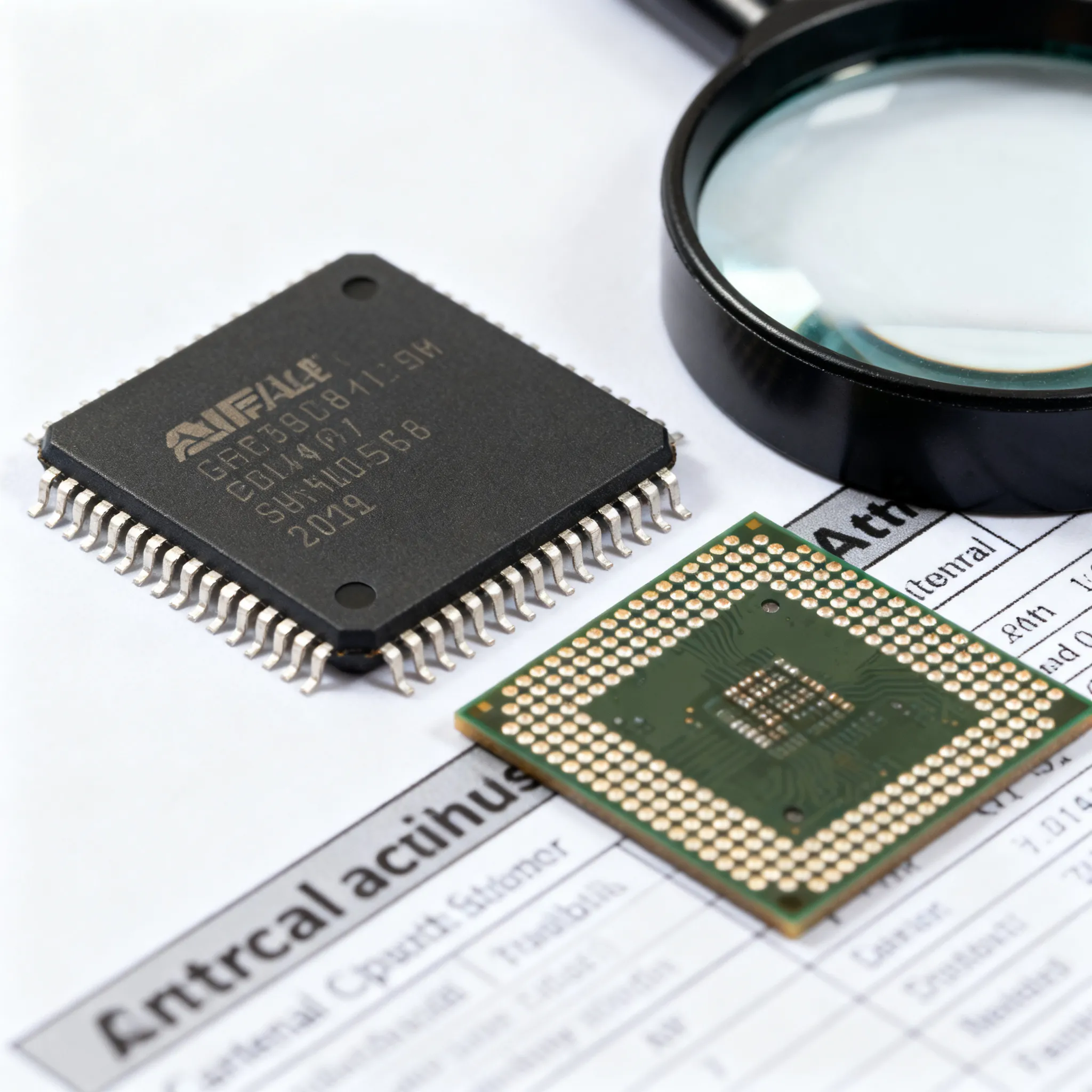
Visual inspection remains the front line. Under magnification (typically 10x to 40x stereo microscopy), inspectors check for inconsistent font, logo proportions, date/lot code format, pin finish, and package molding anomalies. Masline Electronics emphasizes that training should teach buyers exactly when visual concerns warrant escalation to laboratory-level authentication. A suspicious marking under the microscope is often the first signal that a part needs deeper scrutiny. Visual inspection is fast and inexpensive, but it cannot see inside the package.
X-ray inspection reveals the internal structure without destroying the part. It exposes missing or incorrect die sizes, inconsistent wire bonding patterns, and die orientation anomalies. This method catches a significant class of counterfeits—relabeled lower-spec parts, empty packages, and salvaged die in aftermarket lead frames. The limitation: X-ray cannot verify that the silicon itself matches the original design. A die that looks dimensionally correct could still be a different IC with similar pad layout.
Decapsulation and die-level analysis goes further. By chemically removing the package molding, inspectors can read die markings under high magnification and compare them against known-good reference samples from the original component manufacturer. Chipsgate notes that close inspection of die markings is often required to distinguish genuine components from high-quality counterfeits. Die markings include manufacturer logos, part numbers, and revision codes that counterfeiters frequently get wrong or omit. This method is destructive and relatively expensive, but it provides the highest confidence in authenticity short of full electrical characterization.
Electrical testing verifies that the part functions within its datasheet parameters. DigiSource advocates a complementary testing strategy combining automated optical inspection, X-ray, and both electrical and functional testing. A part that passes X-ray and visual checks can still fail under electrical load—wrong die revision, out-of-spec leakage current, or marginal timing performance. Curve trace testing and key parametric measurements provide a functional safety net.
Marking permanency testing applies solvents (per MIL-STD-883 or AS6171 procedures) to verify that markings are not superficially applied. Counterfeiters often re-mark parts with ink or laser etching that dissolves or smears under solvent exposure, while genuine manufacturer markings resist these chemicals. TechBullion provides a crucial caveat: even a clean test panel can miss sophisticated remarking, and not every cosmetic anomaly is a counterfeit. Aging, handling, and legitimate re-taping cause scuffs that can appear suspicious. The art is knowing when a cosmetic flag justifies escalating to X-ray or decapsulation.
Table 2: Inspection Methods Compared—What Each Tier Catches and What It Costs
| Inspection Method | Counterfeit Types Detected | Relative Cost Per Batch | Typical Turnaround | Limitations & Blind Spots |
|---|---|---|---|---|
| Visual / Microscopic (10x–40x) | Remarking, package anomalies, inconsistent date/lot codes, pin finish irregularities | Low | Hours | Cannot detect internal die issues; sophisticated laser remarking may pass |
| Solvent / Marking Permanency | Surface-applied ink, counterfeit laser etching on wrong material | Low | Hours | Does not catch original-marked salvaged parts; some genuine markings show age-related wear |
| X-ray (2D / 3D CT) | Empty packages, wrong die size, inconsistent wire bonding, die orientation errors | Medium | 1–3 days | Cannot verify silicon authenticity; correct-size die can still be wrong IC |
| Electrical / Curve Trace | Out-of-spec parametric performance, wrong die revision, ESD-damaged parts | Medium | 1–5 days | Requires known-good reference and test fixtures; may miss intermittent faults |
| Decapsulation / Die Analysis | Wrong die markings, salvaged/recycled die, clone ICs with visible die differences | High | 3–10 days | Destructive; requires golden sample comparison; costly for large batches |
| Functional / System-Level Test | Timing failures, firmware incompatibility, application-specific faults | Medium–High | 5–15 days | Test coverage limited to designed test cases; not practical for every SKU |
The ROI perspective matters here. TechBullion frames the decision clearly: compare the full-load cost of one in-field incident against your added inspection and test spend. The math almost always favors prevention—especially where safety, compliance, or brand trust are on the line. A $1,500 decapsulation analysis on a suspect batch is inexpensive compared to a field recall that costs hundreds of thousands in rework, warranty claims, and reputational damage. Testing reduces risk; pedigree authenticates. The two work together.
AS6171, AS6081, and DFARS: The Compliance Framework That Separates Replica from Real
Procurement teams operating in regulated industries do not have the luxury of choosing whether to implement counterfeit detection—the standards mandate it. Understanding the hierarchy of these frameworks helps buyers specify exactly what they need from suppliers and test labs, without over-specifying requirements that drive unnecessary cost into commercial products.
SAE AS6171 is the foundational test methods standard for counterfeit electronic parts. GovCon Giants details its scope: avoidance, detection, mitigation, and disposition. AS6171 defines the specific procedures for visual inspection, X-ray, solvent testing, decapsulation, and electrical verification. When a procurement contract references "AS6171 testing," it invokes a defined set of laboratory procedures with pass/fail criteria. This standard is test-lab-facing—it tells the inspector what to do and how to document results.
SAE AS6081 addresses the distribution chain specifically. AAACTL emphasizes AS6081 certification as the benchmark for distributors handling high-reliability components. While AS6171 focuses on test methods, AS6081 addresses the processes that prevent counterfeits from entering inventory in the first place: supplier qualification, procurement controls, traceability requirements, and incoming inspection protocols. A distributor certified to AS6081 has demonstrated that its entire operation—not just its testing capability—is structured to mitigate counterfeit risk.
DFARS (Defense Federal Acquisition Regulation Supplement) clauses—particularly 252.246-7007 and 252.246-7008—impose counterfeit prevention requirements on defense contractors. These clauses flow down through the supply chain, meaning that even lower-tier suppliers must implement detection and avoidance systems that satisfy DFARS obligations. For procurement teams supporting defense programs, DFARS compliance is not optional; it is a condition of contract eligibility.
The NQA Counterfeit Parts Checklist provides an audit-ready reference that bridges these standards into daily procurement practice. It frames supplier management and procurement's role in buying specified parts at the best price while meeting production schedules—and explicitly calls out that due consideration should be given to obtaining parts from sources that mitigate risks associated with part integrity. The checklist translates high-level standards into actionable verification points that a buyer or quality engineer can use during supplier qualification.
Accuris reinforces that incoming inspection protocols aligned with SAE AS6171—X-ray, decapsulation, die-level analysis—are now baseline expectations in regulated sectors, not optional extras. The compliance landscape has shifted from "test when you suspect a problem" to "test as a standard operating procedure." This is particularly true for any part that enters the supply chain through non-franchised channels, where the burden of proof for authenticity rests squarely on the buyer.
For commercial and industrial procurement teams not bound by DFARS, these standards still serve as practical benchmarks. Specifying "incoming inspection per AS6171 visual and X-ray requirements" in a purchase order gives the supplier clear expectations and provides documented recourse if counterfeit parts are discovered. The standards become a contractual tool, not just a compliance checkbox.
From Supplier Verification to Incoming Inspection: A Procurement Action Plan for Authentic Chips
Stopping counterfeit ICs is not a single-point solution. It is a sequence of decisions that starts before an RFQ is issued and continues until parts are on the production line. The following action plan draws on the research and frameworks discussed above, organized into concrete steps that procurement leads can implement without overhauling their entire operation overnight.
1. Anchor sourcing in authorized franchise distributors. Astute Group confirms the industry shift: procurement teams are moving to verified franchise sources even when unit costs are higher. The logic is irrefutable—authorized distributors have contractual traceability to the original component manufacturer and audited quality systems. During allocation-sensitive periods, when authorized channels may have constrained availability, the decision to go outside the franchise network should trigger mandatory escalation and additional inspection, not a routine purchase order.
2. Require encrypted digital signatures and traceability documentation. Summit Interconnect highlights the emergence of encrypted digital signatures as trust anchors. Where available, these provide cryptographic proof of origin. Even without digital signatures, procurement teams should require a Certificate of Conformance with full batch and lot traceability to the original component manufacturer, date codes, and documented chain of custody. Photographs of the actual parts prior to shipment add another layer of pre-receipt verification. For high-value or safety-critical parts, request test reports from an ISO/IEC 17025 accredited laboratory.
3. Define and enforce non-authorized sourcing policies. Accuris recommends explicit policies for non-authorized sourcing that include mandatory incoming inspection aligned with AS6171. These policies should specify exactly which tests apply based on part value, application criticality, and source risk level. A $0.50 decoupling capacitor from an unfamiliar broker may require visual inspection only; a $45 FPGA for a medical device demands X-ray and sample decapsulation. The policy removes judgment calls from individual buyers and embeds them in documented, auditable procedures.
4. Train buyers to recognize red flags. Masline Electronics emphasizes that training should teach procurement staff when visual concerns require additional inspection or laboratory authentication. Red flags that every buyer should recognize include:
- Unusually low pricing—a quote significantly below franchised distributor pricing for the same MPN should trigger immediate suspicion, not celebration
- Inconsistent date codes—parts with date codes that do not align with the manufacturer's documented production timeline warrant investigation
- Vague traceability—suppliers unable or unwilling to provide batch-specific traceability to the original component manufacturer should be treated as high-risk
- Non-standard packaging—generic trays, reels, or bags lacking manufacturer-specific markings can indicate re-handling or counterfeiting
- Pressure to bypass inspection—any supplier urging acceptance without standard incoming QC is raising a red flag that should be documented and escalated
5. Implement a complementary testing strategy at incoming inspection. DigiSource advocates a strategy combining automated optical inspection, X-ray, and electrical testing. The tiered approach from Table 2 above provides the framework: visual and marking permanency testing on every batch from non-franchised sources, X-ray sampling for medium-risk parts, and decapsulation for high-value or safety-critical components. This is not an all-or-nothing proposition—a 10% X-ray sample on a 500-piece lot catches most structural counterfeits at a fraction of the cost of 100% inspection.
6. Justify the budget with total-cost-of-ownership math. TechBullion provides the ROI framework: weigh the full-load cost of one field incident—rework, warranty claims, regulatory exposure, brand damage—against the incremental inspection spend. In most scenarios, preventing a single significant batch escape pays for years of inspection capacity. This framing converts counterfeit prevention from a cost center to a risk management investment, which resonates with finance and executive stakeholders.
Table 3: Mitigation Actions and When to Deploy Them
| Action | When to Use | Trade-off / Consideration |
|---|---|---|
| Franchise-only sourcing policy | Safety-critical, defense, medical, and high-reliability applications | Higher unit cost; may face availability gaps during allocation-sensitive periods—confirm allocation-backed lead time with supplier |
| AS6171 visual + marking permanency on all non-franchised receipts | Any part entering through non-authorized channels, regardless of value | Adds 1–3 hours to incoming QC; minimal cost; catches the majority of crude-to-intermediate counterfeits |
| X-ray sampling (10–20% of lot) | Medium-to-high value ICs from secondary sources; legacy parts for long-lifecycle products | $200–$500 per batch; 1–3 day turnaround; may miss die-level counterfeits with correct internal geometry |
| Decapsulation with die-marking comparison | High-value or safety-critical parts; suspect batches that passed X-ray; first article from new non-franchised source | $800–$2,500 per sample; destructive; 3–10 day turnaround; highest confidence authenticatio |
| Buyer counterfeit awareness training + NQA checklist adoption | Immediately for all procurement staff; refresh annually | Minimal direct cost; requires 4–8 hours per buyer; dramatically raises the barrier for counterfeit parts entering the procurement pipeline |
Chipsgate's procurement guide reinforces a practical point: the lowest purchase price can become extremely expensive if the components are defective or counterfeit. Procurement teams should evaluate the complete cost and risk associated with each sourcing decision—not just the line-item price on the PO. When counterfeits reach production, the costs multiply: rework labor, scrap, line downtime, delayed shipments, and in the worst case, field failures that erode customer trust and trigger contractual penalties.
Tip: Start with the quick wins. A digital microscope inspection station costs less than $500 and can be operational within a week. Combine this with a mandatory supplier qualification checklist and buyer awareness training, and you have raised the counterfeit barrier significantly before investing in X-ray or decapsulation capability. These foundational steps demonstrate ROI that can justify the next tier of investment.
Procurement Leads Ask: Counterfeit IC Risks, Detection ROI, and Supplier Trust
Q: What level of counterfeit detection is appropriate for non-aerospace products where safety is not a direct concern?
Even commercial and industrial products without direct safety implications carry real exposure. Field failures generate warranty claims, service dispatches, and brand damage that compound quickly. A tiered approach works well: visual inspection plus electrical testing at a minimum catches most suspect parts—inconsistent markings, wrong pin-1 indicators, out-of-spec leakage current. Reserve X-ray and decapsulation for high-value assemblies, long-lifecycle products where field replacement is expensive, or batches that trigger visual red flags. TechBullion's ROI analysis consistently shows that prevention spending breaks even after preventing a single significant incident. The question is not whether you can afford the inspection—it is whether you can afford the recall.
Q: How can we justify the cost of AS6171 testing to management when margins are tight?
Frame the conversation around risk transfer. Every dollar not spent on inspection is a dollar of risk retained on your balance sheet. Compare the per-batch testing cost against the fully loaded cost of one field return: rework labor, shipping, customer downtime, engineering investigation time, and—if the failure reaches a regulated environment—potential regulatory fines or contract disqualification. For organizations serving defense or aerospace markets, AS6171-aligned testing is not optional; it is a condition of doing business, and skipping it risks losing the contract entirely. Even in purely commercial lines, the math is compelling: a $1,500 decapsulation that prevents a $50,000 field service event is a 33x return. Present it as an insurance premium, not a quality overhead.
Q: Can we rely solely on franchise distributors, or do we still need in-house inspection?
Authorized franchise distributors dramatically reduce counterfeit risk—their supply chains are contractually linked to original component manufacturers, and their quality systems are audited. But "dramatically reduced" does not mean "eliminated," particularly during acute supply constraints when even authorized channels may supplement inventory from secondary sources to meet demand. Incoming inspection aligned with AS6171—at minimum, visual and marking permanency checks with X-ray sampling—provides a safety net that catches anomalies before they reach your production line. It also satisfies traceability documentation requirements that many end customers now demand. Think of franchise sourcing as your primary defense and incoming inspection as the secondary layer that catches what slips through.
Q: What documentation should we demand from non-franchised sources to reduce traceability gaps?
Require, at minimum: a Certificate of Conformance with batch and lot traceability to the original component manufacturer; clear date codes that align with the manufacturer's documented production timeline; and a documented chain of custody showing each transfer from the OCM to your receiving dock. When parts are high-value or destined for regulated applications, request test reports from an ISO/IEC 17025 accredited laboratory and photographs of the actual parts you will receive—not stock images. Encrypted digital signatures on components, where available from the manufacturer, are an emerging proof point that can cryptographically verify origin. If a supplier cannot or will not provide traceability documentation, treat that as a disqualification criterion—not a negotiation point.
Q: How do I differentiate a genuine cosmetic anomaly from a counterfeit remark?
Aging, handling, and legitimate re-taping during distribution can cause scuffs, faint markings, or surface wear that appears suspicious under magnification. Counterfeit indicators are more systematic: inconsistent font compared to a known-good reference sample; logo proportions or aspect ratios that differ from manufacturer artwork; date or lot codes in formats the manufacturer never used; laser etching that appears under a different angle or depth than genuine examples; and pin-1 indicators that are the wrong shape or position. Chipsgate emphasizes that die-marking comparison against a known-good golden sample is often the definitive check. Keep a library of verified genuine parts for each critical MPN—under a microscope, the differences become visible. When doubt persists after visual comparison, escalate to X-ray or decapsulation rather than making a judgment call at the microscope.
Q: Are there quick wins for improving counterfeit resilience without overhauling the entire procurement process?
Yes, and they can be deployed within weeks:
- Mandate counterfeit awareness training for all procurement staff—a four-hour session covering red flags, documentation requirements, and escalation procedures
- Adopt a supplier qualification checklist using the NQA Counterfeit Parts Checklist as a starting point; make checklist completion mandatory before any new non-franchised supplier is approved
- Set up a digital microscope inspection station at incoming QC—less than $500 in equipment cost, operational within days, and capable of catching the majority of visually detectable counterfeits
- Implement a "red flag" escalation rule: any quote more than 30% below franchised pricing for the same MPN triggers mandatory quality review before purchase order issuance
- Build a golden sample library for your top 20–50 critical ICs—verified genuine parts that serve as visual and electrical reference standards for incoming comparison
These steps do not replace AS6171 lab testing, but they raise the counterfeit barrier significantly and build organizational capability that makes deeper inspection investments more effective when you deploy them.
References & Further Reading
Related Articles
 Blog
BlogWhat Capacitor Series Resistance Is and How It Appears in Standard Hardware
The series resistance of capacitor (ESR) is internal resistance causing voltage drop, heat, and weaker filtering in standard hardware. Learn how it impacts circuits.
 Blog
BlogUnderstanding DC Circuits and Their Practical Uses
What is a dc circuit? It's a closed loop with constant voltage and unidirectional current, powering everyday electronics. See its practical uses in electronics.
 Blog
BlogCut BOM Costs and PPV with Smart RFQ Packaging for OEM EMS Buyers
BOM and RFQ best practices for electronic component procurement. Upload your BOM or request a quote for mixed lines and flexible MOQ.
 Blog
BlogCS8575S Supply Risk Assessment: What to Ask Before You Buy
Assess CS8575S sourcing risks before you buy. RFQ questions on traceability, date codes, testing, alternatives, and supply continuity for procurement teams.
 Blog
BlogFlipper Zero 2026 What It Does in Plain Electronics Language
What can Flipper Zero do? It reads, copies, and emulates wireless signals like RFID, NFC, and infrared. Test only your own devices legally.
 Blog
BlogXARR-10VF Obsolescence Risk Checklist: Verify Lifecycle Status and Secure Supply
XARR-10VF lifecycle and obsolescence risk checklist. What to verify before redesign or last-time-buy — without assuming drop-in replacements.