Flexible MOQ and Mixed BOM Sourcing for NPI: Optimize Your RFQ and BOM Upload Process
BOM and RFQ best practices for electronic component procurement. Upload your BOM or request a quote for mixed lines and flexible MOQ.
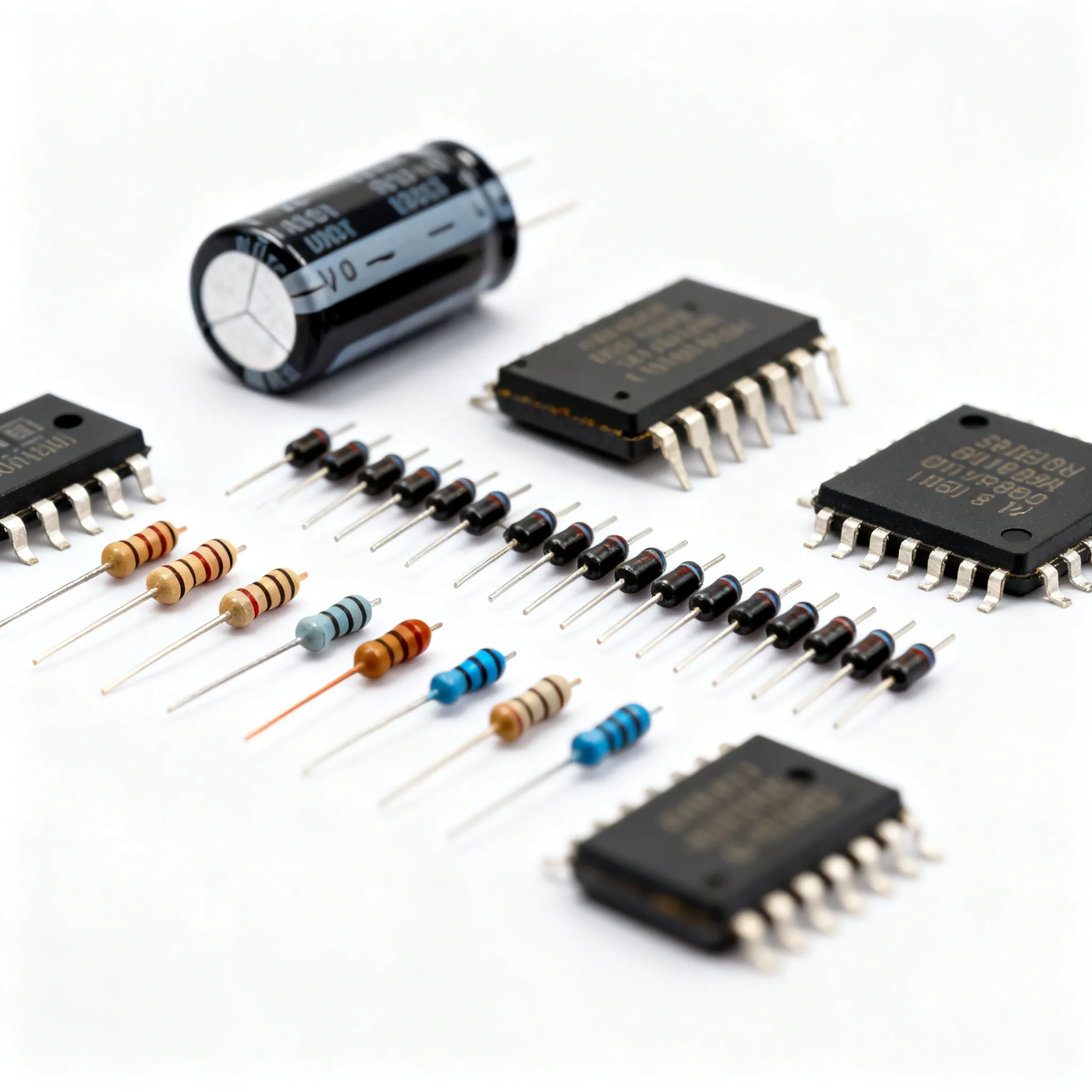
Why Rigid MOQs Can Stifle Your NPI Project Before It Even Starts
An NPI (New Product Introduction) build lives or dies on speed and cash flow. Yet many electronics procurement teams discover too late that standard minimum order quantities (MOQs) from franchise distributors convert a prototype bill of materials into a capital-intensive bottleneck. When a single line item carries a full-reel minimum of 2,000 units and you need just 50 for first-article validation, the math unravels quickly.
A supplier guide published by Alibaba’s electronics sourcing team breaks down the economics: franchise representative markup typically adds 12–15% over list price, and sub‑1k orders can incur penalty fees such as a flat $500 MOQ surcharge (Alibaba, 2026 Supplier Guide). Meanwhile, direct factory channels might quote 8–12% below list — but require a 30% upfront deposit and ship only after 8–12 weeks, a timeline that can derail an aggressive engineering schedule.
These structural constraints push NPI managers toward a painful choice: over-buy and warehouse surplus parts that may become obsolete, or delay the build while hunting for low-volume alternatives. The industry is responding. ADD Components, an independent distributor, states bluntly that “there is no fixed MOQ — it depends on the specific part, its availability, and the sourcing channel” and that for prototype and NPI builds, it can often arrange small quantities from partial reels or excess stock, dodging the cost of full factory packaging (ADD Components FAQ). Similarly, Yuanhui Lighting’s flexible MOQ protocol (50–200 units) demonstrates that modular tooling and mix-model assembly let even hardware-centric teams iterate quickly without mass-production commitment (Yuanhui Lighting).
Before diving into mixed sourcing tactics, it’s worth mapping why rigid MOQs hit NPI projects so hard. The table below isolates five key drivers.
| Driver | Mechanism | Procurement Impact |
|---|---|---|
| Full-pack MOQ enforcement | Distributors require purchase of entire reel/tray/tube as a minimum sellable unit | Forces 2,000–5,000 unit buy when you require 50; ties up NPI budget and shelf space |
| Franchise penalty clauses | Sub-threshold order surcharges (e.g., $500 per line) imposed on orders under 1k units | Adds hidden line-item cost that distorts BOM targeting; may make PCB assembly uneconomical |
| Factory lead-time walls | Direct manufacturer quotes 8–12 week first-lot lead time plus 30% deposit | Delays engineering verification and qualification cycles, pushing revenue recognition further out |
| Single-channel lock-in | Teams rely on one franchised source for everything, even passive components | Little leverage to negotiate MOQ; any line-item OOS triggers full BOM stall |
| Lack of visibility into alternate packaging | Engineering requests specific MPN in reel format, unaware cut-tape or digi-reel exists | RFQ arrives with inflated per-line costs; re-quoting loop wastes 3–5 business days |
The takeaway: MOQ rigidity is rarely about the component’s unit price. It’s about matching order granularity to NPI demand before the RFQ solidifies. The next sections show how to break that rigidity with a mixed BOM approach and smarter tooling.
How Mixed BOM Sourcing Turns Procurement From a Gatekeeper Into a Launchpad
Mixed BOM sourcing is the practice of splitting a single bill of materials across two or three supplier tiers — franchise, independent brokers/excess-stock specialists, and direct factory channels — based on each line item’s criticality, volume, and timeline. Instead of sending the entire BOM to one franchised catalog house and accepting whatever MOQ and lead time apply, you treat the BOM as a portfolio of components with different risk profiles and sourcing flexibility.
Tools like Octopart’s BOM portal (via Altium) generate a purchasing order list that “compares stock levels, unit pricing, lead times, MOQs, and packaging options side by side” across enabled distributors (Altium, Strategic Procurement with BOM Portal). MySupplyParts adds a layer of supply realism by flagging whether a part is truly “In Stock” or on “Factory Lead Time,” preventing accidental orders that would arrive in 20 weeks (MySupplyParts BOM Tool Guide). When you upload a BOM into such a system, you can instantly see which lines carry a 5,000-unit MOQ and which are available in cut-tape quantities — long before you commit to an RFQ.
Understanding the trade-offs by supplier type is essential. The table below frames how each channel affects MOQ flexibility, lead time, and cost for an NPI bill.
| Supplier Type | MOQ Flexibility Effect | Lead Time Effect | Unit Price Effect | NPI Suitability Notes |
|---|---|---|---|---|
| Franchise Distributor (authorized) | Low — full-pack minimums enforced; sub‑1k surcharges common | Short (1–2 weeks) for stock on hand; longer if allocation applies | 12–15% above list price; penalty fees raise per-unit cost on small lots | Best for critical ICs and microcontrollers where authenticity chain is non-negotiable; verify MOQ per line via RFQ |
| Independent Broker / Excess-Stock Supplier | High — no fixed MOQ; partial reel, cut tape, or excess inventory available | Short (days) for in‑stock items; variable for search-and-procure | May carry small markup over factory but avoids full‑pack cost; negotiate based on market conditions | Ideal for prototype builds where quantities are tiny and authenticity testing is in place; ask for date code and traceability docs |
| Direct Factory Channel (OEM-authorized) | Medium — MOQ negotiable but often in the hundreds; initial lot may require batch minimum | 8–12 weeks for first lots, per Alibaba supplier guide; plus 30% deposit | 8–12% below list, but capital tied up in deposit and long lead | Suitable for repeat NPI spins once design is stable and volumes can be forecast; not for urgent first prototype unless planned ahead |
The beauty of a mixed BOM approach is that you don’t need to pick one channel. You can place microcontrollers and high-speed ADCs with a franchise partner, source generic 0402 resistors and decoupling caps through a broker with partial reel flexibility, and if the design calls for a custom magnetics or connector, engage the factory early for that specific line. The key is to run the analysis before the RFQ leaves your desk — otherwise, the quote you receive will bake in all the rigid assumptions of a single-channel world.
Franchise, Broker, or Factory Direct? Mapping NPI Sourcing Channels to Component Priority
Every line on an NPI BOM has a different risk and volume profile. A general-purpose STM32 or GD32 MCU might be available from multiple channels, but a specialized analog front-end IC may have only one franchise path. Passives like MLCCs and chip resistors — especially in standard 0603 or 0402 packages — are commodity items that independent brokers can supply in cut-tape lengths without MOQ headaches. The decision matrix should be driven not by convenience but by a deliberate mapping exercise.
A practical comparison of the three avenues, drawing on the Alibaba supplier guide and the ADD Components insight, helps teams decide where each line belongs.
- Authorized Franchise Distributors: They enforce MOQs but guarantee authenticity and full datasheet compliance (Alibaba guide). Use them for safety-critical ICs, power MOSFETs, and any component where a counterfeit failure would be catastrophic. Verify allocation-backed lead time via RFQ. Expect a 12–15% markup and penalty fees on sub‑1k orders.
- Independent Brokers / Excess-Stock Suppliers: ADD Components explicitly states no fixed MOQ; it arranges small quantities from partial reels or excess stock — crucial for prototype builds (ADD Components FAQ). Best for passives, connectors, and older MCUs where design validation won’t be compromised. Require traceability documentation and a known-good incoming inspection flow.
- Direct Factory Channels: Alibaba’s guide notes direct factories may quote 8–12% below list, but require a 30% upfront deposit and supplier-confirmed lead / delivery timing times (Alibaba guide). This channel works when you have a committed production schedule and can absorb the cash flow impact. Not the place for early-stage NPI unless you’ve factored the lead time into your program plan.
The risk of single-source lock-in is not theoretical. If you route all BOM lines — including jellybean parts — through one franchise distributor, every line with an allocation-sensitive status becomes a project-level blocker. Pushing end-of-life (EOL) or NRND parts to a broker while keeping the MCU on franchise order splits the risk. As the Kynix MOQ analysis emphasizes, “bypassing gatekeeping” on commodity BOM lines is a strategic choice for hardware founders and engineers (Kynix MOQ Analysis).
RFQ and BOM Upload Hacks That Slash Lead Times and MOQ Penalties
Even with a sound channel strategy, the difference between a smooth NPI launch and a procurement fire drill often lies in how you prepare the RFQ and BOM before hitting “submit.” Tooling behavior and a few deliberate upload habits can eliminate the surprise of a 5,000-unit minimum on a line you assumed would ship in cut tape.
First, always check the inventory status flag. MySupplyParts distinguishes “In Stock” from “Factory Lead Time,” which means you won’t accidentally place an order for a part that won’t arrive for 20 weeks (MySupplyParts BOM Tool Guide). In the same vein, Altium’s Order List uncovers packaging mismatches — if a part exists in both reel and cut-tape format, the tool surfaces the lower-MOQ option before you lock in the quote (Altium Strategic Procurement).
Second, consolidate passives across multiple line items. If you need seven different resistor values, each in 50-unit quantities, combine them into a single order with one distributor to reach a threshold that avoids the $500 sub‑1k penalty. The Alibaba guide’s mention of that penalty emphasizes why this tactic matters — a few extra minutes of line consolidation can save hundreds of dollars per BOM revision (Alibaba guide).
Third, use BOM upload tools to request alternate part numbers (APNs) and second-source candidates at the RFQ stage. Octopart’s pulse post on strategic procurement explains that the order list surfaces alternative packaging or equivalent parts automatically, letting you opt for a pin-compatible MCU (such as a GD32 or APM32 family) where the original MPN is allocation-sensitive — provided you verify pinout and firmware compatibility with your engineering team (Octopart Pulse).
The table below translates these insights into a set of actionable mitigations that can be applied at RFQ time.
| Action | When to Use | Trade-off |
|---|---|---|
| Enforce “In Stock” vs. “Factory Lead Time” check | Before finalizing any RFQ for prototype or initial NPI | Reduces available SKU pool; may force substitution to a different grade or package |
| Consolidate passives into single distributor cart | When seven or more low-value lines each have a sub‑100 quantity | Reduces line‑item cost but may limit supplier competition; verify the distributor covers all values before committing |
| Request APNs and cross‑references during BOM upload | Always for MCUs, FPGAs, and memory components in NPI BOMs | Requires engineering sign‑off on candidate substitutes; document firmware/package differences |
| Negotiate partial‑reel availability with independent brokers | When slow‑moving or high‑minimum franchise lines threaten build schedule | Must invest in incoming inspection; date code and traceability docs are mandatory |
| Separate factory‑direct lines into an advance order block | For stable BOMs where first‑article spin is planned 12+ weeks out | Capital tied up in deposit; late design change invalidates factory commitment |
When you combine these hacks with a mixed BOM sourcing plan, you effectively decouple the NPI timeline from the worst-case MOQ of any single supplier. The RFQ becomes a negotiation tool rather than a hindrance, and the BOM upload transforms from a blind data dump into a strategic sourcing exercise.
Flexible MOQ and Mixed Sourcing: The Questions Procurement Teams Actually Ask
Even experienced procurement leads encounter gray areas when moving from a single-channel model to a flexible, mixed sourcing workflow. Here are the questions that surface repeatedly in NPI planning meetings.
- Q: What exactly does “flexible MOQ” mean for an NPI build?
- A: It means sourcing components in quantities below the supplier’s standard full‑packaging requirement — often partial reels, cut tape, or excess stock from brokers. ADD Components notes there is no fixed MOQ; availability depends on the part and channel, so you can avoid ordering 5,000 units when you need 50 (ADD Components FAQ). Flexible MOQ isn’t a guarantee on every part, but it’s a procurement posture that says: find the smallest viable quantity that satisfies validation needs without accepting full-pack penalties.
- Q: How do I avoid $500 MOQ penalties when ordering from franchise distributors?
- A: Consolidate multiple NPI BOM lines with the same distributor to reach their threshold, choose components available in “cut tape” or “digi‑reel” packaging, or supplement with an independent broker for low‑quantity lines. The Alibaba guide highlights that franchise reps often impose these penalties on sub‑1k orders, so plan your BOM split accordingly — push commodity passives and connectors to a flexible broker while keeping franchise lines for ICs where authenticity traceability is critical (Alibaba guide). Checking the component’s available packaging options before issuing an RFQ can eliminate the penalty before it appears.
- Q: Can I safely mix components from independent brokers and authorized distributors on one BOM?
- A: Yes, provided you apply rigorous incoming inspection and only use brokers with proven traceability and authenticity guarantees. For NPI, many teams use authorized distributors for microcontrollers and critical ICs, while sourcing passives and connectors from brokers to balance cost and speed. Require a certificate of conformance, date code documentation, and photographs of the physical parts; for high-risk lines, order a small sample and perform X-ray or electrical testing before committing to the full build.
- Q: How do BOM upload tools help reduce MOQ friction?
- A: Tools like Octopart’s BOM portal and MySupplyParts instantly compare stock levels, MOQs, lead times, and pricing across multiple suppliers. They flag lines where the distributor requires a 5,000‑unit minimum and suggest alternatives, preventing you from locking in a quote that would derail your timeline (Octopart Pulse). MySupplyParts’ stock reliability indicator explicitly surfaces whether a part is in stock or subject to factory lead time, so you can swap lines before the RFQ goes out (MySupplyParts BOM Tool Guide). The result is a finalized BOM that reflects the most flexible, realistic options, not just the first part that met the electrical spec.
- Q: What are the lead‑time trade‑offs when splitting a BOM across franchise, broker, and direct factory?
- A: Franchise distributors offer stock on hand with supplier-confirmed lead / delivery timing but at higher cost. Brokers can ship within days for in‑stock items but may lack long‑term allocation commitment, so you’ll need to re‑validate availability for subsequent builds. Direct factory channels promise supplier-confirmed lead / delivery timing times for first lots with lower unit prices — workable only if you place orders well ahead of the build (Alibaba guide). The optimal split gives fast-turn parts (broker, franchise stock) to the prototype spin, while locking factory orders for repeat runs once the design is frozen.
- Q: Is a flexible MOQ policy only relevant for startups, or do larger companies benefit too?
- A: Even mature OEMs use flexible MOQs for NPI and engineering prototypes to avoid capital drag and warehouse bloat. Yuanhui Lighting’s 50–200 unit flexible MOQ protocol, originally designed for startups, demonstrates that modular tooling and small‑batch builds benefit any team looking to iterate quickly without mass‑production commitment (Yuanhui Lighting). A large company that stocks hundreds of thousands of unused chips gathered from full-reel MOQ buys on previous NPIs incurs holding costs and obsolescence risk — making flexible sourcing a financial discipline, not just a startup hack.
References & Further Reading
- How to Choose Electronic Component Suppliers: A Practical 2026 Guide — Alibaba
- Electronic Components Sourcing FAQ — Shortage, Authenticity & Procurement — ADD Components
- How does a flexible MOQ policy support startups in the lighting industry? — Yuanhui Lighting
- What Is an MOQ? Understanding Minimum Order Quantities in Electronics — Kynix
- Strategic Procurement with BOM Portal: Cost Optimization for Production BOMs — Altium
- Strategic Procurement with BOM Portal: Cost Optimization — Octopart Pulse
- How to Use MySupplyParts: Single Part Search & BOM Tool Guide
Your NPI project doesn’t have to absorb the cost and timeline drag of rigid MOQs. By mixing authorized, broker, and factory direct channels, and by leveraging BOM upload tools that surface packaging alternatives and MOQ flags before you commit to an RFQ, you turn procurement into a competitive advantage. Ready to test a mixed BOM, flexible MOQ approach for your next prototype or pilot build? Upload your BOM or request a quote on IC-Online — our team will help you navigate channel options and find the smallest viable quantities without compromise on traceability.