How OEM EMS Buyers Can Reduce BOM Costs and Improve PPV Using BOM Upload and RFQ
Expert guide on How OEM EMS Buyers Can Reduce BOM Costs and Improve PPV Using BOM Upload and RFQ. Technical specs, applications, sourcing tips for engineers and buyers.
The Real Cost of a Fragmented BOM: When Manual Spreadsheets Lead to Line-Downs, Recalls, and PPV Drift
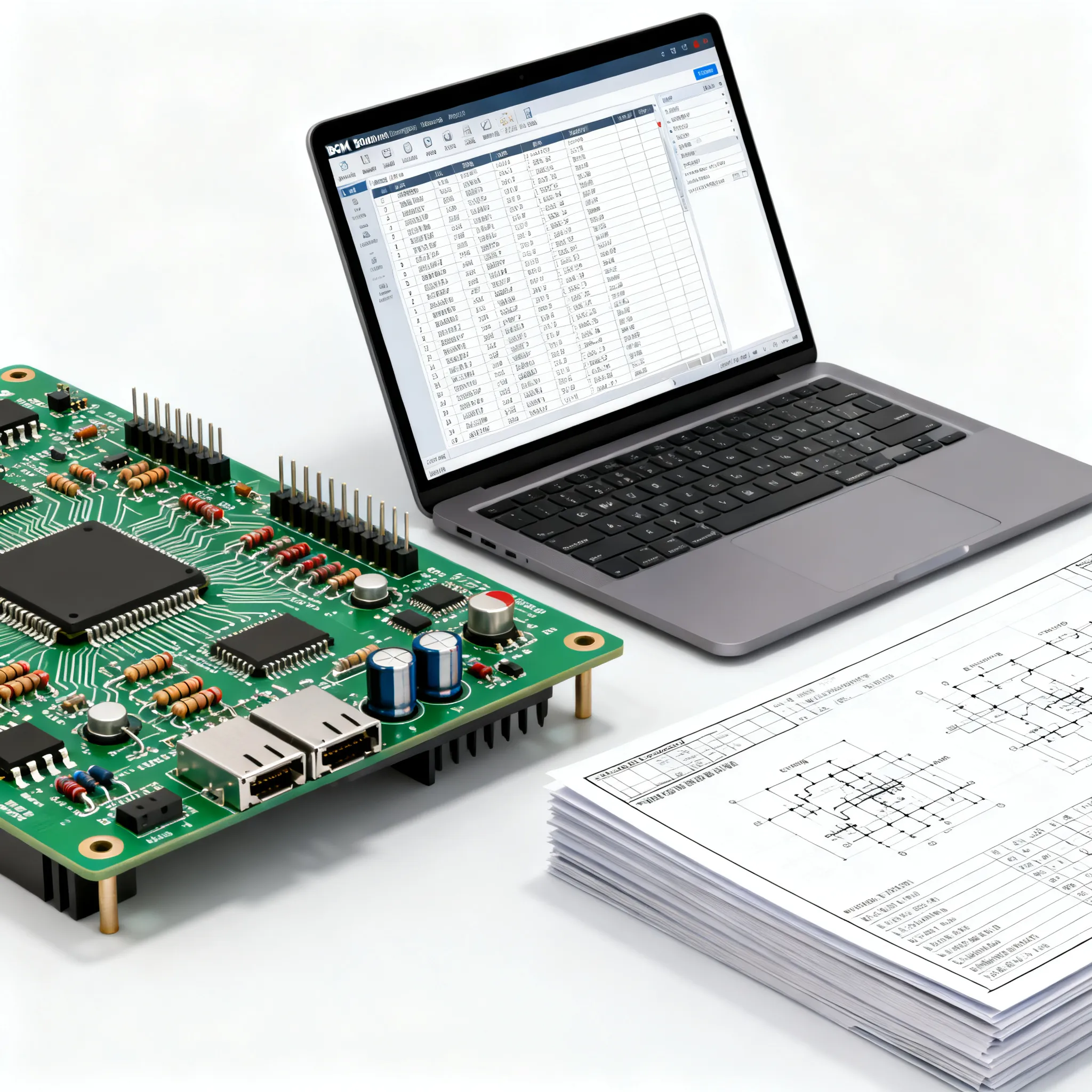
A BOM that lives in a collection of departmental spreadsheets, email threads, and aging ERP exports is not a bill of materials — it is a procurement liability. When an OEM buyer cannot see the full, live picture of every line item, purchase price variance (PPV) begins to drift silently, and the consequences are rarely confined to a spreadsheet cell. Syrma SGS describes the outcome of a coordinated EMS approach as “a lower and more predictable Bill of Materials (BOM) cost, achieved through intelligence and coordination, not corner-cutting.” The reverse is equally true: without that coordination, costs become unpredictable, and the damage can be immediate.
The risks are not hypothetical. Component Solutions Group catalogues the failure costs that hit OEMs when sourcing breaks down: “field failures such as warranty claims, recalls, and reputation damage, plus line-down events caused by a stockout or quality issue.” These events are often triggered by a single part number that was entered incorrectly, omitted from an approved vendor list, or left unchanged while a manufacturer quietly shifted the lifecycle status. Avnan reinforces that “they also vet suppliers for quality and reliability, which reduces the risk of costly quality issues or last-minute scrambles for replacements.” When an OEM tries to manage this vetting manually across dozens of line items, the risk of a missed signal multiplies.
Turnkey EMS providers take a different path. A2Z EMS notes that “instead of each OEM negotiating on its own, turnkey electronics manufacturing services leverage shared purchasing power and market insights to reduce your BOM costs and keep parts flowing.” The difference between a collaborative, data-driven approach and a fragmented manual one is not just price — it is the margin between a production line running at full capacity and a line-down event that costs thousands of dollars per hour. The table below maps the most common drivers of BOM fragmentation and their direct procurement impact.
| Driver of Fragmentation | Mechanism | Procurement Impact |
|---|---|---|
| Multiple BOM versions in circulation | Engineering, sourcing, and manufacturing use different revisions | EMS quotes against obsolete data; PPV drifts as the build discovers missing or changed parts |
| Missing or outdated manufacturer part numbers | BOMs contain internal descriptions only, no full MPNs | Buyers cannot source effectively; spot buys at premium prices inflate BOM cost |
| No approved alternates listed | BOM is rigid, forcing single-source dependency | Price negotiation leverage disappears; stockouts trigger emergency purchases |
| Packaging and MOQ data omitted | Tape-and-reel, tray, or tube quantities not specified | EMS pads quotes to cover MOQ fees; true landed cost is hidden |
| Lifecycle status not tracked | EOL/NRND parts slip into production without notice | Last-time buys and redesigns spike costs; PPV variance becomes uncontrollable |
| Manual cost roll-ups in spreadsheets | Indirect costs (tariffs, freight, overhead) are estimated or ignored | Standard cost lags reality; PPV reports show false savings until a quarter-end correction |
These drivers are the very failure modes that a structured BOM upload and competitive RFQ process are designed to eliminate. When you move from email-based spreadsheets to a centralised digital BOM that flows directly into an RFQ, you stop treating cost as an after-the-fact PPV variance report and start using it as a live sourcing lever. The next section breaks down the mechanics of that transformation.
How a Digital BOM Upload and Competitive RFQ Turn Component Costs into a PPV Advantage
The mechanics are straightforward but powerful. When an OEM buyer uploads a clean, fully specified BOM — complete with manufacturer part numbers, approved alternates, packaging preferences, and target dates — and issues an RFQ to multiple EMS providers simultaneously, the entire cost structure realigns. The quotes that come back are no longer padded with assumptions. Instead, they reflect aggregated purchasing power, component availability forecasts, and intelligent substitution strategies that the OEM could never replicate alone.
Avnan explains that “economies of scale EMS providers consolidate orders for components across multiple customers. This aggregated purchasing means they buy in bulk and can secure parts at lower unit prices.” Those savings are not theoretical; they flow directly into the quoted unit cost of each line item. At the same time, Syrma SGS points out that “the component prices are lowered through EMS scale, supplier relationships, and forecasting tools without any loss in quality.” That last phrase — “without any loss in quality” — is critical because it answers the persistent fear that cost reduction equals corner-cutting. A well-run RFQ process raises quality by forcing every supplier to quote against the same clear specification, making it impossible to hide behind ambiguous data.
Equally important is getting the total cost picture right. AGS Devices emphasises that you must “add indirect costs such as shipping, tariffs, and procurement overhead for a more accurate total.” A digital BOM upload that includes incoterms, freight assumptions, and country-of-origin flags transforms the RFQ from a unit-price race into a genuine landed-cost comparison. Venture Outsource discusses how BOM management and quote pricing strategies reduce material spend, noting that tools like ERP systems and BOM management software help automate and standardise this process. The table below illustrates what changes when you move from a manual spreadsheet to a structured digital BOM upload with RFQ.
| Cost Element | Manual Spreadsheet Approach | Digital BOM Upload + RFQ | PPV Impact |
|---|---|---|---|
| Direct material unit cost | Based on last purchase price or distributor web price | Reflects aggregated EMS volume pricing and multi-supplier quotes | Reduces standard cost basis; narrows PPV gap |
| Indirect costs (shipping, tariffs, duties) | Estimated as a flat percentage, often inaccurate | Quoted using actual incoterms and freight lanes per line item | Eliminates large quarter-end adjustments |
| Total landed cost | Sum of unit cost + rough indirect estimate | Exact landed cost line-by-line, comparable across EMS partners | PPV becomes a true performance metric, not a guess |
| MOQ and packaging surcharges | Hidden; EMS pads quote to cover unknown quantity breaks | Explicitly quoted based on tape-and-reel, tray, or tube requirements | Prevents PPV erosion from unexpected MOQ fees |
| Component substitution risk | EMS may substitute lower-cost parts without visibility | Substitutions flagged, priced, and validated against AVL rules | Controls PPV while maintaining quality |
| Quote comparison speed | Days to weeks of manual spreadsheet consolidation | Side-by-side landed cost comparison in hours | Faster decisions stop PPV from drifting while sourcing |
When you look at the right-hand column, the pattern is clear: PPV stabilises not because the market suddenly becomes cooperative, but because the data flowing into the RFQ eliminates the assumptions that create variance in the first place. A buyer who can compare three EMS quotes on total landed cost for the same 150-line BOM within 24 hours is no longer reacting to PPV — they are actively managing it.
Self-Sourcing, EMS Aggregated Purchasing, or Turnkey: Which Model Delivers the Best PPV?
Once the BOM is digitised and the RFQ discipline is in place, the next strategic question is which sourcing model to use. OEM buyers typically face three options: self-sourcing components and delivering them to the EMS as free-issue material, relying on the EMS’s aggregated purchasing power for the entire BOM, or engaging a full turnkey partner that handles sourcing, assembly, test, and logistics. Each model has a distinct effect on BOM cost, PPV, and operational overhead. The choice is not abstract; it is a decision that a BOM upload and RFQ process makes visible and measurable.
Avnan summarises the advantage of aggregated purchasing in clear terms: “those savings are passed to you, the OEM, resulting in a lower BOM cost than if you sourced individually.” This is the core of the EMS aggregated model — the provider buys across multiple customers, obtains volume pricing, and the OEM benefits without having to carry the inventory or negotiate the contracts. Syrma SGS adds that “the component prices are lowered through EMS scale, supplier relationships, and forecasting tools without any loss in quality,” underscoring that the cost reduction is structural, not a one-off negotiation win.
Turnkey EMS goes further. A2Z EMS explains that “turnkey EMS cuts hidden costs by uniting sourcing, assembly, test, and logistics. Centralized purchasing lowers BOM prices, inventory, and write‑offs.” When a single partner owns the entire material and production flow, the PPV variance that typically appears at handoff points — from OEM warehouse to EMS, from EMS to board-level test — disappears. Furthermore, Fumaxtech reveals a nuance that many buyers encounter: “one possible reason [for pricing differences] is component substitution strategy. Some suppliers may actively replace components with lower-cost alternatives during the quotation stage in order to provide a more competitive BOM cost.” This is not inherently a problem; it can be a cost advantage if the OEM defines substitution rules clearly in the BOM upload. The table below compares the three models across the dimensions that matter most for PPV.
| Comparison Metric | Self-Sourcing (Free-Issue) | EMS Aggregated Purchasing | Turnkey EMS | Selection Criteria & Failure Boundary |
|---|---|---|---|---|
| BOM cost reduction mechanism | OEM controls negotiation; rarely achieves volume discounts | EMS consolidates demand across customers, passes bulk savings | Centralised purchasing plus logistics optimisation reduces total landed cost | Self-sourcing fails when OEM lacks scale; aggregated purchasing works best with standardised BOMs |
| Typical PPV improvement | Marginal; PPV drifts with spot buys and inventory carrying costs | 5–10% BOM cost reduction, narrower PPV variance | 7–15% reduction in total landed cost, most stable PPV | Actual PPV depends on BOM complexity and EMS forecast accuracy |
| Quality risk | OEM bears full responsibility for component authenticity and traceability | EMS vets suppliers; quality risk is shared and documented | Single-point accountability; supplier qualification is integrated | Self-sourcing increases risk of counterfeit parts if supply base is not audited |
| Lead time visibility | OEM must track multiple component orders; gaps cause line-downs | EMS provides consolidated lead time view; buffers with inventory | Turnkey partner owns the entire timeline; early warnings built in | Self-sourcing lead time risk is highest when any part is allocation |
| Administrative overhead | High: multiple POs, inbound logistics, inventory reconciliation | Medium: single PO to EMS, but component cost detail must be audited | Low: one PO, one invoice, full material traceability | Overhead cost can erode any unit-price savings in self-sourcing |
For most OEM buyers, the sweet spot is a structured BOM upload that lets you compare EMS aggregated purchasing and turnkey proposals side by side. When you add the Fumaxtech insight about substitution strategies, the key is to define your substitution policy in the BOM upload itself: which parts are open to alternates, which require manufacturer approval, and which are locked. This turns a potential risk into a managed cost lever, and your RFQ results will tell you exactly which model delivers the best PPV for your specific mix of line items.
Five BOM Upload and RFQ Practices That Stop PPV Drift Before It Starts
PPV drift is not a market condition; it is a data problem. The following five practices, each derived from the research and real EMS behaviour, transform the BOM upload and RFQ sequence from a simple price exercise into a continuous PPV improvement engine. They are designed to be applied immediately, regardless of your current ERP maturity.
- Include full manufacturer part numbers and approved alternates for every line item. Incomplete data forces the EMS to interpret your intent, and that interpretation is always priced conservatively. When you provide exact MPNs and a clear list of alternates from your AVL, you remove the padding. Avnan’s emphasis on vetted suppliers applies here: the EMS can only quote aggressively if it knows exactly what to source.
- Specify landed cost requirements upfront — incoterms, tariffs, freight, and packaging. AGS Devices reminds us that indirect costs are not optional extras; they are part of the true BOM cost. A BOM upload that includes a column for incoterms and packaging type (tape-and-reel, tray, tube) forces every quote to be comparable. Without this, one EMS will quote DDP while another offers EXW, and the PPV comparison becomes meaningless.
- Use a structured BOM with cost history and target pricing. Venture Outsource notes that BOM management software helps standardise the costing process. Include your last purchase price and a target cost for each line item. This gives the EMS a benchmark and signals that you understand the market. It also accelerates the RFQ because the EMS does not need to guess your cost expectations.
- Run RFQs to multiple EMS partners and compare total landed cost, not just unit price. Syrma SGS’s forecasting tools make this scalable, but even a simple side-by-side comparison of landed cost per line reveals the true cost differences. A unit price that is 3% lower but excludes freight and tariffs is not a saving; it is a PPV time bomb. Always normalise quotes to the same incoterms and delivery point.
- Integrate BOM management with ERP for real-time PPV tracking, and involve the EMS early in design. A2Z EMS highlights that early manufacturing input prevents design errors, respins, and rework. When your BOM upload is linked to an ERP that can track actual vs. standard cost as invoices arrive, PPV becomes a live metric rather than a quarterly surprise. EMS design-for-manufacturing feedback, captured during the RFQ stage, often identifies cost drivers that can be eliminated before the first prototype.
Pitfalls to avoid: Ignoring MOQ and tape-and-reel constraints leads to hidden surcharges that invalidate quoted prices. Omitting component lifecycle status means you are blind to EOL risks that will force a last-time buy. And assuming a single quote locks in PPV forever is a dangerous illusion — component prices move, and your RFQ process must be a recurring discipline, not a one-time event.
PPV, BOM Uploads, and RFQ: What Senior OEM Buyers Ask Before They Commit
Senior buyers who have been through the transition from spreadsheets to structured RFQs consistently raise the same practical questions. The answers below are grounded in the research and reflect the behaviour of experienced EMS partners.
Q: How does a structured BOM upload reduce PPV compared to emailing spreadsheets?
It forces consistent part data across every quote. When every EMS receives the same digital BOM with full MPNs, approved alternates, and packaging, automated quoting tools can apply volume discounts and aggregation logic immediately. The errors that cause an EMS to pad prices — missing data, ambiguous descriptions, unknown MOQs — disappear. You can compare true landed costs side-by-side, and PPV improvements are visible from the first quote cycle.
Q: What’s the minimum information an EMS needs to provide a binding quote?
Full manufacturer part number, quantity, required delivery date, packaging (tape-and-reel, tray, tube), and any approved alternate sources. Without these five fields, quotes are non-binding estimates, and PPV will drift as the EMS discovers the real requirements. A binding quote also requires agreed incoterms and a validity period.
Q: How do I handle component substitutions without risking field failures?
Work with the EMS to validate alternates against your approved vendor list. Define substitution rules in the BOM upload: which parts are locked, which can be substituted with manufacturer-approved equivalents, and which require engineering sign-off. Fumaxtech’s observation that some EMS actively propose lower-cost alternates is an opportunity if you control the evaluation process. Use forensic quality data and stick to manufacturers you trust. The BOM upload is your policy document; make it explicit.
Q: Can I use BOM upload to manage multiple EMS partners and still keep PPV stable?
Yes. Standardise the BOM format and require all partners to quote against the same revision and incoterms. This lets you compare landed costs line-by-line, allocate volumes intelligently, and maintain PPV targets even when you split the BOM across two or three EMS partners for risk mitigation. The key is a single source of truth for the BOM data.
Q: What’s a realistic PPV improvement after switching to a structured RFQ process?
Users typically see a 5–15% reduction in total BOM cost and a narrowing of PPV variance within two to three quarters, depending on volume and part complexity. The gains come from aggregated pricing, elimination of last-minute spot buys, and accurate landed-cost quoting. The first quarter often shows the largest step-change as the EMS removes the uncertainty premium from previous quotes.
Q: How do I protect against price increases after the quote is locked?
Include price validity clauses — typically 30, 60, or 90 days — in your RFQ terms. For volatile commodities (memory, passives, certain semiconductors), use index-based pricing or agree on a periodic re-quote mechanism. Run a refreshed BOM upload and RFQ cycle every quarter or when market conditions shift. This keeps the EMS competitive and prevents PPV from silently eroding between annual negotiations.
References & Further Reading
- How EMS Saves Cost for OEMs Through Intelligent Manufacturing Optimization – Syrma SGS
- OEM Procurement Strategy: A C-Parts Cost-Reduction Framework for 2026 – Component Solutions Group
- Building a Better BOM – EMS Strategies to Reduce Costs and Lead Times – Avnan
- How Turnkey EMS Helps OEMs Reduce Manufacturing Costs – A2Z EMS
- Why EMS Quotations Are Different: Understanding Cost and Lead Time Assumptions – Fumaxtech
- BOM Cost in 2025 [Calculations + How To Reduce It] – AGS Devices
- Manufacturing Product Costing Bill-of-Materials (BOM) Management and Quote Pricing Estimates – Venture Outsource
The practices, models, and data flows described above converge on a single action: digitising the BOM and letting a competitive RFQ process do the work of uncovering the best landed cost. The PPV improvement is not a promise; it is a direct result of removing the assumptions that hide in manual spreadsheets. When you give multiple EMS partners a clean, complete BOM and ask them to quote the full landed cost, you stop chasing variance and start managing it.
Ready to turn your BOM into a PPV advantage? Upload your bill of materials, including partial or mixed line items, and request a competitive quote through IC-Online. The platform supports flexible MOQs and structured RFQs that let you compare true landed costs across qualified EMS partners — without the hidden surprises that erode your margins.