LP78070FSPF Datasheet and Pinout: Specs for Design and Sourcing
LP78070FSPF datasheet essentials, pinout overview, key specs, and design/sourcing checks for engineers and buyers. Request a quote on IC-Online.
The LP78070FSPF Is Everywhere in Low-Cost Motor BOMs—Here's Why
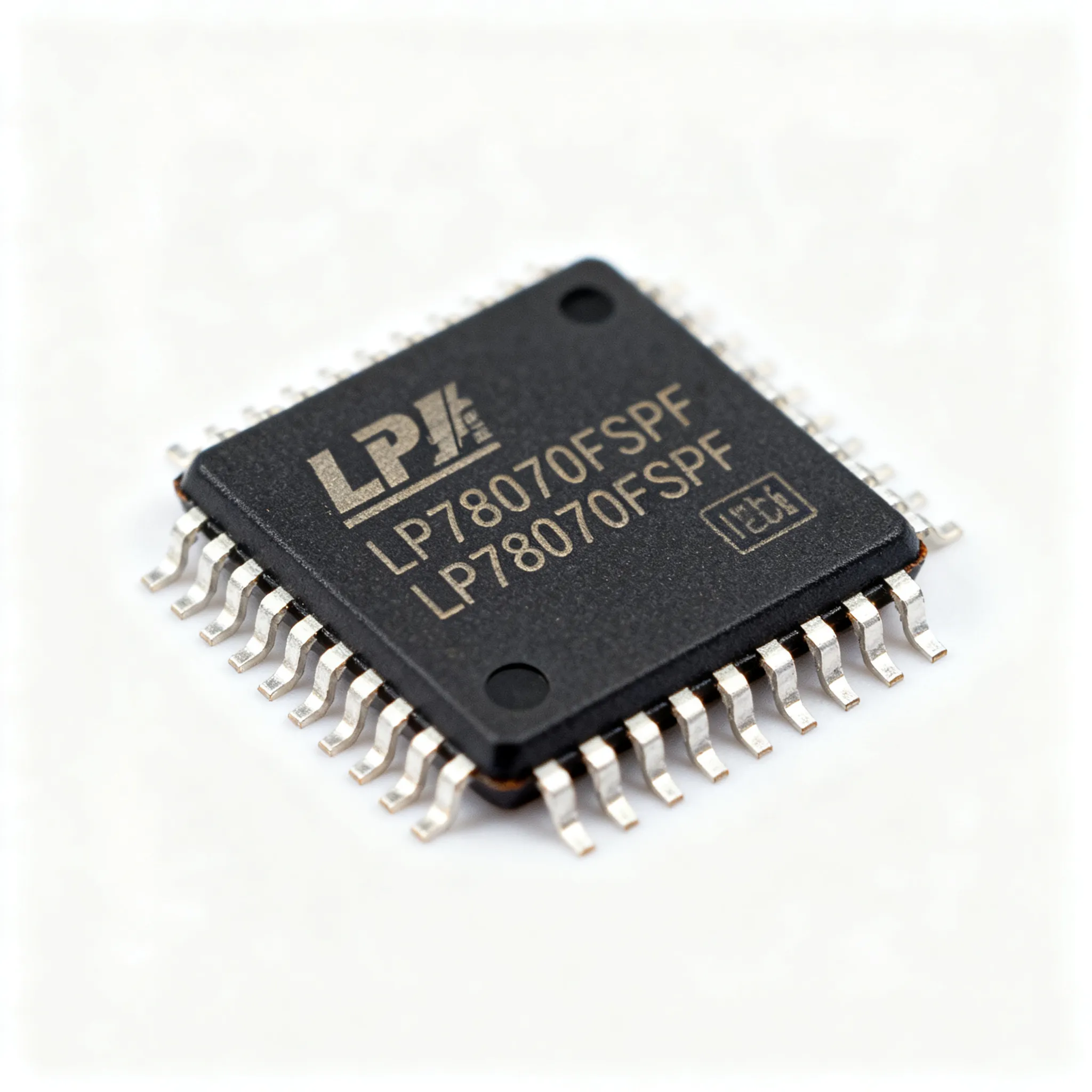
Walk through any Shenzhen consumer-electronics design house and you will find the LP78070FSPF occupying a quiet but indispensable role on the PCB. This single-chip 800 mA motor driver from LOWPOWER Semiconductor has become the default pick for battery‑powered fans, handheld misting devices, USB‑charged toys, and small brushless‑DC fan modules. The reason is not a single breakthrough feature—it is the combination of a sub‑$0.08 unit cost at LCSC quantities, a forgiving ESOP‑8 footprint that any contract manufacturer can handle, and an internal charge‑pump architecture that eliminates the need for external boost circuitry.
For procurement teams managing high‑volume BOMs, the part registers immediately on two fronts. First, the LCSC product page shows roughly 900 pieces in visible stock at the time of research—enough to cover prototype builds and small production runs without triggering allocation conversations. Second, the official LOWPOWER datasheet is a free, one‑click download, which means design engineers can validate pinout, thermal derating, and current‑limit behaviour before committing a single dollar to procurement.
The LP78070FSPF belongs to a broader LP78070 family that also appears on AllDatasheet and various aggregator platforms. What distinguishes the FSPF suffix is the exposed thermal pad on the ESOP‑8 package—a detail we will dissect in the pinout and comparison sections below. For now, the takeaway is straightforward: if your design needs a low‑side or H‑bridge motor driver that can deliver up to 800 mA continuous from a 2.5–7.5 V rail, with on‑chip current regulation and thermal shutdown baked in, this part deserves a hard look.
Key Takeaway: The attraction is practical, not promotional. A verified datasheet, sub‑dollar pricing, and a standard‑package footprint combine to reduce engineering unknowns and purchasing friction simultaneously.
Pinout, Internal Protections and Specs That Define the 800 mA Driver
Understanding the LP78070FSPF pinout is the first step toward a reliable layout. The ESOP‑8 package exposes eight pins, with the large centre pad on the underside serving as both a thermal path and a ground reference. From the LOWPOWER datasheet available on LCSC, the pin assignments break down as follows:
- Pin 1 (VCC): Supply input, 2.5–7.5 V operating range. Bypass with a 10 µF ceramic capacitor placed as close as possible to the pin.
- Pin 2 (GND): Ground return for both the logic and power stages. Internally bonded to the exposed thermal pad.
- Pin 3 (CP): Charge‑pump capacitor connection. A 0.1–1 µF ceramic capacitor between CP and VCC generates the gate‑drive voltage for the internal NMOS output stage.
- Pin 4 (EN): Enable input. Pull high (>1.5 V) to activate the driver; pull low (<0.4 V) to enter shutdown, where quiescent current drops below 1 µA.
- Pin 5 (F1): Speed‑select input 1. Together with F2, configures three speed modes plus off.
- Pin 6 (F2): Speed‑select input 2. The logic combination of F1 and F2 selects the output duty cycle for fan speed control.
- Pin 7 (OUT2): Output terminal 2. Connect to one end of the motor winding.
- Pin 8 (OUT1): Output terminal 1. Connect to the opposite end of the motor winding.
- Exposed Pad (bottom): Thermal pad. Solder to a large copper pour on the PCB for heat dissipation. Electrically connected to GND.
The internal protection suite is what separates a commodity motor driver from one that survives production line faults and end‑user abuse. The LP78070FSPF integrates three hardware safeguards. First, a cycle‑by‑cycle current‑limit comparator senses the voltage across an internal sense FET and clamps peak output current to approximately 1 A. During a sustained overload—a stalled fan blade, for instance—the device enters hiccup mode, periodically retrying the output and checking whether the fault has cleared. Second, a thermal shutdown circuit disables both output FETs when the junction temperature exceeds approximately 150 °C, with hysteresis of roughly 20 °C before automatic restart. Third, the enable pin provides a hard shutdown path that draws less than 1 µA, critical for battery‑operated products where every microamp counts during storage or transport.
Tip: The charge‑pump capacitor on pin 3 is not optional. Without it, the internal NMOS high‑side gate drive cannot bootstrap above VCC, and the output stage will either fail to turn on fully or suffer elevated RDS(on) and thermal runaway. Use an X7R or X5R ceramic capacitor rated for at least 10 V.
The table below consolidates the electrical parameters that design engineers need for schematic capture, PCB layout, and worst‑case analysis. All values are sourced from the manufacturer datasheet and should be verified against the revision applicable to your production lot.
| Parameter | Min | Typ | Max | Unit | Notes |
|---|---|---|---|---|---|
| Operating voltage (VCC) | 2.5 | — | 7.5 | V | Functional across full range; output current derates below 3 V |
| Continuous output current | — | — | 800 | mA | Per datasheet rating; derate above TA = 70 °C with adequate PCB copper |
| Peak current limit | 0.8 | 1.0 | 1.2 | A | Hiccup-mode threshold; not sustained DC |
| RDS(on) total (high + low side) | — | 0.45 | 0.6 | Ω | Measured at VCC = 5 V, IOUT = 500 mA, TJ = 25 °C |
| Shutdown current (EN = low) | — | 0.1 | 1.0 | µA | VCC = 5 V, TJ = 25 °C |
| Quiescent current (EN = high, no load) | — | 2.5 | 5.0 | mA | Includes charge‑pump operating current |
| Thermal shutdown threshold | — | 150 | — | °C | Approximately 20 °C hysteresis |
| Enable high threshold | 1.5 | — | — | V | Below 0.4 V guarantees shutdown |
| Package thermal resistance (θJA) | — | 60 | — | °C/W | ESOP‑8 with exposed pad soldered to 1 in² copper pour |
| Charge‑pump capacitor (CP–VCC) | 0.1 | 0.47 | 1.0 | µF | X7R/X5R, ≥10 V rating; placement within 3 mm of pins |
What these numbers tell you in practice is that the LP78070FSPF is optimised for single‑cell Li‑ion and multi‑cell NiMH applications, where the supply rail sits comfortably between 3.0 V and 6.0 V. The 800 mA continuous rating is sufficient for 3‑speed desk fans drawing 400–700 mA at full speed, while the hiccup‑mode current limiting prevents winding damage when a user pokes a finger into the blades. The RDS(on) figure of 0.45 Ω typical means that at 800 mA, you dissipate roughly 290 mW in the package—manageable on a two‑layer board with the exposed pad soldered to a 1 in² copper pour, but worth calculating for your specific ambient temperature and enclosure.
A typical 3‑speed fan application circuit, reproduced across the LOWPOWER datasheets and referenced in the Shenzhen sourcing guide on Alibaba, connects the motor winding between OUT1 and OUT2, with F1 and F2 pulled to VCC or GND through resistors to select between off, low, medium, and high speed. The charge‑pump capacitor sits directly across pins CP and VCC, and a single 10 µF bulk capacitor decouples VCC to GND. No external flyback diodes are required—the internal body diodes of the output FETs handle inductive recirculation.
Choosing the Right Variant: LP78070FSPF vs. LP78070F and Beyond
LOWPOWER ships the LP78070 architecture in several package suffixes, and selecting the wrong one can mean the difference between a cool‑running design and a thermal‑shutdown nightmare. The LP78070FSPF designation carries specific meaning: F for the motor‑driver function (the base LP78070 covers linear charging applications), SP for the SOP‑style footprint, and the final F indicating the exposed thermal pad. The base LP78070, by contrast, is a linear charger IC in the same ESOP‑8 package but with a completely different pinout—a trap for buyers who search by the LP78070 base number alone.
The LP78070F variant (datasheet PDF on AllDatasheet) is electrically identical to the FSPF version in terms of output drive, current limiting, and speed‑select logic. The difference is entirely mechanical: the standard SOP‑8 lacks the exposed thermal pad, which raises θJA and reduces the safe operating area at elevated ambient temperatures. For designs that never exceed 500 mA continuous or that operate in open‑air enclosures with generous PCB copper, the LP78070F may suffice. But for sealed plastic fan housings where ambient temperatures can reach 55–60 °C, the FSPF suffix buys you thermal margin without changing a single component value or layout trace.
The comparison table below maps the key decisions across the three most commonly encountered members of the family, plus a generic competitor reference that appears in Shenzhen sourcing channels.
| Comparison Metric | LP78070FSPF (LOWPOWER) | LP78070F (LOWPOWER) | LP78070 (Base, LOWPOWER) | Generic ESOP‑8 Motor Driver (Shenzhen) | Selection Criteria & Failure Boundary |
|---|---|---|---|---|---|
| Package | ESOP‑8, exposed pad | SOP‑8, no exposed pad | ESOP‑8, no exposed pad (charger) | ESOP‑8, variable | Exposed pad is mandatory for >500 mA continuous in enclosed designs |
| Primary function | 800 mA motor driver, 3‑speed | 800 mA motor driver, 3‑speed | 800 mA linear charger | Motor driver (claimed) | Verify function via datasheet before ordering; charger and driver are not interchangeable |
| θJA (typical) | ~60 °C/W (1 in² Cu) | ~100 °C/W (minimal Cu) | ~100 °C/W | Unrated or not specified | Higher θJA reduces safe ambient operating range; calculate TJ = TA + (I² × RDS(on) × θJA) |
| Current-sensing | Internal, hiccup mode | Internal, hiccup mode | Charging current regulation | May lack hiccup retry | Hiccup is essential for stalled‑motor protection; verify behaviour on unknown substitutes |
| Typical unit price (LCSC) | ~$0.08 | Similar range | ~$0.10–$0.15 | Varies widely | FSPF pricing advantage scales with volume; spot‑market alternatives may cost more |
| Datasheet availability | Free PDF, 7 pages, LCSC | Free PDF, 8 pages, AllDatasheet | Free PDF, 7 pages, AllDatasheet | Often absent or incomplete | Design without a full datasheet is gambling on current‑limit behaviour and thermal protection |
The LP78070 base part deserves a special warning here. Because it shares the LP78070 root number, it can surface in parametric searches alongside the motor‑driver variants. The base LP78070 is a standalone linear charger for single‑cell Li‑ion batteries—its enable pin and charge‑current programming resistor bear no functional relationship to the F1/F2 speed‑select logic on the motor driver. If a buyer accidentally substitutes the base part into a fan BOM, the PCB will not function and the IC may be damaged. Always verify the full suffix string—FSPF, F, or blank—against the manufacturer datasheet before placing a purchase order.
For sourcing outside LCSC, the Alibaba supplier directory for LP78070F lists multiple Shenzhen‑based distributors offering the motor‑driver variants at unit prices around $0.31 for smaller quantities. These suppliers may also stock competing generic ESOP‑8 motor drivers that claim electrical compatibility. Treat these as evaluation candidates only—verify package dimensions, pinout mapping (especially the charge‑pump pin), and current‑limit behaviour against the LOWPOWER datasheet before approving any alternative. A generic part that omits hiccup‑mode retry or uses a different RDS(on) can cause field failures that far outweigh the marginal BOM savings.
Sourcing LP78070FSPF Sensibly: Pricing, Second Sources and Lead Time Traps
The unit‑cost gap between LCSC and the Shenzhen spot market tells a story that experienced buyers recognise immediately. At the time of research, LCSC lists the LP78070FSPF from approximately $0.0799 in modest volumes, while Alibaba-supplier pricing clusters around $0.31/unit for quantities in the 100–1000 piece range. That is nearly a 4× spread, and it matters when your annual usage runs into the hundreds of thousands.
Several structural factors contribute to this gap. LCSC operates as a franchised or authorised distributor for LOWPOWER, passing through manufacturer‑direct pricing with a slim margin and handling logistics at scale. Shenzhen spot‑market sellers, by contrast, often source from excess inventory, production overruns, or secondary channels, and their pricing reflects the cost of capital tied up in shelf stock, the risk of unsold inventory, and the margin required to cover transaction‑level support. Neither channel is categorically better or worse—what matters is that procurement teams understand the trade‑offs and apply the right verification steps to each source.
The table below outlines a practical sourcing framework that buyers and quality engineers can apply regardless of which distributor they choose.
| Sourcing Dimension | LCSC | Shenzhen Spot (Alibaba) | Buyer Verification Required |
|---|---|---|---|
| Pricing (indicative, low volume) | ~$0.08/unit | ~$0.31/unit (100+ MOQ typical) | Confirm current pricing on product page; negotiate volume breaks above 10k units |
| Visible stock | ~900 pieces at research time | Varies by seller; often claimed in thousands | Confirm allocation-backed availability via RFQ—visible stock can deplete within hours on high‑demand parts |
| Minimum order quantity | No fixed minimum | Typically 100–1000 pieces | Smaller MOQs available at higher unit cost; request a formal quotation before committing |
| Date code / lot traceability | Manufacturer‑direct, traceable | Varies; older date codes possible | Require date code within 24 months of shipment; reject stock older than 3 years without solderability testing |
| Authenticity verification | High confidence (franchised) | Spot‑check required | Measure quiescent current, RDS(on), and current‑limit threshold on a sample; compare to datasheet specs |
| Packaging condition | Factory tape‑and‑reel or cut tape | May be repackaged from open reels | Require moisture‑barrier packaging for ESOP‑8; reject loose‑tray parts without ESD precautions |
| Lead time for out‑of‑stock scenarios | Variable; allocation‑dependent | Typically 2–7 days dispatch from shelf | Confirm allocation‑backed lead time with the supplier; do not rely on website stock indicators alone |
Beyond price and availability, the single‑source nature of the LP78070FSPF warrants a conversation with your supply‑chain team. LOWPOWER is the original manufacturer, and while the LP78070 architecture appears in multiple package variants, the FSPF suffix has no pin‑for‑pin alternative from a major Western or Japanese semiconductor brand. This is not unusual for application‑specific motor drivers in the sub‑$0.10 range—the economics of the segment do not support multiple independent foundry sources—but it does mean that procurement should maintain buffer stock appropriate to the product's lifecycle stage and confirm allocation risk directly with the supplier. Verify single‑source risk via manufacturer and distributor documentation rather than assuming a second source exists.
Practical guidance for incoming inspection:
- Sample test for quiescent current: Apply 5 V to VCC with EN pulled high and no load connected. Quiescent current should measure between 2.5 mA and 5.0 mA. Values below 1 mA or above 10 mA indicate either a different IC or a damaged unit.
- RDS(on) spot check: Force 500 mA through one output channel and measure the voltage drop from VCC to OUTx. Total RDS(on) should fall within 0.45 Ω ± the max datasheet tolerance. An RDS(on) above 0.8 Ω at room temperature points to counterfeit or recycled silicon.
- Charge‑pump functionality: Verify that the voltage on the CP pin (relative to GND) exceeds VCC by at least 2 V when the driver is enabled. A missing or weak charge‑pump waveform suggests a damaged internal oscillator or a missing external capacitor.
- Current‑limit trigger: Apply a resistive load that draws approximately 1.2 A. The output should enter hiccup mode—cycling on and off at intervals of a few milliseconds—rather than latching off or failing short. A part that does not current‑limit is a safety risk in motor applications.
When sourcing through Alibaba suppliers, request the supplier's transaction history and, if available, a money‑back guarantee on the first shipment. For production volumes, LCSC remains the lower‑friction path: factory packaging, direct traceability, and no minimum order quantity simplify both the engineering prototype phase and the production ramp. Treat supply as allocation‑sensitive and confirm current availability and allocation via RFQ before finalising a production schedule.
LP78070FSPF Questions from the Lab Bench and the Purchasing Desk
Q: What is the exact difference between LP78070FSPF and LP78070F?
The FSPF suffix designates an ESOP‑8 package with an exposed thermal pad for improved heat dissipation into the PCB copper plane. The LP78070F typically comes in a standard SOP‑8 without the exposed pad. Electrically, both variants share the same 800 mA continuous output rating, internal charge‑pump architecture, hiccup‑mode current regulation, and 3‑speed fan control logic. The thermal resistance difference—roughly 60 °C/W for the FSPF versus approximately 100 °C/W for the standard F—means the FSPF can sustain higher continuous current at elevated ambient temperatures. If your enclosure is sealed, unventilated, or operates above 40 °C ambient, the FSPF variant is the safer choice. For open‑frame designs or sub‑500 mA loads, the standard LP78070F suffices.
Q: Can I use the LP78070FSPF to drive a 5 V fan motor with PWM?
Yes. The LP78070FSPF operates from a 2.5–7.5 V supply and can drive DC brushless‑fan motors up to 800 mA continuously. The F1 and F2 pins provide three discrete speed settings via internal PWM modulation—the datasheet does not specify an external PWM pin for user‑supplied duty cycles, so speed control is limited to the three preset levels. The built‑in current limiting and thermal shutdown protect against stall conditions, but you should ensure that the motor's start‑up (inrush) current does not exceed the 1 A peak current‑limit threshold for longer than the hiccup‑mode retry interval. For motors with inrush above 1.2 A, consider adding an NTC thermistor in series or selecting a driver with a higher peak‑current rating.
Q: What does the current sensing/regulation function do in practice?
The internal current‑sense circuit monitors the voltage drop across a low‑value sense FET in series with the output stage. When the output current reaches approximately 1 A (typical), the control loop clamps the gate drive to prevent further current increase. If the overload persists—for example, a stalled fan blade or a shorted winding—the driver enters hiccup mode: it shuts down both output FETs for a timeout period, then attempts a restart. This cycle repeats until the overload condition clears. The behaviour prevents the output FETs from overheating and protects the motor winding from sustained over‑current. Note that hiccup mode is not a precision constant‑current regulator; the 1 A threshold has a tolerance window of approximately ±200 mV on the sense node, translating to ±200 mA variation across process and temperature.
Q: Where can I find a verified LP78070FSPF application circuit for a 3‑speed fan?
The most direct source is the LOWPOWER datasheet PDF on LCSC (C387627), which includes a schematic showing the motor connected across OUT1 and OUT2, a 0.47 µF charge‑pump capacitor between CP and VCC, a 10 µF VCC bypass capacitor to GND, and pull‑up/pull‑down resistor networks on F1 and F2 to select between off, low, medium, and high speed settings. The LP78070 datasheet on AllDatasheet also contains reference circuits, though it covers the LP78070 charger variant—verify you are looking at the correct suffix before copying any application schematic. For the LP78070F specifically, the 8‑page datasheet on AllDatasheet provides a more complete application section.
Q: How can I verify the authenticity of LP78070FSPF chips sourced from Shenzhen markets?
Start with a visual inspection: check the laser marking for consistency—LOWPOWER parts typically carry a clean, legible marking with the LP78070FSPF string and a date/lot code in a smaller font. Under a microscope, look for signs of sanding, black‑topping, or inconsistent pin‑1 indentation. Electrically, measure three parameters on a sample of at least five units from the incoming lot: quiescent current (should be 2.5–5.0 mA at 5 V VCC with EN high and no load), RDS(on) (should be below 0.6 Ω at 500 mA and 25 °C), and the current‑limit trip point (should fall between 0.8 A and 1.2 A). Parts that fail any of these tests or show wide lot‑to‑lot variation should be quarantined. Prefer suppliers with documented transaction history and money‑back guarantees—the Alibaba supplier listing for LP78070F provides a starting point for vetted distributors.
Q: What is the typical lead time and minimum order for LP78070FSPF from LCSC versus Alibaba?
LCSC's product page for the LP78070FSPF at the time of research shows approximately 900 pieces in stock with no fixed minimum order quantity—you can order a single reel or a few cut‑tape pieces for prototyping and pay only the per‑unit price plus shipping. Alibaba suppliers typically list minimum order quantities of 100–1000 units, with unit prices around $0.31 at the lower end of that range. Dispatch time for Alibaba sellers is commonly quoted at 2–7 days from confirmed payment. For LCSC, in‑stock items ship within 24–48 hours depending on your selected courier and destination. When the LP78070FSPF shows zero visible stock on LCSC, buyers should confirm allocation‑backed lead time directly with LCSC support—do not rely on automated restocking estimates. The same applies to Alibaba: shelf‑stock claims are only as reliable as the seller's last inventory update.
References & Further Reading
- LP78070FSPF Official Datasheet – LOWPOWER – LCSC Electronics — Primary datasheet for the FSPF variant; 7 pages covering pinout, electrical specs, and application circuit.
- LP78070FSPF Product Page – LCSC — Current pricing, stock visibility, and parametric search entry for the ESOP‑8 motor driver.
- LP78070 Datasheet – AllDatasheet (7 pages) — Base LP78070 linear charger variant; useful for distinguishing charger from motor‑driver functions.
- LP78070F Datasheet – AllDatasheet (8 pages) — Motor‑driver variant without exposed thermal pad; includes application waveforms.
- LP78070F Supplier Directory – Alibaba Electronics — Shenzhen‑based supplier listings, indicative pricing, and MOQ information for the LP78070F family.
- IC-Online – Electronic Component Sourcing Platform — RFQ submission, BOM upload, and multi‑supplier quotation comparison for the LP78070FSPF and related motor‑driver ICs.
Designing with or procuring the LP78070FSPF for your next production run? Whether you are validating a 3‑speed fan circuit, comparing ESOP‑8 thermal‑pad variants, or locking in allocation for a high‑volume BOM, the right distributor relationship makes the difference between a smooth ramp and a last‑minute scramble. Submit your RFQ or upload your bill of materials via IC-Online to compare pricing, confirm current availability, and secure allocation‑backed lead times across multiple authorised channels—no minimum order, no guesswork.