MF52D103F3435L100-1.25-2P Datasheet and Pinout: Specs for Design and Sourcing
MF52D103F3435L100-1.25-2P datasheet essentials, pinout overview, key specs, and design/sourcing checks for engineers and buyers. Request a quote on IC-Online.
Why a $0.045 Thermistor Deserves a Second Look for Your Next Design
In many product designs, the humble NTC thermistor is an afterthought—an anonymous bead that reads ambient temperature and costs next to nothing. But that assumption costs teams time and yield when a budget-priced sensor drifts outside its tolerance window, or when a hard-to-source leadform disappears from catalog distribution without notice. For engineers and procurement buyers scanning the MF52D103F3435L100-1.25-2P datasheet and pinout, the question is not whether a 10 kΩ thermistor can be found for pennies; it’s whether this specific variant from Nanjing Shiheng Electronics can be trusted across the full production lifecycle and temperature range.
The part’s headline specifications are compelling: a nominal resistance of 10 kΩ at 25 °C, a tight ±1 % B‑value tolerance (3435 K ±1 %) that helps hold total system accuracy, and a radial leadform with a tiny 1.25 mm pin pitch that suits dense PCB layouts. Those numbers, drawn from the manufacturer datasheet and verified against listings on LCSC and JLCPCB, explain why variants of the MF52D family routinely appear in industrial IoT nodes, white goods, and USB‑PD charger temperature monitors. Yet the same listings show that availability can shift quickly, and the low unit price (frequently cited around $0.045) means that even a modest allocation squeeze can stall a cost‑optimized BOM.
Recent supply‑chain events have made one thing clear: no passive component is too cheap to derail a production schedule. In the IC‑Online lifecycle and obsolescence risk checklist (see the checklist framework discussed for 2N5551‑class components), the critical advice is to verify second‑source feasibility early, watch for dwindling reel counts, and never assume a drop‑in replacement exists just because the base resistance and B‑value match. The MF52D103F3435L100-1.25-2P deserves exactly that level of scrutiny: a systematic walkthrough of its specs, pinout, design checks, and sourcing strategy is what follows.
Decoding the MF52D103F3435L100-1.25-2P: A No-Nonsense Spec Walkthrough
Before you commit the part to a schematic symbol, you need to know what every character in the part number tells you about the physical device that will arrive on tape‑and‑reel. Nanjing Shiheng uses a consistent naming convention; the breakdown for this variant is:
- MF52D – Series designation. The MF52 family is a small‑size radial‑lead bead thermistor, with the ‘D’ denoting a specific epoxy‑coating and lead‑wire build.
- 103 – Resistance code: 10 × 10³ Ω, i.e., 10 kΩ at the standard reference temperature of 25 °C.
- F – Resistance tolerance at 25 °C: ±1 %.
- 3435 – B‑value constant (3435 K) that describes the resistance‑temperature curve between 25 °C and 85 °C.
- L100 – Nominal lead length before forming: 100 mm. The leads are normally trimmed during PCB assembly.
- -1.25 – Pin spacing (pitch) after lead‑forming: 1.25 mm centre‑to‑centre.
- 2P – Two‑pin configuration. The device is a non‑polarized two‑terminal component.
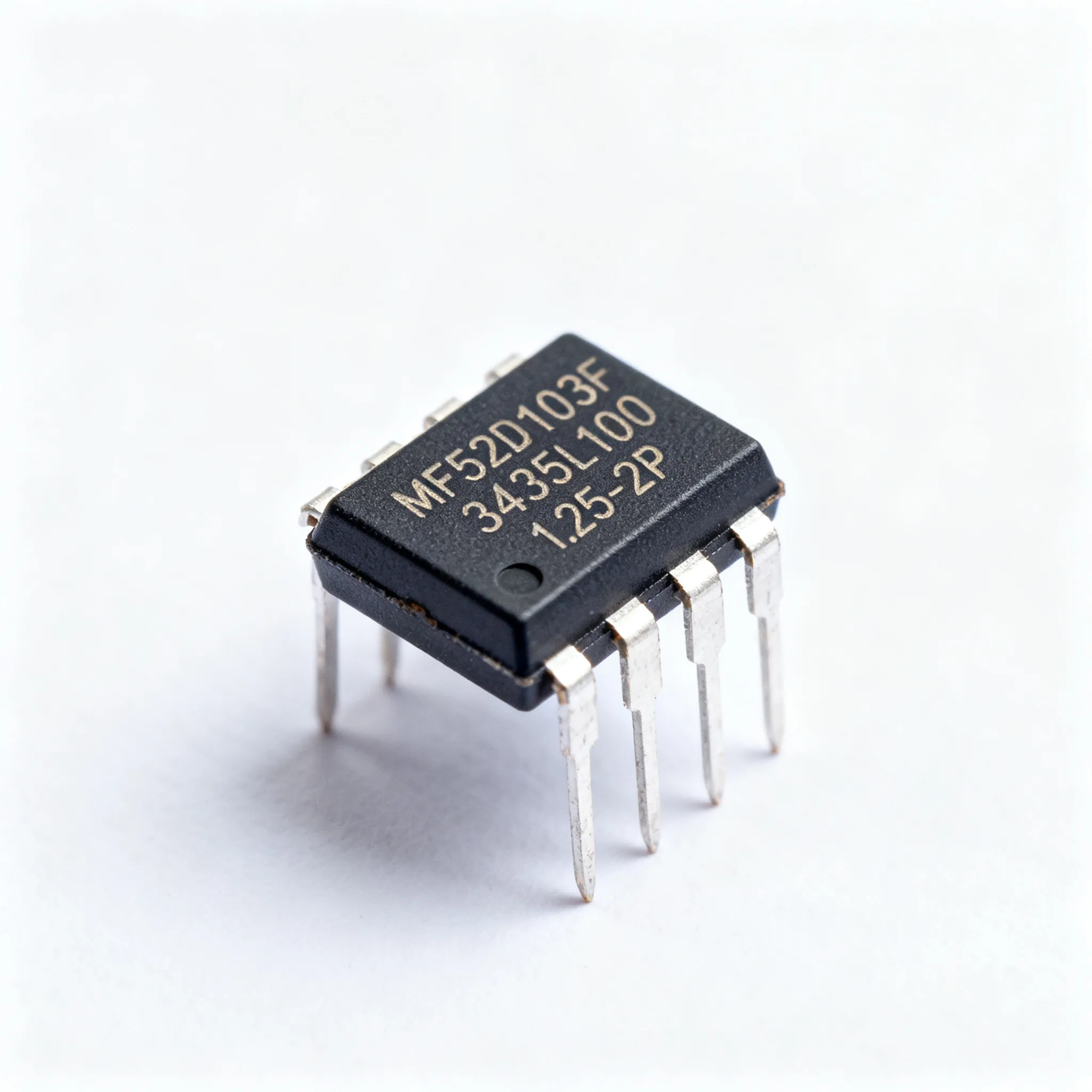
The MF52D103F3435L100-1.25-2P thus packages a 10 kΩ bead with a precise B‑value in a radial through‑hole form factor. Its physical footprint and pinout are documented in the pinout diagram hosted by LCSC Electronics (view the Nanjing Shiheng Elec MF52D 103F3435-100 pinout diagram and footprint). Because the two leads are symmetrical, there is no polarity to observe; either lead can go to the divider node or ground.
Below are the Tier‑A electrical and mechanical parameters pulled from the manufacturer datasheet and verified against the JLCPCB and LCSC product pages.
| Parameter | Value/Range | Unit/Notes |
|---|---|---|
| Resistance at 25 °C (R₂₅) | 10 | kΩ |
| Resistance tolerance | ±1 | % |
| B‑value (25/85 °C) | 3435 | K |
| B‑value tolerance | ±1 | % |
| Maximum power rating (at 25 °C) | 50 | mW |
| Thermal dissipation constant | Approx. 2 | mW/°C (typical for bead size) |
| Thermal time constant (in still air) | ≤7 | seconds (to 63.2 % of final temperature) |
| Operating temperature range | -40 to +125 | °C |
| Insulation voltage (coating to leads) | ≥500 | V (typical, verify with datasheet) |
| Lead pitch (formed) | 1.25 | mm |
| Lead wire diameter | 0.5 | mm (approximate) |
| Package style | Epoxy‑coated radial bead, 100 mm leads | — |
Tip: The 1.25 mm pin spacing is much tighter than the common 2.54 mm or 5.08 mm bristle‑board pitches. PCB layout engineers must create a custom footprint or carefully verify that their pick‑and‑place and wave‑soldering processes can handle such a small gap without bridging. In hand‑soldered prototyping, a fine‑tip iron and magnification are recommended.
The 100 mm lead length means the part arrives with generous wire that is intended to be cropped. For automated insertion, the lead‑forming machine typically sets the final stand‑off height and pitch, so confirming that the lead‑forming tooling can achieve 1.25 mm pitch on a 0.5 mm diameter wire is a critical manufacturing engineering check. The non‑polarized nature simplifies routing—no orientation marks are needed—but keep the two pads close together to minimize loop area and noise pickup in sensitive ADC circuits.
How the MF52D103F3435L100-1.25-2P Stacks Up Against Other 10 kΩ NTC Beads
At first glance, a 10 kΩ, 3435 K glass‑or‑epoxy bead thermistor looks like a generic commodity. Closer inspection reveals differences in B‑value tolerance, time‑constant, and package size that can matter in a tight thermal path. The table below places the MF52D103F3435L100-1.25-2P alongside three alternative 10 kΩ NTC beads that engineers frequently evaluate. The comparisons are drawn from publicly available datasheets and distributor specifications; pricing references are indicative and should be verified via RFQ or live distributor feeds.
| Metric | MF52D103F3435L100-1.25-2P (Nanjing Shiheng) | Vishay NTCLE100E3103JB0 | Murata NCP15XH103F03RC | Generic MF52A 103F3950 (LCSC) |
|---|---|---|---|---|
| R₂₅ | 10 kΩ ±1 % | 10 kΩ ±5 % | 10 kΩ ±1 % | 10 kΩ ±1 % |
| B‑value (25/85 °C) | 3435 K ±1 % | 3977 K ±0.75 % | 3380 K ±1 % | 3950 K ±1 % |
| Max. power at 25 °C | 50 mW | 100 mW | 100 mW | 50 mW |
| Thermal time constant (typ.) | ≤7 s | ≈5 – 7 s (lead dependent) | ≈4 – 5 s (chip bead) | ≤7 s |
| Operating temp. range | -40 to +125 °C | -40 to +125 °C | -40 to +125 °C | -40 to +125 °C |
| Package | Radial, 1.25 mm pitch, 100 mm leads | Axial/radial options, wide lead spacing | 0402 SMD | Radial, 2.54 mm pitch, shorter leads |
| Polarity | No | No | No | No |
| Approx. unit price (1k volume, 2025 ref.) | < $0.05 (verify via LCSC) | $0.25 – $0.40 | $0.08 – $0.15 | < $0.03 |
| Key differentiator | Tight B‑tolerance at 3435 K, ultra‑narrow pitch | Industry‑standard documentation, higher power | Smallest footprint, consistent SMD process | Lowest cost, but B‑value tolerance may be wider |
The table makes it clear that the MF52D103F3435L100-1.25-2P occupies a unique corner: it delivers a ±1 % B‑value at the popular 3435 K curve, something that mainstream competitors often achieve only with looser resistance tolerances or at B‑values like 3380 K or 3950 K. For a design that requires a specific log‑linear slope for a microcontroller’s look‑up table, this matters. However, the Vishay and Murata parts bring stronger supply‑chain guarantees, automotive‑grade options, and more exhaustive characterization data. When the temperature measurement accuracy budget is tight and the BOM cost is king, the Nanjing Shiheng part becomes a strong candidate—provided the sourcing and lifecycle checks in the next section are completed.
What Engineers and Buyers Need to Verify Before Committing to This Part
The MF52D103F3435L100-1.25-2P is not a drop‑in replacement for every 10 kΩ, 3435 K thermistor. Its unique leadform, moderate time constant, and the specific temperature range over which the B‑value is calibrated require a deliberate verification process. Use the following checklist to close the gaps between datasheet promise and production reality.
Design and Sourcing Verification Checklist
| Check Item | What to Verify | Why It Matters |
|---|---|---|
| B‑value interpolation range | Confirm that your temperature‑sensing region is close to the 25/85 °C calibration band. If you operate at -20 °C or 105 °C, extract the full R‑T table from the manufacturer or compute worst‑case error using the Steinhart‑Hart equation with min/max B. | The ±1 % B‑tolerance is stated for 25/85 °C; outside that window the deviation can be several tenths of a degree larger than the resistance tolerance alone implies. |
| Thermal time constant | Test whether a 7‑second thermal response (63.2 % step) meets the dynamic requirements of your application. For fast‑cycling systems or air‑flow sensing, a smaller bead or an SMD alternative may be required. | Slow thermal response can cause control loop lag and inaccurate transient readings, especially in consumer appliances or battery packs that heat up rapidly. |
| Automated insertion compatibility | Verify that your lead‑forming and insertion equipment can handle 1.25 mm pitch on 0.5 mm wire. Request a sample reel for a trial run, and measure the actual formed dimensions. | Incorrect lead forming can lead to jams, bent legs, and shorted pins. The tight pitch also demands precise pad geometries to avoid solder bridges. |
| Lifecycle and obsolescence risk | Use the IC‑Online lifecycle checklist (referenced from the 2N5551 deep‑dive) to evaluate warning signs: long stagnant stock, declining reel counts, missing certification updates. Monitor LCSC and JLCPCB product pages for status changes. | Low‑cost passives can go EOL without a PCN. If the part is sole‑sourced in your design, a last‑time‑buy may come with little notice. |
| Allocation and price tracking | Track live stock and price trends on LCSC and JLCPCB. Set alerts for significant drops in available quantity or sudden price hikes. | A jump in unit price while stock appears high can signal a final allocation phase. Confirm current availability and allocation via RFQ. |
| Second‑source feasibility | Evaluate whether a different leadform (e.g., 2.54 mm pitch MF52A 103F3435) can be qualified as a layout‑compatible backup. Do not assume a perfect drop‑in. | The unique 1.25 mm pitch and 100 mm lead length make a direct mechanical substitute rare. Early qualification of an alternative footprint reduces risk. |
Key takeaway: The datasheet numbers are solid, but the difference between a reliable thermometer and a field‑failure headache often lies in the steps above. Buyers should require a manufacturer’s certificate of conformance that confirms the B‑value tolerance and lead‑forming parameters for each delivery lot, and ask the distributor for a confirmation of allocation‑backed lead time when ordering volumes above 10k pieces. Because the MF52D103F3435L100-1.25-2P is frequently ordered in reels, it is wise to retain a small buffer stock for post‑qualification builds.
Questions Engineering Teams Ask About the MF52D103F3435L100-1.25-2P
Q: What does ‘MF52D103F3435L100-1.25-2P’ actually break down to?
A: MF52D: series (Nanjing Shiheng Electronics radial bead). 103: 10 kΩ at 25 °C. F: ±1 % resistance tolerance. 3435: B‑value 3435 K between 25/85 °C. L100: 100 mm lead length. -1.25: 1.25 mm pin spacing. 2P: two pins. Manufacturer is Nanjing Shiheng Electronics.
Q: Is this thermistor polarized?
A: No. The two leads are interchangeable; it is a simple two‑terminal NTC bead with no polarity. Either lead can be connected to the supply, ground, or ADC input.
Q: How much temperature error does the ±1 % B‑value tolerance introduce?
A: At temperatures close to 25 °C, the additional error from B‑value variation is small—roughly 0.15–0.25 °C for a ±1 % shift. As you move further from the calibration range (e.g., below 0 °C or above 85 °C), the resistance deviation can exceed what the resistance tolerance alone predicts. A worst‑case analysis using the Steinhart‑Hart equation with the min and max B‑values (3400 K and 3470 K) would show potential errors of a few tenths of a degree at the extremes. The exact value depends on the measurement circuit, ADC resolution, and the pull‑up resistor tolerance. Designers should calculate the error budget over the full application temperature range, not just at the calibration point.
Q: What does ‘-1.25-2P’ mean for our PCB layout?
A: It indicates a 1.25 mm pitch between the two radial leads. This is unusual compared to standard 2.54 mm headers, so you will need a custom PCB footprint with small pads and appropriate solder‑mask clearance. The 100 mm lead length (L100) is supplied for forming; you will trim the leads to the desired height during assembly. Verify that your pick‑and‑place and soldering processes can manage the tight spacing without solder bridging.
Q: Is 50 mW dissipation really enough? Can we push higher when measuring with a microcontroller ADC?
A: 50 mW is the maximum allowable power at 25 °C. In a typical voltage‑divider configuration with a 10 kΩ pull‑up resistor to a 3.3 V rail, the thermistor sees roughly 0.27 mW when its resistance equals 10 kΩ—only 0.5 % of the rating. Even if the microcontroller’s ADC input draws negligible current, self‑heating is not a concern. The limit only becomes important if you deliberately pass higher current through the bead (e.g., in constant‑current source circuits) or if the ambient temperature is very high, where the power rating must be derated. For virtually all standard sensing circuits, the 50 mW ceiling is far from reached.
Q: How do we know if the MF52D103F3435L100-1.25-2P is going end‑of‑life?
A: Monitor the product pages on LCSC and JLCPCB for sudden stock shrink or unusual price jumps. Sign up for PCN alerts from Nanjing Shiheng if your distributor offers that service. The lifecycle checklist from IC‑Online (see the obsolescence risk framework) points to several red flags: dwindling reel quantities, a widening gap between listed price and market offer, and absence of fresh date codes. If you observe any of these, initiate a second‑source qualification immediately and consider placing a last‑time‑buy order when supported by your demand forecast.
References & Further Reading
- IC‑Online: Lifecycle and Obsolescence Risk Checklist (illustrated with 2N5551, applicable to all discretes)
- LCSC: MF52D 103F3435-100 Product Page, Datasheet, and Stock Information
- JLCPCB: MF52D 103F3435-100 Specifications and Manufacturer Documentation
- LCSC: Nanjing Shiheng Elec MF52D 103F3435-100 Pinout and Footprint Diagram
- IC‑Online: Request a Quote and Upload Your BOM for Allocation‑Checked Pricing
- Nanjing Shiheng Electronics Co., Ltd. – official datasheet for MF52D series (available through LCSC/JLCPCB product pages).
- Vishay NTCLE100E3 series datasheet – for comparison context.
- Murata NCP15X series datasheet – for SMD NTC reference.
The MF52D103F3435L100-1.25-2P demonstrates that a commodity thermistor can still hide meaningful design and sourcing nuance. When the B‑value tolerance, leadform, and supply path are all verified, this Nanjing Shiheng part can deliver accurate, repeatable temperature sensing at a fraction of the cost of western-brand equivalents. As with any allocation‑sensitive passive, the best insurance is a proactive RFQ that confirms live availability, lead times, and the option of a second‑source qualification. Start your sourcing check at IC‑Online—upload your BOM, specify flexible MOQ, and get the allocation‑backed data you need to lock in production schedules without last‑minute surprises.