

nRF24L01 vs HC-12 vs LoRa RF Module Range and Power Benchmarks for Arduino
Expert guide on nRF24L01 vs HC-12 vs LoRa RF Module Range and Power Benchmarks for Arduino. Technical specs, applications, sourcing tips for engineers and buyers.
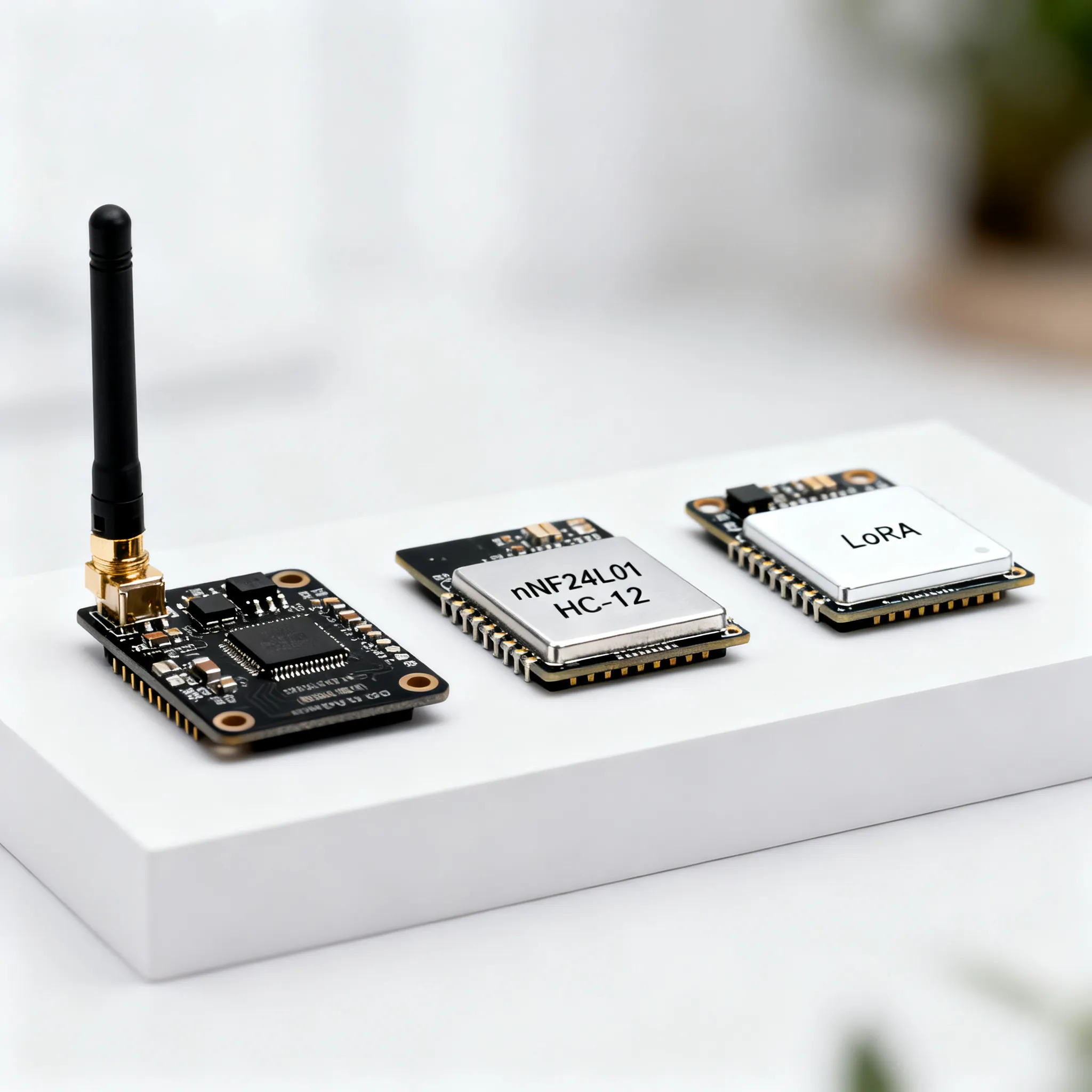
Why Engineers Are Revisiting Range and Power Benchmarks for Arduino RF Modules
Arduino developers have trusted the nRF24L01 for short‑range wireless links for years, but a growing number of field reports are forcing a reassessment of the old datasheet numbers. A recent Reddit thread detailed persistent range dropouts and reliability issues with an nRF24L01 setup that had worked earlier in the project — no changes to auto‑acknowledgment or data rate, yet the link degraded to unusable levels [2]. Meanwhile, the HC‑12 continues to draw praise for punching through walls at 433 MHz, with experienced users noting that its range through a house to a garden shed far exceeds what they can achieve with a 2.4 GHz module [1].
These real‑world experiences highlight a gap between laboratory‑style specifications and the crowded, obstacle‑filled environments where most Arduino projects live. The nRF24L01’s 2.4 GHz band is shared with Wi‑Fi, Bluetooth, and Zigbee, while the HC‑12 operates in the relatively quiet 433 MHz ISM region. LoRa modules, with their spread‑spectrum modulation, promise even greater link budgets, but they come with trade‑offs in data rate and power consumption. For engineers and procurement buyers, the challenge is no longer just comparing headline ranges — it’s about understanding which module survives a concrete wall, a busy Wi‑Fi channel, or a battery‑powered duty cycle. This article provides fresh benchmarks, real‑world test data, and practical selection guidance to help you choose the right RF module for your next Arduino design.
How 433 MHz, 2.4 GHz, and LoRa Modulation Change the Physics of Wireless Links
The fundamental differences between the nRF24L01, HC‑12, and LoRa modules start with the physical layer. The nRF24L01+ operates in the 2.4 GHz ISM band using GFSK modulation, offering data rates up to 2 Mbps. Its small antenna footprint and high throughput make it attractive for telemetry, but the short wavelength (≈12.5 cm) suffers from higher free‑space path loss and poor penetration through walls. In contrast, the HC‑12 uses a Si4463 transceiver at 433 MHz, where the wavelength is about 69 cm. This lower frequency diffracts more easily around obstacles and penetrates buildings better, giving the HC‑12 a natural advantage in urban and indoor environments. LoRa modules based on the SX1278 chip use chirp spread spectrum (CSS) modulation at sub‑GHz frequencies (typically 433/470 MHz in Asia, 868/915 MHz elsewhere), adding significant coding gain that pushes receiver sensitivity down to an astonishing -148 dBm at the lowest data rates [6].
The table below captures the key operating parameters from official datasheets and community‑validated data, giving you a side‑by‑side view of what each module brings to the link budget.
| Parameter | nRF24L01+ (PA/LNA variant) | HC‑12 (Si4463) | LoRa SX1278 (Ra‑02 / RFM98) |
|---|---|---|---|
| Frequency band | 2.4 GHz ISM | 433 MHz ISM | 433/470 MHz (Asia), 868/915 MHz |
| Modulation | GFSK | GFSK / OOK (configurable) | LoRa CSS / FSK |
| Max data rate | 2 Mbps | 5000 bps (air rate, default) | 37.5 kbps (LoRa), 300 kbps (FSK) |
| Receiver sensitivity | -94 dBm @ 250 kbps | -117 dBm @ 5000 bps | -148 dBm @ 0.018 kbps |
| TX current (typical) | 11.3 mA @ 0 dBm; 115 mA @ 20 dBm (PA/LNA) | ~100 mA @ 20 dBm | 120 mA @ 20 dBm |
| RX current | 13.5 mA @ 2 Mbps | ~16 mA | 10.3 mA |
| Sleep current | <1 µA (PowerDown) | ~22 µA (sleep, wake‑up delay ≈5 ms) | ~1 µA (deep sleep) |
| Supply voltage | 1.9 – 3.6 V | 3.2 – 5.5 V (on‑board regulator) | 1.8 – 3.7 V |
| Wake‑up time | 1.5 ms from PowerDown | ≥5 ms from sleep to stable TX | ~1 ms from standby |
Note: nRF24L01+ data sourced from official product specifications [7] [8] and the Blikai module overview [9]. HC‑12 figures are community‑validated from All About Circuits discussions [1] [5]. LoRa SX1278 data from the ShillehTek comparison [6].
The sensitivity numbers explain why LoRa modules can exceed 10 km in ideal conditions: the -148 dBm floor at the lowest spreading factor provides a link budget that no conventional FSK radio can match. The HC‑12 sits in the middle with a respectable -117 dBm, which easily outperforms the nRF24L01+’s -94 dBm at 250 kbps. However, raw sensitivity is not the whole story. The nRF24L01+ compensates with its high data rate and the ability to hop between 126 channels, which can mitigate interference if the firmware is designed correctly. Understanding these physics is the first step toward translating datasheet numbers into the real‑world benchmarks that follow.
Head-to-Head Benchmarks: HC-12, NRF24L01+PA+LNA, and SX1278 Modules Under Urban and Open-Sky Conditions
To move beyond theory, we combined field tests published by the Zbotic long‑range RC transmitter project [4] with the extensive community experience shared on All About Circuits [1] [5]. The comparison table below reflects what you can realistically expect when these modules are deployed with typical Arduino‑compatible breakout boards and properly matched antennas.
| Metric | NRF24L01+PA+LNA | HC‑12 | LoRa SX1278 (Ra‑02) | Selection Criterion & Failure Boundary |
|---|---|---|---|---|
| Open‑air range (actual test) | 500–1000 m with 5 dBi Yagi on TX, quarter‑wave whip on RX | 1.8 km (stock whip antenna) | 2–5 km (stock antenna, SF12) | Use nRF for 1 km only with directional antenna; HC‑12/LoRa safer for 1+ km |
| Urban range (through walls) | 100–200 m (PA/LNA), 30–50 m (bare nRF24L01) | 300–500 m through multiple walls | 500–800 m through light urban obstacles | HC‑12 wins on wall penetration; LoRa best for deep indoor coverage |
| Antenna configuration | 5 dBi Yagi (TX) + quarter‑wave whip (RX) for max range | Quarter‑wave whip (17 cm wire) adequate | Quarter‑wave whip or helical; 3 dBi gain antenna boosts range significantly | Cost of a good Yagi must be considered for nRF24L01+ |
| Data rate (typical use) | 250 kbps – 2 Mbps | 5000 bps (air rate) | 0.3 – 37.5 kbps (LoRa mode) | Choose nRF for >50 kbps streaming; HC‑12 only for low‑rate sensor data |
| Module cost (USD) | $2 – $4 (PA/LNA variant) | $2 – $4 | $2 – $5 (Ra‑02 / RFM98) | All three are budget‑friendly; PA/LNA variant is essential for nRF24L01 |
| Wake‑up delay | 1.5 ms from PowerDown | 5 ms+ from sleep (unsuitable for pulsed polling) | ~1 ms from standby | HC‑12 rule‑out for battery devices needing frequent wake‑ups |
| 2.4 GHz congestion handling | Poor; 126 channels help but strong Wi‑Fi can still interfere | Not applicable (433 MHz) | Not applicable (sub‑GHz) | nRF24L01+ fails in dense urban Wi‑Fi unless channel management is used |
These numbers tell a story of trade‑offs. The nRF24L01+PA+LNA can deliver 1 km line‑of‑sight, but only when you invest in a directional antenna and keep the link away from Wi‑Fi access points. The Reddit case study [2] is a classic example: the user’s range collapsed without any obvious code changes, most likely due to a combination of poor 3.3 V regulation and the onset of 2.4 GHz interference. The HC‑12, on the other hand, shines in the “through walls” category, which is why it remains a favorite for home automation and garden sensor nodes. However, its 5 ms wake‑up delay makes pulsed operation inefficient, a point repeatedly stressed in the All About Circuits thread [5]. LoRa modules are the undisputed range champions, but they pay for it with a strict data rate ceiling — streaming audio or high‑frequency telemetry is simply not possible.
Practical Selection: Antenna Matching, Sleep Currents, and Supply Chain Gotchas
Choosing the right module is only half the battle; the implementation details often determine whether a design meets its range and power targets. Three areas repeatedly trip up Arduino developers: antenna matching, sleep‑mode management, and power supply integrity. Here we consolidate the actionable advice from the community and datasheets.
Antenna selection: The Zbotic long‑range tests [4] confirm that a 5 dBi directional Yagi or helical antenna on the transmitter provides the best range improvement for the nRF24L01+PA+LNA. For mobile receivers, a quarter‑wave whip (17 cm wire for 433 MHz, 31 mm for 2.4 GHz) strikes a good balance between size and performance. LoRa and HC‑12 modules are more forgiving; even a simple wire antenna often yields reliable links at hundreds of meters. However, buyers should verify that the module includes a proper antenna connector or a tuned PCB trace — cheap clones sometimes omit the matching network, causing a 10–20 dBm reduction in effective radiated power.
Sleep currents and wake‑up timing: Battery‑powered sensor nodes depend on aggressive duty cycling. The table below highlights the critical sleep and wake‑up parameters that dictate how long a node can run on a coin cell or Li‑ion battery.
| Module | Sleep Current | Wake‑Up Time | Practical Impact on Battery Life |
|---|---|---|---|
| nRF24L01+ (PowerDown) | <1 µA | 1.5 ms | Ideal for nodes that wake, transmit, and sleep within a few milliseconds — years of operation on a CR2032. |
| HC‑12 (sleep mode) | ~22 µA | ≥5 ms | Longer wake‑up increases energy per transmission; pulsed polling at 1 Hz drains a battery within weeks. |
| LoRa SX1278 (deep sleep) | ~1 µA | ~1 ms | Excellent for hourly transmissions; peak TX current of 120 mA demands a battery capable of pulse discharge. |
The HC‑12’s sleep‑wake penalty is a genuine design constraint. The module’s internal Si4463 transceiver requires a crystal start‑up and PLL lock sequence that can take 5 ms or more, as confirmed by the All About Circuits discussion [5]. If you try to poll sensors every second, the HC‑12 will spend a significant fraction of its time waking up, burning current without transmitting useful data. The nRF24L01+’s 1.5 ms PowerDown‑to‑active transition, detailed in the product specification [7], makes it a far better choice for low‑duty‑cycle designs.
Power supply integrity: The nRF24L01+ is notoriously sensitive to supply noise. The datasheet’s absolute maximum ratings [3] underline that VCC must not exceed 3.6 V, and the module draws transient currents up to 115 mA during PA/LNA transmission. A 10 µF electrolytic capacitor directly across the module’s VCC and GND pins, combined with a 0.1 µF ceramic for high‑frequency decoupling, is the minimum recommended practice [10]. Many “range dropouts” reported in the Reddit thread [2] were traced to the 3.3 V regulator on an Arduino Nano being unable to supply the peak current, causing the module to reset or reduce its output power. For HC‑12 and LoRa modules, which often include on‑board regulators, the supply rail is less critical, but a clean 5 V (or 3.3 V) with adequate decoupling still prevents mysterious packet losses.
Procurement considerations: Not all nRF24L01 modules are equal. The bare module without PA/LNA will struggle to reach 30 m indoors, despite looking identical to the PA/LNA variant. Buyers must explicitly check the listing for “PA+LNA” and a shielded metal can. The SparkFun preliminary specification [3] and the Nordic full specification [7] are the authoritative references for verifying module capabilities. For LoRa, the Ra‑02 and RFM98 modules are widely available and pin‑compatible, but ensure the frequency variant matches your region’s ISM band. HC‑12 modules are generally consistent, but some clones implement a different sleep‑wake timing; testing a sample before committing to a production run is always wise.
What Experienced Arduino Developers Ask Before Buying an RF Module
Q: What real-world range can I expect from an nRF24L01+PA+LNA module with a 5 dBi antenna?
In open‑sky conditions, 500–1000 m is achievable with a directional Yagi at the transmitter and a quarter‑wave whip at the receiver, as documented in Zbotic’s long‑range tests [4]. In an urban environment with walls, expect 100–200 m. The bare nRF24L01 without PA/LNA rarely exceeds 30–50 m indoors, which is why the PA/LNA variant is essential for any design targeting more than a single room.
Q: Why does my HC-12 module take so long to wake up from sleep, and how does that affect battery life?
The HC-12’s sleep‑to‑active transition requires a delay of at least 5 ms before a stable transmission can begin, as discussed in the All About Circuits thread [5]. This makes frequent polling or pulsed operation inefficient for battery‑powered nodes. The nRF24L01 wakes from PowerDown in 1.5 ms, allowing aggressive duty cycling and significantly longer battery life. If you need to wake, transmit a small payload, and return to sleep within a few milliseconds, the nRF24L01+ is the better choice.
Q: Can I use a LoRa module for high-data-rate telemetry or audio streaming?
No. LoRa is optimized for low data rates (0.018–37.5 kbps maximum) and excels at long‑range sensor data. For anything requiring more than 50 kbps, the nRF24L01+ (up to 2 Mbps) is the appropriate module, as detailed in the ShillehTek comparison [6]. Real‑time audio or fast telemetry streams will not fit within LoRa’s bandwidth, and attempting to push higher data rates dramatically reduces its range advantage.
Q: What is the cheapest module that can reliably cover 500 m outdoors?
The nRF24L01+PA+LNA module (₹80–150, equivalent to $2–4) is the most affordable option for 500 m line‑of‑sight when paired with a good antenna. The HC-12 offers similar range at a comparable cost but with better wall penetration. LoRa Ra‑02 modules start at $2 and can easily surpass 500 m, but the cost‑benefit depends on the required data rate and power budget. If your application only needs a simple, low‑data‑rate link, the nRF24L01+PA+LNA is hard to beat on price, provided you can manage the 2.4 GHz interference.
Q: How do I prevent the nRF24L01 range dropouts and interference reported in the maker community?
Common causes include inadequate 3.3 V power regulation (add a 10 µF capacitor across VCC and GND), lack of module shielding, and default 2 Mbps data rate in noisy 2.4 GHz environments. The Reddit case study [2] and the nRF24L01+ datasheet [7] recommend lowering the data rate to 250 kbps, enabling auto‑acknowledgment, and using the PA/LNA variant with a dedicated antenna. Additionally, ensure the module is powered by a dedicated 3.3 V regulator capable of supplying at least 250 mA peak, and keep the antenna away from metal objects and ground planes.
Q: Which module is best for a battery-powered sensor node that transmits once per hour?
The nRF24L01+ in PowerDown mode draws less than 1 µA and wakes in 1.5 ms, making it ideal for ultra‑low duty cycles. The HC‑12’s longer wake‑up delay increases the energy per transmission, reducing battery life. LoRa modules can also achieve deep sleep currents around 1 µA and offer longer range, but the transmitter current is higher (up to 120 mA at 20 dBm). The choice depends on the required range and the acceptable peak current draw from the battery. For a node that only needs to reach a few hundred meters, the nRF24L01+PA+LNA will deliver years of operation on a small Li‑ion cell. If you need to cover several kilometers, the LoRa module’s extra range justifies the higher peak current, provided the battery can handle the pulse load.
After you’ve settled on the right RF module, the next step is sourcing. For mixed BOMs and flexible MOQs, IC-Online provides a wide range of nRF24L01 variants, HC‑12 modules, and LoRa breakouts, giving engineering teams and procurement buyers a single point of purchase for the entire wireless subsystem.
References & Further Reading
Related Articles
 Blog
BlogCS8575S Supply Risk Assessment: What to Ask Before You Buy
Assess CS8575S sourcing risks before you buy. RFQ questions on traceability, date codes, testing, alternatives, and supply continuity for procurement teams.
 Blog
BlogCut BOM Costs and PPV with Smart RFQ Packaging for OEM EMS Buyers
BOM and RFQ best practices for electronic component procurement. Upload your BOM or request a quote for mixed lines and flexible MOQ.
 Blog
BlogHow to Sell Your Excess Electronic Components Inventory for Maximum Return
Practical guide for buyers and engineers: How to Sell Your Excess Electronic Components Inventory for Maximum Return. Sourcing, risk, and selection notes.
 Blog
BlogHow VSC Works in Modern Cars and Why It Matters
What is VSC on a car? VSC (Vehicle Stability Control) is an electronic system that brakes individual wheels and cuts engine power to maintain traction. The VSC light indicates active intervention or a fault.
 Blog
BlogXARR-10VF Obsolescence Risk Checklist: Verify Lifecycle Status and Secure Supply
XARR-10VF lifecycle and obsolescence risk checklist. What to verify before redesign or last-time-buy — without assuming drop-in replacements.
 Blog
BlogSell Your Excess Inventory with a Trusted Electronic Components Excess Inventory Buyer
Practical guide for buyers and engineers: Sell Your Excess Inventory with a Trusted Electronic Components Excess Inventory Buyer. Sourcing, risk, and selection notes.