Introduction
In today's fast-paced electronics industry, the demand for efficient power management solutions is ever-increasing. Low Dropout (LDO) regulators, such as the NCP1117, play a pivotal role in ensuring stable voltage outputs in various applications. These components are crucial for maintaining system reliability and performance, especially in portable and battery-powered devices. As the semiconductor industry continues to grow, with global revenue projected to reach $595.2 billion by 2026, understanding the specifications and applications of components like the NCP1117 LDO regulator becomes essential for engineers and designers.
Technical Overview
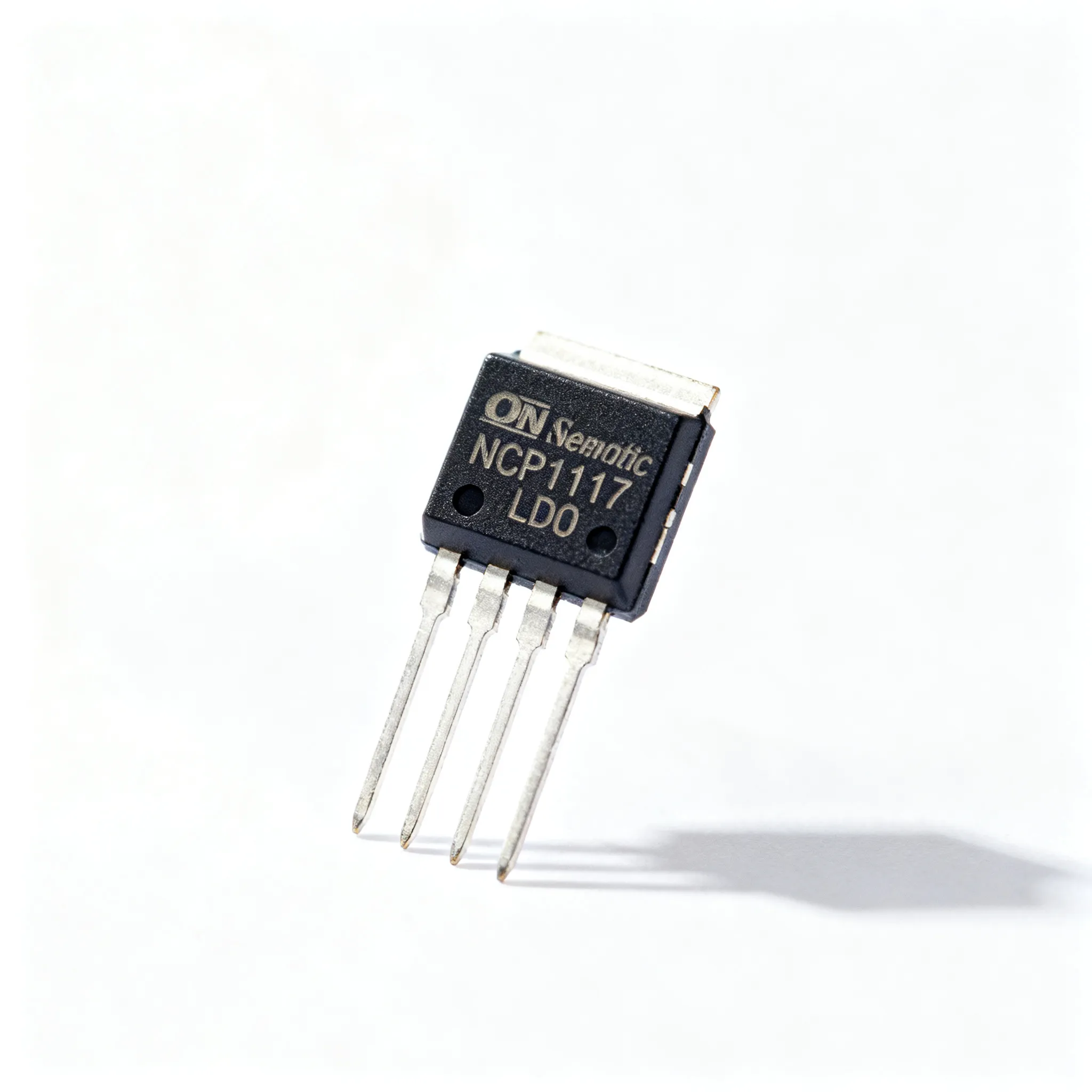
The NCP1117 is a versatile low dropout voltage regulator designed for a wide range of applications. This component is known for its ability to provide a stable voltage output even when the input voltage is close to the output voltage, a characteristic that is critical in battery-powered devices where power efficiency is paramount. The NCP1117 features a dropout voltage as low as 1.2V at 1A, making it suitable for applications where minimal voltage loss is desired.
Key to the NCP1117's performance is its internal circuitry, which includes a bandgap reference and error amplifier. These elements work together to maintain a consistent output voltage, despite variations in input voltage or load current. The device also includes built-in protection features such as current limiting and thermal shutdown, ensuring safe operation under adverse conditions.
The NCP1117 is available in several fixed output voltage versions, as well as an adjustable version, providing flexibility for different design requirements. Its small form factor makes it an ideal choice for space-constrained applications, while its robust electrical characteristics ensure reliability across a wide temperature range.
Detailed Specifications
Below are detailed specifications for the NCP1117 LDO regulator, presented in three comprehensive tables.
| Parameter |
Min |
Typ |
Max |
Units |
Notes |
| Input Voltage Range |
2.5 |
— |
18 |
V |
— |
| Output Voltage |
1.2 |
— |
15 |
V |
Fixed and adjustable versions available |
| Dropout Voltage |
— |
1.2 |
— |
V |
At 1A output current |
| Output Current |
— |
— |
1.0 |
A |
— |
| Line Regulation |
— |
0.2 |
0.5 |
% |
— |
| Load Regulation |
— |
0.2 |
0.4 |
% |
— |
| Quiescent Current |
— |
5 |
10 |
mA |
— |
| Ripple Rejection |
60 |
— |
— |
dB |
At 120Hz |
| Temperature Range |
-40 |
— |
125 |
°C |
Operating junction temperature |
| Thermal Resistance |
— |
— |
50 |
°C/W |
Junction-to-case |
| Parameter |
Value |
Units |
Notes |
| Package Type |
TO-220, DPAK |
— |
Variety of packages available for different applications |
| Thermal Shutdown |
150 |
°C |
Typical shutdown temperature |
| Max Junction Temperature |
150 |
°C |
— |
| Storage Temperature Range |
-55 to 150 |
°C |
— |
| Lead Temperature |
260 |
°C |
During soldering, 10 seconds |
| Thermal Resistance (Junction-to-Ambient) |
65 |
°C/W |
Mounted on a PCB |
| Weight |
1.9 |
g |
Typical for TO-220 package |
| Pin Count |
3 |
— |
— |
| Application |
Input Voltage |
Output Voltage |
Load Current |
Notes |
| Microcontroller Power Supply |
5V |
3.3V |
500mA |
Common in embedded systems |
| Battery-Powered Devices |
3.7V |
3.0V |
300mA |
Ideal for low power applications |
| Communication Equipment |
12V |
5V |
1A |
Used in routers and modems |
| Consumer Electronics |
9V |
5V |
800mA |
Portable audio devices |
| Industrial Control Systems |
24V |
12V |
1A |
Automation equipment |
The NCP1117 LDO regulator specifications highlight its versatility and adaptability across various applications. Its electrical parameters, such as input voltage range and output current, make it suitable for diverse use cases. Additionally, the thermal and mechanical specifications ensure that it can withstand challenging environmental conditions, making it a reliable choice for both consumer and industrial applications.
Design Considerations
When designing with the NCP1117, several factors must be considered to maximize performance and ensure reliability. One of the primary considerations is the dropout voltage, which determines the minimum difference between input and output voltages required for the regulator to operate effectively. For the NCP1117, this is typically around 1.2V at 1A, meaning that the input voltage must be at least 1.2V higher than the desired output voltage to maintain regulation.
Thermal management is another critical aspect. The NCP1117 features a thermal shutdown mechanism to prevent damage from overheating, but proper heat dissipation must still be ensured. This can be achieved through the use of heat sinks or appropriate PCB layout techniques to enhance thermal conductivity. The regulator's thermal resistance, both junction-to-case and junction-to-ambient, should be considered when designing the thermal management system.
Decoupling capacitors are vital for stabilizing the output voltage and minimizing noise. A low ESR capacitor, typically 10µF, should be placed as close as possible to the output pin to ensure stable operation. Similarly, an input capacitor of around 1µF can help filter out any input voltage fluctuations, providing a cleaner supply to the regulator.
Load current and transient response are also important design considerations. The NCP1117 can handle up to 1A of continuous output current, but the actual load should be evaluated to ensure the regulator operates within its safe limits. Additionally, the transient response should be tested to ensure the output voltage remains stable under sudden changes in load current.
Finally, attention should be given to the pin configuration and package type. The NCP1117 is available in multiple package options, such as TO-220 and DPAK, each offering different thermal and mechanical properties. The choice of package will depend on the specific application requirements, such as space constraints and thermal performance.
Step-by-Step Guide
Designing a circuit with the NCP1117 LDO regulator involves several steps to ensure optimal performance and reliability. Below is a step-by-step guide to assist in the design process.
1. **Determine Output Voltage and Current Requirements:**
Begin by defining the desired output voltage and load current for your application. The NCP1117 offers fixed and adjustable output voltage options. Ensure that the load current does not exceed 1A.
2. **Select the Appropriate Package:**
Choose the package type that best suits your application. Consider factors such as available space, thermal performance, and mechanical constraints. The TO-220 package is ideal for applications requiring efficient heat dissipation.
3. **Calculate Input Voltage Requirements:**
Ensure the input voltage is at least 1.2V higher than the desired output voltage to accommodate the dropout voltage. Verify that the input voltage remains within the specified range of 2.5V to 18V.
4. **Add Decoupling Capacitors:**
Place a low ESR capacitor (10µF) close to the output pin to stabilize the output voltage. Additionally, include a 1µF capacitor at the input to filter any voltage spikes or noise.
5. **Design PCB Layout:**
Optimize the PCB layout for thermal performance. Use wide copper traces and thermal vias to enhance heat dissipation. Keep the decoupling capacitors close to the regulator pins to minimize parasitic inductance.
6. **Implement Thermal Management:**
Evaluate the thermal resistance characteristics and consider adding a heat sink if necessary. Ensure that the regulator operates within its safe temperature range under all load conditions.
7. **Test Transient Response:**
Simulate load changes and measure the output voltage to ensure stability. The regulator should maintain a consistent output voltage during sudden load variations.
8. **Verify Performance:**
Conduct a thorough evaluation of the circuit to ensure it meets the design specifications. Check for any signs of instability or thermal stress and make adjustments as needed.
Common Issues & Solutions
Designing with the NCP1117 can present several challenges. Here are common issues and their solutions:
1. **Excessive Dropout Voltage:**
Ensure the input voltage is sufficiently higher than the output voltage. If the dropout voltage is too high, consider using a different LDO with a lower dropout specification.
2. **Thermal Overload:**
If the regulator overheats, check the thermal management system. Improve heat dissipation by adding a heat sink or redesigning the PCB layout to enhance thermal conductivity.
3. **Output Voltage Instability:**
Instability can result from inadequate decoupling. Use low ESR capacitors and place them close to the regulator pins. Verify that the capacitors have the correct values.
4. **Noise and Ripple:**
High-frequency noise can affect performance. Add additional filtering capacitors and ensure proper grounding to reduce noise levels.
5. **Incorrect Output Voltage:**
For adjustable versions, verify the resistor divider network. Ensure the resistors are of the correct value and tolerance to achieve the desired output voltage.
6. **Load Regulation Issues:**
Poor load regulation may be caused by high parasitic resistance. Minimize trace lengths and use wider traces to reduce resistance.
Applications & Use Cases
The NCP1117 LDO regulator is used in various applications due to its versatility and reliability. In microcontroller-based systems, it provides a stable 3.3V supply from a 5V input, ensuring consistent performance for digital circuits. Battery-powered devices benefit from its low dropout characteristics, enabling efficient power conversion with minimal energy loss.
In communication equipment, such as routers and modems, the NCP1117 delivers a stable 5V output from a 12V input, supporting reliable data transmission. Consumer electronics, including portable audio devices, leverage its compact size and efficiency for optimal battery life and sound quality.
Industrial control systems utilize the NCP1117 for powering automation equipment, where its robust electrical and thermal specifications ensure operation in demanding environments. Its adaptability makes it suitable for a wide range of applications, from consumer gadgets to industrial machinery.
Selection & Sourcing Guide
Selecting the right NCP1117 LDO regulator involves considering factors such as output voltage, package type, and thermal performance. For sourcing, visit
IC Online, an authorized distributor of electronic components. They offer competitive pricing and fast delivery, ensuring you have the right components for your design needs.
FAQ
1. **What is the dropout voltage of the NCP1117?**
The typical dropout voltage is 1.2V at 1A output current.
2. **Can the NCP1117 handle 1A continuous current?**
Yes, it is designed to handle up to 1A of continuous output current.
3. **What packages are available for the NCP1117?**
The NCP1117 is available in TO-220 and DPAK packages.
4. **Is the NCP1117 suitable for battery-powered applications?**
Yes, its low dropout voltage makes it ideal for battery-powered devices.
5. **How do I minimize noise in my design?**
Use low ESR capacitors and ensure proper PCB layout and grounding.
6. **What is the operating temperature range?**
The operating junction temperature range is -40°C to 125°C.
7. **How do I set the output voltage on the adjustable version?**
Use a resistor divider network to set the desired output voltage.
8. **What protection features does the NCP1117 have?**
It includes current limiting and thermal shutdown features.
9. **Can I use the NCP1117 for industrial applications?**
Yes, its robust design makes it suitable for industrial environments.
10. **Where can I purchase the NCP1117?**
You can purchase it from authorized distributors like
IC Online.
Conclusion
The NCP1117 LDO regulator is a versatile and reliable component suitable for a wide range of applications. Its electrical and thermal specifications ensure consistent performance, while its protection features safeguard against adverse conditions. By understanding its specifications and design considerations, engineers can effectively integrate the NCP1117 into their systems, achieving efficient power management and system stability.