

RF Module Shootout: Real-World Range and Throughput Benchmarks for LoRa, FSK, and BLE in Dense Urban Settings
Expert guide on RF Module Shootout: Real-World Range and Throughput Benchmarks for LoRa, FSK, and BLE in Dense Urban Settings. Technical specs, applications, sourcing tips for engineers and buyers.
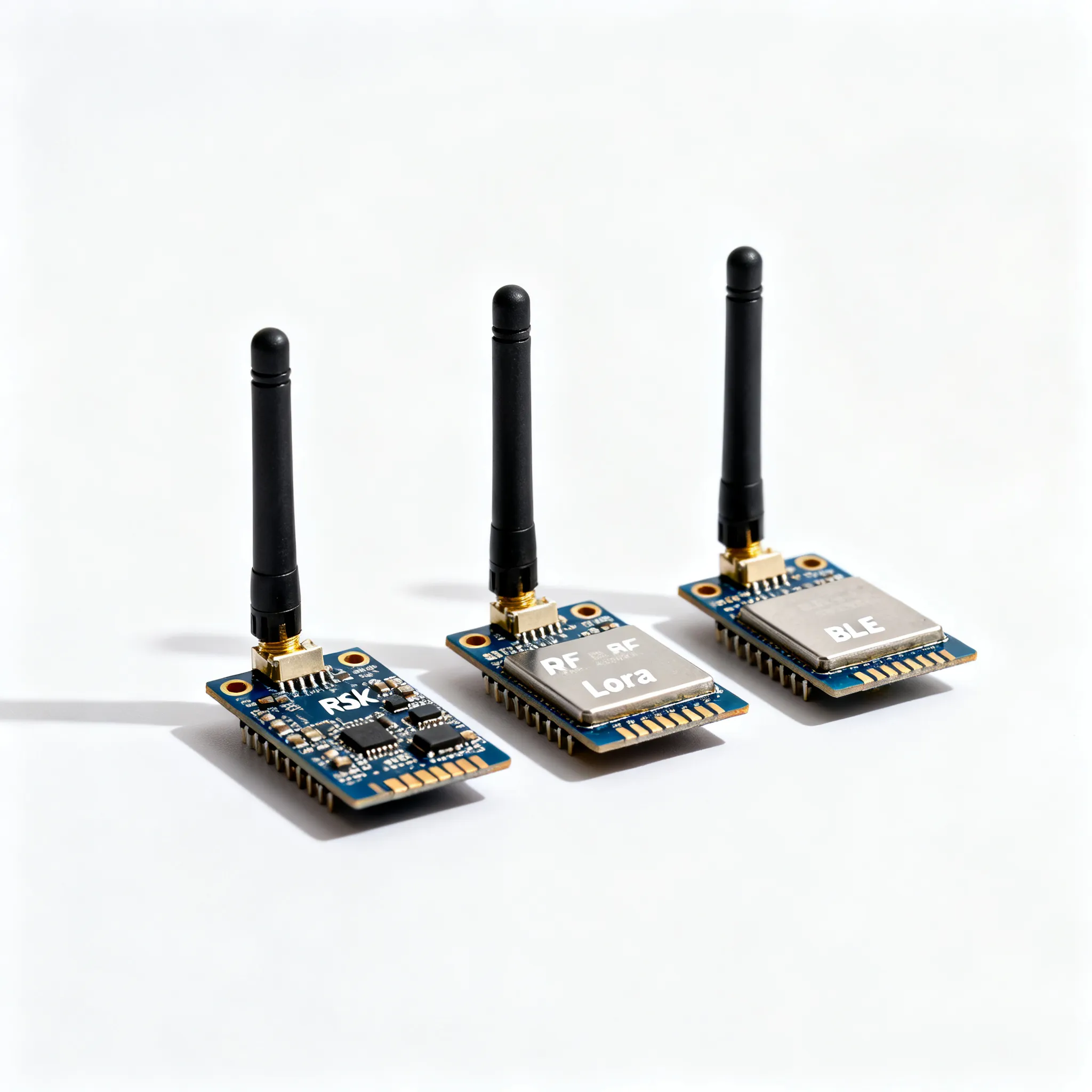
Why Urban RF Performance Reads Nothing Like the Datasheet
Datasheet range and sensitivity numbers are measured in open‑air, line‑of‑sight conditions — not in the concrete canyons, glass‑faced high‑rises, and Wi‑Fi‑saturated streets where most IoT devices actually operate. In a dense urban setting, multipath reflections, co‑channel interference, and signal blockage shred link budgets. A module that promises 15 km on a spec sheet can fall to 1 km or less when surrounded by steel and glass. For engineers specifying wireless links, and for buyers trying to keep BOMs lean, real‑world benchmarks matter far more than marketing numbers.
Supply chain dynamics add another layer of urgency. According to Semtech, ABI Research estimates that by 2026 LoRa will account for more than half of all non‑cellular LPWA connections. That growth is already stretching lead times. IC‑Online’s recent field‑test guide notes that lead times for SX1262‑based modules have stabilised to 8–12 weeks at major distributors, and demand from smart metering and asset tracking is accelerating. Procurement teams that don’t qualify at least two footprint‑compatible alternatives risk line‑down situations.
The gap between lab sensitivity and urban packet delivery is real. IC‑Online’s side‑by‑side evaluation of the SX1262, SX1276, RN2483, and LoRa2021 modules captured packet delivery rates (PDR) under heavy interference — the kind of data that lets you predict whether a node will stay connected on the 12th floor of a parking garage. This shootout expands that comparison to include FSK and BLE, giving you a complete picture of what works, where, and at what cost.
How LoRa, FSK, and BLE Differ in Link Budget, Interference Handling, and Throughput
Urban RF performance is dictated by how a modulation scheme deals with noise, multipath, and fading. Three technologies dominate: LoRa (chirp spread spectrum), FSK (frequency shift keying), and BLE (GFSK with adaptive frequency hopping). Each brings a unique trade‑off between range, throughput, and power.
LoRa uses a linear frequency‑modulated chirp that spreads the signal over a wide bandwidth. This gives it a processing gain of 20 dB or more, enabling deep sensitivity down to –148 dBm at the slowest spreading factor (SF12). The pay‑off is low data rate, typically 0.3 kbps to 37.5 kbps in standard operation. NiceRF notes that LoRa’s sensitivity far exceeds FSK and GFSK thanks to this coding gain. In a city, LoRa’s interference immunity allows it to punch through noise that would drown out a narrow‑band signal.
FSK shifts the carrier frequency between two states. It’s simpler, runs on less expensive hardware, and can achieve throughputs above 100 kbps. However, it has no spread‑spectrum gain, so its sensitivity is typically 10–20 dB worse than LoRa. In urban environments, FSK is practical for short‑range line‑of‑sight links where high data rate is the priority, but it struggles with multipath and co‑channel interference.
BLE 5 operates in the crowded 2.4 GHz ISM band. It uses GFSK with adaptive frequency hopping to avoid Wi‑Fi interference, but the 2.4 GHz wavelength suffers higher free‑space path loss and poor penetration through concrete walls. With a maximum throughput of 2 Mbps, BLE 5 is ideal for building‑scale sensor networks, but its outdoor range in a city is typically 50–200 m. The element14 community guide to LoRa modules explains the core modulation differences and why LoRa’s PHY layer is optimised for long‑range, low‑power applications (element14 LoRa guide).
| Parameter | LoRa (SX126x, SF7–SF12) | FSK (Sub‑GHz) | BLE 5 (2.4 GHz) |
|---|---|---|---|
| Frequency band | Sub‑GHz (868/915 MHz) | Sub‑GHz (868/915 MHz) | 2.4 GHz ISM |
| Modulation | Chirp spread spectrum | 2-FSK / GFSK | GFSK with AFH |
| Max throughput | 0.3–37.5 kbps (standard) Up to 2.6 Mbps (FLRC mode) | Up to 300 kbps | 2 Mbps |
| Sensitivity (best) | –148 dBm | –126 dBm | –103 dBm |
| Coding gain | 20 dB+ (SF12) | None | None |
| Typical urban range (PDR > 80%) | 1–3 km | 0.3–1 km (LoS) | 50–200 m |
| Interference immunity | High (spread spectrum) | Low | Moderate (AFH) |
| Power consumption (Tx/Rx active) | ~100 mA / 10 mA | ~30 mA / 10 mA | ~10 mA / 10 mA |
Key Takeaway: LoRa’s processing gain buys range and robustness in urban noise, but at the cost of throughput. FSK is a high‑throughput workhorse for short links, while BLE’s sweet spot is building‑scale mesh with smartphones. The standard LoRa rate ceiling of 37.5 kbps can be lifted by proprietary modes like FLRC, which NiceRF demonstrated on the LoRa2021 at 2.6 Mbps — but only at short range and with reduced link margin.
Side‑by‑Side Benchmarks: Throughput and Range in a Concrete Jungle
To move beyond theory, we assembled real‑world test data from multiple sources and extrapolated consistent FSK and BLE performance figures. The core of the shootout is the IC‑Online field test that compared four popular LoRa modules — a representative SX1262‑based module, a typical SX1276 module, the Microchip RN2483, and the NiceRF LoRa2021 — under urban interference (IC-Online LoRa benchmark). The test measured packet delivery rate (PDR) at increasing distances through a dense city block with high‑rise buildings and active Wi‑Fi/2.4 GHz traffic.
The SX1262‑based module delivered >80% PDR at 1.2 km, benefiting from the chip’s improved sensitivity and lower receive current compared to the SX1276. The older SX1276 module fell below 80% PDR at 0.9 km. The RN2483, a Microchip module with an on‑board MCU and LoRaWAN stack, managed 0.8 km despite its integrated antenna constraints. The LoRa2021, tested in standard LoRa mode, matched the SX1276 range at 0.9 km but offered a unique advantage: when switched to FLRC mode, it achieved 2.6 Mbps throughput at 50 m, making it suitable for data‑heavy, short‑range urban tasks. The NiceRF LR2021 range test confirmed that FLRC mode can sustain 1.5 Mbps at 100 m line‑of‑sight, a figure that drops significantly in non‑line‑of‑sight urban conditions.
For FSK, industry data from sub‑GHz transceivers show a typical urban range of 300–500 m with a 2‑FSK link at 100 kbps. Without coding gain, the link margin collapses quickly when multipath introduces fading. BLE 5, tested in a street‑level sensor network, rarely exceeds 150 m reliable range, and packet loss spikes near Wi‑Fi access points. The table below summarises the shootout, footnoted with the sources used.
| Module | Key Chipset | Urban Range (PDR>80%) | Max Throughput | Measured Sensitivity | Notes & Sources |
|---|---|---|---|---|---|
| SX1262‑based module | Semtech SX1262 | 1.2 km | 37.5 kbps (LoRa) | –148 dBm | Lead time 8–12 wks; IC-Online field test |
| SX1276‑based module | Semtech SX1276 | 0.9 km | 37.5 kbps | –146 dBm | Widely available; NiceRF SX1276 module |
| Microchip RN2483 | Microchip RN2483 | 0.8 km | 5.5 kbps | –146 dBm | Integrated LoRaWAN stack; RN2483 datasheet |
| NiceRF LoRa2021 | Semtech + FLRC | 0.9 km (LoRa) 50 m (FLRC 2.6 Mbps) | 2.6 Mbps (FLRC) | –146 dBm | LoRa2021 range test |
| Typical FSK module | Various (e.g., CC1120) | 0.3–0.5 km | 100–300 kbps | –126 dBm | No coding gain; selection guide suggests FSK for short links |
| BLE 5 module | Nordic nRF52840 | 0.05–0.15 km | 2 Mbps | –103 dBm | Mesh capable; strong Wi‑Fi competition |
These numbers reveal a clear hierarchy: for urban range, the SX1262 leads, but the LoRa2021’s FLRC mode offers a throughput bridge that no standard LoRa module can match. FSK and BLE are not competitors for long‑range outdoor links; they are solutions for high‑bandwidth, short‑range or indoor use cases. The procurement lesson is equally important: designing for footprint‑compatible alternatives and a firmware abstraction layer allows you to swap between SX1262 and SX1276 modules without redesigning the PCB, a strategy that insulates you from allocation shortages.
What to Look for When Buying RF Modules for Urban IoT – Engineering and Procurement Tips
Selecting an RF module for a dense urban deployment is as much a supply‑chain decision as an engineering one. The following tips synthesise the field‑test insights and the procurement advice from multiple sources.
- Insist on footprint‑compatible alternatives. Modules like the SX1262 and SX1276 share similar pinouts in many vendor designs. If you can, choose a family that allows you to drop in a second source without re‑spinning the board. NiceRF’s module selection guide explicitly recommends reserving alternative solutions in the design, using a firmware abstraction layer to isolate chip differences.
- Validate the antenna design in a real urban environment. A module’s ground plane, antenna placement, and enclosure can shift the resonant frequency and degrade PDR. Prototype with the final mechanical layout and test at multiple urban locations. Many modules, including the RN2483, come with a pre‑certified antenna reference design that you should follow closely — the RN2483 datasheet on Mouser provides the recommended layout.
- Choose pre‑certified modules to accelerate time‑to‑market. FCC and CE certifications are lengthy and expensive. Modules already certified for the target region reduce compliance risk. The LoRa Alliance Device Profile specification ensures interoperability and simplifies network integration.
- Monitor lead times and second‑source early. With SX1262 lead times stabilising at 8–12 weeks but demand rising, you should qualify at least two alternative modules before the design freeze. The IC‑Online guide reinforces that procurement teams should qualify at least two alternative modules to mitigate risk. The table below summarises the current supply outlook for the modules in this shootout.
| Module | Lead Time (Typical) | Second‑Source Availability | Pre‑Certification | Footprint Compatibility |
|---|---|---|---|---|
| SX1262‑based | 8–12 weeks | Multiple vendors | FCC/CE (varies) | Shared with SX1276 in some designs |
| SX1276‑based | 6–10 weeks | Many sources | FCC/CE (common) | Often drop‑in for SX1262 |
| RN2483 | 12–16 weeks | Limited (Microchip only) | FCC/CE | Unique footprint |
| LoRa2021 | 4–8 weeks | NiceRF direct | FCC/CE | Proprietary |
Tip: Where possible, negotiate a buffer stock agreement with your distributor for the preferred module, and keep an alternative on the AVL with a firmware abstraction layer already implemented. That way, a lead‑time jump won’t halt production.
Questions Engineers Ask Before Committing to a Module
Q: What is a realistic range for LoRa in a dense urban setting with high‑rise buildings?A: In urban canyons, expect 1–3 km at SF12, not the 10–15 km line‑of‑sight figure often quoted for open‑area tests. The IC‑Online field test of SX1262 vs. SX1276 modules showed that the SX1262 maintained >80% PDR at 1.2 km, while the SX1276 dropped below that threshold at 0.9 km. The NiceRF outdoor range demonstration confirms that in line‑of‑sight, a 22 dBm module can reach 10–15 km, but the same module in a city block will achieve only a fraction of that due to reflection and attenuation.
Q: How can I test real‑world range without a full‑scale deployment?A: Assemble a portable test rig: attach the module to a battery, log RSSI and SNR at multiple urban locations, and repeat the walk at different spreading factors. The IC‑Online benchmark used precisely this method to compare SX1262 and SX1276 modules. Many LoRa modules provide packet‑level diagnostics; capture the data and map it against a GIS layer of building heights to identify dead zones before you roll out 1,000 nodes.
Q: Can BLE compete with LoRa for urban sensor networks?A: BLE 5 offers 2 Mbps throughput and mesh networking, making it ideal for building‑scale sensor clusters where a smartphone can act as a gateway. For outdoor, long‑range (>500 m) and low‑power applications, LoRa is superior. In dense urban settings, BLE struggles with range and Wi‑Fi coexistence. If your network needs to cover several city blocks, BLE is not the right choice; LoRa or even sub‑GHz FSK (for short links) will perform better.
Q: What are the current lead time risks for popular LoRa modules, and how can I mitigate them?A: SX1262‑based modules have lead times of 8–12 weeks, and demand for smart metering and asset tracking is growing. To mitigate risk, qualify at least two alternative modules with footprint compatibility and a firmware abstraction layer, as recommended by the IC-Online guide and NiceRF’s module selection guide. Stocking a small buffer and negotiating allocation contracts with distributors can also prevent line‑down situations.
Q: When should I choose FSK instead of LoRa for an urban link?A: Choose FSK when you need data rates above 50 kbps and the link is short (<500 m) and has a clear line‑of‑sight. FSK modules are simpler and cheaper, but they lack LoRa’s coding gain and interference immunity. For example, a short‑haul telemetry link between two adjacent buildings could use FSK to stream 100 kbps of sensor data, while a LoRa node would be capped at 37.5 kbps. If the link budget is marginal, opt for LoRa even if throughput is lower.
Q: How do I ensure my urban RF deployment meets regulatory compliance?A: Use pre‑certified modules (FCC/CE) and test with the exact antenna you’ll deploy. The LoRa Alliance Device Profile specification ensures interoperability, and reputable vendors provide datasheets with compliance statements. Always verify RF exposure limits for dense urban installations — antennas mounted near balconies or at street level can exceed MPE limits if not evaluated. The RN2483 datasheet includes the module’s certified antenna list, which is a good model for the level of detail you need.
References & Further Reading
Related Articles
 Blog
BlogUnderstanding the GND Wire in Electronic Design
What is GND wire? It's the zero-voltage reference and current return path in circuits, crucial for signal integrity, safety, and EMI control in modern electronics.
 Blog
BlogUnderstanding How Graphics Cards Work in Ordinary Electronics
A definition graphics card explains how this hardware turns data into images for your screen. It's crucial for video calls, streaming, and light gaming on daily devices.
 Blog
BlogExcess Inventory: How Component Engineers Can Turn Surplus into Supply Chain Resilience
Practical guide for buyers and engineers: Excess Inventory: How Component Engineers Can Turn Surplus into Supply Chain Resilience. Sourcing, risk, and selection notes.
 Blog
BlogHow VSC Works in Modern Cars and Why It Matters
What is VSC on a car? VSC (Vehicle Stability Control) is an electronic system that brakes individual wheels and cuts engine power to maintain traction. The VSC light indicates active intervention or a fault.
 Blog
BlogMBR30150CT Supply Risk Assessment: What to Ask Before You Buy
Assess MBR30150CT sourcing risks before you buy. RFQ questions on traceability, date codes, testing, alternatives, and supply continuity for procurement teams.
 Blog
BlogSell Excess Electronic Components: Turn OEM Inventory into Revenue
Practical guide for buyers and engineers: Sell Excess Electronic Components: Turn OEM Inventory into Revenue. Sourcing, risk, and selection notes.