Smart Safety Helmet Electronics: Sensors, Connectivity Modules, and Industrial Sourcing
Smart Safety Helmet Electronics: Sensors, Connectivity Modules, and Industrial Sourcing
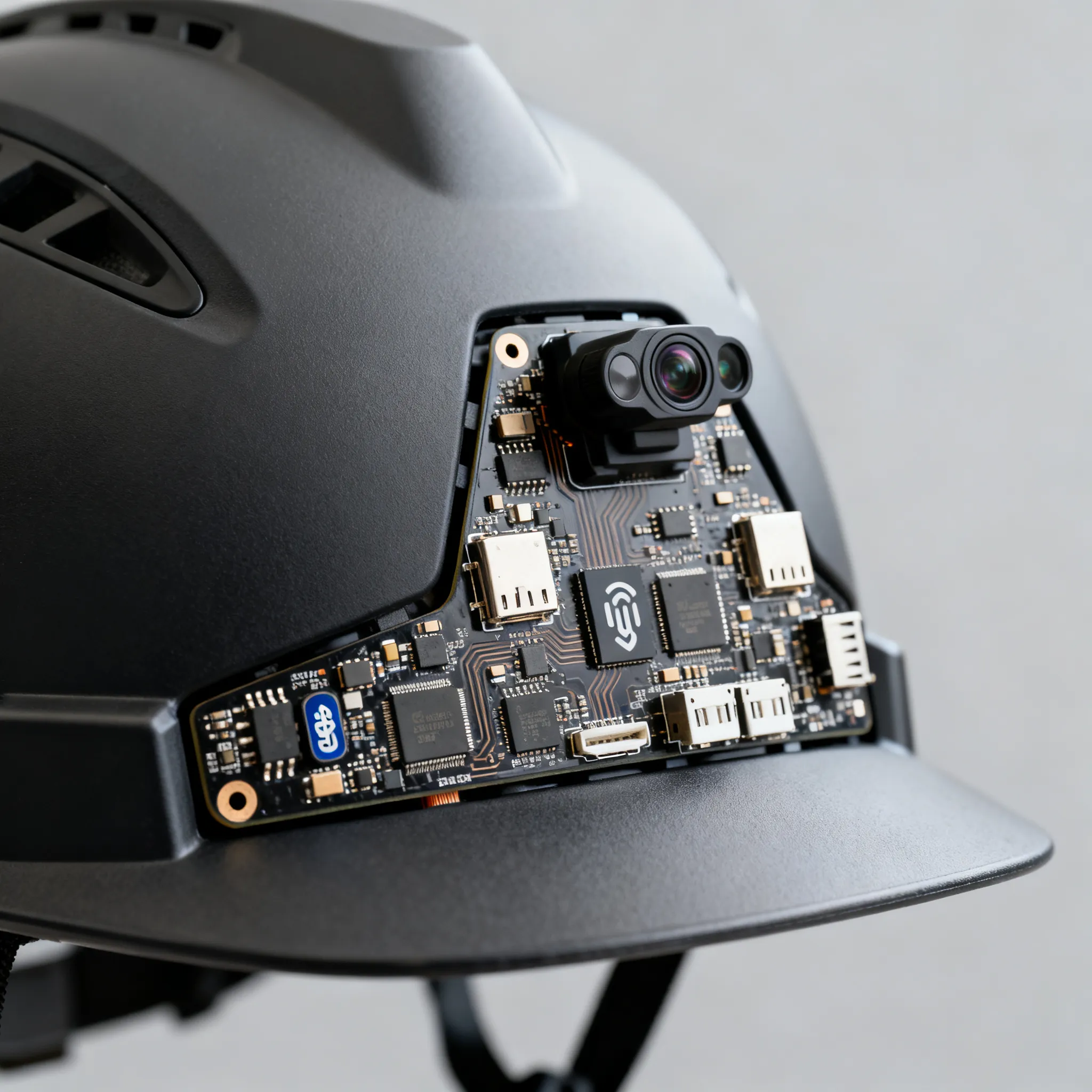
Why IoT-Enabled Helmets Are Reshaping Industrial Safety Procurement
For decades, the industrial hard hat remained essentially unchanged: a polyethylene shell designed to deflect falling objects. That era is ending. Procurement teams across construction, mining, oil and gas, and heavy manufacturing are now evaluating helmets that function as connected sensor hubs — wearable edge nodes that stream physiological data, environmental readings, and geolocation to centralised safety platforms. The shift from passive personal protective equipment to active, IoT-enabled worker monitoring is not a speculative trend; it is a procurement reality driven by tighter safety regulations, insurer requirements, and the measurable ROI of preventing fatigue-related incidents.
A 2022 scoping review published in PMC examined the landscape of smart helmets with multimodal sensing for health and safety, cataloguing systems that integrate EEG measurement modules, accelerometers, heart rate sensors, and environmental gas detectors into helmet form factors. The review highlighted representative cases such as LifeBand from SMARTCAP, which uses an EEG module strapped to the helmet to estimate worker condition in real time, and a smart EEG module from HHS (Health and Happiness Systems) that combines accelerometers, heart rate sensors, and EEG for drowsiness and concentration monitoring (PMC 1). These are not laboratory curiosities — they are fielded systems that procurement managers are now benchmarking.
The implications for electronics sourcing are significant. A smart helmet is not a single SKU; it is a bill of materials that spans MEMS inertial measurement units, photoplethysmography (PPG) heart rate sensors, electrochemical gas sensors, GNSS receivers, and at least two wireless connectivity modules. Buyers who previously sourced PPE from safety equipment catalogues now find themselves negotiating with semiconductor distributors, RF module vendors, and embedded software providers. Understanding the electronics inside these helmets — and the supply chain dynamics that govern their availability — has become essential for industrial procurement professionals.
Key Takeaway: The smart helmet market is pulling electronics buyers into unfamiliar territory where sensor lead times, wireless protocol selection, and SaaS licensing models directly affect total cost of ownership. The PMC scoping review confirms that multimodal sensing — combining EEG, heart rate, and motion data — is the dominant architectural pattern, which means procurement teams must source and integrate multiple sensor types from different supply chains.
Sensor and Connectivity Building Blocks Inside a Smart Helmet
At the component level, a modern industrial smart helmet integrates four to six distinct sensor modalities, a microcontroller or applications processor for sensor fusion, and two or more wireless interfaces. Understanding each building block — and the engineering trade-offs behind component selection — is the foundation of informed sourcing.
The inertial measurement unit, typically a 6-axis or 9-axis MEMS device combining an accelerometer and gyroscope (and optionally a magnetometer), serves as the helmet's motion-sensing core. It detects falls, impacts, and prolonged immobility. The accelerometer also feeds into drowsiness detection algorithms by tracking head tilt and micro-movements — a technique validated in the PMC scoping review, which noted that accelerometer data combined with heart rate and EEG inputs enables reliable fatigue classification (PMC 1).
Heart rate monitoring in helmet-mounted systems typically uses a PPG optical sensor positioned against the forehead or temple, rather than a wrist-worn device. This placement improves signal quality during physical work but introduces mechanical design challenges around skin contact pressure and ambient light rejection. EEG sensors — dry electrode arrays integrated into the helmet suspension or strap — add another physiological data stream for cognitive load and drowsiness assessment. The SMARTCAP LifeBand and HHS modules referenced in the PMC review both use this forehead-contact approach.
Environmental sensing rounds out the sensor suite. Electrochemical gas sensors for carbon monoxide (CO), hydrogen sulphide (H₂S), and oxygen (O₂) are common in oil and gas and confined-space applications. These sensors consume more power than MEMS devices and have finite operating lives — typically two to five years — which introduces recurring replacement costs into the procurement model.
On the connectivity side, the Lansitec Helmet Sensor provides a useful reference design. It achieves a standby current of just 25 μA, with uplink message capabilities that include registration, heartbeat, GNSS position, beacon, and alarm reporting (Lansitec 3). This level of power efficiency is critical for helmets that must operate a full shift — 8 to 12 hours — without recharging.
The table below summarises the core sensor and connectivity modules, their typical specifications, and the procurement considerations that matter most to engineering buyers.
| Module Type | Typical Component / Architecture | Key Specifications | Procurement Consideration |
|---|---|---|---|
| IMU (Accelerometer + Gyroscope) | 6-axis MEMS (e.g., Bosch BMI270, ST LSM6DSO) | ±16 g range, 0.488 mg/LSB, shock survival >10,000 g | High-volume MEMS; lead times 12–20 weeks; second-source from ST or TDK |
| Heart Rate (PPG) | Multi-LED optical sensor (e.g., Maxim MAX86141, TI AFE4404) | SNR >90 dB, ambient light rejection >100 mA, sampling 25–200 Hz | Forehead placement requires custom flex PCB; validate with dev kit before committing |
| EEG (Dry Electrode) | Analog front-end (e.g., TI ADS1299, NeuroSky TGAM) | 24-bit resolution, CMRR >110 dB, 2–8 channels | Niche supply base; expect longer lead times and higher unit cost |
| Gas Sensor (CO, H₂S, O₂) | Electrochemical cell (e.g., Alphasense, SGX Sensortech) | 1–500 ppm range, T90 <30 s, operating life 2–5 years | Plan for recurring replacement; shelf life matters for spares inventory |
| GNSS Receiver | Multi-constellation module (e.g., u-blox M10, Quectel L76) | 2.5 m CEP accuracy, -167 dBm tracking sensitivity | Verify antenna integration in helmet shell; ground plane constraints |
| BLE Module | Nordic nRF52840, TI CC2652, or certified module | BLE 5.2, 2 Mbps PHY, TX current <5 mA at 0 dBm | Pre-certified modules reduce compliance burden; check regional approvals |
| LoRa Module | Semtech SX1262-based module (e.g., Murata, RAKwireless) | 868/915 MHz, SF7–SF12, RX current <5 mA | Gateways required on-site; factor infrastructure into TCO |
| 4G/LTE Module | Quectel EC25, SIMCom SIM7600, or Telit ME910 | Cat 1 or Cat M1, fallback to 2G, embedded SIM option | Carrier certification and data plan negotiation; SaaS often bundled |
What this table makes clear is that a smart helmet BoM spans at least eight distinct component categories, each with its own supply base, lead-time profile, and qualification requirements. The Lansitec design demonstrates that careful power management — achieving 25 μA standby — can extend battery life meaningfully, but this requires tight integration between the MCU power management firmware and each sensor's sleep/wake behaviour (Lansitec 3). Buyers should request power profiles from module vendors early in the evaluation process.
BLE vs. LoRa vs. 4G: Choosing the Right Wireless Module for Continuous Worker Monitoring
No single wireless protocol satisfies every smart helmet use case. The choice between BLE, LoRaWAN, and cellular (4G/LTE) — or a combination — depends on the operating environment, data throughput requirements, power budget, and whether the worker is indoors, outdoors, or moving between both. The iSmarch Smart Helmet illustrates a practical dual-mode approach, combining BLE for energy-efficient local connections with LoRa for wide-area communication, allowing the system to switch between BLE and GPS positioning as the worker moves through different environments (iSmarch 4).
BLE (Bluetooth Low Energy) excels at short-range, low-power links — typically tethering the helmet to a worker's smartphone or a fixed gateway within 10–50 metres. It is the lowest-cost radio to implement, benefits from ubiquitous smartphone compatibility, and supports moderate data rates up to 2 Mbps with BLE 5.2. However, BLE alone cannot provide wide-area coverage across a large construction site or refinery without a dense mesh of gateways.
LoRaWAN addresses the range limitation. Operating in sub-GHz ISM bands (868 MHz in Europe, 915 MHz in North America), LoRa can cover several kilometres in open terrain and penetrate multiple floors in industrial buildings — all while consuming minimal power. The trade-off is data rate: LoRa is suited to periodic telemetry (heartbeat, position, alarm status) rather than continuous waveform streaming. For applications that need to transmit raw EEG or high-sample-rate accelerometer data, LoRa's duty cycle and payload limits become constraints.
4G/LTE — particularly Cat M1 and NB-IoT variants designed for IoT — offers real-time, off-site connectivity without requiring on-premises gateway infrastructure. This is the architecture favoured by MSA and Guardhat in their connected worker platforms, where helmet data flows directly to cloud-based SaaS dashboards (Accio 2). The downside is higher power consumption, carrier dependency, and ongoing data plan costs. The B2B price band for fully equipped helmets ranges from $250 to $700 per unit depending on sensor load — gas sensors, GPS, and 4G modules push the cost toward the upper end of that range (Accio 2).
The comparison table below maps the three connectivity options against the criteria that matter most for industrial helmet deployments.
| Comparison Metric | BLE 5.2 (Nordic nRF52840 / TI CC2652) | LoRaWAN (Semtech SX1262 / Murata Module) | 4G/LTE Cat M1 (Quectel EC25 / Telit ME910) | Selection Criteria & Failure Boundary |
|---|---|---|---|---|
| Range (Typical Industrial) | 10–50 m (indoor); up to 200 m (open air) | 2–10 km (outdoor); 3–5 floors (indoor) | Unlimited (carrier coverage dependent) | Choose LoRa if site exceeds 200 m radius and has no cellular coverage; BLE alone fails beyond 50 m without mesh |
| Data Throughput | 125 kbps – 2 Mbps | 0.3–50 kbps (SF-dependent) | 300 kbps – 1 Mbps (Cat M1) | EEG streaming requires BLE or 4G; LoRa insufficient for raw waveform data |
| Power Consumption (Active TX) | ~5 mA at 0 dBm | ~40 mA at +14 dBm (short burst) | ~200–500 mA (TX burst) | Battery life drops sharply with 4G; factor larger battery or shift-change charging |
| Infrastructure Required | Smartphone or BLE gateway | LoRaWAN gateway(s) on-site | Carrier network; SIM provisioning | LoRa gateways add $300–$1,500 per site; 4G adds monthly data plan per helmet |
| Real-Time Capability | Good (low latency) | Limited (duty cycle, 1% in EU) | Excellent (always-on IP connection) | For alarm/panic use cases, BLE or 4G preferred; LoRa alarm latency may exceed 10 s |
| Cost per Module (1k Volume) | $3–$8 | $8–$15 | $15–$35 (plus data plan) | Dual BLE+LoRa adds ~$15 BoM but eliminates single-point failure; iSmarch uses this approach (iSmarch 4) |
The iSmarch dual-mode architecture — BLE for local, LoRa for wide-area — is emerging as a pragmatic compromise for sites where workers move between indoor and outdoor zones and where cellular coverage is patchy (iSmarch 4). For organisations that need real-time off-site visibility and can absorb the higher per-unit and recurring costs, the MSA/Guardhat 4G-plus-SaaS model remains the benchmark, with the $250–$700 B2B price band reflecting the sensor and connectivity load (Accio 2).
Tip: When evaluating connectivity modules, request the vendor's power profile across all operating modes — TX, RX, idle, and sleep. A module that looks efficient on a datasheet may have a high idle current that drains the battery between transmission events. The Lansitec 25 μA standby figure sets a useful benchmark (Lansitec 3).
Sourcing Pitfalls and Lead-Time Signals for Helmet Sensor Modules
Sourcing the electronics for a smart helmet programme differs from standard PPE procurement in one critical respect: you are buying semiconductor components, not finished goods. That means you inherit the lead-time volatility, allocation risk, and qualification overhead of the electronics supply chain. Several pitfalls catch first-time buyers off guard.
Lead-time mismatch across the BoM. MEMS accelerometers from major suppliers like STMicroelectronics and Bosch typically carry 12–20 week lead times under normal conditions, but industrial-grade variants with extended temperature ranges (-40°C to +85°C) and higher shock survival ratings can stretch further during periods of tight supply. Electrochemical gas sensors from Alphasense or SGX Sensortech have their own production cadence and a limited shelf life — ordering too far in advance risks consuming the sensor's operational life before deployment. Buyers should map lead times for every line item and identify which components are single-sourced versus multi-sourced.
SaaS bundling and total cost of ownership. The Accio market analysis notes that many smart helmet solutions bundle software-as-a-service fees into the procurement package, meaning the $250–$700 B2B unit price often includes the first year of cloud platform access (Accio 2). Buyers must separate the hardware BoM cost from the recurring SaaS fees to make accurate multi-year budget projections. A helmet that appears cost-competitive at purchase may become the most expensive option by year three if SaaS fees are high and sensor replacements are frequent.
Environmental validation gaps. A sensor module that works on the bench may fail on a construction site. Buyers should verify that the complete helmet assembly — not just individual modules — meets IP65 or higher ingress protection and has been tested to MIL-STD-810 for vibration and shock. The Lansitec Helmet Sensor's robust design and 25 μA standby current indicate industrial-grade endurance, but that validation must extend to the entire integrated system (Lansitec 3). Request test reports, not just datasheet claims.
Sensor fusion algorithm dependency. The PMC scoping review underscores that the value of multimodal sensing lies in sensor fusion — combining accelerometer, heart rate, and EEG data to classify worker state (PMC 1). If the algorithm is proprietary and tied to a specific vendor's module set, switching sensor suppliers mid-programme may require revalidating the entire fusion pipeline. Buyers should clarify whether the sensor fusion firmware is open, licensable, or locked to the module vendor.
The table below maps the most common sourcing pitfalls to actionable mitigation strategies.
| Sourcing Pitfall | Root Cause | Impact | Mitigation Strategy |
|---|---|---|---|
| MEMS lead-time blowout | Fab capacity allocation; industrial-grade screening bottleneck | Line-down risk; forced redesign with alternative IMU | Qualify pin-compatible second source (e.g., ST LSM6DSO + Bosch BMI270); hold 8-week buffer stock |
| Gas sensor shelf-life expiry | Electrochemical cells degrade in storage (2–5 year life) | Field failures; unexpected replacement cycles | Order gas sensors on a just-in-time schedule; verify date codes on receipt |
| SaaS cost overrun | Bundled pricing obscures recurring licence fees | TCO 40–60% higher than budgeted over 3 years | Request hardware-only pricing and SaaS schedule separately; model 3-year TCO before commitment (Accio 2) |
| Ingress protection failure | Module-level IP rating does not guarantee system-level sealing | Water/dust ingress; sensor malfunction; safety liability | Require IP65+ system-level test reports; validate with in-house environmental chamber testing |
| Sensor fusion lock-in | Proprietary algorithms tied to specific sensor modules | Inability to second-source; single-vendor dependency | Negotiate algorithm licence terms; prefer open or portable fusion frameworks |
| Antenna integration issues | Helmet shell material (polycarbonate/ABS) detunes antenna | Reduced range; dead spots; unreliable connectivity | Engage RF design review early; budget for custom antenna matching network |
Procurement teams that treat smart helmet sourcing as a conventional PPE exercise — issuing a purchase order against a part number and expecting consistent availability — will encounter these pitfalls. The electronics content demands the same supply chain rigour applied to any embedded system: multi-source qualification, buffer stock planning, and total-cost-of-ownership modelling that extends beyond the initial purchase.
For mixed-BOM programmes where buyers need flexible minimum order quantities across sensor, connectivity, and passive components, platforms like IC-Online provide access to distributor stock and alternative sources that can bridge gaps when primary allocation runs short. The ability to cross-reference part numbers and compare availability across multiple distributors in real time is particularly valuable when a single long-lead-time component threatens the entire helmet build schedule.
Smart Helmet Module Sourcing: Questions Engineers and Buyers Ask
After working through dozens of smart helmet sourcing programmes, certain questions arise consistently — from engineering teams evaluating sensor performance to procurement managers modelling total cost. The answers below reflect current industry practice, validated against the research and vendor data cited throughout this article.
Q: What sensor modules are most commonly integrated into industrial smart helmets, and what specs should I prioritise?
The core sensor suite in a fielded industrial smart helmet typically includes an IMU (6-axis accelerometer plus gyroscope), a PPG heart rate sensor positioned for forehead contact, dry-electrode EEG for cognitive load and drowsiness monitoring, and electrochemical gas sensors for CO, H₂S, and O₂ detection. When evaluating these modules, prioritise four parameters: power consumption (every microamp counts toward shift-life battery runtime), operating temperature range (-20°C to +60°C minimum for outdoor work), shock survival rating (10,000 g or higher for the IMU, reflecting real-world impact survivability), and signal-to-noise ratio for the PPG and EEG channels. The PMC scoping review validates this sensor mix, highlighting accelerometers, heart rate sensors, and EEG as the triad for drowsiness and fatigue detection in industrial settings (PMC 1).
Q: How do I choose between BLE, LoRaWAN, and cellular for helmet connectivity in a large industrial plant?
The decision hinges on three factors: site geography, data payload, and infrastructure budget. BLE is the right choice when workers remain within 50 metres of a gateway or carry a smartphone that serves as a data relay — it is low cost, low power, and simple to implement. LoRaWAN becomes necessary when the site spans several kilometres or includes multi-storey structures where BLE cannot reach; it covers 2–10 km outdoors and penetrates multiple floors, all while drawing minimal current. Cellular (4G/LTE Cat M1) is the option when real-time off-site monitoring is required and the organisation can absorb both the higher module cost and the recurring data plan. The iSmarch Smart Helmet demonstrates a practical dual-mode approach, using BLE for local energy-efficient connections and LoRa for wide-area communication with flexible positioning (iSmarch 4). For sites with mixed indoor/outdoor zones and unreliable cellular coverage, this dual BLE+LoRa architecture is increasingly the default recommendation.
Q: What are realistic lead times for MEMS accelerometers and industrial gas sensor modules?
Plan for 12–20 weeks on standard industrial-grade MEMS accelerometers from tier-one suppliers. This can extend during periods of tight fab capacity or when ordering automotive/industrial screened variants with extended temperature range and higher shock survival ratings. Electrochemical gas sensors have shorter manufacturing lead times — typically 6–10 weeks — but their limited shelf life (2–5 years from manufacture) means you cannot simply order a year's supply and warehouse it. Spot shortages in either category can push lead times beyond 20 weeks. The most effective mitigation is to qualify a pin-compatible second source for the IMU (ST and Bosch offer overlapping portfolios) and to maintain a rolling 8-week buffer stock of gas sensors with strict date-code monitoring. Always verify current distributor stock levels before freezing a BoM; a design locked to a single-source MEMS part with 26-week lead time is a programme risk.
Q: What hidden costs should I anticipate when sourcing helmet-mounted IoT modules?
Beyond the sensor and connectivity module unit prices, budget for enclosure integration engineering (designing the mounting, sealing, and cable management for the electronics inside the helmet shell), antenna design and matching (the helmet material — typically polycarbonate or ABS — affects RF performance and may require custom tuning), certification testing (FCC/CE for intentional radiators, plus industry-specific safety certifications), and ongoing software subscription fees. The Accio market analysis confirms that the $250–$700 B2B price band for fully equipped helmets often includes the first year of SaaS, but subsequent years add recurring costs that can equal or exceed the hardware amortisation (Accio 2). Model a three-year total cost of ownership before comparing vendor proposals, and request hardware-only and SaaS pricing as separate line items.
Q: How do I ensure the sensor module survives the harsh environment of a construction site?
Three validation criteria matter most: ingress protection, mechanical shock and vibration survival, and operating temperature range. Specify IP65 or higher at the system level — not just the module level — because the sealing interfaces between the helmet shell and the sensor enclosures are where water and dust ingress occur. Require MIL-STD-810 compliance for vibration and shock, and verify that testing was performed on the complete helmet assembly, not a bare circuit board. The Lansitec Helmet Sensor's design, with its 25 μA standby current and robust environmental performance, provides a useful benchmark for industrial-grade endurance (Lansitec 3). Additionally, request accelerated life test data from the module vendor and, if possible, conduct your own environmental chamber testing with production-intent helmet assemblies before committing to volume orders. A module that passes bench testing at 25°C may fail at -15°C on a winter construction site or after repeated thermal cycling.
Need components or PCBA support for Smart Safety Helmet products? IC-Online helps smart-device OEMs with sourcing and board-level supply — see our Smart Device Solutions or contact our team for a BOM review.
References & Further Reading
- Trends in Smart Helmets With Multimodal Sensing for Health and Safety: Scoping Review — PMC / National Library of Medicine. Comprehensive survey of EEG, heart rate, and accelerometer integration in industrial smart helmets, including SMARTCAP LifeBand and HHS case studies.
- Best Industrial Smart Safety Helmet 2026 — Accio. Market analysis covering MSA, Guardhat, and connected worker platforms; B2B pricing band $250–$700 per unit with SaaS bundling insights.
- Smart Helmet With Sensors For Accident Prevention — Lansitec. Technical deep-dive on the Lansitec Helmet Sensor, including 25 μA standby current, GNSS positioning, and LoRaWAN uplink message architecture.
- Smart Safety Helmet – Advanced IoT Safety for Industrial Use — iSmarch. Product reference for dual-mode BLE + LoRa connectivity with flexible indoor/outdoor positioning.
- IC-Online — Electronic component sourcing platform for mixed-BOM procurement, distributor stock comparison, and flexible MOQ across sensor, connectivity, and passive component categories.
- Texas Instruments — Supplier of PPG analog front-ends (AFE4404), EEG analog front-ends (ADS1299), and BLE wireless MCUs (CC2652) applicable to smart helmet designs.
- STMicroelectronics — Supplier of industrial-grade MEMS IMUs (LSM6DSO series) with high shock survival ratings for helmet-mounted motion sensing.
- Semtech — Developer of LoRa technology and SX1262 transceiver platform used in long-range, low-power helmet connectivity modules.