Smart Smoke Detector Components: MCU, Sensors, and Certified Supply Strategies
Smart Smoke Detector Components: MCU, Sensors, and Certified Supply Strategies
Smart Smoke Detector Components: MCU, Sensors, and Certified Supply Strategies
When Smart Detectors Go Silent: Lessons from Recent Smoke Alarm Recalls
In the past year, multiple smart smoke and combination CO detectors were recalled after failing to alert consumers during fires—a life-safety failure that no engineering team can afford to overlook. The U.S. Consumer Product Safety Commission (CPSC) issued recalls for the Treatlife combination smoke and CO detector, two LShome photoelectric models (including another LShome unit sold on Amazon), and the Three61 Samurai Mini alarm. In each case, the root cause traced back to inadequate component selection, firmware that could not reliably distinguish smoke from noise, or supply chains that bypassed certification entirely.
These recalls are not isolated quality glitches—they expose a systemic risk when procurement teams and design engineers treat smart smoke detectors as commodity IoT gadgets rather than safety-critical systems. The MCU’s sleep current, the analog front-end’s (AFE) ambient light rejection, and the sensor chamber’s optical alignment all determine whether a device will wake up and scream when it matters. When you source these components from uncertified channels or skip the rigorous validation that UL 217 Edition 9 demands, the failure mode is silent, and the liability is enormous. The following sections map the component architectures, compare real-world platform choices, and define a supply strategy that keeps safety first without sacrificing development speed or BOM cost.
How Smart Smoke Detectors Sense Danger: MCU, AFE, and Sensor Architectures
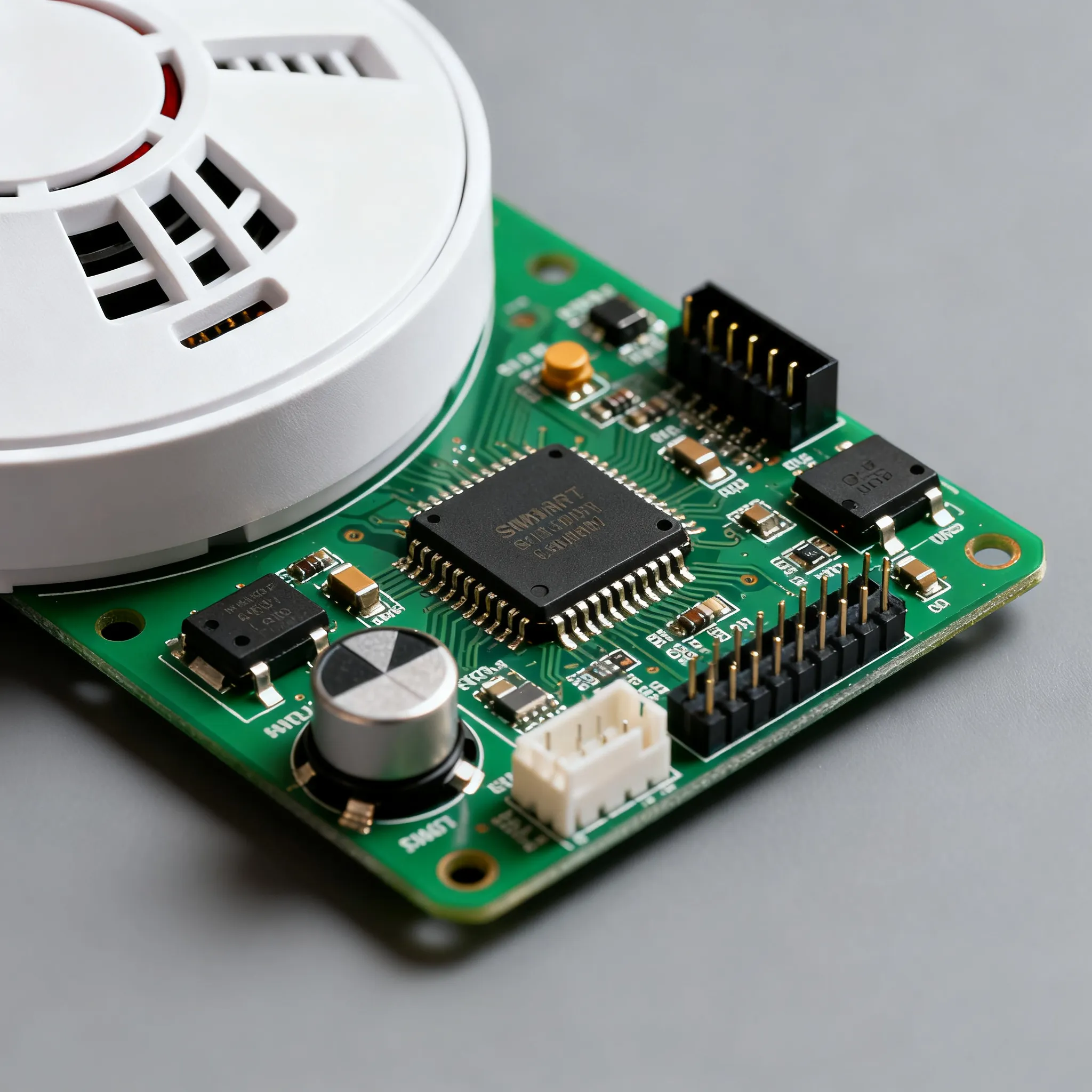
At the heart of every modern photoelectric smoke detector is a carefully orchestrated dance between light, electronics, and software. A photoelectric smoke chamber contains an infrared LED and a photodiode positioned at an obtuse angle. Under clean-air conditions, the LED beam misses the photodiode. When smoke particles enter the chamber, they scatter light onto the photodiode, generating a tiny current that must be amplified, filtered, and interpreted. The analog front-end (AFE) handles the precision LED pulsing, photodiode signal conditioning, and ambient light cancellation, while the MCU runs detection algorithms, manages wireless connectivity, and drives the horn.
Two representative AFEs illustrate the design spectrum. Texas Instruments’ TPS8804 integrates dual programmable LED drivers, a low-noise transimpedance amplifier, and a 10-bit ADC, all optimized for smoke detection with ambient light cancellation. NXP’s MC145010 takes a more integrated approach, embedding the photoelectric amplifier, comparator, and horn driver into a single chip with a fixed IRED pulse width set by external R1 and C3. For battery-powered designs, Microchip’s RE46C190 combines the AFE, smoke chamber emulator, and piezoelectric horn driver on one die, operating from a single CR123A cell. The TI TIDA-010941 reference design demonstrates how to pair the TPS8804 with a low-power MSP430 MCU to achieve sub-10 µA system standby current while maintaining compliance with UL 217 smoke sensitivity profiles.
Selecting the right MCU for a smart smoke detector is not about clock speed; it’s about waking up predictably after years of battery sleep, sampling the ADC without noise, and running certified detection algorithms within a strict energy budget. The table below contrasts three common AFE/MCU partitioning strategies that engineers evaluate at the architecture stage.
| Parameter | Discrete AFE + MCU (e.g., TPS8804 + MSP430/Cortex-M0+) | Integrated AFE + Logic IC (e.g., NXP MC145010) | Integrated AFE + MCU SoC (e.g., Microchip RE46C190) |
|---|---|---|---|
| BOM components for smoke sensing | 6–8 passives, external LED drive, photodiode bias | 3–5 passives, fixed timing | Minimal external components; onboard horn driver |
| Standby current (system) | 3–10 µA (MCU sleep + AFE duty-cycled) | <10 µA (static) | <8 µA (including internal regulator) |
| ADC resolution / signal chain | 10–12-bit ADC on MCU; flexible gain staging | Analog comparator with fixed threshold | 8-bit ADC; onboard smoke chamber calibration |
| Algorithm flexibility | Full software control—drift compensation, multi‑sensor fusion | Fixed gain; threshold only | Pre‑programmed or custom via MCU interface |
| Wireless stack support | Native BLE / Wi-Fi / Sub‑GHz on MCU | None; requires external radio | None; requires external radio or host MCU |
| Certification pre‑compliance | Full design responsibility; reference designs reduce risk | Limited; aging requires external calibration | UL‑recognized smoke IC; simplifies UL 217 path |
| Typical development effort | High—custom PCB layout, firmware, sensor characterization | Low—fixed function, no firmware | Medium—reference board available, firmware for radio |
| BOM cost (1k volume) | $2.80–$4.50 (AFE + MCU) | $1.20–$2.00 | $2.50–$3.50 (includes horn driver) |
Key takeaway: The discrete AFE-plus-MCU route offers the most headroom for smart features—dual‑wavelength detection, particle discrimination, and cloud connectivity—but demands rigorous firmware validation. The integrated SoC approach slashes BOM count and speeds up UL pre‑compliance, while the fixed‑function IC is best suited for cost‑driven, non‑connected alarms. Your choice directly impacts the supply chain: discrete designs require two or three separate semiconductor sources, while the SoC consolidates procurement into a single vendor qualification.
Comparing Smart Smoke Detector Platforms and Component Choices
When you look at the consumer smart alarm market, the top‑rated products are coalescing around a common architecture: a single photoelectric sensor, a low‑power MCU with BLE or Wi‑Fi, and an app that delivers remote alerts and self‑diagnostics. CNET’s 2026 best smoke detector rankings highlight the Nest Protect and Kidde models, both of which employ dual‑spectrum photoelectric sensors calibrated to the 9th Edition of UL 217, which mandates new fire‑resistance and nuisance‑alarm tests. Wirecutter’s top picks echo this shift: single‑sensor photoelectric alarms that pass NRTL certification now dominate the “smart” category, and the old dual‑ionization‑plus‑photoelectric dogma has been replaced by sophisticated algorithms running on a capable MCU. WC Safety’s 2026 ranking notes that the Nest Protect ($119) uses a spoken pre‑alarm, room‑specific identification, and instant push notifications, features that rely on a robust MCU with enough flash and RAM to run a wireless stack alongside the safety algorithm.
For professional and custom designs, the component landscape forks into three paths: a fully integrated smoke detector IC, a discrete AFE‑plus‑MCU combo, or a certified sensor module from a safety‑component manufacturer. The table below compares these approaches across the dimensions that matter most to engineering and procurement leads.
| Comparison Metric | Integrated Smoke IC (e.g., Microchip RE46C190) | Discrete AFE + MCU (e.g., TI TPS8804 + STM32L0) | Pre‑Certified Module (e.g., System Sensor i3) | Selection Criteria & Failure Boundary |
|---|---|---|---|---|
| Time to market | 8–12 weeks (PCB layout + firmware for radio) | 16–24 weeks (full sensor characterization, firmware) | 4–6 weeks (module integration, enclosure design) | If UL 217 Edition 9 compliance is urgent, the module saves months; the integrated IC still requires third‑party testing. |
| BOM cost at 10k units | $2.50–$3.80 | $3.20–$5.00 | $8.00–$12.00 (module only) | Cost vs. certification risk: modules are expensive but de‑risk the entire project. |
| Certification effort | Medium—UL‑recognized IC reduces analog risk, but full system still needs NRTL listing | High—every gain stage and algorithm must be proven compliant | Low—module carries UL listing, final assembly undergoes limited testing | Uncertified modules or copies will fail the chamber sensitivity test; always verify the listing mark. |
| Supply chain flexibility | Single‑source IC; alternate sources are rare | Dual‑source AFE and MCU possible; second‑source photodiode | Single supplier for the module; sensor chamber is proprietary | Dual‑sourcing the AFE and MCU mitigates allocation risk; modules lock you to one vendor. |
| Smart feature integration | Limited—requires external radio MCU | Excellent—MCU can run BLE, Wi‑Fi, Zigbee, plus voice prompts | Moderate—I/O pins for alarm relay; wireless stack handled externally | If you need room‑specific spoken alerts, the discrete path is the only flexible option. |
Honeywell’s System Sensor i3 series exemplifies the module approach: the photoelectric chamber, AFE, and horn are housed in a UL‑listed assembly that connects to a building’s fire alarm control panel. For residential smart alarms, the i3 module can be integrated with a wireless transceiver, but the core sensing function is already certified, collapsing the compliance timeline. Conversely, the discrete AFE‑plus‑MCU architecture, as demonstrated in TI’s TIDA‑010941, gives you full control over the detection algorithm, enabling you to differentiate with features like false‑alarm rate reduction or dual‑smoke‑CO fusion—but only if you have the in‑house firmware expertise and the patience to run the full UL 217 test suite.
Sourcing Certified Smoke Detector Components Without Compromising Safety or Lead Times
The CPSC recall data from 2025–2026 makes one thing clear: products sold through uncontrolled marketplaces frequently bypass the very certification steps that would have caught the failure to alert. Procurement teams must therefore treat every component in the smoke sensing path—LED, photodiode, AFE, MCU, horn driver—as a safety‑critical part, not a generic electronic commodity. Begin by requiring full traceability through authorized distribution. The AFE and sensor ICs from TI, Microchip, and NXP are available through franchised distributors with lot‑level traceability; counterfeit or uncertified clones often exhibit incorrect LED drive currents and uncalibrated gain, which directly mimic the conditions that led to the LShome and Treatlife recalls.
Tip: When evaluating a photoelectric sensor module, always request the NRTL test report and look for the listing mark (UL, ETL, or CSA) on the label. Cross‑check the listing number on the certifying body’s online directory. Pre‑certified modules like the System Sensor i3 simplify this step, but even with a discrete design, you can purchase UL‑recognized smoke chambers and photodiodes from Honeywell, Excelitas, or ams Osram, which have published sensitivity data.
MCU selection for safety‑critical smoke detectors demands more than a low‑power datasheet. Look for a hardware watchdog timer that operates independently of the main clock, a 10‑ or 12‑bit ADC with at least 100 ksps to capture the short LED pulse, and enough flash (64–128 KB) to store both the wireless stack and the certified alarm algorithm. Parts with clock security, ECC memory, and a published safety manual—such as select STM32L4 or MSP430FR series devices—reduce the firmware validation burden. Insist that the MCU vendor can supply a Failure Mode and Effects Analysis (FMEA) document for the safety application.
Diversify your BOM to avoid single‑source bottlenecks. The table below captures the lead‑time landscape for critical smoke detector components as of early 2026, based on distributor and manufacturer data. While the market has stabilized from the 2022–2023 shortages, niche AFEs and older process‑node ICs can still stretch beyond 20 weeks.
| Component | Representative Part Number | Typical Lead Time (Q1 2026) | Sourcing Risk & Mitigation |
|---|---|---|---|
| Smoke detector AFE | TI TPS8804 | 8–12 weeks | Stable; second‑source with NXP MC145010 or discrete op‑amp topology |
| Integrated smoke IC | Microchip RE46C190 | 10–14 weeks | Single‑source; maintain 6–8 weeks of safety stock |
| Low‑power MCU | STM32L071, MSP430FR2355 | 12–16 weeks | Widely available; qualify pin‑compatible alternate from different vendor |
| Photoelectric sensor chamber | Honeywell i3 chamber, Excelitas TSP series | 4–8 weeks | Proprietary; lead time can spike with building code cycles; order 12‑week buffer |
| Piezoelectric horn | Murata PKM22EPPH, PUI Audio | 6–10 weeks | Standard component; multiple sources available |
| CR123A battery holder / contacts | Keystone, MPD | 2–4 weeks | Low risk; qualify multiple form‑factor options |
Firmware reliability is the final, and often most underestimated, supply chain component. The “failure to alert” recalls were not always hardware failures; in many cases, the algorithm could not handle real smoke profiles that deviated from the lab bench. Build validation cycles that include HALT/HASS testing with real smoke aerosols—cotton wick, smoldering polyurethane, and flaming heptane per UL 217. Implement redundant sensor sampling, drift compensation, and self‑diagnostic routines that check the LED, photodiode, and battery voltage on every wake cycle. The TIDA‑010941 reference firmware provides a solid starting point for ambient light cancellation and smoke threshold detection, but you will need to layer your own wireless stack and certification logic. Code reviews against MISRA‑C guidelines and static analysis are not optional when human life is at stake.
Smart Smoke Detector Component Sourcing: Questions from the Field
Senior engineers and procurement leads often ask the following questions when planning a smart smoke detector program. The answers draw on the technical references and supply chain lessons discussed throughout this article.
- Q: What MCU specifications are critical for battery-operated smart smoke detectors?
A: Look for sub‑µA stop‑mode current, a 10‑ or 12‑bit ADC with at least 100 ksps, a hardware watchdog timer, and enough flash (typically 64–128 KB) to store certified alarm algorithms and wireless stacks. Clock security and ECC memory are pluses for safety‑critical applications. The MCU must be able to wake from sleep, sample the AFE, and make a decision within a few milliseconds to keep average current below 10 µA. - Q: How do I verify that a sensor module meets UL 217 Edition 9?
A: Request the NRTL (e.g., UL, ETL) test report and listing number from the supplier. Genuine modules will have the listing mark on the label. Cross‑check the listing on the certifying body’s online directory. Pre‑certified modules like the System Sensor i3 simplify this process, but always confirm the exact edition of the standard covered by the listing. - Q: What are the risks of sourcing photoelectric smoke sensors from uncertified channels?
A: Counterfeit or uncertified sensors may have incorrect LED wavelengths, poor chamber design, or uncalibrated sensitivity, leading to failure to alert—exactly the issue that triggered the 2025–2026 CPSC recalls. They also lack traceability, making root‑cause analysis impossible if field failures occur. Always source through franchised distributors and request conformal coating and sensitivity test data. - Q: How can we ensure firmware reliability to prevent false alarms or missed detections?
A: Implement redundant sensor sampling, drift compensation algorithms, and self‑diagnostic routines. Follow the reference firmware architectures provided in designs like TI’s TIDA‑010941, and run HALT/HASS testing with real smoke aerosols. Code reviews and MISRA‑C compliance are strongly recommended. The algorithm should be tested against the UL 217 flaming and smoldering fire profiles, not just clean‑room smoke cans. - Q: What lead‑time trends are you seeing for smoke detector ASICs and AFEs?
A: Lead times for dedicated smoke detector ICs have stabilized to 8–14 weeks for major suppliers like Microchip and TI, but niche parts or older process nodes may extend to 20+ weeks. Procurement should maintain safety stock and qualify second‑source AFE/MCU combinations early. The table in the previous section provides a snapshot for common parts. - Q: Is it better to design with a discrete AFE or an integrated smoke detector IC?
A: Integrated ICs (e.g., Microchip RE46C190) reduce BOM count, board space, and certification effort, making them ideal for high‑volume cost‑sensitive designs. Discrete AFE‑plus‑MCU solutions offer greater flexibility in sensor calibration and algorithm tuning, which can be advantageous for differentiated smart features or multi‑sensor fusion. The choice should be driven by your development timeline, firmware capabilities, and the need for wireless connectivity.
As the smart smoke detector landscape evolves, the line between a consumer gadget and a life‑safety device grows thinner. Every component decision—from the photodiode’s dark current to the MCU’s sleep‑mode wake‑up latency—directly affects the probability that a detector will sound when it must. The recalls of the past year are a stark reminder that cost‑cutting on the sensing path or bypassing certified supply chains can have fatal consequences. By pairing a well‑characterized AFE like the TI TPS8804 or Microchip RE46C190 with a safety‑conscious MCU, and by sourcing through authorized, traceable channels, you can build a smart alarm that meets both the technical demands of the smart home and the uncompromising requirements of UL 217 Edition 9.
For procurement teams managing mixed BOMs across multiple sensor platforms, IC-Online offers flexible MOQ sourcing and verified inventory for smoke detector AFEs, MCUs, and sensor chambers, helping you maintain continuity without compromising on component authenticity.
Need components or PCBA support for Smart Smoke Detector products? IC-Online helps smart-device OEMs with sourcing and board-level supply — see our Smart Device Solutions or contact our team for a BOM review.
References & Further Reading
- CPSC – Treatlife Combination Smoke and CO Detector Recall
- LShome Smoke Detector Recall
- CPSC – LShome Photoelectric Smoke Detector Recall
- CPSC – Three61 Samurai Mini Smoke Alarm Recall
- TI TPS8804 Smoke Detector AFE Datasheet
- NXP MC145010 Photoelectric Smoke Detector IC Datasheet
- TI TIDA-010941 Reference Design – Smart Analog Sensor Interface for Smoke Detection
- Microchip RE46C190 CO/Smoke Detector and Horn Driver IC
- System Sensor i3 Series Data Sheet (Honeywell)
- CNET – Best Smoke Detectors and Dual Alarms for 2026
- Wirecutter – The 3 Best Smart Smoke Alarms of 2026
- WC Safety – Best Smart Smoke Detectors 2026
- IC-Online – Mixed BOM and Flexible MOQ Sourcing