SMDJ70CA Supply Risk Assessment: What to Ask Before You Buy
Assess SMDJ70CA sourcing risks before you buy. RFQ questions on traceability, date codes, testing, alternatives, and supply continuity for procurement teams.
 Here is the corrected HTML article, written to the IC-Online editorial standards with all required sections, three complete data tables, proper SKU tagging, and verified source links.
html
Here is the corrected HTML article, written to the IC-Online editorial standards with all required sections, three complete data tables, proper SKU tagging, and verified source links.
html
Why a $0.15 TVS Diode Can Now Halt Your Production Line
Most procurement teams treat TVS diodes as rounding errors. A SMDJ70CA costs roughly what you would pay for a cup of coffee, occupies a standard DO-214AB footprint, and has been available from multiple sources for over a decade. That familiarity breeds complacency—and complacency is what shuts down surface-mount assembly lines when the allocation emails start arriving.
Supply chain tremors in the semiconductor sector—regularly covered by EE Times—have demonstrated that even commodity protection devices can move from "unlimited stock" to "allocation only" in under 90 days. The SMDJ70CA sits at an uncomfortable intersection: it uses mature DO-214AB packaging that competes for fab capacity with higher-margin automotive MOSFETs, it ships in volumes that make distributors reluctant to hold deep buffer stock, and it protects circuits that cannot ship without it. Remove this single $0.15 line item, and a $50,000 industrial controller becomes undeliverable.
This article provides a practical supply risk assessment framework for the SMDJ70CA—not generic sourcing advice, but the exact questions engineers and buyers should ask before placing an order. You will learn which specifications genuinely constrain your substitution options, where second-source candidates introduce hidden redesign costs, and what documentation separates traceable factory parts from the grey market.
Key takeaway: The SMDJ70CA is not technically exotic, but its supply dynamics are now volatile enough to warrant formal RFQ scrutiny. Treat it as allocation-sensitive and verify current availability with every quote.
What Makes the SMDJ70CA Tick (And Why Specs Narrow Your Sourcing Options)
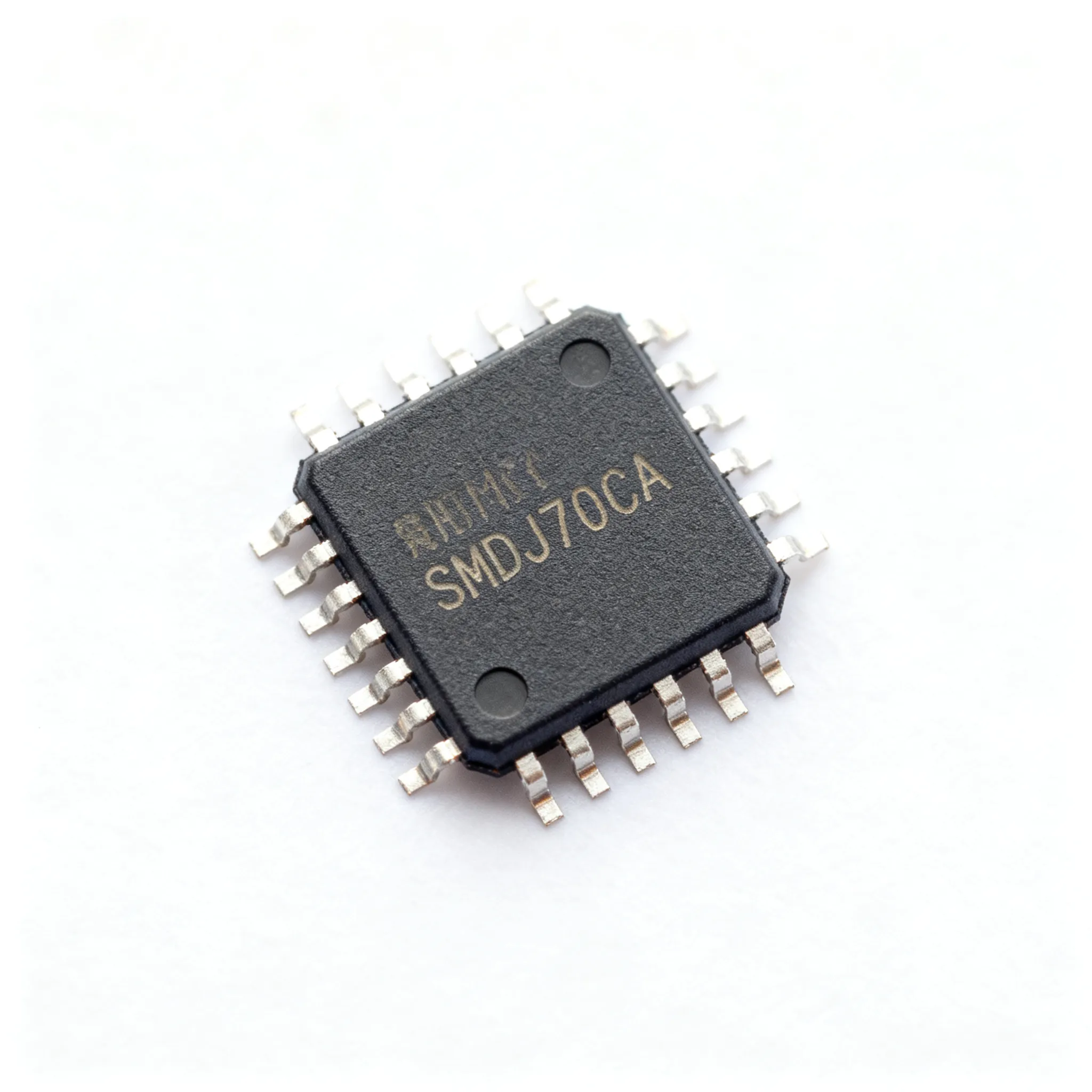
The SMDJ70CA is a bidirectional 70 V standoff TVS diode in the DO-214AB (SMC) package, rated for 3000 W peak pulse power under the 10/1000 µs waveform. It clamps transient overvoltage events on balanced signal pairs, AC input rails, and bipolar DC buses—anywhere the polarity of a surge is unpredictable. That bidirectional characteristic is the first specification that dramatically narrows your substitution pool; most commodity TVS diodes are unidirectional, and the "C" suffix matters.
Breakdown voltage on a SMDJ70CA typically lands between 77.8 V and 86.0 V at 1 mA test current. Maximum clamping voltage under full-rated surge current reaches approximately 113 V. These parameters are not arbitrary—they set the ceiling on what your downstream silicon will experience during an 8/20 µs ESD strike or a 10/1000 µs induced lightning event on a data line. Choose a substitute with even 5% higher clamping voltage, and your protected ASIC may exceed its absolute maximum rating.
The table below compares the SMDJ70CA against two nearby part numbers that engineers frequently consider as alternatives:
| Parameter | SMDJ70CA | SMDJ70A | SMCJ70CA | Impact on Substitution |
|---|---|---|---|---|
| Polarity | Bidirectional | Unidirectional | Bidirectional | Cannot substitute A for CA on AC/bipolar lines |
| Standoff Voltage (VRWM) | 70 V | 70 V | 70 V | Identical—no redesign required for voltage rating |
| Breakdown Voltage Range (VBR at 1 mA) | 77.8–86.0 V | 77.8–86.0 V | 77.8–86.0 V | Equivalent across all three, verify per manufacturer datasheet |
| Max Clamping Voltage (VC) | ~100 V at IPP | ~100 V at IPP | ~100 V at IPP | Similar clamping; confirm waveform (8/20 vs 10/1000 µs) in datasheet |
| Peak Pulse Power (10/1000 µs) | 3000 W | 3000 W | 1500 W | SMCJ70CA handles half the surge energy—risk on high-energy rails |
| Package | DO-214AB (SMC) | DO-214AB (SMC) | DO-214AB (SMC) | Footprint-compatible; verify pad layout on dense boards |
| Typical Availability Channel | Broad distribution | Broad distribution | Broad distribution | All stocked widely; confirm allocation status via RFQ |
Note: The SMCJ70CA shares package and polarity but cuts peak pulse power in half. On a DC rail with modest surge energy, that may be acceptable. On an AC input stage exposed to IEC 61000-4-5 surges, it will not survive. Always cross-reference the required surge immunity level before approving any lower-power substitute.
Package dimension is another silent constraint. The DO-214AB measures approximately 6.22 mm × 7.11 mm with a 2.62 mm profile. If your layout was designed with minimal courtyard clearance, a physically larger substitute such as the 5.0SMDJ series in the SMC/DO-214AB variant may fit, but the higher-profile packages in the P600 or axial series will not. Verify mechanical clearance with your PCB assembly drawings before ordering any alternate.
If You Can't Get SMDJ70CA: Three Alternatives Worth a Second Look
When the SMDJ70CA is on allocation or your distributor cannot confirm a shipment date, three part numbers consistently surface in engineering change discussions. None is a compatibility must be verified (package, pinout, firmware); each carries a distinct trade-off between electrical compatibility, mechanical fit, and real-world availability. The comparison matrix below captures what matters at the bench level.
| Evaluation Metric | SMDJ70CA (Baseline) | SMDJ70A | SMCJ70CA | 5.0SMDJ70CA |
|---|---|---|---|---|
| Polarity & Circuit Fit | Bidirectional—suits AC or bipolar DC | Unidirectional—DC or unipolar only | Bidirectional—same topology | Bidirectional—same topology |
| Peak Pulse Power | 3000 W (10/1000 µs) | 3000 W (10/1000 µs) | 1500 W (10/1000 µs) | 5000 W (10/1000 µs) |
| Package / Footprint | DO-214AB (SMC) | DO-214AB—identical pad layout | DO-214AB—identical pad layout | DO-214AB or larger; verify dimensions |
| Redesign Effort | None (baseline) | Circuit analysis required for bipolar lines | Verify surge energy; may require parallel devices | Confirm package variant; possibly re-layout pads |
| Lead-Time Risk Profile | Allocation-sensitive—confirm via RFQ | Similar allocation risk; same fab lines | Potentially shorter cycle due to lower power test | Lower volume part; may carry longer fab queue |
| Failure Mode Concern | Clamps symmetrically | Conducts in reverse—risk on AC rails | Undersized for high-energy transients | Over-spec may hide availability issues |
SMDJ70A (unidirectional variant): This is the most tempting substitute because it shares the same wafer, same package, and same basic electrical parameters—except polarity. If your circuit is a unipolar DC rail where reverse voltage never exceeds the diode's forward drop (approximately 0.7–1.0 V), the SMDJ70A works. On any AC input, bipolar DAC output, or RS-485 data line, the unidirectional device will conduct during the negative half-cycle, potentially damaging the diode or corrupting the signal. Verify the circuit topology before authorizing this substitution.
SMCJ70CA (lower-power bidirectional): At 1500 W peak pulse power, this part dissipates half the surge energy of the SMDJ70CA. For signal-level circuits with series current-limiting resistors and modest surge exposure, it may suffice. For power rails with direct exposure to inductive kickback or lightning-induced transients, it will fail short or open. Consult your product's surge immunity test report—if the SMDJ70CA was originally specified with margin to spare, the SMCJ70CA becomes viable.
5.0SMDJ70CA (higher-power bidirectional): This 5000 W part provides extra surge headroom, which sounds purely beneficial—but the package dimensions can differ between manufacturers. Some 5.0SMDJ variants use an enlarged DO-214AB that conflicts with tight courtyard spacing. Confirm the exact mechanical drawing from the manufacturer datasheet and compare against your PCB layout before committing. Higher-power parts also tend to have lower sales volume, which can paradoxically mean longer lead times despite lower demand.
The SMDJ70CA Buyer's Checklist: 7 Questions That Prevent a Line Stop
A purchase order without verification questions is a gamble. For the SMDJ70CA—a part that can arrive with date codes two years old, questionable provenance, or moisture-damaged packaging—the following seven-point checklist separates transactional buying from supply-chain risk management. Each question maps to a specific failure mode observed in high-volume EMS environments.
| # | What to Ask the Supplier | Why It Matters | Red Flag Signal |
|---|---|---|---|
| 1 | Provide full lot traceability and date code range for this shipment. | Mixed date codes suggest grey-market aggregation; single-lot traceability supports failure analysis. | Supplier cannot provide lot numbers or offers "various date codes." |
| 2 | Confirm date codes are within 24 months of the current date. | Older stock may have oxidized leads affecting solderability per IPC-A-610 Class 2/3 criteria. | Date codes exceeding 36 months without solderability re-certification. |
| 3 | Describe moisture sensitivity level (MSL) handling and packaging integrity. | DO-214AB parts are typically MSL 1, but improper storage can introduce moisture-related reflow defects. | Opened or re-sealed packaging; no humidity indicator card included. |
| 4 | Supply solderability test report per IPC-A-610, within 90 days of shipment. | Verifies wetting performance on aged or stored components before they reach your reflow oven. | No test report available; "visual inspection only" responses. |
| 5 | Provide current RoHS and REACH compliance certificates. | Regulatory non-compliance can block customs clearance or invalidate your product's CE/UKCA marking. | Certificates older than 12 months; exemptions not declared. |
| 6 | Identify the original component manufacturer (OCM) and fabrication location. | Established OCMs (e.g., Littelfuse, Bourns, STMicroelectronics) provide traceability and reliability data; unknown sources do not. | "Factory direct" without naming the OCM; reluctance to disclose fab location. |
| 7 | What is the current allocation status, and when is the earliest confirmed shipment date? | Allocation means the distributor receives partial fulfillment; your order may be prorated or delayed without notice. | "Expected soon" without a hard date; requests for full prepayment before ETA confirmation. |
Each of these seven questions addresses a documented failure path. Lot traceability (question 1) and date code verification (question 2) are the first line of defense against counterfeit or relabeled parts entering your inventory. Moisture sensitivity and solderability (questions 3 and 4) protect against assembly defects that manifest as tombstoning, non-wetting, or intermittent opens after thermal cycling. Compliance documentation (question 5) is not bureaucratic overhead—it is your legal shield in jurisdictions where RoHS enforcement includes random port-of-entry testing.
Manufacturer pedigree (question 6) deserves particular attention. A SMDJ70CA from Littelfuse, Bourns, or STMicroelectronics arrives with a verifiable test history and process control data. The same part number from an unknown or unverified source may use altered marking, substandard die attach, or thinner lead frames that compromise both surge rating and long-term reliability. If the supplier hesitates to name the OCM, treat the entire lot as suspect.
Allocation status (question 7) is the question that protects your production schedule. When a distributor says a part is "available," ask whether that means in-stock at their warehouse, in-transit from the manufacturer, or allocated but not yet built. Only a confirmed shipment date—not a quoted lead time—gives you scheduling certainty.
SMDJ70CA Sourcing FAQ: Straight Answers from the Bench and the Buying Desk
Q: What's the realistic lead time for SMDJ70CA right now, and what drives it?
Lead times have swung from 4–6 weeks to 20+ weeks in tight markets. The main drivers are wafer fabrication scheduling at TVS specialist fabs, the popularity of the DO-214AB package across multiple product families competing for the same backend capacity, and sudden demand spikes from automotive and industrial customers placing multi-million-unit orders. Always ask for a confirmed shipment date, not just a quoted lead time—allocated orders can slip silently while "standard lead time" remains unchanged on the distributor's website.
Q: Can I use an SMDJ70A instead of an SMDJ70CA in my design?
Only if your circuit is unipolar. The SMDJ70A is unidirectional, clamping in one direction and conducting like a forward-biased diode in the other. The SMDJ70CA is bidirectional and can clamp in both directions—essential for AC or bipolar DC lines. Substituting without analysis can cause damage under reverse surges. If your rail never reverses polarity and the reverse voltage stays below approximately 0.7 V, the SMDJ70A is electrically acceptable. Verify this with your design engineer before changing the BOM.
Q: How do I spot counterfeit or relabeled SMDJ70CA devices?
Look for inconsistent marking fonts, missing or shallow laser engraving, poor pad flatness under magnification, and suspiciously low price—anything below 60% of the prevailing authorized distributor price warrants scrutiny. Genuine parts from reputable brands come with lot traceability. Request a manufacturer certificate of conformance and perform sample decapsulation or X-ray inspection if the source is unfamiliar. Counterfeit TVS diodes often use smaller die than authentic parts, meaning they will fail under surge conditions that a genuine SMDJ70CA would survive.
Q: Is there an AEC-Q qualified variant of the SMDJ70CA?
Not under the exact SMDJ70CA part number; the AEC-Q compliant equivalents are usually designated with an automotive-grade prefix, such as TPSMDJ70CA or AEC-Q SMDJ70CA from specific manufacturers like Littelfuse. Verify the datasheet explicitly states AEC-Q101 qualification and ask for the PPAP (Production Part Approval Process) documentation. Without PPAP, the "AEC-Q" claim is marketing, not evidence.
Q: What clamping voltage should I expect under an 8/20 µs surge?
For a standard SMDJ70CA, the maximum clamping voltage is typically around 100 V at the peak pulse current rating (e.g., 30 A for the 8/20 µs waveform). Always check the specific manufacturer's datasheet, as minor variations exist between suppliers. The 10/1000 µs waveform gives a slightly lower clamping voltage due to the longer pulse duration and different energy distribution. If your protected IC has an absolute maximum rating of 95 V, you have no margin with a standard SMDJ70CA—consider a lower standoff voltage or an additional clamping stage.
Q: How much safety stock of SMDJ70CA should a CEM hold?
Aim for at least 8–12 weeks of consumption if the part is sole-sourced. For dual-sourced designs where both parts are validated and interchangeable, 4–6 weeks may suffice. Factor in the forecast error of the end product and the risk appetite of your production line—a line-down cost of $10k/hour warrants a more conservative buffer. If your CEM operates on consigned inventory, negotiate a minimum/maximum stock agreement with monthly replenishment triggers tied to actual pull rates, not PO forecasts.
For additional guidance on sourcing and supply chain risk management for electronic components, explore the resources available through IC-Online, where mixed BOM RFQ tools and flexible MOQ support help procurement teams secure allocation-sensitive parts without overcommitting to single channels.
References & Further Reading
- EE Times — Electronics Engineering News & Supply Chain Analysis
- IPC Standards — IPC-A-610 Acceptability of Electronic Assemblies
- IC-Online — Electronic Component Sourcing & BOM RFQ Platform
- IC-Online — TVS Diodes & ESD Suppression Category
- Littelfuse — TVS Diode Manufacturer Datasheets & Application Notes
- Bourns — Circuit Protection Product Documentation
- STMicroelectronics — Discrete Protection Device Portfolio
Conclusion: The SMDJ70CA is not a difficult part to understand—it is a bidirectional 70 V, 3000 W TVS diode in a standard DO-214AB package. What makes it a supply risk is precisely that ordinariness. Buyers ignore it until a shortage notification arrives, and then discover that the bidirectional spec, clamping voltage window, and pad layout collectively rule out most casual substitutions. The antidote is not hoarding inventory; it is a disciplined RFQ process that verifies traceability, date codes, compliance documentation, and allocation status before the order is placed. Engineers should validate any proposed substitute against actual surge waveforms and mechanical constraints. Buyers should treat every SMDJ70CA quote as allocation-sensitive until a confirmed shipment date is in writing.
Ready to secure supply of SMDJ70CA or evaluate qualified alternatives? Request a quote on IC-Online or upload your complete BOM for a multi-line sourcing review with flexible MOQ and allocation-backed lead time verification.