Solenoid vs Relay A Guide for Electronic Applications in 2026
Solenoid vs relay: Know when to use each for electronic applications. Compare functions, reliability, and best uses for your 2026 projects.
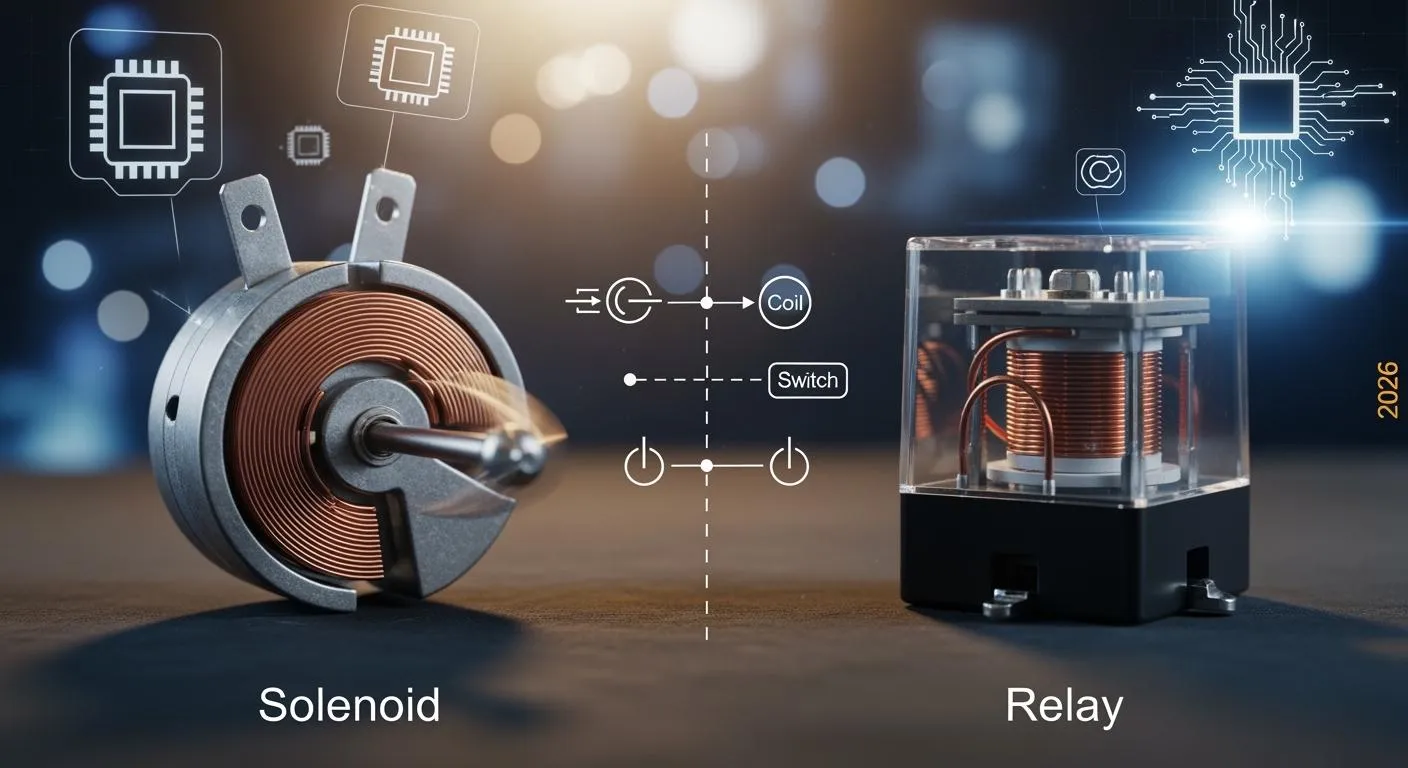
When you face the solenoid vs relay decision in your next project, start by considering what your application needs most. If you require mechanical movement, a solenoid transforms electrical energy into motion. If you need to switch circuits or control high currents with low-power signals, a relay gives you that precision. Your choice affects both reliability and performance. Solenoids may use more power and wear out faster due to heat, while relays often last longer and handle high currents efficiently. You can improve your device by matching the right component to the task, whether you are a hobbyist or a professional.
Key Takeaways
- Choose a solenoid for applications needing mechanical movement, like automated locks or robotics. They provide reliable actuation for physical tasks.
- Select a relay when you need to switch electrical circuits or manage high currents. Relays offer safety and isolation for sensitive electronics.
- Understand the core differences: solenoids convert electrical energy into motion, while relays act as switches for controlling circuits.
- Consider power requirements and durability. Solenoids need high current for short bursts, while relays handle lower currents over longer periods.
- Always match the component to your project needs. Proper selection of solenoids or relays enhances performance and reliability.
Quick Answer: Solenoid vs Relay
Choosing between solenoid vs relay starts with understanding what your project demands. You need to decide if you want mechanical movement or electrical switching. Both components play unique roles in electronic applications, and your decision shapes the reliability and efficiency of your system.
Solenoid: When to Use
You use a solenoid when you need to convert electrical energy into physical motion. Solenoids excel in situations where you want to push, pull, or actuate a device. For example, you might use a solenoid to open a valve, lock a door, or trigger a mechanism. The solenoid vs relay debate often centers on whether you need movement or switching. Solenoids are ideal for tasks that require direct mechanical action.
Tip: When to use a solenoid? Choose it for applications like automated locks, robotic arms, or fluid control systems. You get reliable movement with simple control.
Here are some common scenarios where solenoids shine:
- Door locking systems in smart homes
- Automated vending machines
- Industrial machinery that requires linear actuation
- Robotics projects needing precise movement
- Fluid valves in irrigation or medical devices
You see solenoids in places where you want a device to move or actuate. The solenoid vs relay question becomes clear when you need physical action rather than just switching electrical circuits.
Relay: When to Use
You use a relay when you need to control electrical circuits without direct mechanical movement. Relays act as switches that let you manage high-power devices using low-power signals. In the solenoid vs relay comparison, relays stand out for their ability to isolate and protect sensitive electronics.
Relays are perfect for situations where you want to switch circuits, manage high currents, or ensure safety. You often find relays in automotive systems, industrial controls, and home automation. Relays handle tasks that require electrical isolation and precise switching.
Here is a table that shows typical situations where relays are preferred over solenoids in electronic circuits:
| Situation | Description |
|---|---|
| Safety-critical de-energization | Required for ensuring safety in critical applications |
| Intermittent operation | Solenoids are used for low cycle counts |
| Fail-safe behavior | Mandatory for certain applications |
| Cost concerns | Preferred for small I/O counts |
| High inrush currents | Present from starter coils, making relays more suitable |
You choose a relay when you want to switch signals, protect your circuit, or manage high inrush currents. Relays give you flexibility and reliability in electronic designs. The solenoid vs relay decision often depends on whether you need electrical control or mechanical action.
Note: Relays are essential in safety-critical systems. You get fail-safe behavior and cost-effective solutions for small input/output counts.
Key Differences: Solenoid and Relay

Function and Mechanism
You need to understand the core difference between a solenoid and a relay. A solenoid converts electrical energy into mechanical motion. You see this when a solenoid pushes, pulls, or turns a part in a device. In contrast, a relay acts as a switch. You use a relay to control electrical circuits by opening or closing contacts with a small electric signal.
If you want to know how solenoids work, you look at the electromagnetic coil inside. When you apply voltage, the coil creates a magnetic field. This field moves a plunger or piston, which produces mechanical action. You use solenoids for tasks that require movement, such as locking doors or moving valves.
When you learn how relays work, you see a similar electromagnetic coil. The coil generates a magnetic field that moves contacts. These contacts open or close circuits, allowing you to control high-power devices with low-power signals. You rely on relays for electrical switching, isolation, and protection.
Tip: Solenoids provide mechanical action, while relays regulate electrical flow. You choose based on whether your application needs movement or switching.
You sometimes hear people use solenoid and relay interchangeably. However, you must remember that solenoids focus on mechanical actuation, and relays specialize in electrical switching. This distinction helps you select the right component for your project.
Typical Applications
You find solenoids in many modern electronic systems. You use them in medical technology to control pumps and valves in infusion pumps and surgical instruments. Robotics projects rely on solenoids for actuating movements in robotic arms and gripping mechanisms. Elevators use solenoids to register button presses and signal the control system. Inkjet printers depend on solenoids to move the print head and control ink flow. Security systems use solenoids for remote locking and unlocking of doors. Vending machines employ solenoids to release snacks and drinks. Automotive systems use solenoids to engage starter motors and manage automatic transmissions. Espresso machines use solenoids to control water pressure and flow.
Relays play a crucial role in electronic systems. You use relays as switches to enable or disable circuits based on electrical signals. Automotive applications rely on relays to manage high currents and voltages. Solid-state relays offer fast switching and long life in modern electronics. Thermal relays protect motors from overloads by responding to heat. High voltage relays manage auxiliary functions like interior lighting, infotainment, and HVAC systems in vehicles.
Note: You often see overlap in terminology. Some devices combine both solenoid and relay functions, especially in complex systems.
If you work in the integrated circuit industry, you know that system integration often requires both solenoid and relay solutions. Nova Technology Company (HK) Limited stands out as a HiSilicon-designated solutions partner. You benefit from their expertise in chip-level solutions and system integration for automotive, industrial, and consumer electronics. Nova Technology Company (HK) Limited helps you implement reliable solenoid and relay control in your IC-based designs, ensuring optimal performance and seamless integration.
Comparison Table
You can compare solenoid and relay side by side to see their differences clearly:
| Category | Relay | Solenoid |
|---|---|---|
| Primary Function | Electrical switching | Electrical switching + mechanical actuation |
| Typical Coil Voltage | 3–48 VDC, 24–240 VAC/DC | 3–24 VDC, 24–240 VAC |
| Typical Coil Current | 10 mA–10 A | 0.1–100 A |
| Internal Mechanism | Electromagnetic coil moves contacts | Electromagnetic coil moves plunger/piston |
| Output | Opens/closes circuit | Engages contacts or creates motion |
| Common Failure Modes | Contact wear, coil burnout | Coil burnout, plunger sticking, contact pitting |
| Switching Speed | 5–50 ms | 10–150 ms |
| Durability (High Load) | Moderate | High |
| Cost (Upfront) | $6–$450 | $30–$250+ |
| Maintenance | 6–12 months industrial, 2–5 years automotive | 6–12 months industrial, 1–3 years small DC, 2–5 years automotive |
You see that solenoids excel in mechanical actuation, while relays provide precise electrical switching. You must choose based on your application’s requirements for movement or circuit control.
Callout: You improve reliability and performance by matching the right component to your system. Solenoid and relay selection shapes your project’s success.
Applications: Scenario Recommendations

Automotive Uses
You see solenoid and relay applications everywhere in modern vehicles. Solenoids control starter motors and door locks, providing reliable mechanical movement. Relays handle electrical switching for headlights, fuel pumps, and safety systems. The table below shows how these components work in real-world automotive scenarios:
| Application | Example | Description |
|---|---|---|
| Starter Motors | Solenoid Switch | Controls engine starting in automotive systems. |
| Door Locks | Solenoid Switch | Used in electronic and security devices for locking. |
Relays manage switching for high-current circuits, protecting sensitive electronics. Solenoids deliver precise actuation, making them essential for engine and security applications.
Industrial Automation
In industrial automation, you rely on solenoid and relay solutions for efficient process control. Solenoids convert electrical energy into linear motion, operating valves and actuators. Relays provide switching for high-power circuits, isolating signals and controlling equipment. You use these components to automate manufacturing systems, machine control, and process management.
- Solenoids and relays control high-power circuits with low-power signals.
- Relays function as switches to open or close circuits, while solenoids convert electrical energy into linear motion.
- They automate processes, enhance safety, and improve efficiency in industrial applications.
- Industrial relays switch circuits, isolate signals, and control equipment.
- They support reliable operation in manufacturing facilities and automation environments.
Nova Technology Company (HK) Limited, a HiSilicon-designated solutions partner, offers advanced chip-level solutions and system integration for these applications. You benefit from their expertise in integrating solenoid and relay control into IC-based automation systems.
HVAC Systems
You use solenoid and relay components to manage heating, ventilation, and air conditioning systems. Solenoids operate valves that control refrigerant flow. Relays handle switching for compressors, fans, and pumps. When selecting solenoids for HVAC, follow these best practices:
- Choose materials compatible with refrigerants, such as stainless steel for R22 or R410A.
- Select the right operation type—direct, semi-direct, or servo-operated—based on system needs.
- Size and position valves to minimize pressure drop and avoid water hammer.
- Decide on normally closed or open configurations to prevent refrigerant migration.
- Ensure compliance with safety standards like ATEX and PED.
Relays provide reliable switching for system components, ensuring safe and efficient operation.
Home Electronics
You find solenoid and relay applications in many home devices. Solenoids enable automated door locks, smart appliances, and irrigation systems by providing mechanical movement. Relays manage switching for lighting, alarms, and power supplies. You improve safety and convenience by using the right component for each function. Switching remains a key feature in home automation, allowing you to control devices remotely and efficiently.
Limitations: Solenoid vs Relay
When Not to Use a Solenoid
You should avoid using a solenoid in situations where efficiency and quiet operation matter most. Solenoids often consume significant power, especially during extended activation. Heating becomes a concern if you run a solenoid continuously, which can shorten its lifespan and reduce reliability. Duty cycle limitations mean that rapid or repeated movements may damage the solenoid. Mechanical noise generated during operation can disrupt environments that require silence, such as medical devices or audio equipment.
- Power consumption increases with prolonged use.
- Heating affects performance and durability.
- Duty cycle limitations restrict rapid or repeated movement.
- Operating noise can disturb sound-sensitive spaces.
If your application needs frequent actuation or must operate quietly, you should consider alternatives to a solenoid.
When Not to Use a Relay
You should avoid using a relay when your circuit demands high reliability under harsh conditions or precise switching for minimum loads. Relays may misidentify harmless events as faults, causing unnecessary shutdowns. Equipment mismatch, such as current transformer saturation, can lead to missed faults or nuisance tripping. Traditional relays struggle to adapt to modern inverter-based systems, where fault currents are less obvious.
| Condition | Explanation |
|---|---|
| Contact failure | Poor contact alignment, worn out contacts, mechanical failure |
| Improper voltage application | Voltage exceeding rated levels, induced voltage from long wiring |
| Excessive vibrations | Poor operating conditions leading to relay failure |
| Minimum load switching | Contact resistance build-up due to insufficient load |
| Incorrect relay type | Mismatch of relay specifications with application needs |
If your system operates in environments with excessive vibration or requires switching at very low loads, you should select a different solution instead of a relay.
Common Mistakes
You may encounter problems if you select a solenoid or relay without considering their limitations. One common mistake is using a solenoid for continuous operation, which leads to overheating and early failure. Another mistake involves choosing a relay without matching its specifications to the application, resulting in contact failure or unreliable switching. You might also overlook the impact of environmental factors, such as vibration or noise, which can affect both solenoid and relay performance.
Tip: Always check the duty cycle, voltage ratings, and environmental conditions before selecting a solenoid or relay. Proper selection prevents costly errors and improves system reliability.
Choosing Solenoid or Relay
Selection Tips
You need to make the right choice between solenoid and relay for your electronic application. Start by looking at the main criteria that affect performance and reliability. Use the following table to compare the most important factors:
| Criteria | Solenoids | Relays |
|---|---|---|
| Application | Ideal for controlling valves and switches | Suitable for switching larger loads |
| Response Time | Instantaneous response | Slower due to mechanical movement |
| Size | Compact, suitable for space-constrained areas | Generally larger due to mechanical components |
| Durability | Robust and consistent | Limited by mechanical wear |
| Power Requirements | Requires high current for short durations | Can handle lower currents over longer periods |
You see that solenoids work best when you need quick mechanical movement and compact size. Relays fit applications where you must control larger loads and need electrical isolation. Think about the power requirements and durability for each component. Solenoids require high current for short bursts, while relays handle lower currents over longer periods.
Tip: Always match the component to your control needs. Solenoids excel in fast actuation, while relays provide reliable switching for complex circuits.
Consider these points when you select a solenoid or relay:
- Solenoids offer quick response and robust performance.
- Relays switch larger loads and suit many control applications.
- Solenoids need more power for operation.
- Relays respond slower because of mechanical parts.
If you work in the integrated circuit industry, you want advanced chip-level solutions and seamless system integration. Nova Technology Company (HK) Limited stands out as a HiSilicon-designated solutions partner. You benefit from their expertise in IC-based control systems, helping you implement solenoid and relay functions for automotive, industrial, and consumer electronics.
Real-World Scenarios
You face many situations where you must decide between solenoid and relay. In automotive systems, you use solenoids to control starter motors and door locks. Relays manage switching for headlights and fuel pumps. In industrial automation, solenoids operate valves and actuators, while relays control high-power circuits and isolate signals.
Home electronics rely on solenoids for automated locks and irrigation systems. Relays control lighting, alarms, and power supplies. HVAC systems use solenoids to control refrigerant flow and relays to switch compressors and fans.
You improve reliability and performance by matching the right component to your control requirements. Always check the response time, size, durability, and power needs before making your choice. You ensure your project succeeds when you select the right solenoid or relay for each control task.
You now understand that solenoids deliver mechanical movement, while relays provide electrical switching. Matching the right component to your application improves performance, reliability, and reduces costs. Use this checklist for your final selection:
- Identify if you need motion or switching.
- Check power and durability requirements.
- Consider manufacturability and long-term reliability.
Looking ahead, you will see trends like smart integration, miniaturization, and energy efficiency shaping electronic systems. New materials, advanced algorithms, and IoT capabilities will drive innovation in solenoid and relay technology.
FAQ
What is the main difference between a solenoid and a relay?
You see a solenoid create mechanical movement using a coil. A relay switches electrical circuits with a coil. Both are electromechanical devices, but only a solenoid in action produces motion. You select based on whether you need movement or switching.
How does a coil work in electromechanical devices?
You apply voltage to a coil. The coil generates a magnetic field. This field moves parts inside electromechanical devices. You see the coil in relays and solenoids. The coil is essential for both switching and actuation.
Where do you use electromechanical devices in daily life?
You find electromechanical devices in cars, home appliances, and industrial machines. The coil inside these devices controls locks, valves, and switches. You see solenoid in action in door locks and vending machines. Relays manage circuits in lighting and HVAC systems.
What problems can occur with a coil in electromechanical devices?
You may notice overheating if you run a coil too long. The coil can wear out or cause noise. Electromechanical devices may fail if the coil burns out. You prevent issues by checking coil ratings and using proper maintenance.
How do you choose the right electromechanical device for your project?
You decide based on your needs. If you want movement, you pick a solenoid. If you need switching, you select a relay. You check coil voltage and current. You match the electromechanical device to your application for best results.