Sourcing TCC0603COG8R2B500CT Capacitors: Avoid Counterfeit Parts and Reduce BOM Costs
Expert guide on Sourcing TCC0603COG8R2B500CT Capacitors: Avoid Counterfeit Parts and Reduce BOM Costs. Technical specs, applications, sourcing tips for engineers and buyers.
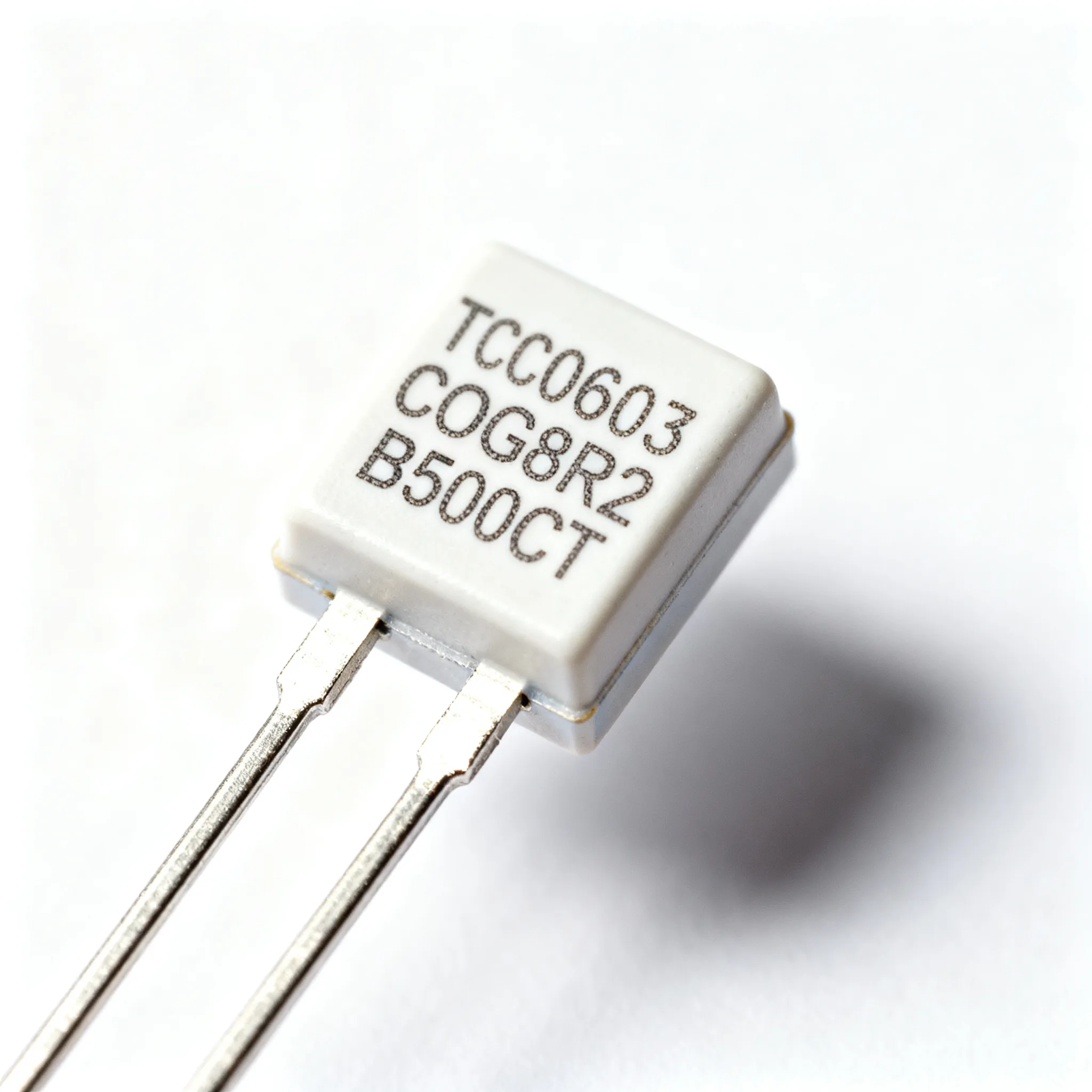
Why TCC0603COG8R2B500CT Shortages Are Fueling Counterfeit Risks and BOM Overruns
If your BOM carries TCC0603COG8R2B500CT — a precision 8.2 pF COG/NP0 MLCC in an 0603 footprint — you are already operating inside one of the tightest corners of the passive component market. The 2026 MLCC allocation cycle has tightened supply across multiple dielectric families, and COG parts are not exempt. Engineering teams are being pushed toward unvalidated substitutes as authorized distributors post lead times that stretch into the 20–26 week range. Procurement departments, caught between production deadlines and cost targets, are increasingly tempted by broker stock that promises immediate availability at half the authorized price.
The math is sobering. Approximately 15% of components sourced through unauthorized channels may be counterfeit, and capacitors rank among the most frequently targeted passives alongside ICs and semiconductors. For a capacitor like TCC0603COG8R2B500CT — which might sit in a timing circuit, an RF matching network, or a filter stage — a counterfeit part does not simply fail gracefully. It shifts pole frequencies, degrades phase noise, or cracks under thermal stress, producing failures that are intermittent, difficult to diagnose, and catastrophically expensive when they surface in the field.
Tip: The time to ask about sourcing hierarchy is during quoting, not after a failure investigation. By the time a counterfeit part causes a field failure, it is too late to change the sourcing decision.
Three forces are converging to make TCC0603COG8R2B500CT sourcing particularly vulnerable right now. The table below captures the key drivers that procurement teams and engineers need to have on their radar before committing to any purchase order.
| Driver | Mechanism | Procurement Impact |
|---|---|---|
| MLCC fab allocation shifts | Manufacturers prioritize high-volume, high-margin case sizes and dielectrics; precision COG parts in small footprints receive reduced production slots | Authorized lead times extend to 20–26 weeks; buyers face pressure to seek non-authorized stock |
| Counterfeit sophistication | Counterfeiters repackage substandard X7R or Y5V dielectrics in COG-labeled reels with convincing laser marking and packaging | Visual inspection alone cannot distinguish genuine COG from substituted dielectric; full electrical and thermal testing is required |
| BOM data gaps | Incomplete part descriptions (missing tolerance, voltage, or packaging codes) invite supplier substitution without engineering review | Generic "8.2 pF 0603" descriptions open the door to X7R substitutes that fail in COG-critical circuits |
| Single-sourcing inertia | Engineering teams lock in one manufacturer part number during design and procurement does not qualify a second source | When allocation hits, there is no approved alternate; panic buying from brokers becomes the default |
| Price-versus-risk miscalculation | Broker prices for scarce MLCCs can appear 40–60% below authorized distribution when demand spikes | One field failure from a counterfeit capacitor can erase years of component-cost savings in warranty claims and brand damage |
These drivers are not theoretical. They play out weekly in purchasing offices and engineering labs. Qualifying a second source for every critical part before a shortage hits is the single most effective hedge against this cycle, yet it remains one of the most frequently skipped steps in BOM development. The next section breaks down what the part number itself tells you — because understanding the specification is the first line of defense against accepting a part that does not meet it.
Decoding the TCC0603COG8R2B500CT: What the Part Number Tells You
The part number TCC0603COG8R2B500CT is not an arbitrary string. It encodes six parameters that define exactly what the capacitor is and where it can be used. Misreading any one of these — or accepting a substitute that differs on even a single character — can push a circuit outside its design envelope. The table below maps each segment of the part number to its engineering meaning.
| Segment | Parameter | Value | Engineering Significance |
|---|---|---|---|
| TCC | Manufacturer / Series | Manufacturer-specific prefix | Identifies the OEM and product family; critical for traceability and qualification records |
| 0603 | EIA Footprint | 0603 (1.6 mm × 0.8 mm) | Defines PCB land pattern; substitution with 0402 or 0805 requires layout change |
| COG | Dielectric | COG (NP0) — Class I ceramic | Near-zero temperature coefficient (±30 ppm/°C), zero voltage coefficient; essential for timing, RF, and filter stability |
| 8R2 | Capacitance | 8.2 pF | Precision value typical of RF matching, oscillator loading, and filter tuning applications |
| B | Tolerance | ±0.1 pF | Tight absolute tolerance; X7R substitutes typically offer ±5% or ±10%, which is orders of magnitude looser |
| 500 | Rated Voltage | 50 VDC | Must be respected at maximum operating temperature; derating guidelines apply for high-reliability designs |
| CT | Termination / Packaging | Nickel-barrier with tin plating, 7" reel | Affects solderability, aging behavior, and compatibility with automated pick-and-place |
Why does COG matter so much for a tiny 8.2 pF capacitor? In a timing circuit, the capacitance value directly sets the frequency. COG/NP0 dielectric maintains that capacitance within ±30 ppm/°C across the full temperature range — meaning the value at −55°C is essentially the same as at +125°C. An X7R dielectric, by contrast, can drift ±15% over temperature alone, and its capacitance also shifts with applied DC voltage. In an RF matching network or crystal oscillator load, a 15% shift in capacitance can detune the stage, degrade phase noise, or prevent oscillation entirely. Selection principles for high-reliability capacitors start with understanding exactly this dielectric-behavior trade-off.
Even with the correct part number in hand, a BOM that omits these details is a procurement accident waiting to happen. A clean BOM gives suppliers enough precision to quote correctly and reduces avoidable back-and-forth during sourcing. When the BOM simply says "8.2 pF 0603 capacitor," the sourcing door is open to any dielectric, any tolerance, and any voltage rating — and the first field failure will trace back to that ambiguity.
Key Takeaway: The part number TCC0603COG8R2B500CT is a specification, not a suggestion. Every character carries a design constraint. Before approving any alternate, verify that all six parameters match — not just the capacitance and footprint.
Authorized Distribution vs. Broker Stock: Sourcing Channel Risks for TCC0603COG8R2B500CT
When TCC0603COG8R2B500CT goes into allocation, buyers face three distinct sourcing paths, each with its own risk profile, cost structure, and traceability guarantee. The comparison below draws on real supply-chain patterns observed during the 2024–2026 MLCC cycles and reflects the documentation standards that separate legitimate supply from counterfeit risk.
| Comparison Metric | Authorized Franchise Distribution | Independent / Broker Channel | Strategic Private-Label Sourcing | Selection Criteria & Failure Boundary |
|---|---|---|---|---|
| Traceability to OEM | Full lot traceability with manufacturer CoC | Variable; often one or more intermediaries obscure the origin | Direct manufacturer relationship with documented supply chain | If the supplier cannot name the original manufacturer and provide lot-level documentation, reject the part |
| Lead Time (typical) | 20–26 weeks during allocation | Immediate to 2 weeks (claimed) | 8–14 weeks with forward planning | Immediate stock at half price is a red flag, not a bargain — a 26-week lead time at authorized distribution vs. broker "in stock" at half price demands scrutiny |
| Price Position | Contract or market price; transparent | Can be 40–60% below authorized during shortages | OEM-direct pricing, typically 15–25% below authorized distribution | Prices significantly below authorized levels should trigger documentation demands, not celebration |
| Counterfeit Risk | Near zero; manufacturer-guaranteed | Highest; 15% counterfeit rate across unauthorized channels | Low when manufacturer is vetted; requires audit | Risk increases in direct proportion to the number of intermediaries between manufacturer and your receiving dock |
| Design Validation | Part is exactly as specified | Cross-reference results are sourcing leads, not design approvals | Requires engineering qualification before BOM insertion | Never treat a distributor's cross-reference as a substitute for board-level validation |
| Quality Documentation | Full CoC, test reports, PPAP if requested | Often missing or fabricated; insist on third-party test reports | Available with proper supplier agreement | ISO 9001:2015, AS9120B, and IDEA-STD-1010-B are minimum requirements for any supplier |
The broker channel deserves particular attention here. A buyer's BOM includes an analog IC that shows a 26-week lead time at the authorized distributor. A broker offers the same part number "in stock" at half the price. This scenario repeats with passives like TCC0603COG8R2B500CT. A supplier following proper sourcing discipline would flag this to the buyer, recommend either waiting for authorized stock or engaging the manufacturer directly for allocation guidance, and refuse to ship parts that cannot be traced.
Private-label sourcing programs offer a middle path — OEM-priced authentic capacitors with full traceability — but they require upfront supplier qualification. The program works by establishing a direct relationship with a vetted manufacturer who produces to the same specification under a private label, bypassing the traditional distribution markup. For high-volume BOMs where TCC0603COG8R2B500CT appears across multiple assemblies, this can reduce annual spend by 15–25% without sacrificing traceability. The trade-off is lead time: private-label programs need 8–14 weeks of forward planning, which means they work best when procurement acts before the shortage, not during it.
How to Verify a TCC0603COG8R2B500CT Before It Hits Your BOM
Verification of TCC0603COG8R2B500CT should happen before the parts reach your receiving dock — ideally before the purchase order is even issued. The workflow below describes a practical sequence that combines supplier qualification, documentation review, and incoming inspection into a single defensible process.
Step 1: Qualify a second source before the shortage hits. Qualify a second source for every critical part before a shortage hits, run a regular BOM evaluation to flag single-sourced and at-risk lines, and plan last-time buys for parts approaching end-of-life. For TCC0603COG8R2B500CT, this means identifying and validating an alternate manufacturer part that matches all six parameters — footprint, dielectric, capacitance, tolerance, voltage, and termination — and testing it at the board and system level before the primary source goes into allocation.
Step 2: Demand a sourcing hierarchy disclosure at quoting time. Ask about sourcing hierarchy at quoting time, not after a problem surfaces. Any supplier that hesitates to disclose where it obtained the parts — or offers vague answers like "our overseas warehouse" — should be disqualified immediately. Legitimate distributors and private-label programs can trace every reel back to a specific manufacturer production lot.
Step 3: Require inspection to recognized standards. Industry-certified quality assurance adhering to ISO 9001:2015, AS9120B, and IDEA-STD-1010-B standards is not optional for high-reliability procurement. For incoming TCC0603COG8R2B500CT batches, the IDEA-STD-1010-B standard provides a detailed inspection framework covering visual, mechanical, and electrical verification of passive components. Insist that your supplier or a third-party lab performs this inspection and provides the report before parts are accepted.
Step 4: Lock down the BOM with exact manufacturer part numbers. A detailed BOM with exact part numbers, manufacturers, and certifications blocks counterfeit entry points. When the BOM specifies TCC0603COG8R2B500CT — not "8.2 pF 0603 COG" — the procurement team has a clear target, and any deviation requires formal engineering change control.
The table below summarizes the verification actions, when to deploy them, and the trade-offs involved.
| Action | When to Use | Trade-off |
|---|---|---|
| Second-source qualification | During design phase or BOM review, before production ramp | Requires engineering time for board-level validation; delays BOM release by 2–4 weeks |
| Supplier sourcing hierarchy disclosure | At RFQ stage, before PO issuance | May eliminate low-cost brokers; legitimate suppliers will comply without resistance |
| IDEA-STD-1010-B incoming inspection | On every batch from non-authorized sources; sampled for authorized stock | Adds 2–5 days to receiving; cost is negligible compared to one field failure |
| Annual volume agreements with authorized distribution | During annual procurement planning | Requires volume commitment; secures allocation priority and typically 10–20% price advantage over spot buys |
| Private-label program qualification | When annual consumption exceeds 50k units per part number | 8–14 week lead time; requires upfront supplier audit; delivers 15–25% cost reduction with full traceability |
| Last-time-buy planning | When manufacturer issues EOL or NRND notice | Requires capital outlay for inventory; avoids redesign cost and schedule impact |
Note: No single verification step catches every counterfeit. The combination — supplier qualification before ordering, documentation review before acceptance, and physical/electrical inspection after delivery — creates a defense-in-depth that makes it far harder for counterfeit parts to reach your production line.
TCC0603COG8R2B500CT Sourcing: Questions Engineers and Buyers Actually Ask
Q: What is the typical lead time for TCC0603COG8R2B500CT from an authorized distributor right now?
Lead times for precision COG MLCCs in small footprints can stretch to 20–26 weeks during tight MLCC allocation cycles. This is not a temporary blip — it reflects structural fab allocation decisions where manufacturers prioritize higher-volume, higher-margin case sizes and dielectrics. The practical response is to review your BOM early, qualify a second source while engineering bandwidth is available, and avoid the trap of treating broker stock as a quick fix. If a broker offers immediate stock of TCC0603COG8R2B500CT at half the authorized price, that is a red flag — not a solution. Demand full lot traceability documentation, and if the supplier cannot produce it, walk away. The cost of waiting for authorized stock is predictable; the cost of a counterfeit capacitor failing in the field is not.
Q: How can we quickly verify a batch of these capacitors is genuine after delivery?
Start with physical inspection under magnification: check body dimensions against the 0603 standard (1.6 mm × 0.8 mm ± 0.15 mm), examine laser-marking clarity and consistency across the reel, and inspect the terminal finish for uniform nickel-barrier tin plating. Then move to electrical verification: use a precision capacitance meter to confirm 8.2 pF within ±0.1 pF at the specified test frequency. For deeper confidence, pull a sample and run thermal cycling or a burn-in sequence to catch insulation-resistance degradation — a signature failure mode of counterfeit parts using inferior ceramic dielectric. Require incoming inspection against IDEA-STD-1010-B and demand the supplier's own test reports as a condition of acceptance. If the supplier cannot produce coherent test data, the parts should not be used.
Q: Is it safe to replace TCC0603COG8R2B500CT with a generic 8.2 pF X7R capacitor from the same footprint?
No. COG/NP0 dielectric maintains near-zero capacitance change over temperature (±30 ppm/°C) and zero voltage coefficient. X7R dielectric can vary ±15% over temperature alone, and its capacitance drops further under DC bias. In a timing circuit, RF matching network, or filter stage, a 15% shift in capacitance can shift pole frequencies, degrade timing accuracy, and cause intermittent failures that are notoriously difficult to diagnose. A distributor's cross-reference result is a sourcing lead, not a design approval. Engineering teams must validate any substitute at the part, board, and system levels before a controlled BOM change. If the board has already been laid out, the substitute may also differ in parasitics, pad requirements, or thermal behavior — all of which need verification.
Q: What certifications should a capacitor supplier hold for mil/aero or medical designs?
At minimum, look for ISO 9001:2015 and AS9120B for aerospace distribution. AS9120B extends ISO 9001 with specific requirements for traceability, counterfeit prevention, and lot control that are essential for regulated industries. For high-reliability programs, insist on inspection to IDEA-STD-1010-B and demand full lot traceability back to the original manufacturer's production records. If the supplier hesitates when asked to produce these certifications — or offers a generic "we are certified" without providing certificate numbers and scope — that is a disqualifier. Walk away. The documentation burden is real, but it is the only barrier between your design and a counterfeit reel.
Q: How can we reduce BOM cost on this capacitor without inviting counterfeits?
Three legitimate paths exist. First, negotiate annual volume agreements with authorized distributors — committing to a forecast unlocks allocation priority and typically 10–20% better pricing than spot buys. Second, qualify a second manufacturer-approved source early, which creates competitive tension in quoting and insulates your BOM from single-source allocation shocks. Third, evaluate private-label sourcing programs that deliver OEM-direct pricing with full traceability; these work best when annual consumption exceeds roughly 50,000 units per part number. What you should not do is chase the false economy of broker stock. One field failure from a counterfeit TCC0603COG8R2B500CT — a capacitor that costs a few cents — can trigger a recall, a line-down situation, or a customer qualification audit that erases years of component-cost savings.
Q: What are the most common failure modes of counterfeit COG capacitors?
Counterfeit COG capacitors typically fail through four mechanisms. Flex cracking and thermal-mechanical micro-cracks occur when the counterfeit part uses inferior ceramic dielectric that cannot withstand board-level stress or soldering thermal gradients. Insulation-resistance degradation manifests as rising leakage current over time, particularly at elevated temperature and humidity. Short-circuit failure after soldering or thermal cycling is common when the internal electrode layers are poorly aligned or the dielectric layer is too thin to sustain the rated voltage. Finally, capacitance drift outside the COG specification — the part may measure 8.2 pF at room temperature but shift by several percent across the operating temperature range — indicates that the dielectric is not genuine COG at all. Each of these failure modes can be caught by proper incoming inspection, but none of them can be detected by visual inspection alone.
Conclusion
Sourcing TCC0603COG8R2B500CT in today's allocation-constrained MLCC market demands discipline, not panic. The part number encodes a precision specification — COG dielectric, ±0.1 pF tolerance, 50 V rating — that cannot be met by generic substitutes. When authorized distribution lead times stretch past 20 weeks, the temptation to reach for broker stock is strong, but the data is clear: unauthorized channels carry a material counterfeit risk, and the failure modes of counterfeit COG capacitors are silent, intermittent, and expensive. The defense is a layered one: qualify a second source early, demand sourcing hierarchy disclosure at the RFQ stage, insist on IDEA-STD-1010-B inspection, and lock down your BOM with exact manufacturer part numbers. For procurement teams managing mixed BOMs across multiple assemblies, consolidating sourcing through a platform that offers flexible MOQ and verified supply chains can reduce the administrative overhead of chasing individual part numbers. IC-Online provides access to a broad range of electronic components with the traceability and documentation that high-reliability sourcing demands.
References & Further Reading
- MLCC Shortage 2026: Price Increases and PCBA BOM Risks — BestPCBs
- Counterfeit Components — Risks, Detection, and Avoiding Them — AGS Devices
- How to Source Electronic Components: 2026 Guide — GlobX
- Are the Components Genuine, and How Is Authenticity Verified? — PCBCart
- Capacitor Alternatives: Strategic Sourcing Guide 2026 — Adage Components
- Alternative Electronic Components for Safer PCBA Builds — BestPCBs
- Smart Strategies for Efficient Electronic Component Procurement in 2026 — Vigorcomp
- The PCB Component Supplier Blacklist: How to Avoid Counterfeit Parts — AllPCB
- Identifying Electronic Components: A Practical Guide — AGS Devices
- Computer Grade Capacitors: The Complete Selection and Replacement Guide — Specap