STPS40L45CW Supply Risk Assessment: What to Ask Before You Buy
Assess STPS40L45CW sourcing risks before you buy. RFQ questions on traceability, date codes, testing, alternatives, and supply continuity for procurement teams.
Why STPS40L45CW Supply Risk Deserves a Second Look Right Now
Power discretes have occupied an uncomfortable corner of the sourcing landscape for the better part of three years. The STPS40L45CW — a dual center-tap Schottky rectifier rated at 40 A total forward current and 45 V reverse voltage — sits squarely in the crosshairs of that pressure. It is not that a single catastrophic event has upended availability. Rather, the cumulative effect of factory allocation, thinning distributor buffer stocks, and the component's deep entrenchment in switching power supply designs makes a reactive purchasing posture risky.
Engineers and procurement professionals who treat the STPS40L45CW as a commodity part — something you order from the top of the BOM without a second thought — are increasingly likely to encounter surprises. The rectifier appears in server power supplies, industrial AC-DC converters, telecom rectifiers, and high-current DC-DC modules. In each of these applications, removing or redesigning around the part is non-trivial. The thermal budget, PCB layout, and magnetics often assume the specific forward voltage drop and junction temperature characteristics of this device.
Tip: A supply risk assessment is not about predicting shortages. It is about asking the right questions before a line-down situation forces your hand. The STPS40L45CW warrants exactly that kind of scrutiny now — not because anyone has declared an allocation crisis, but because the margin for error in power discretes has narrowed enough that informed buyers are running RFQs with multi-source contingency plans already baked in.
What makes the STPS40L45CW particularly worth a second look is the intersection of three factors: it is a relatively mature design that has been in production for years, it originates from a single primary manufacturer (STMicroelectronics), and it occupies a performance niche — low VF at high current with a 150°C Tj ceiling — that not every commodity Schottky can match. The Vishay VS-STPS40L45CW-N3 exists as a near-identical alternative, but treating it as a drop-in without verification introduces its own set of risks. The sections that follow unpack what you need to know, what to ask, and how to structure an RFQ that protects your production schedule.
Before diving into datasheets and comparison tables, one point deserves emphasis: supply risk for the STPS40L45CW is not a binary condition. It is a gradient. The goal of this assessment is to move you from "hoping availability holds" to "knowing what you will do if it does not." That shift requires hard questions, not assumptions. IC-Online provides the RFQ infrastructure to test those questions across multiple suppliers simultaneously — a capability that becomes especially valuable when you are evaluating both the ST original and the Vishay alternative in parallel.
Reading the STPS40L45CW Datasheet: Key Specs That Shape Sourcing Decisions
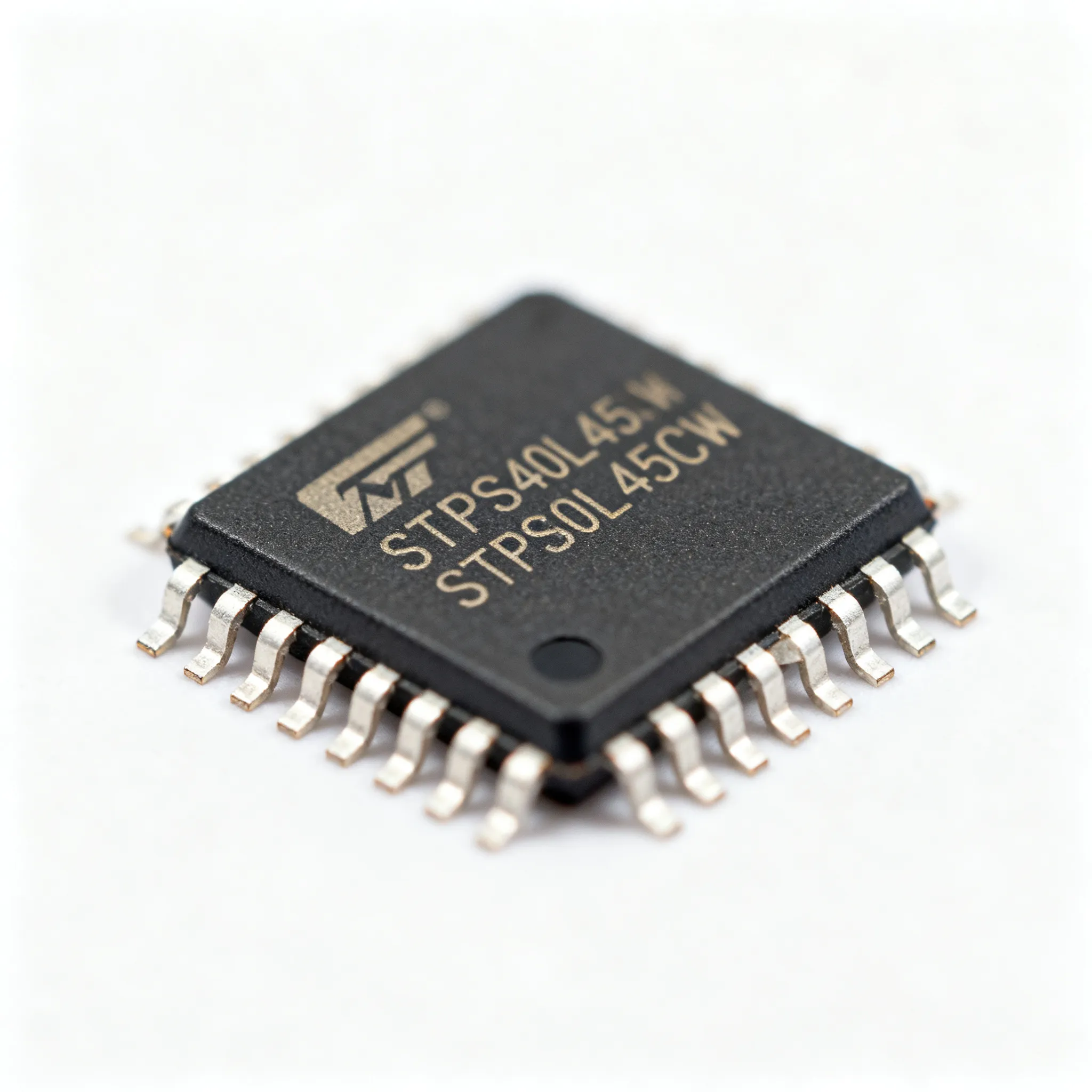
Before you can intelligently evaluate supply alternatives, you need to understand exactly what the STPS40L45CW delivers electrically. The datasheet tells a story that goes well beyond headline numbers. The part is a dual center-tap Schottky rectifier in a TO-247 package, with two diodes sharing a common cathode. Each leg is rated for 20 A average forward current, giving a total device rating of 40 A. The repetitive peak reverse voltage (VRRM) sits at 45 V — a rating that places it in the sweet spot for low-voltage, high-current rectification stages where output voltages rarely exceed 12–24 V but where current demands are substantial.
The defining characteristic of the STPS40L45CW — and the spec that makes sourcing alternatives genuinely challenging — is the forward voltage drop. STMicroelectronics specifies a maximum VF of 0.55 V per leg at 20 A forward current and 125°C junction temperature. At 25°C, the typical VF rises to approximately 0.62 V at the same current. These numbers matter because they directly translate into conduction losses. In a 40 A output rectifier operating at 50% duty cycle, even a 0.1 V increase in VF adds 2 W of additional dissipation. That is heat your thermal management system must handle, and it may be the difference between a design that operates reliably at 55°C ambient and one that trips overtemperature protection.
STMicroelectronics achieved this low VF through proprietary barrier technology, which is detailed in the official datasheet. The ST datasheet on alldatasheet provides the full electrical characteristics, while datasheet4u offers an alternative download source for the same document. Both are worth consulting before you commit to any alternative sourcing strategy.
The table below distills the parameters that carry the most weight in a supply risk assessment. These are not just "nice to know" specs — they are the values you will need to compare side-by-side with any alternative part you evaluate.
| Parameter | Value | Unit / Condition | Why It Matters for Sourcing |
|---|---|---|---|
| VRRM — Repetitive Peak Reverse Voltage | 45 | V | Defines the voltage ceiling; any alternative must meet or exceed this rating to avoid field failures in the same socket. |
| IF(AV) — Average Forward Current (total) | 40 | A | Total device current; per-leg rating is 20 A. Verify that alternative parts do not derate more aggressively at elevated temperatures. |
| IF(RMS) — RMS Forward Current | 60 | A | Critical for capacitor-input filter applications where RMS current can substantially exceed average current. |
| IFSM — Surge Non-Repetitive Forward Current | 350 | A (tp = 10 ms, sinusoidal) | Surge handling is a key reliability differentiator; verify that alternatives match or exceed this value under identical pulse conditions. |
| VF — Forward Voltage Drop (max, per leg) | 0.55 | V @ 20 A, Tj = 125°C | The headline spec. Low VF minimizes conduction losses. A higher VF in an alternative forces a thermal re-evaluation. |
| IR — Reverse Leakage Current (max) | 15 | mA @ 45 V, Tj = 125°C | Leakage increases exponentially with temperature. Higher leakage in an alternative can affect standby power and thermal runaway margins. |
| Tj max — Maximum Junction Temperature | 150 | °C | Operating at or near Tj max accelerates wear-out. Verify that alternative parts carry the same 150°C rating, not 125°C or 175°C (which changes derating behavior). |
| RthJC — Thermal Resistance, Junction-to-Case (per leg) | 1.5 | °C/W | Determines how effectively heat can be removed. A higher RthJC in an alternative means higher junction temperature for the same power dissipation. |
| Package | TO-247 | — | Footprint and mounting compatibility are prerequisites for any drop-in alternative. Confirm mechanical drawing dimensions, not just package name. |
| Configuration | Dual center-tap, common cathode | — | Not all TO-247 Schottky rectifiers share this topology. Verify pinout mapping: pin 1 = anode A1, pin 2 = cathode (common), pin 3 = anode A2. |
What the table does not capture — and what experienced power supply designers know — is that these parameters interact. A part with slightly higher VF but lower RthJC might actually run cooler at the system level if the heatsink interface is the dominant thermal bottleneck. Conversely, a part with identical VF but higher leakage current could cause subtle issues in light-load efficiency or standby power compliance. The takeaway is that sourcing decisions for the STPS40L45CW cannot be reduced to a single number. You need the full parametric picture, and you need to test under your actual operating conditions.
One additional note on the datasheet: STMicroelectronics specifies typical and maximum values across two junction temperatures (25°C and 125°C). This granularity is valuable for thermal simulation but also sets a bar for evaluating alternatives. If a candidate part only provides room-temperature specs, you are taking on risk that elevated-temperature behavior diverges from the STPS40L45CW in ways you cannot predict from the datasheet alone.
ST vs. Vishay: Evaluating the VS-STPS40L45CW-N3 as a Drop-In Candidate
The existence of Vishay's VS-STPS40L45CW-N3 is both a blessing and a trap for procurement teams. On the surface, it looks like a straightforward second source: same part number pattern, same TO-247 package, same dual center-tap topology, and the same 45 V / 40 A headline ratings. The Vishay datasheet confirms that the part has been optimized for very low forward voltage drop with moderate leakage — language that mirrors ST's own datasheet description. The alldatasheet listing for the Vishay variant provides an additional access point for the same document.
But "near-identical" is not "identical," and the differences — while subtle — can matter in high-stress applications. The comparison matrix below is designed to help you identify which parameters warrant your closest scrutiny before you approve the Vishay part as a second source for the STPS40L45CW.
| Comparison Metric | STMicroelectronics STPS40L45CW | Vishay VS-STPS40L45CW-N3 | Selection Criteria & Verification Step |
|---|---|---|---|
| VRRM | 45 V | 45 V | Identical rating. No voltage margin concern when substituting. |
| IF(AV) total | 40 A (2 × 20 A) | 40 A (2 × 20 A) | Same total and per-leg rating. Verify that derating curves at your ambient temperature are comparable. |
| VF max (per leg, 20 A, 125°C) | 0.55 V | 0.55 V (typical; max 0.58 V at 125°C per datasheet) | Close but not identical. Request the Vishay part's maximum VF specification at your operating current and temperature, not just the typical. A 0.03 V delta may be acceptable but requires thermal verification. |
| IR max (45 V, 125°C) | 15 mA | 15 mA | Matched on maximum leakage. Verify typical leakage at your operating temperature; divergence in typical values could affect light-load efficiency. |
| Tj max | 150°C | 150°C | Same junction temperature ceiling. Both parts use proprietary barrier technology for reliable operation up to this limit. |
| RthJC (per leg) | 1.5°C/W | 1.5°C/W | Matched thermal resistance. Confirm that your heatsink interface and mounting torque specifications are consistent between the two parts. |
| IFSM (surge, 10 ms) | 350 A | 350 A | Identical surge rating. This is a critical match for power supply holdup and inrush scenarios. |
| Package mechanical | TO-247 | TO-247 | Same package outline. Verify lead dimensions, standoff height, and heatsink hole diameter from mechanical drawings — not just the package name. Vishay mechanical drawing should be overlaid with ST's. |
| Manufacturer lifecycle commitment | Active production (verify current status) | Active production (verify current status) | Both ST and Vishay have long-standing power discrete businesses. Ask each manufacturer or authorized distributor for a product longevity program letter if your design has a multi-year production horizon. |
The comparison reveals that the Vishay VS-STPS40L45CW-N3 is a highly credible candidate for second-sourcing the STPS40L45CW. The parametric differences are small enough that, in many applications, the parts will be functionally interchangeable. However, the word "many" is doing heavy lifting here. The applications where differences matter most — synchronous rectification in high-frequency converters, parallel operation of multiple devices, and designs operating near the thermal limit — are precisely the ones where the STPS40L45CW is most commonly deployed.
Note: When evaluating the Vishay part, do not limit your comparison to the datasheet tables. Request characterization data for the specific parameters that matter in your circuit. Forward voltage at your actual operating current (which may be 12 A, not 20 A), reverse recovery behavior (even for Schottky devices, there is a capacitive recovery charge), and junction capacitance at your reverse voltage are all worth measuring on actual samples before you commit to a dual-source strategy.
A practical step that many engineering teams overlook: request a qualification report from Vishay that includes batch-to-batch variation data. Even if the typical specs align perfectly, wider process variation in the alternative part could cause field failures that a single qualification sample would never catch. This is not a reason to avoid the Vishay part — it is a reason to qualify it properly. The STPS40L45CW has years of production history behind it; the Vishay variant, while electrically similar, may exhibit different lot-to-lot consistency that only becomes apparent over multiple production runs.
Smart Questions to Ask Before You Commit to a STPS40L45CW Purchase
The difference between a smooth production run and a line-down crisis often comes down to the questions you ask before the purchase order is cut. For the STPS40L45CW, the right questions fall into three categories: availability and allocation, lifecycle and qualification, and logistics. What follows is a structured RFQ framework that procurement and engineering teams can use together to de-risk their sourcing decisions.
Availability and allocation questions: These are the most urgent but also the most prone to vague answers. Do not accept "lead time is normal" as a response. Ask the distributor to confirm the factory allocation window for your requested quantity and date. Specifically, request written confirmation of the committed ship date, not the estimated ship date. The distinction matters because estimated dates can slip without triggering notification, while committed dates typically carry contractual weight. Also ask whether the distributor is holding buffer stock or is entirely dependent on factory allocation. Parts sourced from buffer stock may carry older date codes, which is not necessarily a problem but should be factored into your shelf-life and solderability planning.
Lifecycle and qualification questions: For the STPS40L45CW, confirm the product status directly on STMicroelectronics' website. The part should be listed as "Active." If it moves to "NRND" (Not Recommended for New Designs), you need to know immediately — not six months later when a distributor mentions it in passing. Set up a PCN (Product Change Notification) alert on ST's website for this specific part number. Also ask your distributor whether they have visibility into any pending die revisions, fab transfers, or assembly site changes. These are not necessarily red flags, but they can affect electrical characteristics in subtle ways that your qualification testing may not have captured.
Logistics and packaging questions: The STPS40L45CW is typically supplied in tubes for the TO-247 package. Confirm whether your required quantity is available in full tubes, fractional tubes, or only full box quantities. If you are prototyping or running a small pre-production batch, fractional packaging availability can save you from carrying excess inventory. Also verify the date code window the distributor is quoting. For a part that may sit in your inventory for several months before use, a date code within the last 12 months is generally desirable. For high-reliability applications, you may want to require a date code within the last 6 months and a solderability test report less than 90 days old.
The table below summarizes the essential RFQ questions and the documentation you should request in response. These are not theoretical — they are the questions that separate a well-managed supply chain from one that is constantly reacting to surprises.
| RFQ Question Category | Specific Question to Ask | Documentation to Request | Red Flag If |
|---|---|---|---|
| Availability | What is the factory-allocation-backed committed ship date for quantity X? | Written confirmation with committed (not estimated) date | Distributor cannot or will not provide a committed date; only "best estimate" is offered |
| Allocation | Is the quantity sourced from factory allocation or distributor buffer stock? | Stock source transparency letter | Source is unclear; mixed sources could mean mixed date codes or batch quality |
| Lifecycle | Is the STPS40L45CW in Active, NRND, or EOL status? | Current product status screenshot from ST.com or manufacturer letter | Status is NRND or no confirmation is provided; EOL notice requires immediate redesign |
| PCN | Are there any pending or recent PCNs for this part number? | PCN history for the last 24 months | Recent die revision or fab transfer without supporting qualification data |
| Alternative qualification | Can you supply qualification samples of the Vishay VS-STPS40L45CW-N3? | Datasheet, mechanical drawing, and sample lot with traceability | No samples available; suggests the alternative is not a realistic near-term option |
| Date code | What is the date code window for the offered stock? | Date code confirmation in writing | Date codes older than 24 months; may require solderability re-testing |
| Packaging | Is the quantity available in full tubes, fractional tubes, or full boxes only? | Packaging specification and MOQ for each packaging level | MOQ far exceeds your requirement and no fractional option is available |
| Traceability | Can you provide full chain-of-custody documentation? | Certificates of conformance and origin | Distributor is not authorized or cannot provide traceability back to the manufacturer |
These questions are not optional in a tight supply environment. They are the minimum due diligence that protects your production line from the downstream consequences of supply decisions made without adequate information. The STPS40L45CW is a power discrete — a category that has seen enough volatility in recent years to make any buyer cautious. Asking these questions through an RFQ on IC-Online allows you to test multiple distributor responses simultaneously and compare not just pricing but the quality of supply assurance each source can offer.
Here is a practical checklist to run through before you finalize any purchase order for the STPS40L45CW:
- Confirm lifecycle status. Check ST.com for the official product status. Do not rely on distributor verbal confirmation alone. If the part is Active, set a calendar reminder to re-check quarterly.
- Request allocation-backed lead time in writing. Distinguish between estimated and committed ship dates. Push for the committed date. If the distributor cannot provide one, understand that your production schedule is at risk of slippage.
- Secure Vishay VS-STPS40L45CW-N3 samples. Even if you do not plan to dual-source immediately, having qualified samples in hand reduces your response time if the ST part becomes constrained. Test under worst-case conditions — maximum load, minimum input voltage, and elevated ambient temperature.
- Verify date code windows. For production builds, require date codes within 12 months. For high-reliability or long-shelf-life applications, tighten to 6 months and request a solderability test report.
- Set up PCN alerts. Register on ST.com for product change notifications. A die revision or assembly site transfer can affect thermal performance or leakage current in ways that matter for your design.
- Negotiate fractional packaging if needed. If your volume does not justify full tubes or boxes, confirm that the distributor offers fractional quantities without a punitive markup. For prototyping, this is often the difference between carrying excess inventory and operating lean.
STPS40L45CW Supply Risk FAQ: Questions Engineers and Buyers Should Ask
Supply risk assessment for the STPS40L45CW generates a predictable set of questions — predictable because they reflect the genuine tension between design inertia and supply chain pragmatism. The answers below are grounded in the datasheet specifications and procurement best practices discussed throughout this article. They are intended to give you a starting point for conversations with your engineering team, your distributor, and your manufacturing partners.
Q: Is the STPS40L45CW a single-source part, and what alternative exists?
While STMicroelectronics is the original manufacturer of the STPS40L45CW, Vishay offers the VS-STPS40L45CW-N3, which is electrically and mechanically compatible in terms of package, pinout, and headline ratings. The two parts share the same 45 V VRRM, 40 A total forward current, 0.55 V typical VF, and 150°C Tj max. However, "compatible" is not the same as "identical." Verify all parameters — particularly VF at your actual operating current, leakage current at your worst-case junction temperature, and thermal resistance — before mixing batches or approving the Vishay part as a second source. The existence of the Vishay part reduces single-source risk but does not eliminate the need for qualification testing.
Q: How do I confirm that the Vishay part is a true drop-in replacement?
A true drop-in replacement must match electrically, thermally, and mechanically. Start by comparing the key parameters side-by-side: VF at your operating current and temperature, reverse leakage current at maximum reverse voltage and Tj, junction capacitance, and thermal resistance (RthJC). Then overlay the mechanical drawings from both manufacturers — the TO-247 package is standardized, but lead form, standoff height, and mounting hole diameter can vary by fractions of a millimeter that affect heatsink fit. The most critical step is to request qualification samples and test them in your actual circuit under worst-case conditions: maximum load, minimum input voltage, and maximum ambient temperature. A part that works perfectly at room temperature and 50% load may exhibit unexpected behavior at the thermal limit. Do not skip this step.
Q: What lead-time and lifecycle signals should I monitor?
For the STPS40L45CW, monitor three signals continuously. First, check the product status on STMicroelectronics' official website. The part should show as "Active." If it transitions to "NRND" (Not Recommended for New Designs), you have a window — typically 12 to 24 months — to re-qualify an alternative before the part enters end-of-life. Second, ask your authorized distributor for delivery trend data. Even without quoting specific lead times, a distributor can tell you whether availability is improving, stable, or tightening relative to historical norms. Third, set up PCN (Product Change Notification) alerts on ST.com. A die revision, fab transfer, or assembly site change may not change the part number but can affect electrical characteristics in ways that your design margin may or may not absorb. STMicroelectronics has a documented longevity commitment for power discretes; request the specific program terms for this part number if your production horizon extends beyond five years.
Q: Why does the datasheet emphasize low forward voltage drop, and how does that affect supply decisions?
Low forward voltage drop (VF) is the defining performance characteristic of the STPS40L45CW because it directly determines conduction losses. At 20 A per leg, the difference between a 0.55 V VF and a 0.70 V VF is 3 W of additional dissipation per device — heat that must be removed by the heatsink and accounted for in the thermal budget. If your alternative part has a higher VF, you face a choice: accept higher junction temperatures (which accelerate wear-out), increase the heatsink size (which may not fit the enclosure), or reduce the operating current (which may not be possible). The supply chain implication is that VF is not a flexible parameter. A part with higher VF is not a drop-in replacement; it is a redesign trigger. This is why the Vishay VS-STPS40L45CW-N3, with its closely matched VF, is a more credible alternative than a generic 45 V / 40 A Schottky rectifier from a different manufacturer that was not optimized for low VF.
Q: Can I mix ST and Vishay parts on the same board without re-qualification?
Mixing ST and Vishay parts on the same board — or even on different boards in the same production run — is not recommended without thorough side-by-side testing. While both the STPS40L45CW and the VS-STPS40L45CW-N3 are designed to the same TO-247 footprint and share very similar electrical characteristics, differences in dynamic behavior can cause subtle issues. In parallel rectifier configurations, even a small difference in forward voltage can cause current sharing imbalance, with one device carrying more than its rated share of the load. In synchronous rectifier applications, differences in reverse recovery charge or junction capacitance can affect switching waveforms and efficiency. The safest approach is to qualify both parts independently and then run a mixed-population test — one ST part and one Vishay part on the same board — to confirm that no unexpected interactions occur. If your design does not have the margin to accommodate the measured differences, do not mix parts. Pick one source per production lot and manage inventory accordingly.
References & Further Reading
- STPS40L45CW Datasheet — STMicroelectronics (alldatasheet.com) — Primary datasheet for the STPS40L45CW low drop power Schottky rectifier. 6 pages, 105 Kbytes.
- STPS40L45CW Datasheet — Vishay Siliconix (alldatasheet.com) — Vishay variant datasheet. Schottky rectifier, 2 × 20 A. 6 pages, 118 Kbytes.
- VS-STPS40L45CW-N3 Datasheet — Vishay Semiconductors (vishay.com) — Official Vishay datasheet with mechanical drawings, electrical characteristics, and thermal data. Revision 04-Jan-18.
- STPS40L45CW Datasheet — STMicroelectronics (datasheet4u.com) — Alternative download source for the ST datasheet. 180.36 KB PDF.
- IC-Online — Electronic Component Sourcing & RFQ Platform — Submit RFQs for the STPS40L45CW and Vishay VS-STPS40L45CW-N3 simultaneously. Mixed BOM support, flexible MOQ.
- STMicroelectronics — STPS40L45CW Product Page — Official product page for lifecycle status, PCN alerts, and manufacturer documentation.
- Vishay — VS-STPS40L45CW-N3 Product Page — Official Vishay product page for the alternative device. Check for availability, samples, and technical support.
Supply Risk Assessment Is a Continuous Process
The STPS40L45CW is not a part that should keep you awake at night — provided you have done the work to understand its supply dynamics and have a qualified contingency plan in place. The Vishay VS-STPS40L45CW-N3 represents a credible second-source candidate, but credibility is not a substitute for verification. The parametric match is close enough to be promising, but the residual differences — in VF tolerance, leakage current distribution, and lot-to-lot consistency — are exactly the kind of details that separate a reliable dual-source strategy from a costly field failure investigation.
The questions outlined in this article — about allocation-backed lead times, lifecycle status, PCN alerts, date code windows, and qualification testing — are not burdensome. They are the cost of supply chain resilience in a market where power discretes no longer behave like the commodities they once were. The engineering team that can answer these questions before the production schedule is at risk is the team that keeps lines running while others are scrambling.
The next step is to put these questions into action. Request a quote or upload your BOM via IC-Online to test availability and pricing for the STPS40L45CW and the Vishay VS-STPS40L45CW-N3 in parallel. IC-Online supports mixed BOM RFQs with flexible MOQ, allowing you to evaluate both sourcing options simultaneously and compare not just unit pricing but the quality of supply assurance each distributor can provide. In a constrained market, information is the most valuable commodity — and the right RFQ is how you get it.