T410H-6T Supply Risk Assessment: What to Ask Before You Buy
Assess T410H-6T sourcing risks before you buy. RFQ questions on traceability, date codes, testing, alternatives, and supply continuity for procurement teams.
When a TRIAC Looks Like a Server: The T410H-6T Naming Trap
A procurement engineer keys “T410H” into the ERP search bar and gets two very different results: a Dell PowerEdge T410 rack server with dual Xeon sockets and a small TO‑220AB STMicroelectronics TRIAC. The Dell T410 technical guide describes 5500/5600‑series processors, hot‑swap power supplies, and RAID controllers, while the server spec sheet lists four 3.5‑inch drive bays. Neither document has anything to do with an AC switch, yet automated searches routinely mix the two — a mistake that can derail a bill of materials when a buyer adds a $600 server chassis instead of a $1 semiconductor.
This naming collision is the first supply‑risk test for the T410H-6T. Part numbers that double as server model strings are magnets for order‑entry errors, inflated cost quotes, and phantom stock alerts. For a device that often goes into appliance controls, motor‑start circuits, and industrial heating where a dropped lot can idle a production line, the simplest typo can turn into a line‑down event. Engineers and buyers need to frame the sourcing conversation around this confusion from the very first RFQ.
Inside the T410H-6T: Specifications That Define Sourcing Decisions
The T410H‑6T datasheet reveals a high‑temperature sensitive‑gate TRIAC (4 A RMS on‑state current, 600 V repetitive peak off‑state voltage) designed for applications where the load is small but the ambient temperature can exceed 100 °C. The part’s ability to trigger with just a few milliamps — a hallmark of the sensitive‑gate family — makes it a favorite in microcontroller‑driven designs that cannot afford a heavy base‑drive current. However, that same sensitivity also makes gate‑drive matching critical, so you cannot treat the T410H-6T as an interchangeable commodity TRIAC.
The table below distills the parameters that most directly influence sourcing decisions. When qualifying a supplier, these are the numbers you should compare against an ST‑authenticated sample lot, not just against a distributor datasheet copy.
| Parameter | Value / Range | Unit / Notes |
|---|---|---|
| RMS on‑state current (IT(RMS)) | 4 | A — full‑cycle, Tc ≤ 105 °C |
| Repetitive peak off‑state voltage (VDRM) | 600 | V — “‑6T” suffix; verify full marking |
| Max gate trigger current, Q1 (IGT) at 25 °C | 5 | mA — sensitive gate; 10 mA in other quadrants |
| IGT at 125 °C, Q1 | max 2.5 | mA — gate sensitivity improves with temperature |
| Max holding current (IH) | 15 | mA — critical for low‑current latching margin |
| Max repetitive surge current (ITSM) | 30 | A, 20 µs single half‑sine, Tj = 25 °C |
| Critical dV/dt (dV/dt)c at 125 °C | 5 | V/µs — low value demands snubber care |
| Junction temperature range (Tj) | –40 to +150 | °C — key for appliance and automotive compartments |
| Package | TO‑220AB | Through‑hole, insulated tab option available |
Tip: Any lot that cannot demonstrate IGT ≤ 5 mA in Q1 at 25 °C (and ≤ 2.5 mA at 125 °C) with a repeatable gate‑current waveform should be flagged as a potential non‑conforming source. Even a small upward deviation in gate‑trigger current can cause missed firing in a high‑temperature environment, a failure mode that is difficult to catch in a cold‑bench test but shows up as warranty returns in the field.
The 150 °C Tj ceiling is a differentiator against standard 125 °C TRIACs. While many industrial‑grade TRIACs exist on paper, sensitive‑gate versions that maintain a 5 mA IGT across the full temperature span are far rarer. This is why a generic parametric search often returns parts that look identical but require a 20–50 mA gate pulse — a 10× difference that breaks the original bill of materials. The T410H-6T sits in a narrow niche that procurement teams must treat as allocation‑sensitive; verify with the supplier that the parts you receive have the matching die revision and test coverage for the full Tj range.
T410H-6T Alternatives: When to Consider a Different TRIAC
Sensitive‑gate TRIACs with ≤ 5 mA IGT and a 150 °C junction rating are not a menu you can pull from every distributor. When the T410H-6T experiences a gap in allocation — or when a design review suggests a larger current margin — engineers and buyers weigh evaluating a different TRIAC. The decision is never a pin‑to‑pin substitution; it is a gate‑drive redesign exercise that must be grounded in the datasheet numbers. The table below sets the T410H-6T against two real candidates that appear in alternative‑sourcing discussions, with the critical failure boundaries clearly labeled.
| Comparison Metric | T410H-6T (Reference) | BTA16‑600B (Standard‑gate high‑current alternative) | Z0103MN (Sensitive‑gate low‑current alternative) | Selection Criteria & Failure Boundary |
|---|---|---|---|---|
| RMS on‑state current | 4 A | 16 A | 1 A | Match load current with thermal margin; exceeding 4 A forces topology check |
| VDRM | 600 V | 600 V | 600 V | Verify your line voltage transients; all three meet 600 V, but snubber values shift |
| IGT max (Q1) at 25 °C | 5 mA | 50 mA | 3 mA | Gate drive must deliver sufficient current: 50 mA may require a driver IC re‑spin |
| IGT at 125 °C | ≤ 2.5 mA | not specified at 5 mA level | ≤ 2 mA (approx.) | Sensitive‑gate margin shrinks at high temperature; test at worst‑case Tj |
| Max Tj | 150 °C | 150 °C | 125 °C | Z0103MN not rated for hot‑compartment use above 125 °C; engineering qualification required |
| dV/dt (critical) | 5 V/µs at 125 °C | 100 V/µs typ. | 10 V/µs | Snubber and commutation behave differently; test with inductive load switching |
None of these candidates is a guaranteed, 100 % drop‑in replacement for the T410H-6T. The BTA16‑600B, while capable of higher current, demands a gate current that far exceeds what a microcontroller I/O pin can provide directly. The Z0103MN offers an even lower IGT but gives up 75 % of the RMS current capability and 25 °C of junction‑temperature headroom. Every alternative requires you to verify package, pinout, and firmware timing against the original T410H‑6T datasheet baseline. A systematic approach that includes a gate‑current waveform capture at Tj = 125 °C is non‑negotiable before a substitution can be approved.
Questions to Ask Before You Place a T410H-6T Order
Sourcing the T410H-6T is not a price‑comparison exercise; it is a risk‑verification process that starts with the RFQ. A well‑constructed RFQ does more than ask for 1,000 pieces — it weeds out suppliers who cannot prove traceability or who systematically confuse the TRIAC with a Dell PowerEdge. The checklist below translates the engineering risk areas into tangible questions that a buyer should embed in every quotation request. IC‑Online’s sourcing platform encourages engineers to assess T410H-6T sourcing risks before you buy, and this table serves as the practical implementation of that recommendation.
| RFQ Field / Inquiry | What to Ask | Supply‑Risk Signal if Overlooked |
|---|---|---|
| Full manufacturer part number | Confirm the exact string “T410H-6T” — not “T410H”, not “T410”, and not a Dell reference | Order‑entry errors spawn server chassis deliveries; stock‑out at the assembler floor |
| Date code / batch traceability | Request a photo of the lot label with ST’s internal trace code and date code | Mixed‑date lots may include pre‑qualification or unmarked engineering samples |
| Franchised channel status | Ask “Are you an authorized STMicroelectronics distributor for this line?” | Unauthorized resellers often recycle production rejects with faded marking |
| Test report validity | Require a gate‑trigger test report (IGT ≤ 5 mA in Q1 at 25 °C) issued within 90 days | Out‑of‑spec IGT causes in‑field misfire; latent failures at high temperature |
| Allocation‑backed lead time | Ask “What is your factory‑acknowledged lead time, and is it backed by ST allocation?” | Generic lead‑time quotes without allocation confirmation can slide silently |
| Packaging and moisture sensitivity | Specify tube or tray packing; TO‑220AB is not moisture‑sensitive but require ESD protection | Bent leads from loose packaging cause insertion‑machine jams |
The real‑world experience difference between a smooth ramp and a line stop is usually baked into one of those rows. A structured RFQ that goes beyond unit price — and that you send through a multi‑line platform like IC-Online — gives you multiple supplier views, which makes it far easier to spot an outlier price or an ambiguous part‑number entry before it becomes a purchase order. Use these points as a mandatory pre‑order script:
- Insist on a real photograph of the part marking, not a stock database thumbnail, and compare it against the official package outline in the datasheet.
- Request a written confirmation that the part is not assembled on a non‑ST die — sensitive TRIACs are occasionally copied with standard 10 mA dies that pass a cold test but fail at 125 °C.
- Validate the distributor’s claim of “active” lifecycle status against ST’s T410H product page; ask for a PCN subscription for the line.
- Make a split‑sample gate‑current measurement part of the IQC procedure; a 6 mA IGT in a purportedly 5 mA part is a red flag even if the device triggers on the bench.
- Run a search on the exact string “T410H-6T” in your ERP before the RFQ — little‑used SKU fields can auto‑map to Dell server part numbers; purge ghost associations.
Note: The “T410” prefix is so deeply embedded in the Dell ecosystem that even inventory management tools that rely on part‑number OCR can pick up second‑hand server components with “T410” stamped somewhere on the chassis. Manually scrub your internal part‑number catalog for cross‑contamination before the RFQ goes live.
T410H-6T Supply Risk FAQ for Engineers and Buyers
Q: Is the T410H-6T still in active production, or are there end-of-life signals?
STMicroelectronics currently lists the T410H family in its standard catalog, and the T410H product page shows an “Active” status as of the last public update. However, high‑temperature sensitive TRIACs occupy a specialized niche, and foundries occasionally optimize lines that shift production capacity away from small‑wafer processes. For every order, procurement teams should request a Product Change Notification (PCN) confirmation from their authorized distributor. A verbal “yes, it’s active” is not enough; insist on a written statement that no Last‑Time‑Buy notice has been issued and that the distributor will forward any PCN within 48 hours of receipt.
Q: What is the difference between a T410H and a T410H-6T?
The “‑6T” suffix designates a 600 V repetitive peak off‑state voltage grade. ST’s T410H base family includes multiple voltage variants; a plain “T410H” without the voltage code could refer to a 400 V part (no suffix or “‑4T”) or a 700 V part (“‑7T”), depending on the specific ordering code printed on the package. In a 230 V AC application, a mis‑specified 400 V part may survive normal conditions but fail under transient overvoltage. Always match the full marking “T410H-6T” on the device to the purchase order, and verify the marking against the ordering information table in the datasheet.
Q: How can I spot a counterfeit T410H-6T?
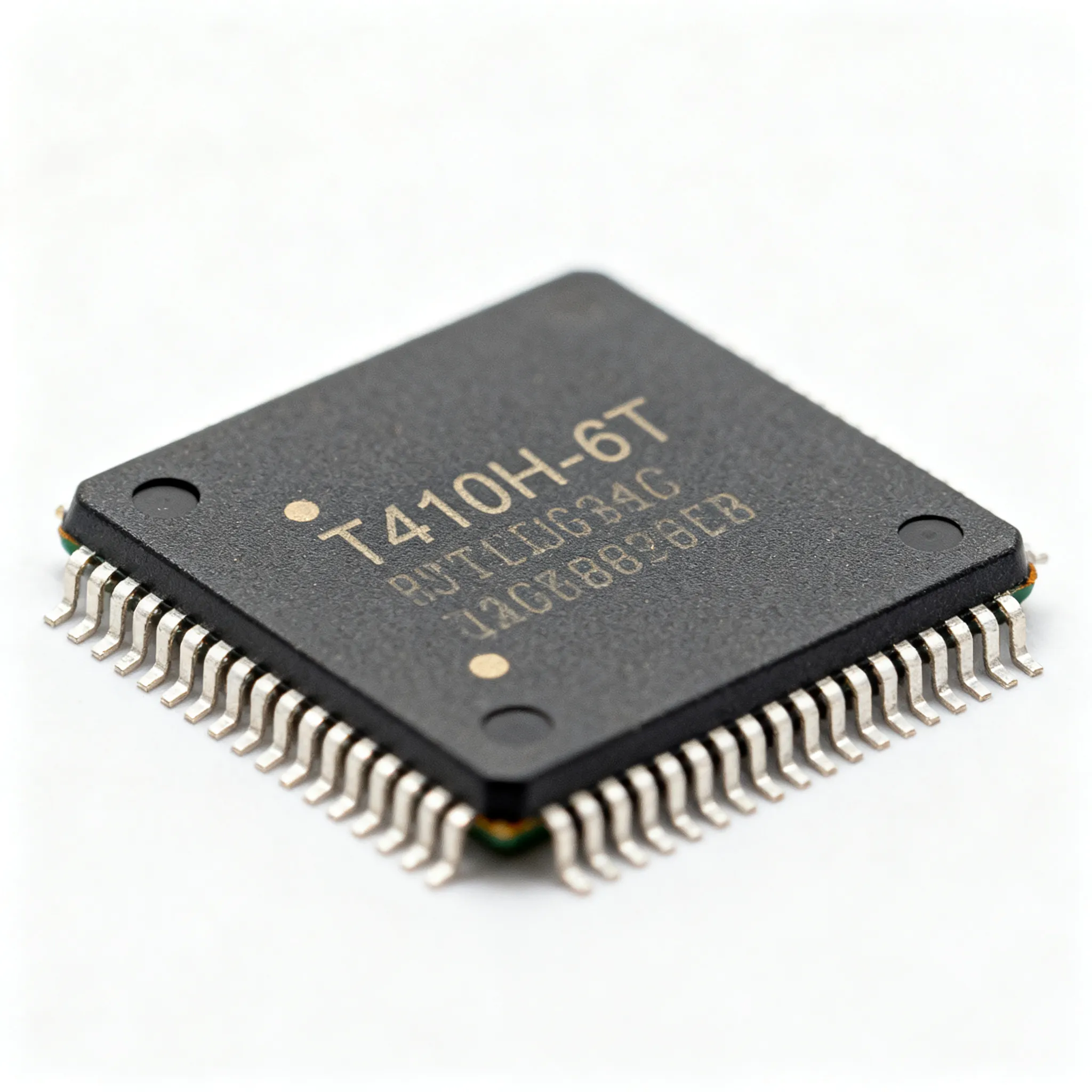
Start with the laser marking consistency against the official datasheet package outline. ST’s TO‑220AB marking uses a specific character set and alignment; off‑center etching or mismatched font width is a first hint. Then, test IGT at room temperature and at 125 °C — a genuine ST die stays ≤ 5 mA in Q1 at both temperatures, while a re‑marked conventional‑gate TRIAC often shows 8–15 mA. Counterfeit mitigators also ask the supplier for a photograph of the batch label that includes ST’s internal trace code; if the supplier cannot provide it, treat the lot as unverifiable and refuse it. A 5‑minute IGT measurement on a curve tracer is cheaper than a field recall.
Q: Can I drop a standard gate TRIAC into a circuit designed for the T410H-6T?
Not without re‑evaluating the gate drive. The T410H-6T triggers with ≤ 5 mA in Q1, whereas common 25–50 mA gate TRIACs (such as the BTA series) need a pulse that the original microcontroller I/O or opto‑coupler may not be sized to deliver. At low line or high ambient temperature, the required gate current can drift upward; a marginal 5 mA design implemented with a 50 mA device can result in erratic firing or complete latch‑up failure. If you must consider a substitute, subject the candidate to a full gate‑drive characterization at minimum VDD and maximum Tj — and expect to add a buffer transistor or a dedicated gate driver.
Q: Why does searching ‘T410H’ sometimes return Dell PowerEdge servers?
The Dell PowerEdge T410 server family uses “T410” as the model identifier, so search engines, e‑catalog APIs, and internal ERP systems that tokenize numeric suffixes frequently conflate the two. Even well‑trained procurement platforms can surface the server if the manufacturer field is missing or if the SKU field contains only “T410H.” The Dell T410 technical guide and spec sheet illustrate how a server description can mimic a semiconductor parametric block. Always include the manufacturer name “ST” or “STMicroelectronics” and the full part number “T410H-6T” in every search string and RFQ header to filter out server hardware.
Q: What lead‑time signals suggest I should lock in a T410H-6T purchase?
If several franchised distributors simultaneously move the part from warehouse stock to factory lead‑time — typically 8–14 weeks for a sensitive‑gate TRIAC in TO‑220 — that is an early warning that demand is beginning to pull on limited wafer starts. Another critical signal: ST’s product page flags “Not Recommended for New Designs” (NRND) or moves the T410H line to a selective‑availability status. In either case, you should qualify a second source or negotiate a Last‑Time Buy before a formal discontinuation notice appears. Even without a PCN, a sustained factory‑lead‑only posture among three independent authorized distributors is a strong trigger to place a buffer order and to start the engineering qualification of an alternative gate‑drive architecture.
An informed RFQ, anchored in datasheet parameters rather than online-search assumptions, turns the T410H-6T from a sourcing pitfall into a managed risk. The priority is always to verify, never assume, and to build a trail of written supplier confirmations that protect your production line from a silent gate‑sensitivity drift or a Dell server in disguise.
References & Further Reading
- STMicroelectronics T410H Datasheet – High temperature 4 A sensitive TRIACs
- STMicroelectronics T410H Product Page – Thyristors and TRIACs
- Dell PowerEdge T410 Technical Guidebook
- Dell PowerEdge T410 Specification Sheet
- IC‑Online: Assess T410H‑6T Sourcing Risks Before You Buy
- IC‑Online Electronic Component Marketplace – Request a Quote or Upload BOM
For an allocation‑sensitive part like the T410H-6T, transparent multi‑distributor RFQs reduce the chance of a sudden specification drift. Use the tools on IC‑Online to compare authorized‑channel offers, validate date codes, and enforce your pre‑order checklist — whether you are procuring a single tray for a service repair or a full reel for a high‑runner product. Upload your BOM today and let the platform flag part‑number mismatches, lifecycle changes, and pricing anomalies before they become a line‑down event.