Understanding PC123 Optocoupler Pinout and Common Equivalents
You should find the pc123 pinout quickly when using the pc123 optocoupler. Knowing the pinout helps you fix circuits, swap broken parts, or build new systems without worry.
You should find the pc123 pinout quickly when using the pc123 optocoupler. Knowing the pinout helps you fix circuits, swap broken parts, or build new systems without worry.
Tip: Picking the right pc123 optocoupler or a similar one saves time and stops mistakes.
If you pick the right pc123, your circuit stays safe and works well. Many engineers like the pc123 optocoupler because its pinout is easy to see and it is simple to replace.
Key Takeaways
-
The PC123 optocoupler has 4 pins. This makes it easy to use in circuits. You can also replace it easily.
-
It gives strong electrical isolation up to 5000 Vrms. This helps protect important parts from high voltage and noise.
-
There are many similar parts like PC817 and TLP621. These can take the place of the PC123. But you should always check voltage, current, and package type first.
-
The PC123 works well in industrial controls and power supplies. It is also good for microcontroller projects that need safe signal isolation.
-
Always look at the datasheet before using it. This helps you check the pinout and ratings. It also keeps your circuit safe and working well.
PC123 Pinout
Pin Configuration
You will find that the pc123 optocoupler uses a simple 4-pin layout. This makes it easy for you to connect and replace in your circuit. The pc123 pinout stays the same whether you use the DIP or SMT version. Both types have four pins that handle the input and output signals.
Here is a table showing the main package types and their features:
|
Package Type |
Pin Count |
Dimensions (mm) |
Description |
|---|---|---|---|
|
DIP (Dual Inline Package) |
4-pin |
7 x 7 x 2 |
Through-hole mounting, standard 4-pin DIP package |
|
SOP (Small Outline Package) |
4-pin |
N/A |
Compact SMT, saves board space, double molded vertical construction |
You can choose the DIP package if you want to use through-hole mounting. If you need to save space on your board, the SOP package works better. Both options give you the same pc123 pinout, so you do not need to change your circuit design.
Note: The pc123 optocoupler always uses a 4-pin configuration. This helps you keep your design simple and reliable.
Pin Functions
Each pin on the pc123 has a clear job. You will see two pins for the input side and two pins for the output side. The input side connects to the LED inside the optocoupler. When you send a signal to these pins, the LED lights up. The output side connects to the phototransistor. The phototransistor picks up the light from the LED and changes the output signal.
Here is how the pc123 pinout usually works:
-
Pin 1: Anode (LED input)
-
Pin 2: Cathode (LED input)
-
Pin 3: Emitter (Phototransistor output)
-
Pin 4: Collector (Phototransistor output)
You send your input signal to pins 1 and 2. The optocoupler uses the LED to turn your electrical signal into light. Pins 3 and 4 handle the output signal. The phototransistor receives the light and lets the signal pass through to the next part of your circuit.
The pc123 optocoupler works well for isolating signals. You can use it to keep high-voltage and low-voltage parts of your circuit safe from each other. The clear pinout helps you avoid mistakes when wiring or replacing the pc123.
Tip: Always double-check the pc123 pinout before soldering or plugging the device into your board. This step helps you prevent signal errors and keeps your circuit working as expected.
PC123 Optocoupler Equivalents
Equivalent Parts List
If you need a pc123 equivalent, you have many choices. These parts work in most circuits that use the pc123 series. You can use them for I/O isolation or noise suppression. They also help with signal transmission and over-voltage detection. Here are some common equivalents used in many places:
-
PC816
-
PC817
-
TLP621
-
TLP321
-
TLP421
-
PC17K1
-
H11A817
-
SFH615A
-
PS2501-1
-
PS2561-1
-
PS2571-1
-
LTV-816
-
LTV-817(-V)
-
LTV123
-
LTV-610
-
K1010
-
K817P
You can trust these parts because they have similar package types. They also have similar isolation voltage and output types as the pc123 optocoupler. Many engineers use these as replacements for the pc123 series.
Note: Sharp, Toshiba, Lite-On, Everlight, and Vishay are top brands. They make reliable equivalents for the pc123 series.
Choosing a Replacement
You should check a few important things before picking a pc123 equivalent. The right part keeps your circuit safe and working well. Use this table to compare the most important features:
|
Criteria |
PC123 Specification |
What to Check in an Equivalent |
|---|---|---|
|
Operating Voltage |
3.3V - 5.0V |
Must match this range |
|
Output Voltage (Max) |
70V |
Match or exceed 70V |
|
Output Current (Max) |
50mA |
Match or exceed 50mA |
|
Isolation Voltage |
1500V to 5000Vrms |
Similar isolation voltage needed |
|
Current Transfer Ratio |
50% to 600% at 5mA |
Comparable CTR for signal transfer |
|
Package Type |
4-pin SOP or DIP-4 |
Must fit your board layout |
|
Mounting Type |
Through Hole |
Match mounting type (TH or SMD) |
|
Operating Temperature |
-40°C to 85°C |
Similar temperature range |
You should also check the brand. Sharp, Toshiba, Lite-On, and Everlight make good equivalents for the pc123 optocoupler. These brands give strong performance and last a long time in your projects.
Tip: Always check the datasheet for the pc123 equivalent you pick. Make sure the voltage, current, and package fit your needs before you use it.
PC123 Optocoupler Features
How It Works
The pc123 acts like a bridge in your circuit. It keeps two parts safe from each other. Inside, there is an infrared emitting diode and a phototransistor. When you send a signal to the input pins, the diode lights up. This light stays inside the device. It shines right onto the phototransistor. The phototransistor sees the light and changes it back to an electrical signal. This gives strong isolation between input and output. You can use the pc123 to send signals between different parts. It does not let electricity pass directly. This helps protect sensitive circuit parts from high voltage or spikes. The pc123 is a photocoupler. It uses light to move signals. This makes it safe and reliable for connecting different voltage levels.
Key Benefits
The pc123 optocoupler gives you many good benefits. It can handle high voltage isolation up to 5000 Vrms. This is more protection than many other optocouplers. You can trust the pc123 to keep your circuits safe in high-voltage places. The pc123 has wide creepage paths and different lead-form options. These help lower the chance of electrical problems. The pc123 meets UL safety standards. This means it is safe for industrial and power supply systems.
Here is a quick look at the main features:
|
Feature |
Description |
|---|---|
|
Isolation Voltage |
5000 Vrms (5kV RMS) for strong voltage isolation |
|
Creepage Paths |
Wide lead-form increases safety and reduces fault risk |
|
Safety Certification |
UL recognized for compliance with safety standards |
|
Application Suitability |
Works well in industrial control and power supply systems |
|
Current Transfer Ratio |
50% to 400% at 5mA, supports many signal isolation needs |
You can count on the pc123 optocoupler for safety and good performance. It works well in tough jobs where you need strong isolation and steady signal transfer.
PC123 Datasheet Highlights
Electrical Specs
The pc123 datasheet gives you the important numbers for your project. The pc123 keeps signals apart and switches quickly. You can check the table below for the main electrical details:
|
Parameter |
Value |
|---|---|
|
Isolation Voltage |
5000 Vrms |
|
Current Transfer Ratio (CTR) |
50% to 600% @ 5mA |
|
Maximum Forward Current |
0.05 A |
|
Collector-Emitter Voltage (VCEO) |
200 mV |
|
Output Voltage |
70 V |
|
Typical Forward Voltage (VF) |
1.2 V |
|
Operating Temperature Range |
-30°C to 100°C |
|
Package Type |
4-pin DIP Through Hole |
|
Output Type |
Transistor |
|
Rise/Fall Time (Typical) |
4 μs / 3 μs |
|
Number of Channels |
1 |
|
RoHS Compliance |
Non-RoHS Compliant |
|
UL Recognition |
Yes |
The pc123 works in many places because it handles hot and cold. The current transfer ratio (CTR) shows how much signal goes from input to output. For the pc123, CTR is between 50% and 600% when you use 5mA. This means the signal can be strong or weak, depending on your needs.
Note: Always look at the datasheet for your exact pc123 part. Some versions might be a little different.
Maximum Ratings
You must know the highest limits for the pc123 before using it. The datasheet tells you these ratings to keep your circuit safe:
|
Parameter |
Maximum Rating |
|---|---|
|
Maximum Collector Current |
50 mA |
|
Maximum Power Dissipation |
50 mW |
|
Maximum Reverse Voltage |
6 V |
|
Minimum Isolation Voltage |
5000 Vrms |
The LED side of the pc123 can take up to 50mA of current. Do not go over this number or you could break the device. The pc123 works best if you stay under these limits.
You also need to check the temperature range. Some datasheets say -40°C to 85°C, but others say -30°C to 100°C. Make sure the temperature fits your project.
Tip: The pc123 datasheet helps you check all the limits and details. Use it to compare specs and make sure your circuit will work well.
PC123 vs PC817 Optocoupler
Main Differences
When you compare the pc123 and pc817, you notice some key things. The pc123 can handle higher voltage and gives better isolation. The pc817 is good for simple signal isolation in low-voltage circuits. The pc123 can take more voltage stress than the pc817. Look at the table below to see how they are different:
|
Parameter |
PC123 |
PC817 |
|---|---|---|
|
Collector-Emitter Breakdown Voltage (Vceo) |
70 V |
35 V |
|
Input-Output Isolation Voltage (rms) |
5000 V |
5000 V |
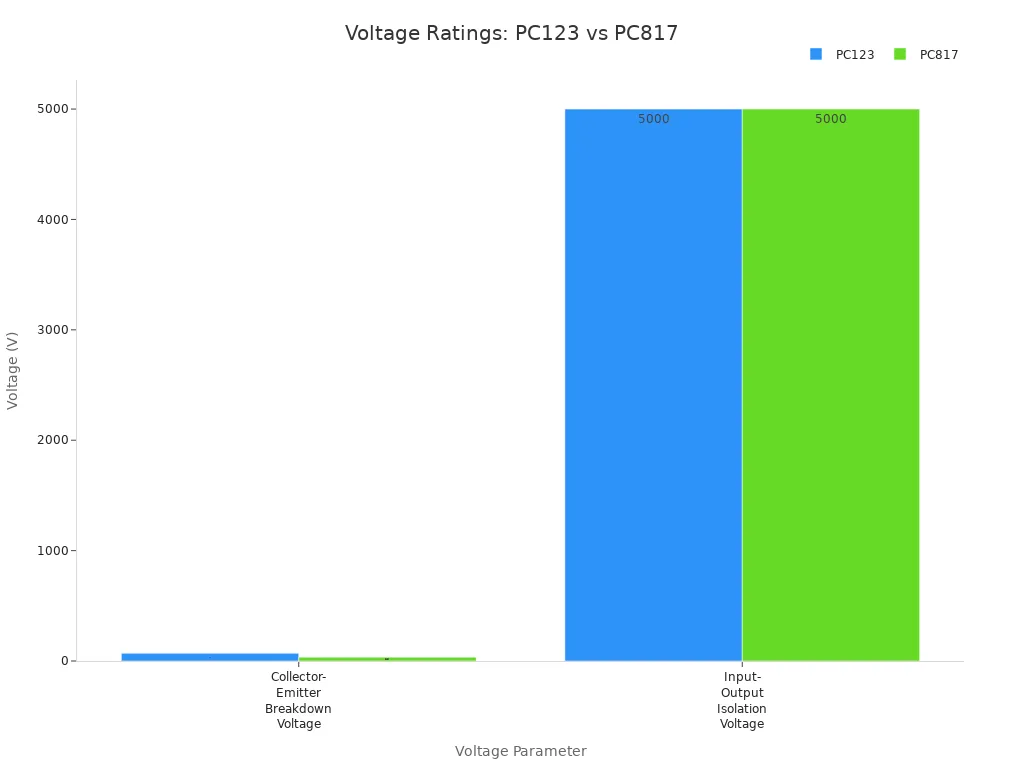
The pc123 gives you more choices for package types. You can pick a 4-pin DIP with wide leads or a surface-mount type. The pc817 usually comes in a regular 4-pin DIP. The pc123 works in colder and hotter places, from -65°C to 150°C. The pc817 works from -30°C to 100°C. Both can handle up to 50 mA output current.
|
Feature / Parameter |
PC123 |
PC817 |
|---|---|---|
|
Package Options |
4-pin DIP with wider lead spacing and surface-mount gullwing leads |
Standard 4-pin DIP |
|
Isolation Voltage |
5000 Vrms |
5000 Vrms |
|
Reverse Voltage |
70 V |
35 V |
|
Operating Temperature Range |
-65°C to 150°C |
-30°C to 100°C |
|
Current Transfer Ratio (CTR) |
50% to 600% at 5mA |
Lower nominal CTR |
|
Output Current Max |
50 mA |
50 mA |
|
Typical Use Cases |
High-voltage, industrial, power supply, noise mitigation, voltage surge detection |
General optical isolation in low-voltage digital circuits, microcontroller signal isolation |
|
Safety and Compliance |
UL recognized, high Q factor, superior isolation |
Commonly used but lower voltage tolerance |
|
RoHS Compliance |
Non-RoHS compliant |
Non-RoHS compliant |
When to Use Each
Pick the pc123 if your project needs strong isolation and high voltage safety. The pc123 is best for industrial controls, power supplies, and places with voltage surges. If you want to protect sensitive parts from high voltage, use the pc123. You also get more package choices with the pc123.
The pc817 is good for simple digital circuits. You can use it for basic signal isolation between a microcontroller and other low-voltage parts. The pc817 is easy to find and works well in most home electronics. If your project does not need high voltage or a wide temperature range, the pc817 is enough.
Think about what your circuit needs when choosing between pc123 and pc817. If you want higher voltage ratings and more safety, use the pc123. If you just need a basic optocoupler for simple signals, the pc817 will work.
Tip: Always check your voltage and temperature needs before picking the pc123 or pc817. The right optocoupler keeps your signals safe and your project working well.
PC123 Optocoupler Applications
Typical Circuits
You can use the pc123 in lots of electronics. This optocoupler is great when you need to keep signals safe and separate. Here are some common ways people use the pc123:
-
It helps control power supplies and switching power supplies.
-
It is used in industrial automation and control systems.
-
It works in data collection systems.
-
It separates microcontroller I/O interfaces.
-
It helps stop noise in switching systems.
-
It sends signals between different voltage levels.
-
It finds voltage surges to protect sensitive electronics.
The pc123 is used when you want to keep high and low voltage parts apart. You often see it in power supply circuits. It helps lower noise and keeps signals clear. In microcontroller projects, it protects I/O pins from voltage spikes. The pc123 is also used in industrial control panels. It helps keep signals safe and steady.
Tip: The pc123 has high isolation voltage (5kV RMS) and fast switching. This makes it a good choice for tough jobs in both home and industrial electronics.
Usage Tips
You can make your circuit work better by following some easy tips with the pc123. Always use its high isolation voltage and wide creepage paths for safety. Keep the pc123 away from noisy power lines to stop interference. Add filters or shields if your circuit has a lot of electromagnetic noise.
-
Use voltage suppressors or metal oxide varistors to stop voltage surges.
-
Make your PCB layout so signal paths are short and away from high-power traces.
-
Pick the right current transfer ratio (CTR) for your project to move signals well.
-
Use the pc123 to keep microcontroller I/O safe from noise and spikes.
-
Make sure the optocoupler fits your board and matches your voltage and current needs.
Note: Good design and smart parts choices help your pc123 circuits last longer and work better.
You can count on the pc123 to work well in power supply circuits, industrial controls, and any place that needs safe, steady signal isolation.
PC123 Datasheet and Resources
Where to Find Datasheets
You can get the pc123 datasheet from many trusted places. The official datasheet has all the important technical facts for your project. Most companies, like Sharp and Everlight, put a datasheet pdf on their websites. You can also go to big electronic parts sellers. These sites let you download the datasheet fast.
Here are some places to find the pc123 datasheet:
-
Manufacturer websites (Sharp, Everlight, Lite-On)
-
Major distributors (Digi-Key, Mouser, RS Components)
-
Technical resource sites (AllDatasheet, Datasheet4U)
Always make sure you download the right datasheet pdf for your exact pc123 model. This helps you avoid mistakes when building your circuit.
Further Reading
If you want more help with the pc123 or need tips for fixing problems, you have good choices. Some websites give extra help, like sample circuits and test guides. Lisleapex is a trusted place. You can find technical info, pinout pictures, and how it works there. The site also gives advice for fixing problems and buying guides. Lisleapex follows strict rules, so you can trust what they say.
You can use these resources for harder projects or to fix issues:
-
Lisleapex: Has technical blogs, market news, and direct help for optocouplers.
-
Manufacturer application notes: Show how to use the pc123 in real circuits.
-
Online electronics forums: Let you talk to other engineers for advice.
If you need more help, ask the support team from your supplier or manufacturer. They can answer questions about the pc123 datasheet or your project.
The pc123 optocoupler has a 4-pin DIP pinout. This makes it simple to use in many projects. If you need a replacement, you can pick parts like PC817 or TLP621. Always check the reverse voltage and temperature range first. The pc123 works well in places with high voltage or heat. This means it is reliable in tough spots. Look at the datasheet for more details or special circuits. Knowing the right pinout and equivalent helps you make safe and strong projects.
FAQ
What happens if you connect the PC123 optocoupler pins incorrectly?
You risk damaging the optocoupler or your circuit. Always check the pinout before connecting. If you mix up the input and output, the device will not work, and you may cause a short circuit.
Can you replace the PC123 with a PC817 directly?
Yes, you can often swap a PC123 with a PC817. Check the voltage, current, and package type first. Both have similar pinouts, but always review the datasheet for your exact needs.
How do you test if a PC123 optocoupler works?
-
Apply a small voltage to the input pins.
-
Measure the output pins with a multimeter.
-
If you see a change in output, the optocoupler works.
Is the PC123 optocoupler safe for high-voltage circuits?
The PC123 provides strong isolation up to 5000 Vrms. You can use it in high-voltage circuits for signal separation. Always follow the datasheet limits to keep your project safe.