What Is the AD734AN? Defining the Analog Multiplier/Divider IC for Today’s Engineers
If you’re working in analog signal processing or maintaining classic instrumentation, you’ve likely heard of the A
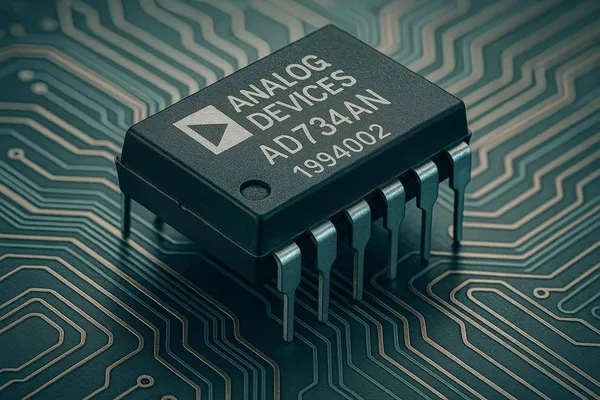
If you’re working in analog signal processing or maintaining classic instrumentation, you’ve likely heard of the AD734AN. But what exactly is this component, and why do professionals still care about it—even in a market saturated by digital solutions and rapid innovation?
AD734AN in Plain Language: The “Analog Calculator”
The AD734AN, developed by Analog Devices, is a precision analog multiplier/divider integrated circuit (IC). Think of it as a mini analog "calculator": it can instantly multiply or divide two voltage signals, all in real time. Where a digital chip needs code and conversion, the AD734AN manipulates voltages directly, making it invaluable for engineers who demand real-world mathematical operations in their signals without delay or quantization.
How Does It Work? The Basics of Analog Multiplication and Division
Most modern equations are solved by digital processors, but the AD734AN performs continuous multiplication and division on analog signals themselves. This means you can feed in two voltages (let’s call them X and Y), and instantly get their product or their ratio at the output—critical for everything from audio modulation to industrial control feedback.
It achieves this by using differential input stages and a sophisticated internal core—often based on designs like the Gilbert cell, a classic building block of analog computation, as described in Analog Multiplier Theory – SchematicsForFree.com.
Key Features and Performance Specifications
The AD734AN is respected for:
- Four-quadrant multiplication: Handles both positive and negative input voltages, so you’re not limited to just one signal polarity.
- True analog division: Unlike many multiplier chips, the AD734AN can also divide signals (making it unique among legacy analog ICs).
- Precision and stability: Expect high linearity (low error), temperature-stable performance, and low signal distortion.
- Bandwidth: Up to roughly 1 MHz, suitable for most instrumentation and control applications.
- Standard supply: Runs on ±15 V, with a classic 14-pin DIP package for easy integration.
These combined features let the AD734AN function at the heart of analog signal chains where accuracy and reliability matter most.
Typical Applications: Where Is the AD734AN Used?
While new designs rarely start with the AD734AN today, it’s still the go-to solution for repairing or extending legacy systems that depend on real analog math. Common use cases include:
- Instrumentation systems: RMS-to-DC conversion, signal linearization, and precision gain control circuits.
- Audio electronics: Analog modulation effects (like ring modulation in synthesizers), RMS detection for compressors, and mixing.
- Industrial control: Analog feedback loops, adaptive gain controllers, and process monitoring equipment.
- Sensor interfaces: Power measurement, analog mixers, and variable signal conditioning.
For deeper examples of vintage multipliers in action, see the Darlington Electronics usage directory.
AD734AN in 2025: Sourcing Risks and Market Reality
Here’s the candid truth for 2025: the AD734AN is officially obsolete. Analog Devices no longer produces it, and most primary distributors have exhausted their new-old-stock supplies. If you search major procurement platforms such as Fusion Worldwide, you’ll notice inventories are unpredictable, and prices are often inflated due to scarcity.
This trend means:
- High risk of encountering counterfeit or degraded surplus parts
- Extra diligence needed for authenticity verification
- Surplus brokers might be your only option, but always confirm with cross-reference tools and authentication services
Choosing the Right Analog Multiplier/Divider: How Does AD734AN Compare?
In the analog multiplier market, alternatives like the AD633, AD835, and Texas Instruments’ MPY634 offer similar capabilities—though not all support division. Here’s a quick comparison:
| Feature | AD734AN | AD633 | AD835 | MPY634 |
|---|---|---|---|---|
| Multiplier | Yes (4-quadrant & Divider) | Yes (Multiplier only) | Yes (High-speed) | Yes (4-quadrant & Divider) |
| Divider | Yes | No | No | Yes |
| Bandwidth | ~1 MHz | ~1 MHz | ~10 MHz | ~1 MHz |
| Supply V | ±15V | ±15V | ±5V to ±15V | ±15V |
| Application Focus | Legacy math, repairs | Multiplication, upgrades | Fast analog ops | Math circuits, repairs |
Practically: If your legacy system needs true analog division or four-quadrant multiplication, the AD734AN or MPY634 are your primary options. For new designs where only multiplication is required, the AD633 or AD835 are generally more accessible, with wider contemporary support.
Real-World Example: Repairing an Audio Modulator
Imagine a vintage ring modulator circuit on a classic synth fails in a studio. Rather than replacing the whole instrument, an engineer finds a remaining AD734AN via an authenticated surplus distributor. With it, the analog character and dynamic response of the original synth are fully restored—something purely digital emulations struggle to capture.
Selection and Sourcing Tips for 2025
If you’re tasked with procuring AD734AN or a similar part:
- Verify authenticity: Always source from distributors offering detailed origin and test documentation. Counterfeit parts are a rampant risk for legacy ICs (Fusion Worldwide – AD734AN distribution update, 2025).
- Consider alternatives for new designs: Evaluate AD633, AD835, or digital solutions unless true analog division is strictly required.
- Redesign where practical: For ongoing production, consider migrating analog computation to reliable, actively manufactured ICs or digital platforms unless you must preserve legacy hardware.
Conclusion: AD734AN’s Enduring Value for Engineers
The AD734AN may be an "old school" chip, but it still solves problems that modern silicon sometimes can’t. Whether you’re repairing classic systems or ensuring authentic analog computation, it delivers four-quadrant multiplication and true division reliably—if you can find genuine stock. In 2025, staying informed on sourcing tips, market trends, and alternative ICs empowers engineers and procurement teams to keep legacy hardware alive and performing.
References: