ADC vs DAC Key Differences and Modern Electronics Applications
You interact with analog and digital signals every day, often without noticing. When you speak into a microphone, it changes
You interact with analog and digital signals every day, often without noticing. When you speak into a microphone, it changes your voice (an analog signal) into an electrical signal. Your phone then uses an ADC to turn that signal into digital data. Later, a DAC changes digital audio back into sound through your phone’s speaker. The adc vs dac debate matters because these converters help your devices understand and share information. By knowing how adc vs dac work, you see how modern electronics connect the real world to digital technology.
Key Takeaways
- ADCs convert real-world analog signals like sound or light into digital data that devices can process and store.
- DACs change digital data back into smooth analog signals to produce sound, images, or control devices.
- Choosing the right ADC or DAC depends on your needs for speed, accuracy, and resolution in your project.
- ADCs and DACs work together to connect the analog world with digital technology in everyday devices like phones and medical tools.
- Understanding ADC and DAC helps you see how modern electronics capture, process, and recreate real-world signals efficiently.
ADC vs DAC Overview
Understanding adc vs dac helps you see how electronics handle signals from the real world. You use these converters every time you listen to music, take a photo, or measure temperature with a sensor. Both play a key role in connecting analog and digital systems.
Analog to Digital Converter (ADC)
An analog to digital converter changes a continuous analog signal, like sound or light, into digital data that computers and microcontrollers can process. You find adc in devices that measure physical phenomena, such as microphones, cameras, and sensors. The adc samples the analog input at regular intervals and assigns each sample a digital value. This process allows digital systems to store, analyze, and transmit information efficiently.
ADCs are essential in data acquisition systems. They link analog transducers to digital processing units, making it possible for devices to understand and use real-world signals.
Main functions of analog-to-digital converters:
- Transform analog signals into binary data for digital processing.
- Enable digital signal processing, filtering, and analysis.
- Support storage and communication of measured data.
- Allow control systems to make decisions based on sensor inputs.
You see adc vs dac differences in their core tasks. ADC digitizes analog inputs, making them usable for digital devices.
| ADC Type | Principle & Use | Typical Applications |
|---|---|---|
| Flash ADC | Fast, uses many comparators | Oscilloscopes, radar, video processing |
| SAR ADC | Successive approximation, low power | Microcontrollers, audio, instrumentation |
| Delta-Sigma ADC | High resolution, oversampling | Precision measurement, audio |
| Pipeline ADC | Multi-stage, high speed | Wireless communication, video |
| Integrating ADC | Integrates input over time | Multimeters, weigh scales |
| Time-Interleaved ADC | Parallel sampling for high speed | Communications, medical imaging |
Digital to Analog Converter (DAC)
A digital to analog converter does the opposite. It takes digital data, like numbers stored in a computer, and turns it into a smooth analog signal. You use dac in speakers, displays, and motor controls. The dac reads digital values and outputs a voltage or current that matches the input data.
DACs let digital devices create real-world outputs, such as sound or images, by converting digital samples into continuous analog signals.
Main functions of digital-to-analog converters:
- Convert digital signals into analog form for output devices.
- Enable audio playback, video display, and motor control.
- Bridge the gap between digital processing and analog output.
You find dac in modems, video adapters, and audio equipment. The adc vs dac comparison shows that while ADCs digitize, DACs analogize.
| DAC Type | Description | Typical Applications |
|---|---|---|
| Binary-Weighted DAC | Uses weighted resistors, simple design | Low-resolution uses |
| R-2R Ladder DAC | Resistor ladder for good precision | Many electronics |
| Delta-Sigma DAC | Oversampling for high accuracy | Audio, measurement systems |
| Current Steering DAC | Fast switching, high speed | Communication, signal processing |
You rely on digital-to-analog converters for smooth sound, clear images, and precise control in modern electronics. The adc vs dac relationship keeps your devices connected to both digital and analog worlds.
How ADC and DAC Work
Signal Conversion Direction
You see a clear difference in the direction of signal conversion when you compare adc and dac. An adc takes a continuous analog signal, such as your voice, and changes it into digital data. This process allows devices to transmit information with less interference. For example, when you make a cell phone call, the microphone captures your voice as an analog signal. The adc samples this signal and produces binary bits for digital transmission. On the other hand, a dac performs the reverse operation. It takes digital binary data and converts it back into an analog waveform. Your phone uses a dac to turn the received digital audio into sound you can hear through the speaker. This fundamental difference in direction is what makes analog digital conversion possible in modern electronics.
Tip: You rely on adc to digitize real-world signals and on dac to recreate those signals for playback or control.
Operation Principles
You can understand how adc and dac work by looking at their basic steps:
-
An adc converts a continuous analog signal into a digital signal. It follows four main steps:
- Anti-aliasing: A low-pass filter removes unwanted high-frequency parts.
- Sampling and Holding: The adc samples the signal at regular intervals and holds each value.
- Quantizing: The sampled values are mapped to discrete levels.
- Encoding: The discrete levels become binary codes for digital processing.
-
A dac does the opposite. It takes digital signals and generates analog outputs at a set sampling frequency.
-
Different types of adc use unique methods:
- Flash adc uses many comparators for fast conversion.
- SAR adc compares bits one at a time for good accuracy.
- Dual Slope adc integrates the input over time for high precision.
You see that adc and dac work together to bridge the gap between analog and digital worlds. This teamwork makes analog digital conversion possible in devices you use every day.
Technical Differences
Resolution and Accuracy
You often hear about resolution when you compare adc and dac devices. Resolution means the number of bits used to represent a signal. More bits let you detect or reproduce smaller changes in the signal. For example, an adc with 12 bits can show 4096 different levels. A dac with 16 bits can create 65,536 smooth steps in sound or voltage.
Note: High resolution does not always mean high accuracy. Accuracy depends on errors like offset, gain, and nonlinearity.
You need to look at both resolution and accuracy when you choose an adc or dac. Accuracy can be lower than the resolution because of errors. For instance, a 12-bit adc with an integral nonlinearity error of 4 LSBs acts more like a 10-bit device. You can use the formula: Accuracy = Resolution - log2(Error), where Error is measured in LSBs.
Here is a table that shows how resolution and accuracy compare for adc and dac devices:
| Aspect | Description | Typical Values / Examples |
|---|---|---|
| Resolution | Number of bits representing analog or digital values; determines smallest detectable/reproducible change | ADCs: 8-bit to 24-bit depending on application; DACs: 16- to 24-bit in audio applications |
| Accuracy | Influenced by quantization error, noise, distortion, offset, gain, and integral nonlinearity (INL) | Effective Number of Bits (ENOB) often lower than nominal resolution |
| ADC Typical Resolution | Control and measurement: 10- to 16-bit; High-precision (medical devices): up to 24-bit | High resolution needed for subtle signal detection |
| DAC Typical Resolution | Audio applications require 16- to 24-bit resolution for smooth output | Lower resolution causes distortion or stair-step effects |
| Accuracy vs Resolution | Accuracy can be lower than resolution due to errors; formulas exist to calculate accuracy from resolution and error terms | Accuracy depends on error sources beyond quantization |
| Shared Concepts | Both ADCs and DACs share resolution concepts but differ in conversion direction and typical values vary by application | Resolution impacts accuracy and application performance |
Many factors affect the accuracy of adc and dac devices. You should watch for offset error, gain error, differential non-linearity, and quantization noise. Temperature drift and power supply noise also play a role. Calibration helps reduce these errors, especially in sensitive applications like medical imaging and audio.
- Offset error: Shifts all output values by a fixed amount.
- Gain error: Changes the slope of the output signal.
- Linearity errors: Make the output less consistent.
- Quantization noise: Limits how small a change you can detect.
- Temperature drift: Alters accuracy as temperature changes.
- Power supply noise: Adds unwanted signals.
Speed and Performance
Speed is another key difference between adc and dac devices. Speed means how fast the device can process signals. You measure adc speed by its sampling rate. You measure dac speed by how quickly it can update its output.
Tip: Fast adc devices are needed for video, radar, and communications. High-resolution dac devices are important for audio and control systems.
You should also consider performance metrics like signal-to-noise ratio (SNR), dynamic range, and effective number of bits (ENOB). Higher SNR means cleaner signals. A larger dynamic range lets you handle both loud and soft signals without distortion. ENOB shows the real resolution after accounting for noise and errors.
Here is a table that explains these metrics:
| Metric | Definition / Formula | Impact on Performance |
|---|---|---|
| Signal-to-Noise Ratio (SNR) | Ratio of signal power to noise power, expressed in dB: SNR(dB) = 10 log10(Signal Power / Noise Power) | Higher SNR means cleaner signals with less noise, improving signal fidelity. |
| Dynamic Range | Ratio of max to min signal amplitude ADC can resolve, in dB: Dynamic Range(dB) = 20 log10(Largest Signal / Smallest Signal) | Larger dynamic range allows handling wide amplitude variations without distortion or clipping. |
| Effective Number of Bits (ENOB) | Actual resolution considering noise and distortion. | Higher ENOB indicates more accurate analog-to-digital conversion. |
| Power Consumption | Includes static power (leakage when idle) and dynamic power (active conversion), approximated by P_dynamic = C * V^2 * f | Lower power consumption is critical for battery-powered and portable devices. |
| Speed (Sampling Rate) | Rate at which ADC converts analog to digital signals. | Higher speed improves frequency domain resolution but increases power consumption and processing needs. |
| Accuracy | How closely digital output matches analog input, affected by offset and gain errors | High accuracy is essential for precise measurements in instrumentation and sensor data acquisition. |
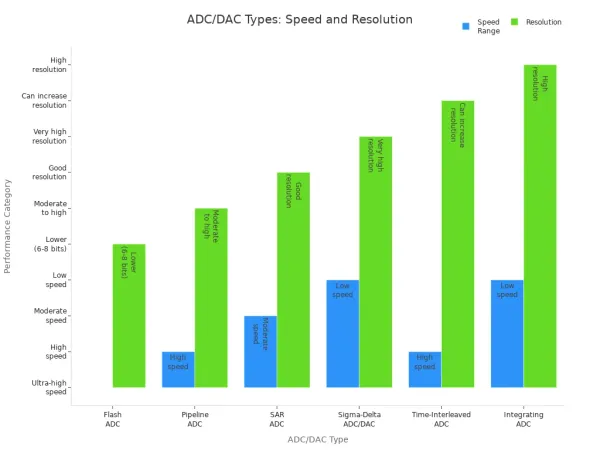
You can see that adc and dac devices must balance speed, resolution, and power. For example, flash adc devices work at ultra-high speeds but have lower resolution and use more power. Pipeline adc devices offer high speed and moderate resolution, making them good for video and radar. Sigma-delta adc and dac devices focus on high resolution and low distortion, which is perfect for audio.
Here is a chart that compares speed and resolution for different adc and dac types:
Architectures
You find many architectures for adc and dac devices. Each design has strengths and weaknesses. You need to match the architecture to your application.
- Sigma-Delta: Gives high resolution (12-24 bits) at low to moderate speed. You use it for audio and precision measurement.
- SAR (Successive Approximation Register): Offers 8-18 bits and medium speed. You see it in microcontrollers and data acquisition.
- Pipeline: Delivers 8-16 bits at high speed. You use it for radar, imaging, and video.
- Flash: Provides ultra-high speed but lower resolution. You find it in applications where speed matters most.
- Integrating (Dual-Slope): Gives high accuracy at slow speed. You use it in digital multimeters.
- Time-Interleaved: Combines multiple adc devices for very high speed. You use it in communications and medical imaging.
For dac devices, you see these architectures:
- Sigma-Delta dac: Up to 24-bit resolution, slower settling times, best for audio.
- R-2R ladder and resistor string: 8-16 bits, fast settling, used in industrial control.
- Current steering dac: Ultra-fast, used in video and communications.
Here is a table that compares common adc architectures:
| ADC Architecture | Key Characteristics | Typical Resolution | Speed Range | Power & Complexity | Typical Applications |
|---|---|---|---|---|---|
| Flash | Uses many comparators (2^N-1), very fast conversion | Lower resolution due to complexity | Ultra-high speed | High power consumption, high complexity, large size | Ultra-high speed applications where power is less critical |
| SAR (Successive Approximation Register) | Binary search algorithm, sample and hold, DAC | 8 to 18 bits | Medium speed (up to ~5 Msps) | Low power, moderate complexity, compact size | Data acquisition, microcontrollers, audio processing, battery-powered devices |
| Pipeline | Multiple stages with sample and hold, digital correction | 8 to 16 bits | High speed (few Msps to 100+ Msps) | Moderate power and complexity | Radar, medical imaging, high-speed instrumentation |
| Delta-Sigma | Oversampling, noise shaping, digital filtering | High resolution (12 to 24 bits) | Low to medium speed | Moderate complexity and power | Precision industrial measurement, audio, instrumentation |
| Integrating (Dual-Slope) | Integrates input over time, measures time to zero | High resolution | Slow conversion speed | Low power, simple but precision components needed | Digital multimeters, weigh scales |
| Time-Interleaved | Multiple ADCs working in parallel, combined output | Can increase effective resolution | Very high speed (faster than pipeline but slower than flash) | High complexity and power | High-speed communications, radar, medical imaging |
You need to consider the advantages and disadvantages of each architecture. SAR adc devices use less power and fit small spaces, but they do not work well at very high speeds. Delta-sigma adc devices give you high accuracy but have more latency. Flash adc devices are fast but use a lot of power and space. Pipeline adc devices balance speed and resolution but add some delay. Integrating adc devices reduce noise but work slowly. Time-interleaved adc devices reach high speeds but need careful calibration.
Block Quote: You should always match the adc or dac architecture to your application's needs. Fast conversion is vital for video, while high accuracy matters most in measurement and audio.
Modern Applications

ADC in Electronics
You see adc technology everywhere in modern electronics. Audio systems use adc chips to turn sound into digital data. These chips need high resolution, often 16 bits or more, to capture clear audio. Video devices use adc with much higher sampling rates, sometimes several million samples per second, but lower resolution. Measurement tools, like digital multimeters, rely on adc for precise readings. You find different types of adc for each job. Sigma-delta adc works best for audio and high-precision measurement. Dual slope adc gives strong noise rejection in multimeters. Pipelined adc handles fast video processing and medical imaging. Flash adc works in oscilloscopes and radar because of its speed. SAR adc balances speed and accuracy for industrial control and communication devices.
| ADC Type | Key Characteristics | Primary Application Areas |
|---|---|---|
| Sigma-Delta | High resolution, accuracy, noise shaping | Audio encoding, high-precision measurement |
| Dual Slope | Excellent accuracy, strong noise rejection | Digital multimeters, precise measurement |
| Pipelined | Fast, high-resolution conversions | Digital video processing, medical imaging, high-speed data acquisition |
| Flash | Very high speed conversion | Oscilloscopes, radar, video digitization |
| SAR | Balanced speed, resolution, power consumption | Industrial control, communication devices, audio |
| TDC | Time/frequency critical measurements | Time-of-flight, frequency counters, ultrasonic systems |
Integrated circuits make adc chips smaller and faster. You get better performance and lower costs. These chips combine analog and digital parts, which helps protect signals and makes your devices more reliable. Power management features, like clock gating and dynamic frequency scaling, help save battery life in portable electronics.
DAC in Electronics
You use dac technology every day, often without noticing. Audio playback systems, such as CD players and smartphones, rely on dac chips to turn digital files into sound for speakers or headphones. Video devices, like DVD players, use dac to convert digital video signals for display. Industrial control systems use dac to drive motors and valves with analog signals. Communication systems, including modems and cell networks, depend on dac for sending data. Test equipment uses dac to create analog signals for checking circuits.
Modern dac chips use advanced integrated circuits. These designs allow low-power operation and high accuracy. You benefit from smaller devices and longer battery life. Current-mode signal processing in dac chips gives faster performance, which is important for high-speed data and audio. Integrated circuits also help reduce errors and improve sound quality.
Real-World Examples
You find adc and dac working together in many products. Your cell phone uses an adc to digitize your voice during a call. The digital signal travels through networks. At the other end, a dac converts the data back into sound for the listener. Smartphones use adc for recording audio and capturing images, while dac handles playback and display. Medical devices use adc to digitize signals from sensors, such as ECG or MRI, and dac to output processed results. These converters make sure you get clear sound, sharp images, and accurate measurements.
Tip: ADC and DAC chips are the bridge between the real world and digital technology. You rely on them for every modern application, from entertainment to healthcare.
ADC or DAC: When to Use
Choosing ADC
You should choose an adc when you need to turn real-world signals into digital data. This is common in measurement, monitoring, and control systems. Different types of adc work best for different jobs. The table below shows where each type fits best:
| ADC Type | Common Preferred Scenarios |
|---|---|
| SAR ADC | Motor control, vibration analysis, system monitoring, and protection-relay applications in utilities |
| Sigma-Delta ADC | High accuracy tasks like instrumentation, gas analysis, and oil industry measurements |
| Pipeline ADC | Super-fast sampling for radios, radar, and communications |
| Integrated ADCs in Microcontrollers | Cost-effective uses like temperature sensing and basic monitoring |
| Discrete ADCs | High precision or isolation needs, such as PLC analog inputs |
Tip: Pick an adc when you want to measure, digitize, or monitor signals from the physical world.
Choosing DAC
You should use a dac when you need to change digital data back into an analog signal. This is important for devices that must interact with speakers, displays, or other analog equipment. Here are some common scenarios:
- Short-distance, high-speed connections in data centers
- Top of Rack or Adjacent Rack server connections
- Middle of Row setups for distances under 15 meters
- End of Row architectures within a 15-meter limit
- Replacing optical modules for short wiring with low latency and energy savings
- Connecting servers, switches, routers, and storage devices in high-speed networks
Note: A dac is the right choice when your system must output analog signals for real-world use.
Practical Scenarios
You see both adc and dac in many everyday devices. For example, a smartphone uses an adc to capture your voice as digital data. It then uses a dac to play music or sounds through the speaker. In digital signal processing systems, the adc changes analog signals to digital for processing. If you need to hear the result, the dac converts it back to analog sound. Medical devices use adc for accurate sensor readings. Televisions and computers use dac to drive speakers and displays, making digital content easy to enjoy.
| Scenario/Application | Role of ADCs | Role of DACs | Explanation |
|---|---|---|---|
| Digital Signal Processing (DSP) Systems | Convert analog signals to digital for processing | Convert processed digital data back to analog if needed | ADCs digitize signals for processing; DACs used if analog output is required, e.g., audio playback |
| Voice-band/Audio Applications | Capture analog audio signals digitally | Convert digital audio back to analog for playback | DACs are essential to produce analog sound from digital data |
| X-ray Imaging and Sensor Data | Precise digitization of real-world analog signals | N/A | ADCs critical for accurate measurement and sampling |
| Consumer Devices (TVs, Smartphones, Computers) | N/A | Convert digital data to analog voltages/currents to drive speakers or displays | DACs translate digital information into analog signals for real-world interfacing |
Remember: You rely on these converters every day, whether you are listening to music, watching TV, or using a sensor.
You now know that ADCs convert real-world analog signals into digital codes, while DACs turn digital data back into smooth analog signals. These converters let your devices process, store, and share information with accuracy and speed.
- ADCs focus on resolution and sampling rate for precise measurement.
- DACs emphasize output voltage accuracy and step size for quality analog output.
When you design a project, always check your needs for speed, resolution, and signal quality.
- Review your system requirements.
- Compare converter types and features.
- Use datasheets and design tools to make the best choice.
With the right ADC or DAC, you can build reliable and efficient electronic systems.
FAQ
What is the main difference between an ADC and a DAC?
You use an ADC to turn analog signals into digital data. You use a DAC to change digital data back into analog signals. Each converter works in the opposite direction.
Why do you need both ADC and DAC in electronics?
You need both because real-world signals are analog, but computers use digital data. ADCs let you measure and process signals. DACs let you create sound, images, or control devices.
How do you choose the right ADC or DAC for your project?
You should check your needs for speed, resolution, and accuracy. Look at the datasheet for each converter. Pick the one that matches your application, such as audio, measurement, or control.
Can you use an ADC without a DAC?
Yes, you can. Some devices only need to measure or record signals, so they only use an ADC. If you want to create analog output, you need a DAC.