Essential Logic Gates in Integrated Circuits every Electronics Engineer Should Master
You use essential logic gates every day as an electronic engineer. These essential logic gates include AND, OR, NOT, NAND, NOR, XOR, and XNOR. You rely on these gates to control signals and manage information, as well as to build digital systems. Each essential logic gate follows its own specific rule for operation

You use essential logic gates every day as an electronic engineer. These essential logic gates include AND, OR, NOT, NAND, NOR, XOR, and XNOR. You rely on these gates to control signals and manage information, as well as to build digital systems. Each essential logic gate follows its own specific rule for operation. It’s crucial to understand each type of essential logic gate for your projects. Essential logic gates form the foundation of all electronics and digital logic. You’ll find these essential logic gates in calculators, computers, and many other electronic devices. Learning about essential logic gates helps you design, analyze, and troubleshoot circuits. The types of essential logic gates you choose determine how your circuits function and connect.
Key Takeaways
-
Logic gates like AND, OR, NOT, NAND, NOR, XOR, and XNOR are very important. They are the base of all digital circuits. These gates control how electronic devices work.
-
If you learn these gates well, you can design digital systems. You can also check and fix problems in them. This makes your projects work better and faster.
-
NAND and NOR gates are very strong. You can make any digital circuit with just one type of these gates.
-
Logic gates are made with transistors. They are put together on silicon chips. CMOS technology makes them fast and saves power.
-
Doing hands-on practice and using simulation tools helps you learn more. This lets you build better digital circuits.
Importance of Logic Gates
Foundation of Digital Circuits
When you work with digital circuits, you use logic gates. Logic gates are the main parts of digital electronics. They handle binary signals and help you make complex systems. In the 1930s, Akira Nakashima, Claude Shannon, and Victor Shestakov found that boolean algebra could explain switching circuits. This idea started all digital electronics.
-
Logic gates took the place of old relay and vacuum tube parts. Now, you use transistor-based gates like PMOS, NMOS, and CMOS for faster speed and less power use.
-
CMOS technology came in the 1960s and uses two types of MOSFETs. This method gives you fast speed and low power loss, making things work better and last longer.
-
Electronic logic gates are not like relay switches. They work as strong voltage amplifiers, which makes circuits more reliable and efficient.
-
You can link logic gates together to make any boolean function. This lets you build things like multiplexers, registers, ALUs, and microprocessors. These show how logic gates are the base of digital circuits.
Logic gates are needed in every digital circuit. You cannot make digital electronics without them.
Boolean Functions and Operations
Logic gates help you do boolean operations like AND, OR, NOT, NAND, NOR, XOR, and XNOR. You use these gates to work with binary data and control how circuits act. Boolean algebra lets you explain and study your circuit’s logic.
You often use computer models, like Monte Carlo simulations, to see how logic gates change circuit behavior. These tools help you learn how changes in parts affect noise, signal quality, and power use. Data about noise and power use show how logic gates change the reliability and efficiency of digital and mixed-signal circuits. When you test your circuits, you use parametric and functional tests to check if your logic gates work well.
You use logic gates to turn analog signals into digital signals. This step lets you use binary operations in digital electronics. The xnor gate and other gates help you make circuits for error checking, parity checking, and comparing data. You can put logic gates together in many ways to make any boolean function you want.
Essential Logic Gates Overview
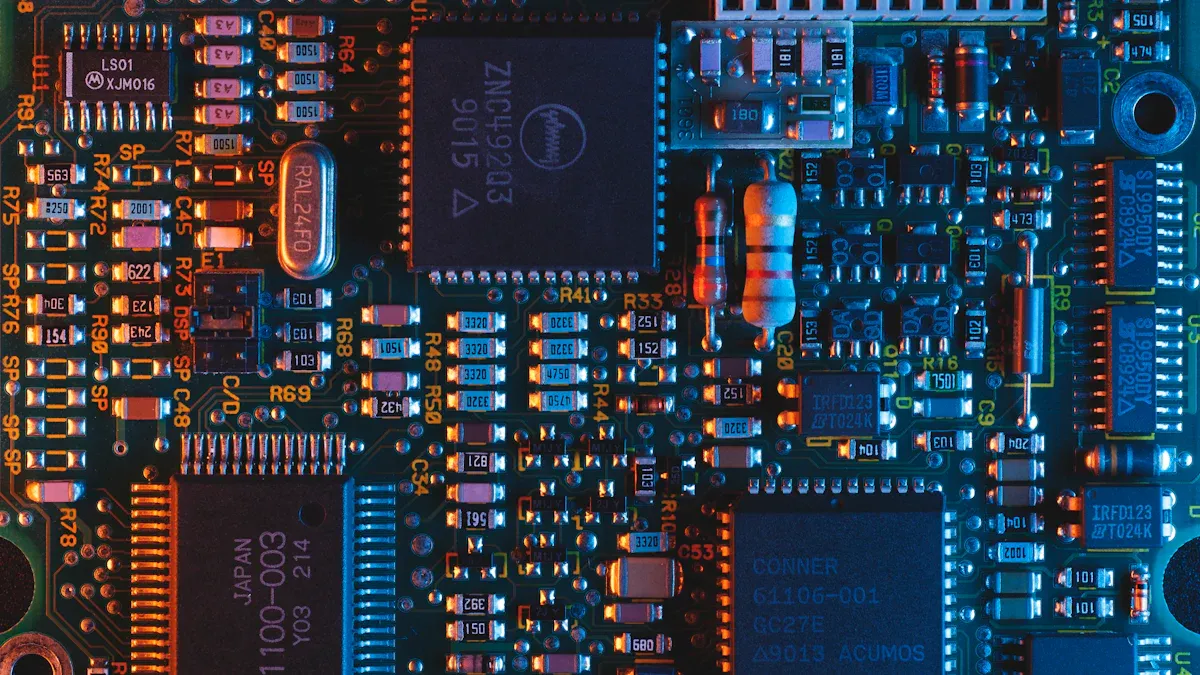
Understanding essential logic gates gives you the power to design and analyze digital circuits. Each gate has a unique function and symbol. You use these gates to build every digital circuit, from simple switches to advanced microprocessors.
AND Gate
The AND gate is one of the most basic logic gates. You use it to output a high signal only when all inputs are high. This gate forms the backbone of many digital circuits.
Symbol:
   ______
A ----|    \
      | AND )---- Q
B ----|____/
Truth Table:
|
A |
B |
Q (A AND B) |
|---|---|---|
|
0 |
0 |
0 |
|
0 |
1 |
0 |
|
1 |
0 |
0 |
|
1 |
1 |
1 |
Key Applications:
You use the AND gate in digital adders, multiplexers, and control circuits. It helps you check if multiple conditions are true at the same time.
OR Gate
The OR gate lets you output a high signal if at least one input is high. You often use this gate when you want your circuit to respond to several possible signals.
Symbol:
   ______
A ----|     \
      | OR  )---- Q
B ----|_____/
Truth Table:
|
A |
B |
Q (A OR B) |
|---|---|---|
|
0 |
0 |
0 |
|
0 |
1 |
1 |
|
1 |
0 |
1 |
|
1 |
1 |
1 |
Key Applications:
You use the OR gate in alarm systems, data selection, and logic control. It helps you trigger actions when any one of several conditions is met.
NOT Gate
The NOT gate, also called an inverter, changes the input signal to its opposite. If you input a high signal, the output becomes low, and vice versa.
Symbol:
A ----|>o---- Q
Truth Table:
|
A |
Q (NOT A) |
|---|---|
|
0 |
1 |
|
1 |
0 |
Key Applications:
You use the NOT gate to invert signals, create control logic, and build more complex gates. It is essential in memory circuits and digital signal processing.
NAND Gate
The NAND gate combines the AND and NOT gates. It outputs a low signal only when all inputs are high. In every other case, the output is high. You find the NAND gate in almost every digital system.
Symbol:
   ______
A ----|    \
      | AND )o--- Q
B ----|____/
Truth Table:
|
A |
B |
Q (A NAND B) |
|---|---|---|
|
0 |
0 |
1 |
|
0 |
1 |
1 |
|
1 |
0 |
1 |
|
1 |
1 |
0 |
Key Applications:
You use the NAND gate in memory chips, microprocessors, and digital logic circuits. It is a building block for flip-flops and latches. The NAND gate is functionally complete. You can use only NAND gates to build any other logic gate or digital circuit. Goñi-Moreno and Amos (2012) showed that you can create reconfigurable NAND logic gates for complex digital circuits. This makes the NAND gate one of the most powerful tools in your toolkit.
NOR Gate
The NOR gate combines the OR and NOT gates. It outputs a high signal only when all inputs are low. You use the NOR gate to create strict control logic.
Symbol:
   ______
A ----|     \
      | OR  )o--- Q
B ----|_____/
Truth Table:
|
A |
B |
Q (A NOR B) |
|---|---|---|
|
0 |
0 |
1 |
|
0 |
1 |
0 |
|
1 |
0 |
0 |
|
1 |
1 |
0 |
Key Applications:
You use the NOR gate in timers, oscillators, and control circuits. The NOR gate is also functionally complete. You can use only NOR gates to build any other logic gate or digital circuit. Gander et al. (2017) and Tamsir et al. (2011) demonstrated that NOR gates can create complex digital logic in biological systems. This shows the power and flexibility of the NOR gate in both traditional and new types of integrated circuits.
Tip: You can build any digital logic circuit using only NAND or only NOR gates. This makes them essential logic gates for every electronics engineer.
XOR Gate
The XOR gate, or exclusive OR gate, outputs a high signal only when the inputs are different. You use the XOR gate to compare signals and detect changes.
Symbol:
   ______
A ----|     \
      | XOR )---- Q
B ----|_____/
Truth Table:
|
A |
B |
Q (A XOR B) |
|---|---|---|
|
0 |
0 |
0 |
|
0 |
1 |
1 |
|
1 |
0 |
1 |
|
1 |
1 |
0 |
Key Applications:
You use the XOR gate in adders, parity checkers, and error detection circuits. It helps you find differences between two digital signals.
XNOR Gate
The XNOR gate, or exclusive NOR gate, outputs a high signal only when the inputs are the same. You use the XNOR gate to check for equality.
Symbol:
   ______
A ----|     \
      | XNOR)---- Q
B ----|_____/
Truth Table:
|
A |
B |
Q (A XNOR B) |
|---|---|---|
|
0 |
0 |
1 |
|
0 |
1 |
0 |
|
1 |
0 |
0 |
|
1 |
1 |
1 |
Key Applications:
You use the XNOR gate in digital comparators, error correction, and equality checkers. It is important for data integrity and digital communication.
Note: Mastering these essential logic gates helps you design, analyze, and troubleshoot any digital circuit. You can combine these gates to create any logic function you need in integrated circuits.
Logic Gates in Integrated Circuits
Construction and Components
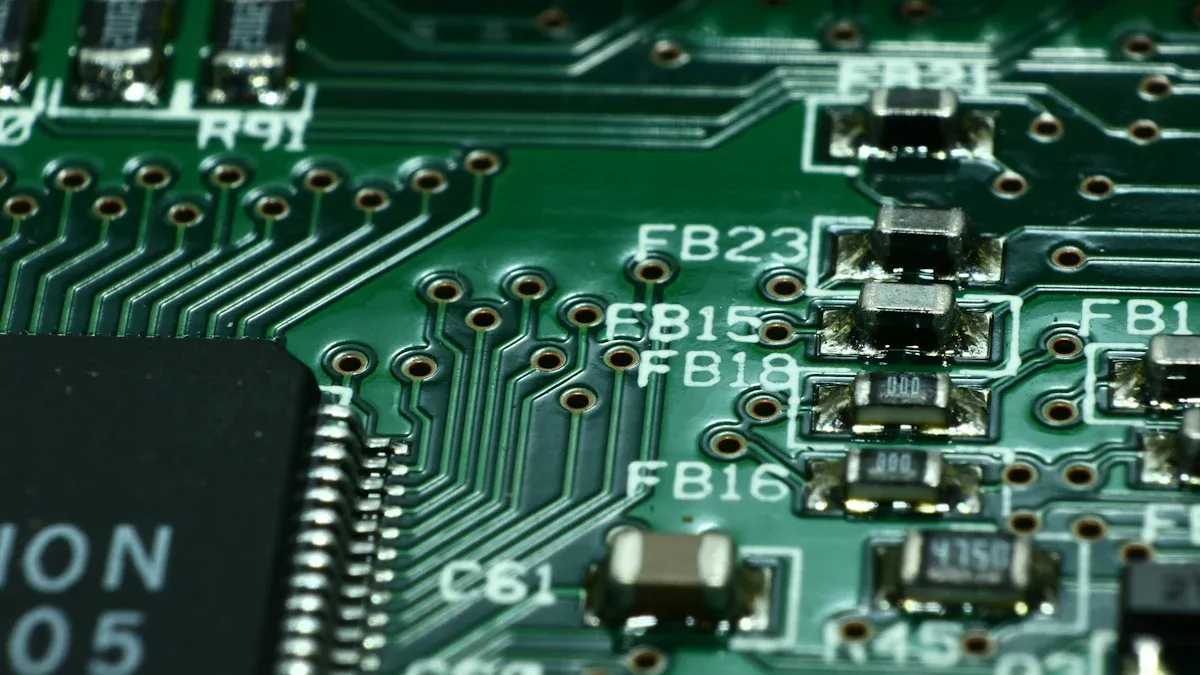
Logic gates are made with transistors, diodes, and resistors. Each gate has its own way of putting these parts together. MOSFETs help make gates that are fast and use little energy. The gates sit on a silicon chip. The chip is the main part of your logic circuits. Metal lines connect the gates to each other. These lines let signals move between gates. This helps you make more complex logic systems.
CMOS technology is often used for logic gates. CMOS uses NMOS and PMOS transistors together. This setup gives you fast speed and low power use. You can fit millions of gates on one chip. This lets you build strong logic circuits for computers, phones, and more.
Gate Arrangements and Complex Systems
You can put logic gates together in many ways. This helps you make more complex logic circuits. AND, OR, and NOT gates can be combined to make adders, multiplexers, and memory units. When you work on big systems, you use special methods to connect gates better.
-
The method of moving asymptotes (MMA) algorithm helps you design high-performance logic gates. This tool helps you deal with hard rules and find the best way to place your gates.
-
Each logic device unit has input and output ports. You pick the size and shape on the silicon base. You connect these units to make gates with more than two inputs, like three-input AND or OR gates.
-
These multi-input gates do not need control ports. This makes your design easier and helps you avoid mistakes.
-
Smart design tools, like neural networks and genetic algorithms, help you improve your logic circuits. These tools help you get strong signals and make sure your logic works well.
-
You set clear goals for your gates and change the design until it works right. This way is faster and cheaper than old methods.
These new design tools help you make logic gates that are faster and use less power.
Power, Ground, and Capacitors
Every logic gate needs to be connected to power and ground. Power gives the voltage needed for the gates to work. Ground lets the current go back. Capacitors help keep the voltage steady and block noise. They help your gates switch fast and stop mistakes in your circuits.
Power and ground lines run across the chip. Each gate is linked to these lines. This makes sure all gates get steady power. Decoupling capacitors are put near the gates to keep the voltage from changing. This is important for making sure your logic works well.
Good power and ground connections help your logic gates work right and stop errors.
Benefits of Mastery
Design and Troubleshooting
When you know logic gates well, you get good at designing and fixing digital circuits. You learn how each gate works in a system. This helps you find problems fast and fix them the best way.
-
You can guess how broken transistors or diodes in gates will change outputs.
-
You make and test real circuits to see how logic gates act.
-
You use science steps to check your designs and fix mistakes.
-
You learn to spot problems like missing power or bad connections in gates, like a NOR gate or an XOR gate.
-
You get better at solving design problems and explaining odd circuit actions.
-
You build your troubleshooting skills by making and testing your own digital projects.
When you really understand logic gates, you solve electronics problems better.
Real-World Applications
You find logic gates in almost all modern electronics. You use them in computers, phones, and control systems. Gates like AND, OR, NAND, NOR, XOR, and XNOR are the heart of digital electronics.
Many products need these gates to work well. TTL gates use bipolar transistors and have clear voltage levels, so they are fast and work well. CMOS gates use MOSFETs, which use less power and block noise. You see CMOS gates in microcontrollers, memory chips, and digital gadgets. These gates handle binary signals and keep your devices working right. The OR gate and XOR gate help you process data and control logic in many systems.
Logic gates make digital electronics work, from simple toys to big computers.
Innovation in Digital Systems
Knowing logic gates well helps you make new things in digital systems. You can design circuits that do more than just math. You use AND, OR, NOT, NAND, NOR, XOR, and XNOR gates to build smart systems in electronics and biology.
|
Host/System |
Logic Gate Type(s) |
Quantitative Details |
|
|---|---|---|---|
|
AND gate built with hrpR and hrpS genes under two promoters, output from hrpL promoter |
E. coli |
AND |
Promoter strength checked at 30°C and 37°C; memory seen |
|
16 two-input logic functions made using NOR gates |
Mammalian cells |
NOR, AND, OR, NAND, NOT, XOR, N-IMPLY |
Complex control of transcription; digital output predicted |
|
Synthetic circuits with two molecule inputs for control |
Mammalian cells |
NOT, AND, NAND, N-IMPLY |
Digital logic with bit-wise XOR; half-subtractor and half-adder made |
|
DNA logic gates wired into three-level circuits with XOR function |
Various hosts |
AND, OR, AND-NOT, XOR |
Multi-level circuit made and measured |
|
Synthetic multicellular computer made using cell–cell conjugation |
Bacterial cells |
Various |
Specific tasks shown |
|
Programming language as digital circuit counting user inputs |
E. coli |
Multiple |
Counts input frequency and can be expanded |
You see how logic gates help you make new electronics and even control living cells. You use gates like NAND, NOR, XOR, and XNOR to solve hard problems and invent new things.
Knowing logic gates well lets you create new ideas in any field that uses digital logic.
Learning Resources and Tips
Study Strategies
You can learn logic gates by doing hands-on work and using digital tools. Try making simple circuits with breadboards and logic chips. This lets you see what each gate does. Many students learn faster with software simulators like Logisim or TinyCAD. These programs let you test circuits without real parts. One study showed more students passed digital circuit classes when they used simulators. The pass rate went from 82% to 96%. You can also join group projects. Working with others helps you solve problems and learn teamwork. Flipped learning means you study logic online before class. Then, you use class time for harder questions and real projects. This way helps you get better at solving problems and understanding how logic gates work.
Tip: Use both digital labs and hands-on practice. This mix helps you master logic gates.
|
Study / Author(s) |
Study Strategy / Intervention |
Key Outcomes / Findings |
|---|---|---|
|
Prasad et al. (2014) |
Use of software simulators (Logisim, TinyCAD, etc.) |
Higher pass rates; supports self-study; expands teaching possibilities |
|
Montañana et al. (2015) |
Participative learning in VHDL teaching |
Improved teamwork and project management; more learning autonomy |
|
George (2018) |
Traditional classroom-based methodology |
Stepwise learning; hands-on labs; better performance |
|
Weng et al. (2009) |
Use of programmable logic tool kits |
86% positive student experience; practical approach enhanced learning |
Books and Courses
There are many books that teach logic gates and integrated circuits. Some books use real-life examples and computer exercises. Others use jokes to make logic easier. Here are some top-rated books:
|
Book Title |
Author |
Rating |
Key Features / Review Summary |
|---|---|---|---|
|
Semiconductor Device Fundamentals |
Robert F. Pierret |
4.00 |
Computer-based exercises, MATLAB integration, review mini-chapters, real device data |
|
Electrical Machines, Drives, and Power Systems |
Theodore Wildi |
3.99 |
Covers fundamentals and practical aspects of electric power and electronics |
|
There Are No Electrons |
Amdahl |
N/A |
Unique, accessible, and humorous approach to electronics |
Note: These books help you learn about logic gates and digital circuits. You can use them for self-study or in a class.
Simulation Tools
Simulation tools let you test and improve your logic circuits before building them. You can use tools like Multisim to check voltage, current, and power in real time. These tools show how your gates react to changes in temperature and noise. You can also use virtual instruments, like oscilloscopes, to measure signals and find problems. Many students think simulation tools make learning logic gates easier and more fun. You save time and money by testing ideas on your computer first. Simulation tools also work with PCB design software, so you can check your circuits in real layouts.
-
Simulation tools help you:
-
Check power and signal quality for fast logic circuits.
-
Practice fixing problems and making better designs.
-
Make fewer mistakes and get better results before building real circuits.
-
Learn faster with interactive experiments.
-
Try different simulation tools to see which one you like best. Practice a lot to get good at using logic gates.
You need logic gates to make any digital system. If you learn all seven essential logic gates, you can design and fix any circuit. Logic gates help you move data, choose what happens, and link signals. When you put AND, OR, NOT, NAND, NOR, XOR, and XNOR gates together, you can build alarms, counters, and microprocessors. Logic gates help you handle information and make systems that work well and can grow. You will see their symbols and truth tables in all your projects. Keep learning about logic gates and how to use them. Stay interested and keep building your skills as technology changes.
FAQ
What is the most important logic gate to learn first?
Start with AND, OR, and NOT gates. These are the basic gates. They help you understand how logic works. When you know these, you can learn harder gates. Then you can study NAND, NOR, XOR, and XNOR gates.
Can you build any digital circuit using only NAND or NOR gates?
Yes, you can use just NAND or just NOR gates. You can make any other logic gate with them. These gates can do everything you need. This helps you build strong and flexible circuits.
Why do you need capacitors with logic gates in integrated circuits?
Capacitors keep voltage steady and block noise. They help your logic gates work fast and well. Good placement of capacitors makes your circuits better.
How do you test if a logic gate works correctly?
You can use a logic probe or a digital multimeter. Give the gate known inputs and check the outputs. You can also use simulation tools to test gates before building them.
Where do you see logic gates used in real life?
You see logic gates in computers, phones, and calculators. They are also in traffic lights. Logic gates help control signals and process data. They help devices make choices in many electronics you use.