Explaining the Key Differences of LoRa and LoRaWAN
Understanding the key differences between LoRa and LoRaWAN is crucial. The debate of lorawan vs lora is simple: LoRa is the

Understanding the key differences between LoRa and LoRaWAN is crucial. The debate of lorawan vs lora is simple: LoRa is the physical long-range signal. LoRaWAN is the network protocol that organizes the communication. Think of LoRa technology as the voice for long-range communication. The LoRaWAN protocol provides the language rules, enabling a network that connects over 350 million IoT devices today.
Expert Insight: As a HiSilicon-designated solutions partner, Nova Technology Company (HK) Limited emphasizes that grasping these lora vs lorawan distinctions is the first step in designing a successful, scalable solution.
Key Takeaways
- LoRa is the radio signal. It sends data over long distances.
- LoRaWAN is the network. It organizes how devices talk to each other.
- LoRaWAN uses LoRa to build big, secure IoT networks.
- LoRa is like a voice. LoRaWAN is like a language.
- You need both LoRa and LoRaWAN for a complete IoT solution.
Defining LoRa: The Physical Layer Signal

LoRa is the foundational physical layer technology. It enables long-range, low-power communication for the Internet of Things. This patented technology modulates data onto a radio wave, creating a robust signal that can travel great distances. LoRa technology operates on unlicensed sub-gigahertz frequency bands, which vary by region.
| Region | Standard Band | Frequency Range |
|---|---|---|
| Europe | 868 MHz | 863–870 MHz |
| North America | 915 MHz | 902–928 MHz |
| Asia (China) | 470 MHz | 470–510 MHz |
| Asia (India) | 865 MHz | 865–867 MHz |
The Wireless Modulation Technique
LoRa technology uses a unique modulation method called Chirp Spread Spectrum (CSS). CSS encodes data into "chirps" that sweep across a channel. This wideband signal makes LoRa highly resistant to interference and noise. A receiver can detect the signal even when it is weaker than the background noise level. This resilience is a key reason for LoRa's excellent long range performance. The CSS method is fundamental to achieving low power wireless connectivity over extended distances.
How Spreading Factors Work
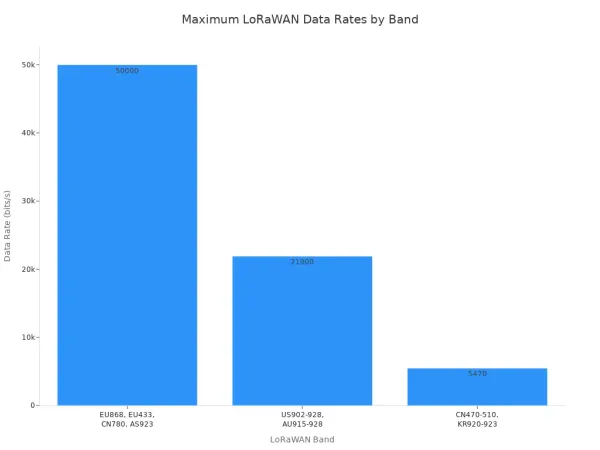
A Spreading Factor (SF) is a critical setting in LoRa that balances data transmission speed with communication range. A lower SF, like SF7, sends data faster. A higher SF, like SF12, sends data slower. This trade-off directly impacts battery life. A device using SF12 can consume up to 25 times more energy for data transmission than one using SF7. This is because the signal requires more time on air. The maximum data rate depends on the SF and the region.
Core Function of the LoRa Signal
The core function of the LoRa signal is to provide reliable, long-range wireless communication. It is the "physical layer" that carries data for a low power wide area network, or LPWAN. This technology's long-range capabilities are impressive. A LoRa signal can achieve a range of a few kilometers in cities and over 10 kilometers in rural areas. This makes LoRa technology ideal for LPWAN applications where devices are spread out and need low power operation. The signal itself is the foundation for any LPWAN solution built with LoRa.
Defining LoRaWAN: The Network Protocol
While LoRa provides the signal, LoRaWAN provides the intelligence. LoRaWAN is a Media Access Control (MAC) layer protocol. It sits on top of the LoRa physical layer to create a complete communication network. The LoRaWAN protocol's main role is to manage the entire LPWAN ecosystem, connecting devices to the internet while handling data routing, security, and overall network health. This framework is essential for building a scalable IoT solution.
The LoRaWAN Network Architecture
The LoRaWAN network uses a star-of-stars topology. This design connects end-devices to gateways, which then forward messages to a central network server. This architecture includes four key components:
- End-Devices: The sensors or actuators collecting data.
- Gateways: Antennas that receive LoRa packets and forward them to the network server via standard IP connectivity.
- Network Server: The core of the LoRaWAN network. It manages the network, de-duplicates data from multiple gateways, and routes messages to the correct application. It also uses Adaptive Data Rate (ADR) to optimize data transmission speeds.
- Application Server: This server processes the application-specific data. It decodes the data payloads from devices, enabling applications like asset tracking or environmental monitoring.
Managing Security and Data Encryption
Security is a fundamental part of the LoRaWAN specification. The protocol provides two layers of security using AES-128 encryption.
- Network Session Security: A unique Network Session Key (NwkSKey) ensures that data comes from an authenticated device on the network.
- Application Data Security: An Application Session Key (AppSKey) provides end-to-end encryption for the data payload itself. This means the network operator cannot read the application data.
Devices join the network using one of two methods: Over-the-Air Activation (OTAA) or Activation by Personalization (ABP). OTAA is more secure because it generates new, dynamic session keys each time a device joins the network.
How LoRaWAN Manages Devices
LoRaWAN manages device behavior to balance data transmission needs with battery life. It defines three device classes for different use cases.
| Feature | Class A (Lowest Power) | Class B (Balanced) | Class C (Lowest Latency) |
|---|---|---|---|
| Power Use | Lowest | Medium | Highest |
| Downlink Latency | Highest | Medium | Lowest |
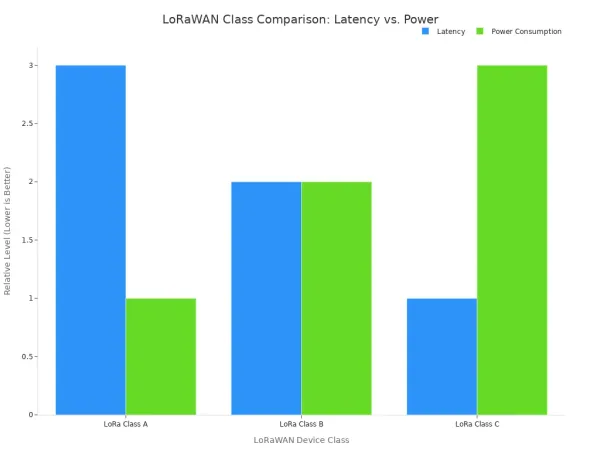
Class A offers the best low-power performance, making it ideal for battery-operated sensors. Class C provides constant connectivity for devices with a mains power source. The LoRaWAN network also uses Adaptive Data Rate (ADR) to manage the data transmission settings for each device. ADR optimizes the spreading factor and power level, preserving battery life and maximizing network capacity for the entire LPWAN. This intelligent management makes LoRaWAN a robust choice for IoT connectivity.
LoRa vs LoRaWAN: A Direct Comparison
Understanding the direct comparison of lorawan vs lora clarifies their distinct roles in an IoT system. While they work together, their fundamental purposes are completely different. Examining these key differences reveals why both are necessary for a complete solution.
Layer: Physical vs. Network
The most fundamental distinction in the lorawan vs lora debate lies in their position within the OSI model, which standardizes communication functions. LoRa technology operates at the Physical Layer (Layer 1). Its job is to handle the radio signal, encoding and decoding data for wireless data transmission. It creates the physical path for communication.
LoRaWAN, in contrast, is a protocol that functions at the Data Link Layer (Layer 2). It sits on top of the LoRa physical layer. LoRaWAN's role is to manage how devices access the network and how data packets are addressed and organized.
In Simple Terms:
- LoRa (Layer 1): Creates the long range radio wave that carries the message.
- LoRaWAN (Layer 2): Provides the rules for sending and receiving messages over that radio wave.
Function: Signal Modulation vs. Network Management
The functions of LoRa and LoRaWAN are entirely separate. LoRa technology is concerned only with the signal itself. Its primary function is signal modulation, creating a robust, long-range link with low power consumption. It enables the core data transmission over the air.
LoRaWAN performs the high-level task of network management. It takes the raw communication capability of LoRa and builds an organized, secure, and scalable network. Key LoRaWAN functions include:
- Device Authentication: Verifying that a device is authorized to join the network.
- Data Routing: Directing messages from thousands of devices through gateways to the correct application server.
- Security: Implementing end-to-end encryption to protect data.
- Adaptive Data Rate (ADR): Optimizing the data rate and power level for each device to maximize battery life and network capacity.
Without LoRaWAN, you would only have a raw signal with no rules for communication.
Scope: Point-to-Point vs. Star Network
The scope of a solution built with LoRa versus LoRaWAN is vastly different. LoRa technology can be used to create a simple point-to-point link between two devices. This is useful for basic remote control or data exchange but is not scalable. It lacks built-in security, routing, or management for multiple devices, limiting its range and application.
LoRaWAN, however, is designed for a large-scale star-of-stars topology. In this architecture, many end-devices communicate with multiple gateways. These gateways forward data to a central network server. This structure offers immense scalability. A single LoRaWAN gateway can typically support thousands of end-devices, and a full network can manage tens of thousands of nodes. This makes the LoRaWAN network ideal for applications like smart cities or industrial asset tracking where a massive number of devices need to connect over a wide area. The effective range of the network is far greater than a simple point-to-point link.
Standard: Proprietary vs. Open
One of the final key differences in the lorawan vs lora discussion is ownership. The LoRa modulation technology itself is proprietary. It was developed by a French company named Cycleo, which was acquired by Semtech in 2012. Semtech now owns the intellectual property for LoRa technology and produces the chipsets that enable this unique long-range communication.
In contrast, the LoRaWAN protocol is an open standard. It is managed and maintained by the LoRa Alliance®, a non-profit technology alliance with hundreds of members worldwide. This open approach ensures interoperability. It means that a certified device from one manufacturer can communicate on a network built with hardware from another. This standardization is crucial for building a healthy, competitive global ecosystem for IoT solutions.
Analogy: LoRa as Voice, LoRaWAN as Language
To simplify the relationship between LoRa and LoRaWAN, an analogy is very helpful. Think of LoRa as a person's physical voice and LoRaWAN as the language they speak. Both are essential for meaningful conversation, but they perform very different jobs. This comparison clarifies why you need both for a complete IoT communication solution.
LoRa Carries the Message
LoRa is the voice itself. It is the physical ability to produce a sound that travels across a distance. A strong voice can be heard from far away, just as LoRa technology enables a long communication range. The voice carries the words, but it does not create the words or their meaning.
The core LoRa signal is like a hum or a tone. It has properties like volume and pitch that determine how well it travels. This is the fundamental carrier for any data.
This physical signal is the foundation. Without the voice, there is no way to send a message. The LoRa signal provides this essential long-range physical link.
LoRaWAN Provides the Rules
LoRaWAN is the language. A language provides the rules, grammar, and structure that turn sounds into understandable words and sentences. LoRaWAN does the same for the raw LoRa signal. It organizes the data communication into a structured network.
The LoRaWAN protocol defines these critical rules:
- Who can speak? It authenticates devices to ensure they are allowed on the network.
- How do you address someone? It routes messages from a specific device to the correct application.
- How do you speak privately? It provides encryption so only the intended recipient can understand the message.
Without these rules, thousands of devices trying to "speak" at once would create chaos. LoRaWAN brings order to the network.
Why Both are Needed for Communication
A voice without a language is just noise. A language without a voice cannot be heard. This shows why LoRa and LoRaWAN are a team. You cannot have one without the other for a scalable IoT network. The LoRa technology provides the impressive range and low-power signal. The LoRaWAN protocol adds the intelligence to manage a network of many devices securely and efficiently. For any large-scale IoT project, the solution is always LoRaWAN, which uses the power of the LoRa signal to function.
Practical Use Cases

Examining real-world use cases highlights why the complete LoRaWAN protocol is essential for scalable Internet of Things (IoT) applications. A simple LoRa link cannot provide the security, scalability, or management needed for these complex iot applications. These practical use cases demonstrate the power of a full LPWAN network.
Smart Agriculture and Farming
Farmers use LoRaWAN to build a connected agricultural ecosystem. A single LoRaWAN network can support thousands of low power sensors across vast fields. This connectivity enables many iot applications. For example, companies like CropX and SmartFarmNet provide soil moisture sensors that help farmers reduce water usage by up to 50%. Other real-world use cases involve livestock monitoring.
- mOOvement offers GPS ear tags that transmit cattle location and health data.
- Allflex uses LoRaWAN collars to track livestock health, improving herd management.
These applications require a secure, managed network to handle data from countless devices, a task only LoRaWAN can perform.
Smart City Infrastructure
Cities deploy LoRaWAN for large-scale monitoring and management. The protocol's long-range connectivity, often exceeding 10 miles, allows a few gateways to cover a large urban area. This makes it ideal for smart city applications. In Huntington Park, California, LoRaWAN parking sensors provide real-time availability data to drivers. Philadelphia uses the technology for waste management, optimizing collection routes. These real-world use cases depend on the LoRaWAN network to securely route data from thousands of public sensors to city management platforms, improving efficiency and quality of life. This is one of the most impactful iot applications for the LPWAN technology.
Industrial Asset Tracking
In logistics and manufacturing, LoRaWAN provides robust iot connectivity for tracking valuable assets. A simple point-to-point link is not enough for a large facility or supply chain. A full LoRaWAN network is necessary to manage data from numerous tracked items securely. Logistics firms in Illinois and Florida use the network to get precise location data for pallets and shipping containers. This improves inventory management and reduces operational costs. These use cases require a scalable and secure framework to ensure reliable data transmission. Companies like Nova Technology Company (HK) Limited, a HiSilicon-designated solutions partner, provide the expertise to build such complex tracking solutions, turning these iot applications into reality.
The lorawan vs lora discussion is not about competition. The two are complementary parts of a single solution. LoRa technology provides the powerful long-range physical link for long-range communication. The LoRaWAN protocol provides the essential network framework. For building a functional, secure, and scalable IoT network, the solution is always LoRaWAN. This open standard, managed by the LoRa Alliance, uses LoRa technology to provide robust LPWAN connectivity. It organizes communication for a complete LPWAN.
The key takeaway is simple: You use LoRa technology through the LoRaWAN protocol to build a complete IoT solution.
FAQ
Can a developer use LoRa without LoRaWAN?
Yes, developers can use LoRa technology for simple point-to-point communication between two devices. This setup, however, lacks the security, scalability, and network management features that the LoRaWAN protocol provides. It is best for basic hobbyist projects or simple remote controls.
Which technology is better for an IoT project?
The best choice depends on the project's scale. LoRaWAN is essential for building large, secure, and manageable networks with many devices. Most commercial IoT solutions require the full LoRaWAN protocol to connect sensors to the internet reliably and efficiently.
Who controls the LoRaWAN protocol?
The LoRa Alliance®, a global non-profit organization, manages the open LoRaWAN standard. This ensures that certified devices and networks from different manufacturers can work together. In contrast, Semtech Corporation owns the proprietary LoRa physical layer technology.
What is the main benefit of LoRaWAN's network design?
LoRaWAN's star network topology offers excellent scalability and power efficiency. End-devices send data directly to gateways, which conserves battery life. This design allows a few gateways to support thousands of sensors, simplifying the deployment of a large-scale IoT network.