How PCB Assembly Services Take Your Design to Finished Product
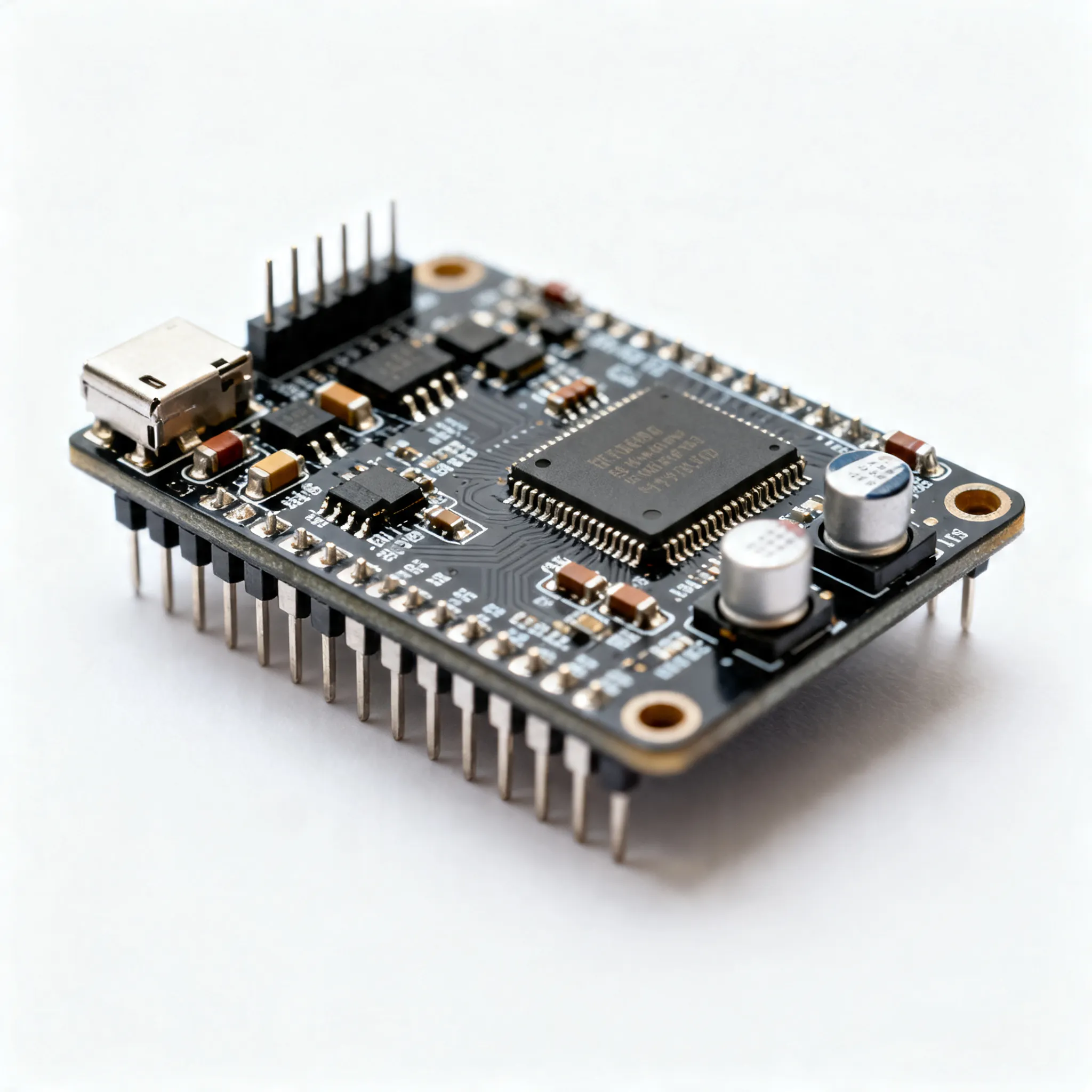
You can rely on pcb assembly services to manage every stage from your design to final assembly. These services handle prototyping, low- and mid-volume production, and even turnkey solutions.
You can rely on pcb assembly services to manage every stage from your design to final assembly. These services handle prototyping, low- and mid-volume production, and even turnkey solutions. Many leading providers offer online quoting and expert support, giving you quick answers and guidance. Thanks to advances in the Asia Pacific region, companies now deliver quick-turn PCB manufacturing in as little as 24 hours, even for complex boards. This rapid turnaround helps you keep projects on schedule and meet demanding deadlines.
Key Takeaways
-
PCB assembly services handle your project from design to final product, saving you time and reducing errors with full-service solutions.
-
Rapid prototyping and fast turnaround times, sometimes as quick as 24 hours, help you test ideas and meet tight deadlines.
-
Thorough design reviews and advanced testing improve quality, reduce costs, and catch issues early to keep your project on track.
-
Custom assembly services offer flexibility for complex designs, mixed-volume batches, and quick changes to fit your unique needs.
-
Choosing an experienced partner with clear communication ensures faster delivery, higher quality, and smoother project success.
PCB Assembly Services Overview
Full-Service Solutions
You can count on pcb assembly services to cover every stage of your project. These services include prototype pcb assembly, low-volume runs, and mid-volume production. Many providers offer turnkey pcb assembly solutions, so you do not need to manage multiple vendors. You get everything from sourcing components to final assembly in one place. This approach saves you time and reduces errors.
Tip: Full-service providers often offer online quoting tools. You can upload your design files and get instant pricing, which helps you plan your budget and timeline.
The benefits of world-class pcb design and assembly services go beyond convenience. You also see real savings. For example, startups often save up to 30% on costs by using flexible runs and design-for-manufacturing (DFM) suggestions. Established manufacturers can cut costs by 15% through design tweaks and bulk purchasing. Research institutions working with complex boards may save 20% thanks to expert guidance and advanced testing.
|
Client Type |
Challenge Description |
Solution Highlights |
Cost Savings (%) |
Time Savings |
|---|---|---|---|---|
|
Startup Electronics Co. |
Low-volume, high-quality PCB assembly on tight budget |
DFM suggestions, optimized components, flexible run |
30 |
N/A |
|
Established Manufacturer |
High-volume production cost reduction |
Design tweaks, optimized assembly, bulk purchasing |
15 |
N/A |
|
Research Institution |
Complex multi-layer PCB assembly with strict quality |
Advanced assembly, rigorous testing, expert guidance |
20 |
N/A |
Prototype to Production
You can start with prototype pcb assembly to test your ideas quickly. Providers help you move from a single prototype to larger production runs without changing partners. This seamless transition means you keep your project on track. You also get fast turnaround times, sometimes as quick as 24 hours for prototypes.
Remember, fabrication creates the bare board, while assembly places and solders the components. Top pcb assembly services handle both steps or work with trusted partners to ensure quality. You get a finished product that meets your needs, whether you need one board or thousands.
Process Steps
Design Review
You start your journey from design to final assembly with a thorough design review. This step checks your schematics, layout, and bill of materials for errors or inefficiencies. A strong review process helps you catch issues before production begins. Industry benchmarks show that companies using structured design reviews can reduce PCB production cycle time by over 30%. You also see a 90% yield rate and a 15% drop in production costs. These improvements come from tracking key metrics like defect rates and yield rates. Regular reviews and real-time analytics help you keep your project on track and competitive. Companies like Hewlett-Packard have used these methods to close performance gaps and improve quality.
Note: A detailed design review not only prevents costly mistakes but also ensures your board meets industry standards and customer expectations.
Prototyping
You move to prototype pcb assembly after your design passes review. This stage lets you test your ideas quickly and make changes before full production. Many pcb assembly services offer rapid prototyping with lead times as short as 24 to 48 hours. You benefit from dedicated prototype lines, flexible tooling, and on-demand manufacturing. Providers often stock common materials and reserve factory capacity for quick-turn orders. Automated order processing and prioritized scheduling help you get your prototypes faster than traditional methods.
|
Aspect |
Details |
|---|---|
|
Production Lead Times |
24 hours to 5 days depending on complexity and specifications |
|
Traditional Lead Times |
2-4 weeks |
|
Process Optimizations |
Streamlined workflows, dedicated lines, parallel processing |
|
Quality Control |
Inline inspection, automated optical inspection, SPC |
|
Accelerated Testing |
Reliability feedback within hours or days |
|
Benefits |
Reduced development costs, faster time-to-market, risk reduction |
You can use prototype pcb assembly to validate your design and reduce risk before scaling up.
Production Prep
You prepare for production by finalizing your design and setting up the manufacturing process. This step includes sourcing components, creating stencils, and programming machines. Custom pcb assembly services excel at handling unique requirements, such as high-complexity layouts or specialized components. Providers use advanced tools like laser-cut stainless steel stencils and multi-level stencils with X-Y-Z motion control. These tools help regulate solder paste application and improve coplanarity. Laser Direct Imaging (LDI) technology creates precise circuit patterns, which is critical for complex boards. Automated machines and robots reduce labor costs and improve accuracy, especially for small or mixed-volume batches.
Tip: Custom pcb assembly services can adapt quickly to design changes, ensuring your project stays flexible and efficient.
Assembly
You see your design come to life during the assembly stage. Machines place and solder components onto your board with high precision. Custom pcb assembly services use advanced vision systems and laser technology to align fine-pitch components. Automated machines with cameras inspect placement and reduce errors. Solder Paste Inspection (SPI) systems measure solder volume, area, and shape to prevent defects like bridging or insufficient solder. High-speed laser galvo scanners and extended field of view platforms increase throughput, letting you scale from small batches to larger runs without delays.
-
Automated machines and robots improve accuracy and speed.
-
Vision systems ensure precise alignment for miniaturized components.
-
3D X-ray inspection systems detect hidden defects without slowing production.
Custom pcb assembly services support both standard and specialized assembly needs, making them ideal for projects that require high precision or unique features.
Testing & QA
You reach the final step with testing and quality assurance. Custom pcb assembly services use a range of inspection and testing methods to ensure reliability. Mechanical inspections include visual checks, X-ray, peel tests, and automated optical inspection (AOI). Electrical tests cover continuity, hi-pot, in-circuit, and flying probe testing. Stress tests like vibration, thermal shock, and burn-in simulate real-world conditions. Providers follow IPC standards for qualification and dimensional tolerances.
Quality assurance starts with design validation and continues through every stage. Inline AOI, X-ray, and functional testing catch defects early. Stringent protocols verify component integrity, electrical continuity, and solder joint quality. These steps matter in industries like medical devices and automotive, where reliability is critical. Failure analysis techniques, such as microsectioning and stress simulations, help identify root causes and improve future designs.
Note: Custom pcb assembly services deliver reliable, high-quality boards by combining advanced testing with strict industry standards.
Custom PCB Assembly Services
Tailored Solutions
You face new challenges as technology advances. Devices now require more complex and compact circuit boards. Custom pcb assembly services help you meet these demands. You can rely on these services to handle high-complexity projects, including High-Density Interconnect (HDI), flexible, and multilayer PCBs. You get precise assembly for intricate designs and components that need micron-level accuracy.
-
The PCB assembly market is growing fast. It is expected to reach $21.46 billion by 2032, up from $9.1 billion in 2023.
-
This growth comes from the need for advanced PCBs in many industries.
-
Custom pcb assembly services use advanced software and strict procedures like Surface Mount Technology and Through-Hole Technology.
-
You benefit from quick-turn options for urgent projects and fast prototyping.
-
These services ensure your boards perform well and stay reliable.
You can choose custom pcb assembly services for projects that need special attention. You get support for unique layouts, tight tolerances, and specialized components. Providers offer small batch pcb assembly for prototypes or limited runs. You can test your ideas quickly and move to larger production when ready.
Tip: Custom pcb assembly services give you flexibility and speed. You can adapt to changes and keep your project on track.
Mixed-Volume Batches
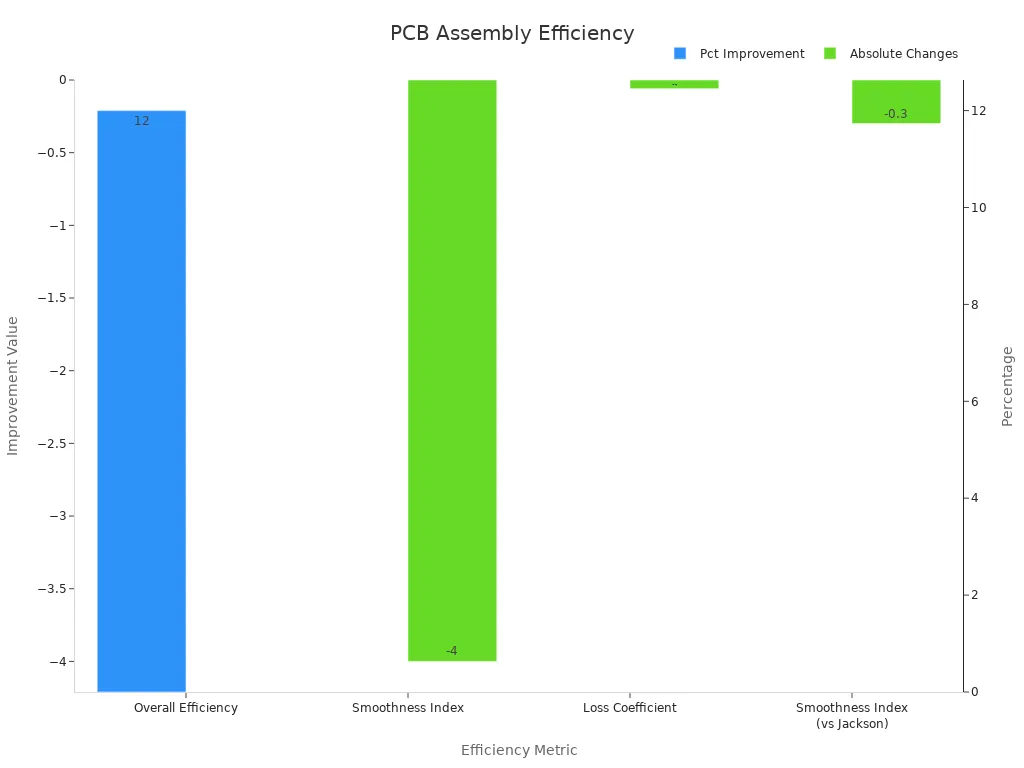
You may need to produce different quantities at different times. Custom pcb assembly services support mixed-volume batches, so you can order what you need, when you need it. This approach works well for startups, research teams, and established companies.
|
Metric |
Numerical Improvement |
Description |
|---|---|---|
|
+12% |
Production efficiency increases with the hybrid model. |
|
|
Smoothness Index |
-4 |
Variability in the assembly line decreases, improving flow. |
|
Loss Coefficient |
-0.06 |
Production losses drop, so you use resources better. |
|
Smoothness Index (vs Jackson's law) |
-0.3 |
Optimization improves compared to a known benchmark. |
You see real benefits from this flexibility. Custom pcb assembly services help you manage both small batch pcb assembly and larger runs without delays. You can scale production up or down as your needs change. Providers use automated systems to keep quality high and costs low. You get reliable boards, fast turnaround, and support for every stage of your project.
Quality & Standards

Industry Compliance
You need to trust that your PCB assembly partner follows strict industry standards. These standards help you get high quality pcbs that work safely and reliably. Leading providers use guidelines from IPC, ISO, and other organizations. You see these standards in every step, from solder paste application to final inspection.
|
Process Step |
Industry Standard(s) |
Numerical Data / Specifications |
|---|---|---|
|
Solder Paste Application |
IPC-J-STD-001 |
|
|
Component Placement |
IPC-A-610, IPC-J-STD-001 |
Placement accuracy: ±0.05 mm; 0201, 0402, 0603 types |
|
Wave Soldering |
IPC-J-STD-001 |
Preheat: 90-150°C; Solder pot: 250-260°C; Speed: 0.8-1.5 m/min |
|
Through-Hole Insertion |
IPC-A-610 |
Lead clinching: 30-45°; Lead extension: 2-3 mm |
|
Quality Assurance |
IPC-A-610 |
Visual criteria for soldering, placement, cleanliness |
|
Process Control |
IPC, SPC methods |
Statistical Process Control (SPC) monitoring |
|
Industry-Specific |
IPC-6012-AT, AS9100 |
Stricter for automotive, aerospace |
|
Environmental Standards |
ISO 14001 |
Environmental management requirements |
|
Standards Update Cycle |
IPC, ISO |
IPC: 5-7 years; ISO: 5 years |
You also benefit from compliance with regulations like RoHS, REACH, and UL 94. Providers keep detailed records, use serial numbers, and offer certificates of compliance. This approach supports traceability and safety for every board you order.
|
Compliance Area |
Key Standards / Regulations |
Compliance Actions / Documentation Practices |
|---|---|---|
|
IPC Standards |
IPC-A-600, IPC-2221, IPC-2581, IPC-7351 |
Visual inspection, design standards, data exchange, surface mount design standards |
|
Industry-Specific |
ISO 13485, IATF 16949, AS9100 |
Stricter documentation, traceability, risk management |
|
Environmental & Safety |
RoHS, REACH, UL 94, CE, FCC |
Material declarations, test reports, certificates, EMC, flammability ratings |
|
Traceability & Documentation |
Serial numbers, barcodes, RFID, CoC, TCF |
Record keeping, change management, test and inspection procedures, post-market audits |
You see this compliance in industries like medical, automotive, and aerospace. Providers also follow NIST 800-171 to protect sensitive data and contracts, which is important for secure and reliable PCB manufacturing.
Inspection Methods
You want your boards to work right the first time. Providers use advanced inspection methods to catch problems early and keep defect rates low. They measure quality with clear metrics.
|
Metric Name |
Description |
|---|---|
|
Percentage of PCBs passing inspection without any adjustments or rework. |
|
|
Defect Rate |
Number of defects found per produced unit. |
|
Mean Time to Failure (MTTF) |
Expected operational lifetime of the PCB before failure. |
|
Rework Rate |
Percentage of PCBs needing adjustments after initial inspection. |
You can track quality with these metrics. Providers classify defects as critical, major, or minor. They use Automated Optical Inspection (AOI), X-ray, and functional tests to find issues like:
-
Solder fillet problems
-
Missing leads
-
Coplanarity issues
-
Bridging
-
Incorrect component orientation
You benefit from these inspections because they improve yield rates and reduce rework costs. This process helps you receive reliable boards that meet your project needs.
Delivery & Support
Fast Shipping
You need your PCBs delivered on time to keep your project moving. Top PCB assembly services offer both standard and rush shipping options. Standard lead times usually range from 2 to 8 weeks. If you need your boards faster, you can choose premium rush orders for even quicker delivery. Providers use strict process controls, such as solder paste inspection and reflow profile optimization, to maintain quality even with tight deadlines. Multi-stage inspections—including Automated Optical Inspection, X-ray, In-Circuit Testing, and Functional Testing—help ensure every board meets your requirements.
You benefit from on-time delivery guarantees and transparent production timelines. Providers track performance using metrics like defects per million opportunities (DPMO), yield, and test pass rate. They also use statistical process control (SPC) and regular process audits to keep quality high. This approach allows you to scale production quickly without sacrificing reliability. When you choose a service with fast shipping, you can trust that your boards will arrive when you need them, ready for the next step in your project.
Tip: Ask your provider about their on-time delivery rate and available rush options. This helps you plan your schedule with confidence.
Ongoing Assistance
You deserve support that continues after your boards ship. Leading PCB assembly services offer ongoing assistance to help you solve problems, answer questions, and keep your project on track. You can measure the effectiveness of this support using several key metrics:
|
Metric Name |
Description |
How to Measure |
Why It Matters |
|---|---|---|---|
|
Rates how well support meets your expectations |
Survey customers after support interactions |
Shows overall satisfaction |
|
|
Customer Effort Score (CES) |
Measures how easy it is to resolve issues |
Ask customers to rate ease of support process |
Reflects how simple support feels |
|
Net Promoter Score (NPS) |
Gauges loyalty and likelihood to recommend |
Ask if customers would recommend the service |
Indicates trust and loyalty |
|
First Reply Time (FRT) |
Tracks how quickly support responds |
Average time to first reply on tickets |
Shows responsiveness |
|
Resolution Time |
Measures how fast issues get solved |
Average time from ticket open to close |
Reflects efficiency |
You can expect fast replies, clear answers, and helpful guidance. Providers aim to resolve your issues quickly, so you can focus on your work. If you need extra help, many offer technical support, troubleshooting, and even design advice. This ongoing assistance ensures your project stays successful from start to finish.
Choosing a Partner
Experience Matters
You want your project to succeed from the start. Choosing a trusted pcb assembly company with proven experience gives you a strong advantage. Experienced providers help you avoid costly mistakes and delays. They spot design and manufacturing issues early, saving you time and money. You benefit from specialized equipment that delivers high-quality soldering and reliable miniaturized components. Turnkey services let you focus on your core business while experts handle sourcing, assembly, testing, and logistics.
-
Early detection and correction of issues prevent expensive errors.
-
Specialized equipment ensures precise assembly for even the smallest parts.
-
A single point of contact simplifies your communication and reduces risks.
-
Comprehensive services streamline production and shorten lead times.
-
Real-time order tracking and expert oversight improve transparency and quality.
-
Turnkey solutions free up your resources and boost productivity.
You see faster turnaround, higher quality, and better financial planning. These factors reduce risk and help your project succeed.
Communication
Clear communication shapes your project’s outcome. You need a partner who values transparency and quick responses. Open channels help you share files, track progress, and solve problems fast. Providers who focus on communication deliver better results and fewer errors.
|
Metric / Statistic |
Description / Benefit |
|---|---|
|
Suppliers deliver on schedule, reducing delays. |
|
|
Yield quality |
Product quality improves with clear documentation. |
|
Engineering response speed |
Fast answers keep your project moving. |
|
Documentation accuracy |
Fewer mistakes and less rework. |
|
Defect rates |
Lowered by open feedback and problem-solving. |
|
First-pass yield |
Higher rates from clear instructions and revision control. |
|
Cost targets |
Controlled by shared goals and alignment. |
|
Responsiveness to ECOs |
Quick changes with formal management and open communication. |
|
Two-way feedback |
Builds trust and supports improvement. |
|
Data sharing |
Enables better planning and faster response. |
|
Mutual trust and alignment |
Strengthens your supply chain and speeds up delivery. |
You build trust by sharing goals and feedback. Regular updates and clear instructions help everyone work together. This approach leads to better products, fewer delays, and a smoother process.
You gain a clear advantage when you choose PCB assembly services that manage your project from start to finish. Turnkey solutions help you save time, cut costs, and boost quality. The table below shows how these services improve key outcomes:
|
Metric |
Outcome / Improvement |
|---|---|
|
Lead Time Reduction |
60% faster |
|
Cost Savings |
23% lower production costs |
|
Defect Rate |
Less than 0.5% |
|
Scalability |
300% more capacity |
|
Time-to-Market |
40% faster launches |
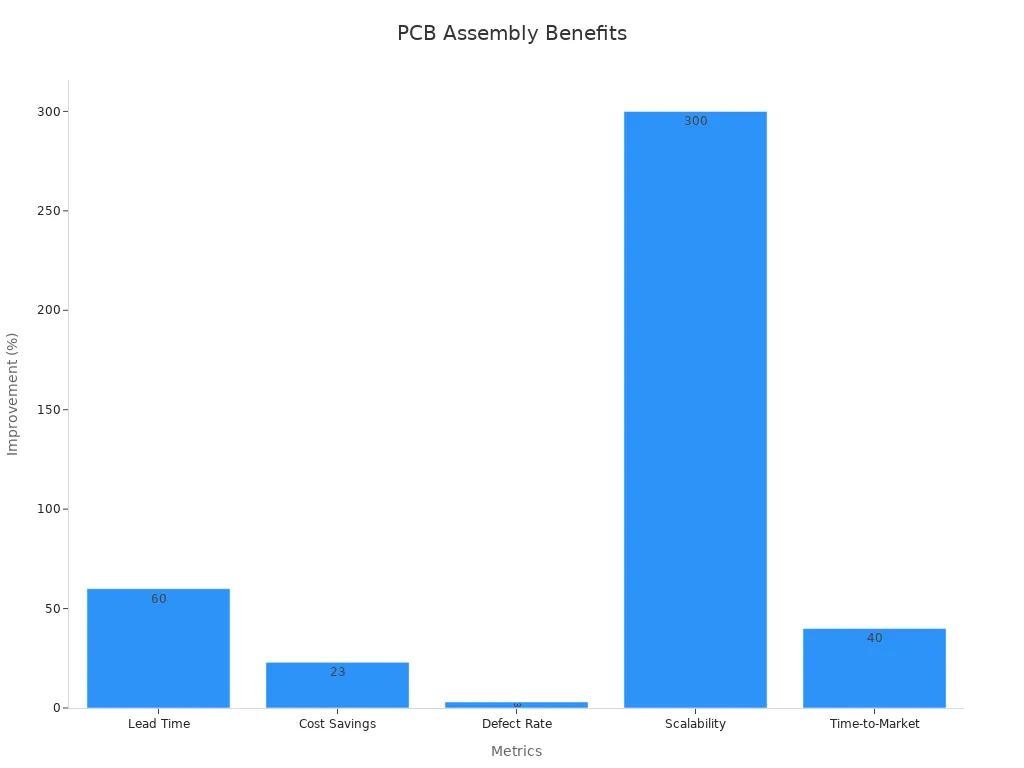
You should always select a partner with proven expertise, fast delivery, and open communication. This choice ensures your next PCB project succeeds from concept to completion.
FAQ
What files do you need for PCB assembly?
You need to provide Gerber files, a Bill of Materials (BOM), and a pick-and-place file. These files help your provider understand your design and place components correctly.
How fast can I get my assembled PCBs?
You can receive prototypes in as little as 24 hours. Standard production usually takes 2 to 8 weeks. Rush options are available if you need boards sooner.
Can you handle special components or unique layouts?
Yes. Providers support custom parts, odd shapes, and complex layouts. You can request special handling for sensitive or high-value components.
What quality checks do you perform?
Providers use Automated Optical Inspection (AOI), X-ray, and functional tests. These checks catch defects early and ensure your boards meet industry standards.