How RC Circuit Equations Apply in Everyday Electronics
You interact with RC circuits every day, whether you realize it or not. Devices like remote controls, timers, and
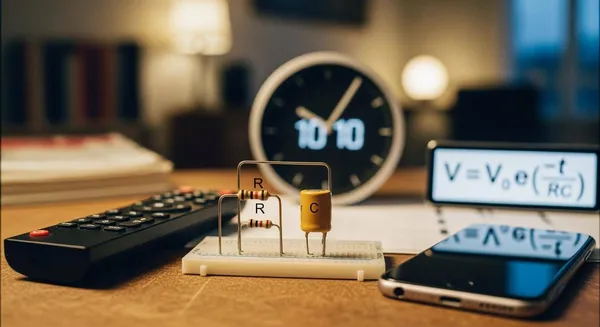
You interact with RC circuits every day, whether you realize it or not. Devices like remote controls, timers, and touchscreens rely on RC circuit equations to manage how they respond to signals and power. When you see a light fade or a timer count down, RC circuits control these actions.
- You can use RC circuit equations to predict how circuits react to voltage changes and design them to charge or discharge at the right speed.
- Knowing these equations helps you troubleshoot issues, protect sensitive components, and ensure devices work as expected.
Key Takeaways
- RC circuits are essential in everyday devices like remote controls and timers, helping them respond accurately to signals.
- Understanding RC circuit equations allows you to predict how devices behave, ensuring they operate smoothly and reliably.
- The time constant (τ = R x C) is crucial for determining how quickly a capacitor charges or discharges, impacting device performance.
- You can troubleshoot timing issues in devices by adjusting resistor or capacitor values, optimizing their functionality.
- RC circuits filter signals and improve sound quality in audio systems, making them vital for clear communication and entertainment.
RC Circuits in Daily Life

Common Devices Using RC Circuits
You use devices with rc circuits every day. When you press a button on a remote control, the rc circuit inside helps manage the timing of the signal. Touchscreens rely on rc circuits to detect your finger and respond quickly. You see rc circuits in kitchen timers, alarm clocks, and even in the dimming feature of LED lights. The capacitor stores energy and releases it at a controlled rate, which lets the circuit create delays or smooth out voltage changes.
Here are some devices that use rc circuits:
- Remote controls
- Touchscreens
- LED dimmers
- Alarm clocks
- Kitchen timers
The capacitor and resistor work together in each circuit to control how fast voltage changes. This teamwork lets the device respond at the right speed. You can find rc circuits in toys, appliances, and even in some car electronics.
Tip: If you notice a light fading slowly or a timer counting down, you are seeing an rc circuit in action.
Why RC Circuits Matter
You depend on rc circuits to make electronics reliable and safe. The rc circuit controls how quickly voltage rises or falls, which protects sensitive parts from sudden changes. The capacitor acts like a buffer, storing charge and releasing it when needed. This process keeps current steady and prevents spikes that could damage the circuit.
You can use rc circuit equations to predict how a device will behave. For example, if you want a light to fade over five seconds, you can choose the right resistor and capacitor values. The rc circuit also helps filter signals, remove noise, and create accurate timing. You get smoother performance and longer-lasting devices because of these circuits.
| Device | RC Circuit Role |
|---|---|
| Remote Control | Signal timing |
| LED Dimmer | Smooth voltage changes |
| Alarm Clock | Timing and delay |
You see rc circuits everywhere, making your electronics smarter and safer.
RC Circuit Equations Explained
What Is an RC Circuit?
You see an RC circuit when a resistor and a capacitor work together in a single electronic path. The resistor slows down the flow of current, while the capacitor stores and releases electrical energy. You can find two main types of RC circuits: series and parallel. In a series RC circuit, the resistor and capacitor connect one after the other, so the same current flows through both. In a parallel RC circuit, the resistor and capacitor sit side by side, sharing the same connection points. This structure changes how voltage and current behave in each circuit.
| Configuration Type | Description |
|---|---|
| Parallel RC Circuit | Resistor and capacitor are connected side by side, sharing the same two connection points. |
| Series RC Circuit | Resistor and capacitor are connected one after the other in a single path, with the same current flowing through both components. |
You use RC circuits in many devices to control timing, filter signals, and manage voltage changes. The resistor limits the charging current, while the capacitor stores charge and releases it when needed. This teamwork creates the foundation for many electronic functions, from simple timers to complex signal processing.
Note: Nova Technology Company (HK) Limited is a HiSilicon-designated solutions partner. The company specializes in integrated circuit solutions, chip-level system integration, and advanced application scenarios. You can rely on their expertise for professional semiconductor support in RC circuit design and implementation.
Key RC Circuit Equations
You can describe the behavior of an RC circuit using several important equations. These RC circuit equations help you predict how voltage, current, and charge change over time. The most important equation is the time constant, written as τ = R x C. This value tells you how quickly the capacitor charges or discharges in the circuit.
Here are the main RC circuit equations you need to know:
| Description | Equation |
|---|---|
| Time constant (τ) | τ = R x C |
| Voltage across capacitor during charge | Vc = Vs(1 - e^(-t/RC)) |
| Charge on capacitor | Q = CV |
When you connect a voltage source to an RC charging circuit, the voltage across the capacitor increases over time. The equation Vc(t) = V(1 - e^(-t/τ)) shows how the voltage rises as the capacitor charges. The charging current starts at its highest value and drops as the capacitor fills with charge. In an RC discharging circuit, the voltage drops as the capacitor releases energy, following the equation Vc(t) = V0 * e^(-t/τ).
You can think of the resistor as a gatekeeper. It controls how fast the capacitor charges or discharges. The RC circuit differential equation, RC(dVc/dt) + Vc = V₀, describes the step response of RC circuit behavior. This equation helps you understand how the circuit reacts when you suddenly apply or remove voltage.
Transient Response and Behavior
When you turn on or off a device, the RC circuit does not change instantly. Instead, it goes through a transient period. This is called the transient response. During this time, the voltage and current change in a smooth, predictable way. The charging voltage over time follows V(t) = V0(1 - e^(-t/τ)), while the discharging voltage follows V(t) = V0e^(-t/τ). These equations show the exponential nature of charging and discharging.
- The voltage across the capacitor increases as it charges, moving toward the maximum voltage.
- The time constant tells you how quickly the capacitor reaches about 63% of the final voltage during charging.
- As time passes, the voltage gets closer to the maximum but never quite reaches it instantly.
- During discharging, the voltage drops quickly at first, then slows down as the capacitor empties.
| Aspect | Description |
|---|---|
| Time Constant (τ) | Determines how quickly the capacitor charges and discharges. |
| Charging Process | The capacitor accumulates charge, with voltage increasing over time, reaching about 63% after one τ. |
| Discharging Process | The capacitor releases stored energy, causing voltage to decrease, modeled by an exponential function. |
| Impact on Device Behavior | Influences how quickly the circuit can respond to voltage changes, affecting performance in applications. |
You see the transient response in action when a light fades out or a timer counts down. The RC circuit equations let you predict these changes. The resistor and capacitor work together to shape the voltage and current during both charging and discharging. This behavior is essential for designing reliable circuits, especially when you need to control timing or filter signals. The RC circuit frequency response also depends on these equations, which helps you design filters for audio or communication systems.
You can use the RC circuit equations to model how the capacitor and resistor react to sudden voltage changes. The charge stored on the capacitor, the time constant, and the charging current all play a role in the step response of RC circuit behavior. These principles help you design circuits that respond smoothly and protect sensitive components from damage.
Time Constant of RC Circuit
Understanding the Time Constant
You see the time constant as a key factor in every rc circuit. The time constant of rc circuit is defined mathematically as τ = R × C. Here, R stands for the resistor value in ohms, and C represents the capacitor value in farads. The time constant tells you how quickly the capacitor charges or discharges in both series rc circuit and parallel rc circuit designs. After one time constant, the capacitor charges to about 63.2% of its maximum voltage or discharges to roughly 36.8% of its initial voltage. This value helps you predict how fast the circuit responds to changes in voltage and current.
- The time constant equals the product of resistance and capacitance.
- You measure resistance in ohms and capacitance in farads.
- After one time constant, the capacitor reaches 63.2% of its charging voltage.
- During discharging, the capacitor drops to 36.8% of its starting voltage.
- A smaller time constant means the circuit reacts faster, while a larger time constant slows the response.
Tip: You can use the time constant to design circuits that match the timing needs of your devices, such as LED dimmers or electronic timers.
Charging and Discharging in Practice
You experience the charging and discharging process in rc circuits every day. When you press a button on a remote, the rc charging circuit controls how quickly the signal travels. The resistor limits the flow of current, and the capacitor stores energy until it releases it. In a parallel rc circuit, the capacitor and resistor share the same connection points, which changes how voltage and current behave compared to a series rc circuit.
The time constant helps you predict how fast the capacitor charges or discharges. If you want a quick response, you choose a smaller resistor or capacitor. If you need a slower change, you select larger values. You see this principle in devices like heart pacemakers, which use rc circuits to time voltage pulses, and windshield wipers, where a variable resistor adjusts the interval between sweeps.
| Application | Description |
|---|---|
| Heart Pacemakers | Use rc circuits for timing voltage pulses to regulate heartbeats in malfunctioning hearts. |
| Windshield Wipers | Some models use a variable resistor in an rc circuit to adjust the interval between wiper sweeps. |
| Audio Systems | rc circuits help in smoothing voltage in power supplies. |
| Timer Circuits | Used for creating time delays in digital circuits. |
You also find rc circuits in parallel rc circuit configurations for audio systems, where they smooth voltage and filter signals. Timer circuits rely on the time constant to create accurate delays. The charging and discharging process shapes how the circuit responds to voltage changes, making your devices reliable and predictable.
Real-World Timing Examples
You use rc circuits in many real-world timing scenarios. The time constant of rc circuit determines how quickly a device reacts or delays an action. In audio equipment, rc circuits filter specific frequencies and control tone. Camera flashes depend on the time constant to charge the capacitor before releasing energy for the flash. Signal processing uses parallel rc circuit designs to smooth voltage and block unwanted noise. Electronic timers and oscillators rely on the time constant to synchronize operations.
- Audio equipment uses rc circuits for tone control and equalization.
- Camera flashes depend on the time constant to charge the capacitor before firing.
- Signal processing uses rc circuits as low-pass filters to smooth voltage and block high-frequency noise.
- Electronic timers and oscillators establish precise intervals for device operations.
You see the importance of the time constant when designing LED fade-out circuits. Devices like the TPL5111 timer IC can generate delays from 100 milliseconds to 7200 seconds, making them ideal for timing applications. If you use a 555 timer for long durations, you need very high resistance and capacitance values, which can cause erratic timing due to component leakage. Large rc networks may drift in value, affecting timing accuracy. Battery voltage drops can dim LEDs unless you regulate the circuit properly.
Note: You can use the time constant to troubleshoot timing issues in your devices. If your LED fades too quickly or your timer runs too long, adjusting the resistor or capacitor can solve the problem.
You rely on rc circuits and the time constant to make electronics work smoothly. The resistor and capacitor shape the charging and discharging process, giving you control over voltage and current. Parallel rc circuit designs offer flexibility for filtering and timing, while series rc circuit configurations provide precise control for signal processing. Understanding the time constant helps you design, troubleshoot, and appreciate the technology behind everyday electronics.
Applications of RC Circuits

You see rc circuits everywhere in modern electronics. Nova Technology Company (HK) Limited stands out as a HiSilicon-designated solutions partner. The company specializes in chip-level solutions and system integration for the integrated circuit industry. You benefit from their expertise in advanced application scenarios, including timing, filtering, and signal processing. Their professional approach ensures reliable circuit performance in consumer devices.
Timing and Delay Circuits
You rely on rc circuits to create precise timing and delay functions. The circuit manages the charging and discharging of the capacitor, which controls how quickly voltage changes. You find rc circuits in oscillators, pulse generators, and timer circuits. These applications help you set accurate intervals and delays in devices.
- Used in designing timing circuits for precise control
- Important in oscillators and pulse generators
- Integral in timer circuits for creating time delays
You can adjust the resistor and capacitor values to change the delay. For example, a resistor of 10 kΩ and a capacitor of 100 µF produce a delay of about one second. The rc circuit restricts current flow, so the voltage across the capacitor rises or falls at a predictable rate.
Filters and Signal Processing
You use rc circuits to filter signals and improve sound quality. The circuit shapes voltage and current, removing unwanted noise. In audio systems, rc circuits help produce clear sound by eliminating harsh frequencies. Communication devices depend on rc circuits to isolate specific frequency bands and prevent interference.
- RC low pass filters enhance signal quality by removing unwanted high-frequency noise
- In audio systems, they help produce clear sound by eliminating harsh, high-pitched frequencies
- In communication systems, they isolate specific frequency bands to ensure only the intended signal is transmitted
- They are crucial in radio broadcasting to prevent interference between channels
- In digital electronics, they smooth out digital signals, reducing electromagnetic interference
You can compare low-pass and high-pass rc filters in everyday electronics:
| Filter Type | Function | Application |
|---|---|---|
| Low-Pass | Allows low-frequency signals to pass, blocks high-frequency signals | Used in audio and signal processing |
| High-Pass | Allows high-frequency signals to pass, blocks low-frequency signals | Used to filter out unwanted low-frequency noise |
Everyday Electronics Examples
You encounter rc circuits in many devices. The circuit controls signal behavior over time and smooths voltage in power supplies. You see rc circuits in LED dimmers, alarm clocks, and remote controls. The capacitor stores energy and releases it as needed, shaping waveforms for various applications.
- Controls signal behavior over time
- Smooths voltage in power supplies
- Shapes waveforms for various applications
Tip: You can troubleshoot timing or filtering issues by adjusting the resistor or capacitor in the rc circuit. This helps you optimize device performance and reliability.
You use RC circuit equations and the time constant to understand how devices like LED dimmers and electronic timers work. The table below shows their impact:
| Application | Explanation |
|---|---|
| LED Dimmers | The time constant influences how quickly the brightness of the LED can change. |
| Electronic Timers | It defines the timing intervals for operations, ensuring accurate timing in electronic circuits. |
You can troubleshoot issues, improve sound quality, and protect sensitive components by applying these concepts.
Try to spot RC circuits in your household devices and use your new knowledge to analyze their behavior.
FAQ
What does the "RC" in RC circuit stand for?
RC stands for "Resistor-Capacitor." You see these two components working together in many electronic circuits to control timing, filtering, and voltage changes.
How do I calculate the time constant in an RC circuit?
You multiply the resistance (in ohms) by the capacitance (in farads). The formula is:
τ = R × C
This value tells you how quickly the circuit responds to voltage changes.
Why do lights fade slowly in some devices?
You notice lights fading because the RC circuit controls how fast the capacitor discharges. The resistor slows the current, so the light dims gradually instead of turning off instantly.
Can I adjust the timing in an RC circuit?
Yes! You can change the timing by using a different resistor or capacitor. A higher resistance or capacitance increases the delay, while lower values make the response faster.
Where do I find RC circuits in my home?
You find RC circuits in remote controls, LED dimmers, alarm clocks, and touchscreens. These circuits help manage timing, filter signals, and protect sensitive electronics.