IGBT vs MOSFET: Key Considerations for Your Next Electronics Project
Expert guide on IGBT vs MOSFET: Key Considerations for Your Next Electronics Project. Technical specs, applications, sourcing tips for engineers and buyers.
Introduction
In the rapidly evolving world of electronics engineering, selecting the right power semiconductor device for your project is crucial. Two of the most commonly used components in power electronics are the Insulated Gate Bipolar Transistor (IGBT) and the Metal-Oxide-Semiconductor Field-Effect Transistor (MOSFET). Both have their unique characteristics, advantages, and limitations. Understanding these differences is essential for optimizing performance, efficiency, and cost-effectiveness in your designs. As the semiconductor industry continues to grow, with a projected revenue of $595.2 billion by 2026, making informed component choices is more critical than ever.
Technical Overview
IGBTs and MOSFETs are both semiconductor devices used to switch and amplify electronic signals. An IGBT combines the characteristics of a MOSFET and a bipolar transistor, providing high efficiency and fast switching. It is ideal for high-voltage applications exceeding 600 volts. Conversely, a MOSFET is known for its fast switching speed and low on-state resistance, making it suitable for low to medium voltage applications. The choice between IGBT and MOSFET depends on the specific requirements of your application, such as voltage, current, switching frequency, and thermal management.
Detailed Specifications
Electrical Specifications
| Parameter | IGBT | MOSFET | Units | Notes |
|---|---|---|---|---|
| Voltage Rating | 600V - 1200V | 100V - 600V | Volts | Higher voltage applications prefer IGBTs |
| Current Rating | 10A - 1000A | 1A - 300A | Amperes | IGBTs handle higher currents |
| Switching Frequency | Up to 50 kHz | Up to 1 MHz | Hertz | MOSFETs are better for high-frequency applications |
| On-State Voltage Drop | 2V - 3V | 0.1V - 0.5V | Volts | MOSFETs have lower on-state voltage drop |
| Gate Charge | 100nC - 500nC | 10nC - 100nC | NanoCoulombs | MOSFETs have lower gate charge |
| Input Capacitance | 1nF - 5nF | 100pF - 1nF | Farads | Lower in MOSFETs |
| RDS(on) | 10mΩ - 200mΩ | 1mΩ - 100mΩ | Ohms | MOSFETs offer lower RDS(on) |
| Reverse Recovery Time | 50ns - 200ns | 10ns - 50ns | Nanoseconds | MOSFETs have faster recovery times |
| Maximum Junction Temperature | 150°C | 175°C | Degrees Celsius | MOSFETs can handle higher temperatures |
Thermal & Mechanical Specifications
| Parameter | IGBT | MOSFET | Units | Notes |
|---|---|---|---|---|
| Thermal Resistance, Junction-to-Case | 0.1°C/W - 0.5°C/W | 0.1°C/W - 0.3°C/W | °C/Watt | Lower in MOSFETs |
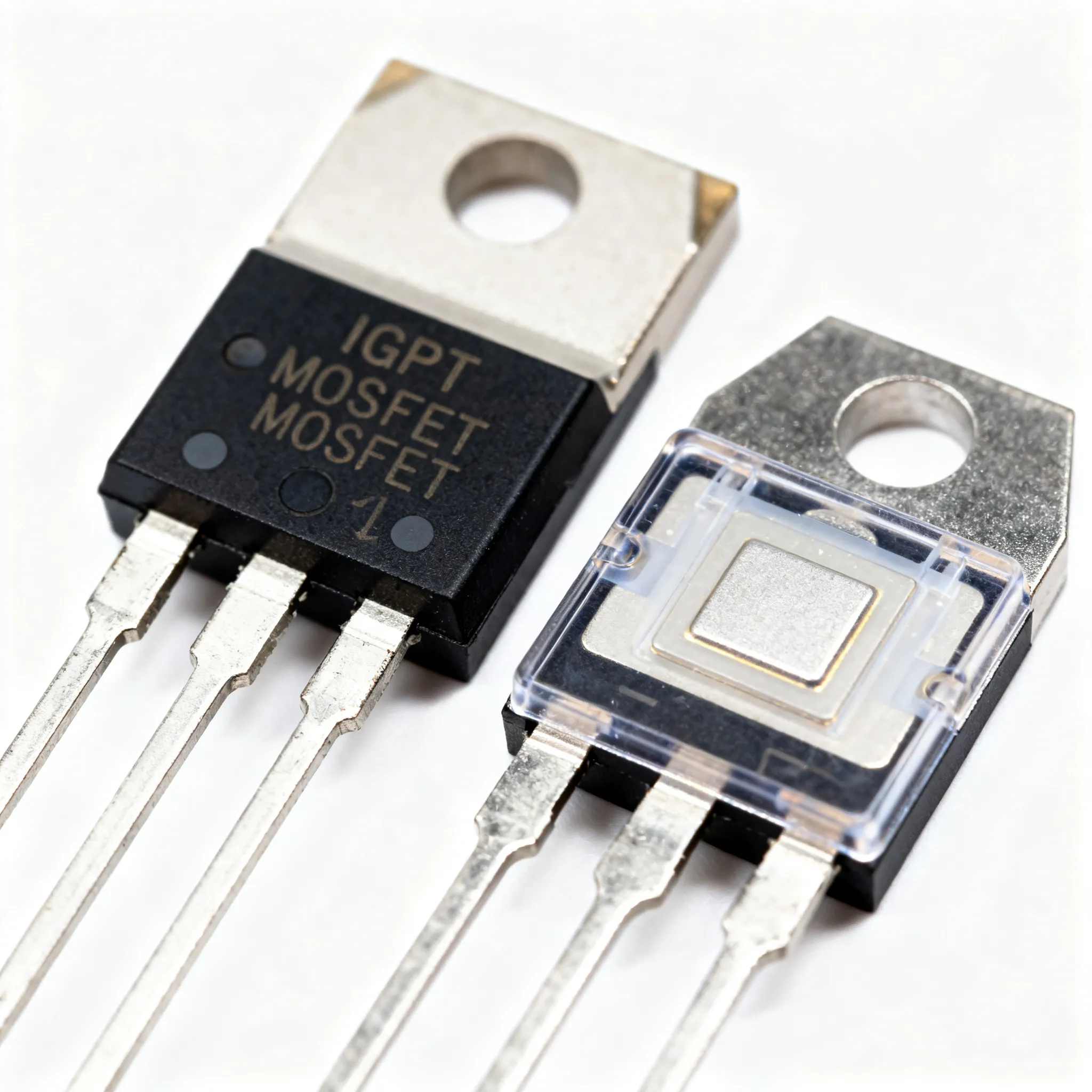
| Package Type | TO-247, TO-264 | TO-220, TO-247 | - | Varies by manufacturer |
| Die Size | Larger | Smaller | - | MOSFETs have smaller die sizes |
| Weight | 5g - 10g | 2g - 5g | Grams | IGBTs are heavier |
| Mounting Type | Through-hole | Surface-mount, Through-hole | - | MOSFETs offer more mounting options |
| Thermal Conductivity | 1.5 W/mK | 2.0 W/mK | Watts/meter-Kelvin | Better in MOSFETs |
| Cooling Requirements | High | Moderate | - | IGBTs require more robust cooling |
Application Comparison
| Application | IGBT | MOSFET | Notes |
|---|---|---|---|
| Inverters | Preferred | Used | IGBTs are more efficient in high-power inverters |
| Motor Drives | Preferred | Used | IGBTs handle higher voltage and current |
| Switch Mode Power Supplies | Used | Preferred | MOSFETs are better for high-frequency SMPS |
| Lighting Systems | Used | Preferred | MOSFETs are commonly used due to fast switching |
| Welding Equipment | Preferred | Used | IGBTs are robust for high-current applications |
Design Considerations
When choosing between IGBT and MOSFET for your project, several design considerations should be taken into account. Firstly, consider the voltage and current requirements of your application. IGBTs are better suited for high-voltage, high-current applications such as motor drives and inverters, while MOSFETs excel in low to medium voltage applications like switch mode power supplies and lighting systems. Another critical aspect is the switching frequency. MOSFETs are ideal for high-frequency applications due to their fast switching capabilities, whereas IGBTs are more efficient at lower frequencies.
Thermal management is another important consideration. IGBTs typically have higher thermal resistance and require more robust cooling solutions compared to MOSFETs. Therefore, if your design is sensitive to thermal constraints, MOSFETs might be a better choice. Additionally, consider the size and weight of the components. MOSFETs generally have smaller die sizes and are lighter, which can be advantageous in compact designs.
Finally, evaluate the cost implications of each component. While IGBTs are generally more expensive than MOSFETs, their higher efficiency in specific applications may justify the cost. Similarly, the availability and sourcing of components should be considered, as some specialized IGBTs may have longer lead times compared to widely available MOSFETs.
Step-by-Step Guide
- Define Application Requirements: Determine the voltage, current, and switching frequency requirements of your application. This will help you decide whether an IGBT or MOSFET is more suitable.
- Analyze Thermal Constraints: Evaluate the thermal performance of the components. Consider the thermal resistance and cooling requirements for your design.
- Examine Switching Speed Needs: If your application requires high-frequency switching, a MOSFET may be more appropriate due to its fast switching capabilities.
- Cost Evaluation: Compare the cost of IGBTs and MOSFETs. Consider not only the initial purchase price but also the long-term efficiency and reliability of each component.
- Component Sourcing: Use a reliable distributor like IC Online to source components. Ensure the availability and lead times align with your project schedule.
- Prototype and Test: Build a prototype using the selected component. Perform thorough testing to validate performance under expected operating conditions.
- Iterate and Optimize: Based on testing results, make any necessary adjustments to your design. This may involve changing component values or improving thermal management.
- Finalize Design: Once optimized, finalize your design for production. Ensure all documentation, including schematics and bill of materials, is complete and accurate.
Common Issues & Solutions
- Overheating: Ensure adequate cooling and thermal management. Use heat sinks and thermal interface materials to dissipate heat effectively.
- Switching Losses: Optimize gate drive circuits to minimize switching losses. Consider using faster gate drivers for MOSFETs.
- Component Availability: Plan for potential supply chain disruptions by selecting components with multiple sourcing options.
- Parasitic Inductance: Minimize parasitic inductance in PCB layout by using short, wide traces and proper grounding techniques.
- EMI Issues: Implement proper filtering and shielding techniques to reduce electromagnetic interference in your design.
- Reliability Concerns: Perform stress testing and ensure components are rated for the expected environmental conditions.
Applications & Use Cases
IGBTs are widely used in high-power industrial applications such as motor drives, inverters, and welding equipment due to their ability to handle high voltages and currents efficiently. For instance, in electric vehicle inverters, IGBTs are preferred for their robustness and efficiency. On the other hand, MOSFETs are commonly used in consumer electronics, switch mode power supplies, and lighting systems. Their fast switching speed and low on-state resistance make them ideal for applications requiring high-frequency operation and energy efficiency.
Selection & Sourcing Guide
When selecting and sourcing IGBTs or MOSFETs for your project, it is crucial to use reliable distributors to ensure component quality and availability. IC Online provides a comprehensive selection of electronic components, including IGBTs and MOSFETs, with competitive pricing and fast delivery options. Their extensive database and search tools can help you find the right component for your needs.
FAQ
- What is the main difference between IGBT and MOSFET? IGBTs are better suited for high-voltage, high-current applications, while MOSFETs excel in low to medium voltage applications with high switching frequencies.
- Which component is more efficient for high-frequency applications? MOSFETs are more efficient for high-frequency applications due to their fast switching capabilities.
- How do I choose between IGBT and MOSFET for my project? Consider the voltage, current, and switching frequency requirements of your application, as well as thermal management and cost considerations.
- Can MOSFETs handle high currents? While MOSFETs can handle high currents, IGBTs are generally more robust for very high-current applications.
- What is the role of gate charge in component selection? Gate charge affects the switching speed and power consumption of the device. Lower gate charge is preferable for faster switching.
- Are IGBTs more expensive than MOSFETs? Generally, IGBTs are more expensive, but their efficiency in certain applications may justify the cost.
- What are common applications for IGBTs? IGBTs are commonly used in motor drives, inverters, and welding equipment.
- What are common applications for MOSFETs? MOSFETs are widely used in switch mode power supplies, lighting systems, and consumer electronics.
- How can I minimize EMI in my design? Implement proper filtering, shielding, and grounding techniques to reduce electromagnetic interference.
- Where can I source reliable IGBTs and MOSFETs? Use authorized distributors like IC Online to ensure component quality and availability.
Conclusion
Selecting the appropriate power semiconductor device is crucial for the success of your electronics project. Understanding the key differences and specifications of IGBTs and MOSFETs will help you make informed decisions that optimize performance, efficiency, and cost. By carefully considering your application's requirements and leveraging reliable sourcing options, you can ensure the success of your designs in an ever-evolving industry.