Exploring RC Time Constant Circuits in Everyday Technology
RC time constant circuit controls timing and signal filtering in electronics, ensuring reliable operation in devices like clocks and audio systems.
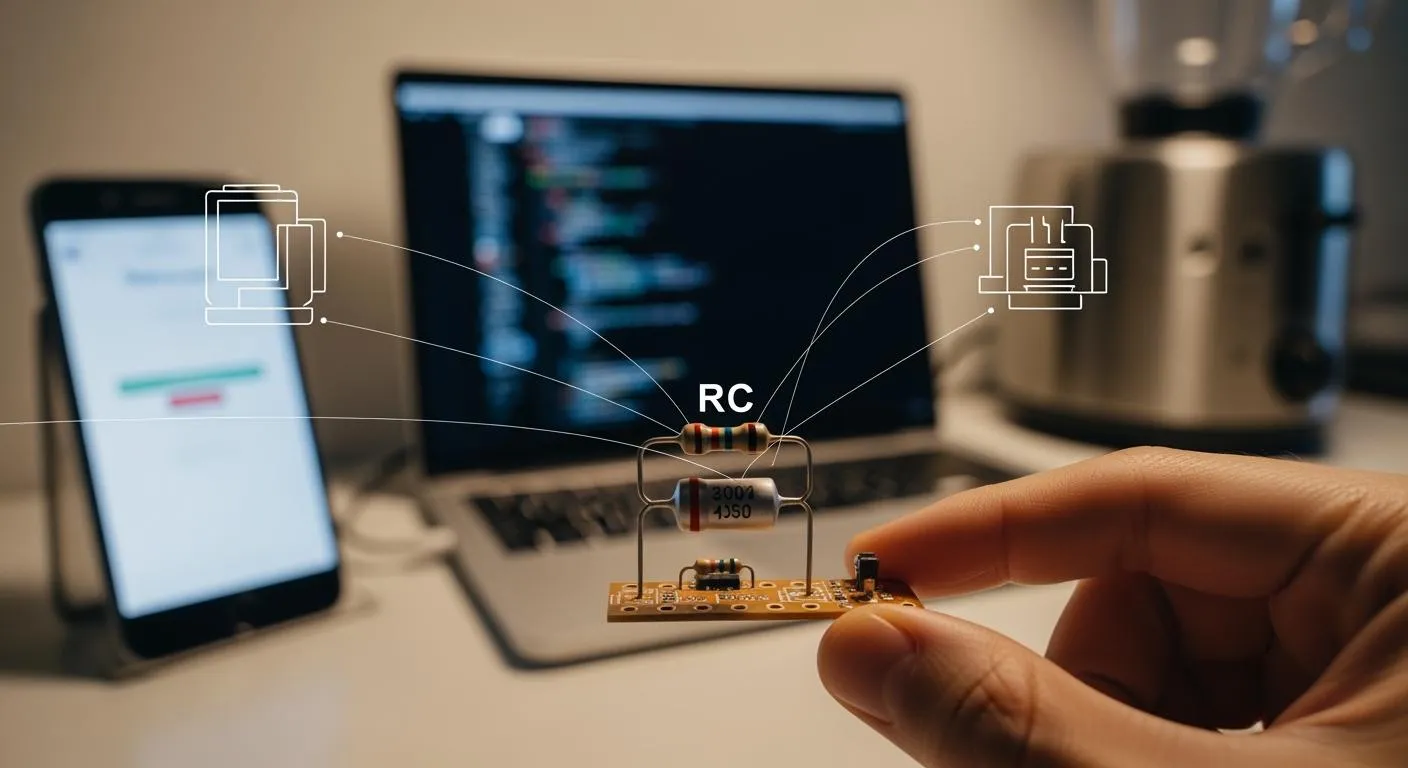
Imagine you set your alarm clock before bed, expecting it to wake you up on time. Even if the power flickers during the night, your clock often keeps accurate time. This reliability comes from clever electronic design. Many household gadgets depend on precise timing to work well. The rc time constant circuit plays a hidden but vital role in these devices.
- In alarm clocks, RC oscillators help keep time during power outages.
- These circuits act as backup timekeepers, so your clock does not reset when power returns.
- While timing may become less accurate, the device continues to function.
You can think of an RC circuit like a leaky bucket: it fills and empties at a predictable rate, which helps electronics measure and control time.
Key Takeaways
- RC time constant circuits are essential for precise timing in everyday devices like alarm clocks and remote controls.
- The time constant, calculated as τ = R × C, determines how quickly a capacitor charges or discharges, influencing circuit behavior.
- Adjusting resistance or capacitance allows you to control the timing and response of RC circuits, making them versatile for various applications.
- RC circuits are used in filters to manage signal quality, allowing specific frequencies to pass while blocking unwanted noise.
- Understanding the RC time constant helps you design better electronic devices and improve their performance in real-world applications.
What Is an RC Time Constant Circuit?
RC Time Constant Definition
You encounter the rc time constant circuit in many electronic devices. This circuit combines a resistor (R) and a capacitor (C) to control how quickly electrical signals change. The rc time constant circuit helps you manage timing, filtering, and signal shaping in electronics.
To understand the rc time constant, look at its formal definition from electrical engineering textbooks:
| Term | Definition |
|---|---|
| RC Time Constant | A measure of the time it takes for a capacitor to charge or discharge through a resistor. |
| Symbol | τ (tau) |
| Calculation | τ = R × C (where R is resistance in ohms and C is capacitance in farads) |
| Significance | Indicates how quickly or slowly a capacitor charges or discharges, affecting circuit behavior. |
| Applications | Timing circuits, signal filtering, wave-shaping circuits, analog-to-digital converter input conditioning. |
When you use an rc time constant circuit, you set the pace for how fast a capacitor fills up or empties. This timing is crucial for many functions, such as creating delays, smoothing signals, or shaping waves in audio and communication systems. The rc time constant circuit acts as the heartbeat for these processes.
Formula and Physical Meaning
You calculate the rc time constant using the formula:
τ = R × C
Here, τ (tau) stands for the rc time constant. R is the resistance in ohms, and C is the capacitance in farads. This formula tells you how long it takes for the voltage across the capacitor to change significantly after a sudden voltage is applied.
The rc time constant circuit follows a predictable pattern. When you apply a voltage, the capacitor does not charge instantly. Instead, it charges in a curve, rising quickly at first and then slowing down. The rc time constant marks the point where the voltage across the capacitor reaches about 63.2% of its final value. This behavior comes from the natural exponential growth of voltage in the circuit.
Note: The rc time constant circuit uses this 63.2% point as a reference for timing. After one rc time constant, the capacitor has covered 63.2% of the gap to its final voltage. This makes the rc time constant circuit very useful for precise timing and control.
- The rc time constant circuit represents the time it takes for a capacitor to charge to 63.2% of its maximum voltage.
- This percentage comes from the exponential nature of the charging curve.
- After one rc time constant, the capacitor has closed 63.2% of the remaining gap to its final voltage.
- This predictable point is essential for timing applications in electronics.
You can see the rc time constant circuit at work in many devices. For example, when you press a button on a remote control, the rc time constant circuit helps filter out noise and ensures the signal is clean. In audio equipment, the rc time constant circuit shapes the sound by controlling which frequencies pass through.
The rc time constant circuit gives you a simple yet powerful way to manage time and signals in electronics. By adjusting the resistor or capacitor, you can change how fast the circuit responds. This flexibility makes the rc time constant circuit a key building block in modern technology.
How RC Circuits Work

Charging and Discharging Behavior
You see RC circuits in action every time you use devices that rely on timing circuits. The process of charging and discharging in these circuits follows a predictable pattern. When you connect a voltage source, the capacitor starts charging through the resistor. The voltage across the capacitor rises quickly at first, then slows down as it approaches its maximum value. This gradual change is not linear; it follows an exponential curve.
Think of the capacitor as a toilet tank. When you flush, the tank drains quickly, but refilling takes time. The size of the water pipe represents the resistor. A smaller pipe means the tank fills more slowly. In an RC circuit, the resistor controls how fast the capacitor charges, just like the pipe controls the tank's refill rate.
The time constant of a circuit, represented by τ, determines how fast this charging happens. After one time constant, the capacitor reaches about 63.2% of its final voltage. If you let the circuit run for five time constants, the capacitor becomes almost fully charged, reaching over 99% of its maximum voltage. During discharging, the voltage drops to about 36.8% of its initial value after one time constant. This behavior makes RC circuits ideal for timing circuits, as you can predict how long it takes for the voltage to change.
Here is a comparison between RC and RL circuits:
- In an RC circuit, the capacitor charges and discharges through the resistor, causing an exponential voltage change.
- In an RL circuit, the inductor resists changes in current, leading to exponential current buildup and decay.
- The time constant of a circuit is τ = RC for RC circuits and τ = L/R for RL circuits.
You can see these differences in how each circuit responds to changes. RC circuits manage voltage changes, while RL circuits control current changes.
The typical time scales for charging and discharging in consumer electronics are shown below:
| Process | Percentage of Voltage Reached | Time Scale (τ) |
|---|---|---|
| Charging | 63.2% | 1τ |
| Discharging | 36.8% | 1τ |
| Fully Charged | >99% | 5τ |
You use the time constant of a circuit to set the pace for electronic events. This makes RC circuits essential in devices that need precise timing.
Time Constant in Action
You experience the effects of the time constant of a circuit every time you use a timer or delay function in electronics. The time constant determines how quickly a capacitor charges or discharges, which directly affects the response time of timing circuits. When you press a button on a timer, the circuit enters a transient state. The capacitor voltage changes rapidly at first, then slows as it approaches a steady state. After about five time constants, the voltage stabilizes, and the circuit completes its timing function.
- The time constant of a circuit is calculated as τ = R × C.
- It measures the time it takes for a capacitor to charge or discharge through a resistor.
- After one time constant, the capacitor charges to about 63.2% of its final value or discharges to about 36.8%.
- After five time constants, the capacitor is considered fully charged or discharged (over 99%).
- This behavior defines the speed of voltage change in the circuit, directly influencing the response time of timing circuits.
You can use RC circuits to create delays, filter signals, or shape waveforms. The predictable charging and discharging process allows you to design circuits that respond at just the right moment. This reliability is why RC circuits are so common in timing circuits found in everyday technology.
Note: The time constant of a circuit gives you control over how fast or slow electronic events happen. By adjusting the resistor or capacitor, you can fine-tune the timing to match your needs.
You see RC circuits in alarm clocks, remote controls, and audio devices. These circuits help manage timing, filter unwanted signals, and ensure smooth operation. The charging process in RC circuits makes them perfect for applications where precise timing matters.
Applications of RC Time Constant Circuits

You encounter the time constant in many practical applications. The rc circuit forms the backbone of timing, filtering, and signal-shaping functions in electronics. You can see its influence in everything from simple delay circuits to complex communication systems. Let’s explore how the time constant shapes these applications.
Timers and Delays
You rely on the time constant when you need precise timing in electronic devices. The rc circuit sets the pace for timers and delay circuits. Engineers use the time constant to control how long a signal stays high or low. This control is essential in monostable multivibrators, relaxation oscillators, and general timing circuits.
| Application Type | Description |
|---|---|
| Monostable Multivibrators | The time constant sets the duration of output pulses for accurate timing. |
| Relaxation Oscillators | It determines oscillation periods, creating stable timing signals. |
| General Timing Circuits | Used to create precise delays and timing functions in electronics. |
- The time constant is crucial in timing circuits, such as oscillators and timers.
- You use it to create precise time delays in electronic devices, relays, and control systems.
- The time constant determines how quickly a circuit responds, which is vital for reliable operation in industrial automation.
You can trust the time constant to remain stable, even if the voltage changes. This stability ensures your timing circuits work reliably in many environments.
Filters and Frequency Response
You use the rc circuit to shape signals in audio and communication devices. The time constant defines how the circuit responds to different frequencies. You can build several types of filters with rc circuits:
- Low-pass filter: Lets low frequencies through, blocks high frequencies. You use it to smooth sensor data.
- High-pass filter: Allows high frequencies, blocks low ones. You use it for AC coupling.
- Band-pass filter: Passes a specific frequency range. You use it to tune radios.
- Notch filter: Removes a narrow frequency band. You use it to eliminate power line interference.
The cutoff frequency of these filters depends on the time constant. You calculate it with:
f_c = 1 / (2πRC)
You find rc circuits in analog design, where they help manage signal integrity and shape frequency responses. The time constant limits how fast signals can change, which affects the clarity and quality of audio and communication signals.
Everyday Device Examples
You see the time constant at work in many everyday applications. Alarm clocks, remote controls, and audio equipment all use rc circuits to manage timing and filter signals. In battery-powered devices, the time constant helps circuits reach equilibrium quickly, saving energy and extending battery life.
You also find the time constant in industrial automation. Here, engineers use the five time constants rule to ensure capacitors charge or discharge fully, reaching over 99% completion. This practice guarantees reliable timing in automated systems.
Nova Technology Company (HK) Limited, a HiSilicon-designated solutions partner, specializes in chip-level solutions and system integration. You benefit from their expertise in designing rc circuit-based applications for smart devices, industrial control, and communication systems. Their solutions ensure optimal performance and reliability in real-world scenarios.
You should remember that the time constant has some limitations. Rc circuits struggle with very high frequencies and can introduce phase shifts. Capacitors may react to temperature and voltage changes, which can affect performance. Despite these challenges, the time constant remains a key factor in the design of many electronic applications.
Factors Affecting the Time Constant of an RC Circuit
Resistance and Capacitance Impact
You control the time constant in resistive-capacitive networks by adjusting either the resistance or the capacitance. When you increase the resistance, the time constant grows larger. This means the capacitor charges and discharges more slowly. If you decrease the resistance, the time constant becomes smaller, so the capacitor charges and discharges faster. The same principle applies to capacitance. A higher capacitance value makes the charging time longer because the capacitor can store more charge. Lower capacitance leads to a shorter charging time.
You see these effects in practical applications like high-pass filters and signal processing circuits. For example, if you want a high-pass filter to block low frequencies more effectively, you might reduce the capacitance or resistance to lower the time constant. In signal processing, you often adjust these values to fine-tune how quickly a circuit responds to changes in input signals.
Tip: Always double-check your component values. Misreading resistance or capacitance can lead to incorrect time constants and poor circuit performance.
Real-World Considerations
You must consider several real-world factors when designing RC circuits for practical applications. Temperature changes can affect both resistance and capacitance, causing the time constant to drift. Aging components, especially electrolytic capacitors, may lose their original values over time. Humidity can also impact the performance of resistors and capacitors.
Common mistakes in designing RC circuits include:
- Misreading component values, which leads to inaccurate time constants.
- Neglecting unit conversions, especially for capacitance (microfarads vs. picofarads).
- Overlooking how the circuit configuration changes the effective resistance or capacitance.
- Assuming the time constant stays the same under all conditions.
- Believing the capacitor charges instantly or linearly, instead of following an exponential curve.
- Ignoring the role of resistance in determining how the circuit responds.
You can avoid these errors by carefully checking your calculations and understanding how each component affects the time constant. In signal processing and high-pass filters, even small mistakes can cause big problems in performance. Always test your circuit under different conditions to ensure reliable operation in all practical applications.
Calculating the T RC Time Constant
Step-by-Step Calculation
You can calculate the t rc time constant for any circuit by following a clear process. This method helps you design circuits that meet your timing needs. Here is a simple way to find the t rc time constant:
- Decide how many time constants you need. For example, if you want the voltage across a capacitor to reach 99% of its final value, you need about five time constants.
- Calculate the required time constant tau. Divide your desired total time by the number of time constants. For instance, if you want the circuit to reach the target in 10 seconds, tau equals 10 seconds divided by 5, which is 2 seconds.
- Select a capacitor value. Choose a capacitor that fits your circuit’s needs and is easy to find.
- Calculate the resistor value. Use the formula tau = R × C. Rearrange it to find R = tau / C. Plug in your chosen capacitor and the calculated tau to get the resistor.
- Verify your design. Build the circuit and use a wave generator to apply a voltage. Connect an oscilloscope to observe the voltage across a capacitor. Measure the actual time it takes to reach your target voltage. Compare this with your calculated t rc time constant.
Tip: Always measure the actual resistor and capacitor values before finalizing your design. Real components can vary from their labeled values.
Common Pitfalls
You may encounter several common errors when calculating the t rc time constant:
- Capacitance in ceramic capacitors can drop if the voltage is too high.
- Stray capacitance on circuit boards can add extra capacitance, especially with small capacitors.
- High-value resistors can absorb moisture, which changes their resistance.
- Oscilloscope probes can affect the t rc time constant in high-impedance circuits.
- Electrolytic capacitors may drift in value over time or with temperature.
- Ignoring resistor or capacitor tolerances can cause your timing to be off. For example, a resistor with ±5% and a capacitor with ±20% tolerance can make the actual t rc time constant much different from your calculation.
Note: Always check the tolerances of your resistor and capacitor. This helps you predict the range of possible t rc time constant values and ensures your circuit works as expected.
You have seen how RC time constant circuits shape the way modern electronics handle signals, filter noise, and create precise timing. Understanding the time constant helps you predict how quickly a circuit stabilizes after changes and design better filters and timers. You can try simple experiments with a resistor, capacitor, and LED to see the exponential charging and discharging in real time. If you want to explore electronics, start by building and observing RC circuits. This hands-on approach will help you master the exponential timing that powers everyday technology.
FAQ
What is an rc circuit and why do you see it in electronics?
You use an rc circuit to control how fast voltage changes. You find rc circuits in devices that need timing and delay applications, such as delay timers and signal filtering systems.
How does an rc circuit help with timing and delay applications?
You set the timing in electronic devices by adjusting the resistor and capacitor in an rc circuit. This lets you create delay timers for alarms, lights, and other gadgets.
Why do you use rc circuits for signal filtering?
You use rc circuits to remove unwanted noise from signals. This process is called signal filtering. You improve audio quality and communication reliability with rc circuits.
What is a low-pass filter and how does it use an rc circuit?
You build a low-pass filter with an rc circuit. This filter lets low frequencies pass and blocks high frequencies. You use it in audio equipment and sensor systems.
How do rc circuits support filtering and signal conditioning?
You rely on rc circuits for filtering and signal conditioning. These circuits help you shape signals, remove interference, and prepare data for processing in electronic devices.