BOM Upload and RFQ Packaging Tactics to Reduce PPV and Sourcing Costs for OEM EMS Buyers
BOM and RFQ best practices for electronic component procurement. Upload your BOM or request a quote for mixed lines and flexible MOQ.
Why Siloed BOMs Trigger Re-Quote Cycles and Drive Up PPV
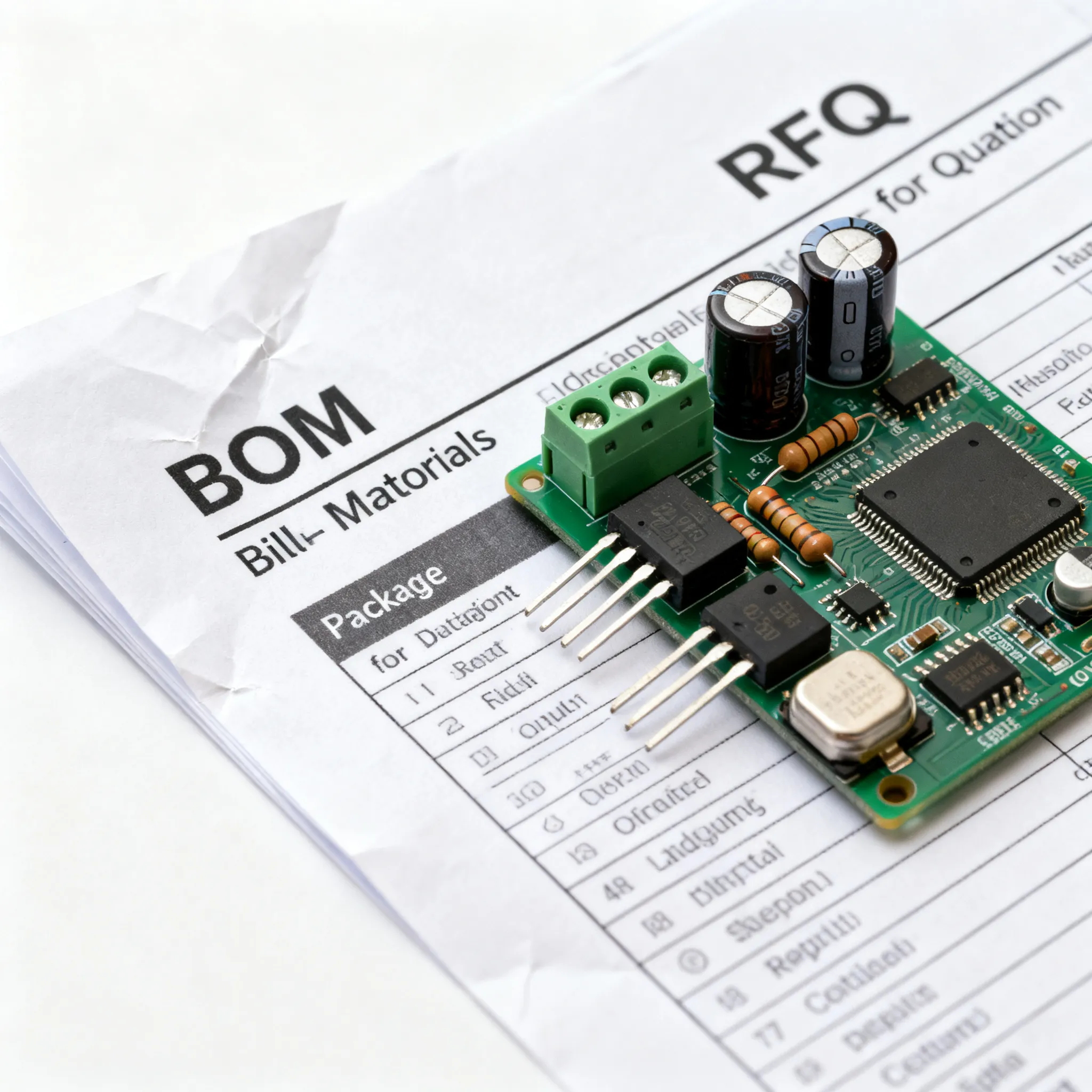
Most procurement teams learn this lesson the hard way: a single line item with stale data can invalidate an entire supplier quote. Consider the real-world scenario documented by Elisaindustriq's RFQ process analysis — one capacitor tied to an outdated specification and a resistor missing its revision number went unnoticed during quoting. Every supplier responded to incorrect data. When engineering released the updated specs, the entire RFQ cycle had to run again, erasing weeks of work and inflating purchase price variance (PPV) across the board. The damage compounds quickly. Re-quoting doesn't just burn time; it signals to suppliers that your BOM data is unreliable, which can harden pricing and reduce negotiation leverage in subsequent rounds.
This is not an isolated failure mode. In a separate walkthrough from Elisaindustriq's electronic component procurement guide, a buyer received a 300-line production BOM that needed cleaning before any supplier could quote it accurately. Lines lacked clear MPNs. Package designations were inconsistent. Some items listed only internal part numbers with no manufacturer cross-reference. The BOM entered CalcuQuote, where each line was enriched with correct MPNs, packages, and commercial data, then RFQs went out to approved sources. The difference between the raw BOM and the cleaned version was the difference between sourcing chaos and a structured, trackable procurement cycle.
For OEM and EMS buyers managing hundreds or thousands of line items, these scenarios are daily threats. PPV — the gap between the planned or standard cost and the actual purchase price — is not simply a negotiation metric. It is a direct reflection of how well your BOM data holds together before it ever touches a supplier's desk. When BOMs remain siloed in engineering tools, decoupled from procurement reality, every design revision, lifecycle change, or part-number discrepancy becomes a future cost overrun waiting to surface.
Key takeaway: PPV doesn't start at the quote. It starts at the BOM. Every missing field, stale revision, or uncrossed manufacturer name multiplies across suppliers and time, turning what should be a competitive sourcing event into a recurring fire drill.
The Anatomy of a Procurement-Ready BOM: From Engineering Data to Cost-Ready Package
An engineering BOM describes what to build. A procurement-ready BOM describes what to buy — and how to source it competitively. The gap between those two documents is where PPV hides. Closing it requires deliberate transformation: taking the structured but commercially incomplete output of a CAD or PLM system and overlaying the fields that suppliers actually need to return accurate, comparable quotes.
The process starts with the technical core: manufacturer part number (MPN), manufacturer name, package or footprint, and a verified revision or date code. Without an unambiguous MPN, suppliers must interpret — and interpretation variance across three or four sources can produce price spreads of 20% or more on the same functional component. Material specifications matter too. As AuraVMS explains in their technical specifications guide, material composition, grade, and source requirements prevent suppliers from quoting a component that meets the electrical spec but fails in the field due to, for instance, a different plating material or substrate.
From there, the BOM absorbs commercial overlays: target price per unit, unit of measure (each, reel, tray, tube), required delivery window, and any supplier allocation constraints. A line without a delivery window leaves the supplier free to propose a date that suits their inventory profile, not your production schedule. When multiple lines share a common supplier or franchise restriction, noting that in the BOM prevents fragmented quotes that can't be consolidated into a single PO.
Structured data management transforms this from a manual, error-prone exercise into a repeatable workflow. OpenBOM's production-purchasing workflow demonstrates how linking CAD data to a BOM management layer keeps procurement data synchronized with design changes automatically. When the design updates in CAD, the BOM updates downstream without a buyer manually reconciling revision tables. The result is that quotes stay aligned with the current design intent, and re-quote cycles triggered by engineering changes shrink dramatically.
The table below maps the typical transformation from an engineering BOM to a procurement-ready package:
| Engineering BOM Column | Procurement-Ready Equivalent | Commercial Impact If Missing |
|---|---|---|
| Internal part number | Manufacturer MPN + manufacturer name | Suppliers can't cross-reference; quotes vary by interpretation |
| Designator (R1, C5, U3) | Package / footprint (0402, QFN-48, SOIC-8) | Alternate sourcing impossible without package data |
| Schematic value ("10k", "0.1uF") | Full electrical spec (tolerance, voltage rating, temp coefficient) | Substitutions drift from design intent; field failures possible |
| Blank or "TBD" | Target price per unit (or budget range) | No cost guardrail; suppliers anchor high |
| Blank or "stock" | Unit of measure (each, reel, cut tape) | Quantity translation errors; MOQ mismatches |
| Blank | Required delivery window / dock date | Late deliveries accepted without penalty signal |
| Blank | Approved alternate MPNs (if any) | Single-source lock-in; no competitive tension |
| Rev date (often stale) | Verified revision + PCN check status | Quotes based on obsolete specifications |
Beyond the static columns, BOM intelligence tools now actively scan for errors before the RFQ reaches a supplier. CalcuQuote's RFQ overview describes how AI-based validation agents ingest BOMs from CAD, Excel, or PDF, flag missing attributes, check revision consistency, and provide conversational insights across cost and change workflows. The tool doesn't just format the BOM — it interrogates it, surfacing discrepancies that a human reviewer might miss on a 300-line spreadsheet. For procurement teams handling multiple BOMs simultaneously, this pre-quote validation layer is the difference between catching a capacitor tied to an outdated spec during planning versus discovering it after three suppliers have already quoted it incorrectly.
Tip: Before sending any RFQ, run a simple audit: can a supplier understand every line without asking a single clarification question? If the answer is no, expect re-quotes, inflated pricing buffers, or both.
BOM Sourcing Tools Compared: CalcuQuote, ProcureKey, OpenBOM, and Manual Workflows
Buyers who manage BOM sourcing through Excel and email often discover that the time saved by not adopting a platform is lost many times over in re-keying errors, version confusion, and invisible PPV drift. The tools available today do more than automate RFQ sending — they structure the data, flag high-risk lines, track landed costs, and create an auditable trail from quote to PO. But they approach the problem from different angles, and selecting the right one depends on whether your primary pain point is BOM cleaning, supplier collaboration, or data synchronization with engineering.
The comparison table below evaluates four approaches that buyers commonly encounter, drawing from documented capabilities and real-world procurement workflows:
| Comparison Metric | CalcuQuote | ProcureKey | OpenBOM | Manual Excel / Email |
|---|---|---|---|---|
| BOM ingestion & cleaning | AI-assisted MPN identification and attribute enrichment; cleans BOMs from CAD, Excel, or PDF ¹ | Structured BOM conversion with commercial field overlays (UOM, target price, delivery requirement) ² | CAD-integrated; BOM updates automatically when design changes ³ | Manual cross-referencing; no automated validation; high error rate on large BOMs |
| Risk flagging (EOL, allocation, long lead times) | Automated flagging of lines with long lead times for alternates and split sourcing | Real-time visibility and risk scoring within sourcing dashboard | Not native; relies on user-defined attributes and manual review | Depends entirely on buyer experience and supplier PCN monitoring |
| RFQ packaging & dispatch | Structured RFQs to approved sources; collects responses in one place | Supplier collaboration portal with structured RFQ packaging | RFQ generation from synchronized BOM data; less advanced than dedicated procurement tools | Cut-and-paste BOM lines into emails; version control is manual and error-prone |
| Landed cost & PPV tracking | Quote-to-buy handoff with PPV tracking per line ⁴ | Built-in cost visibility and comparison across supplier responses | Limited; focuses on data management rather than procurement analytics | Requires separate spreadsheet; easy to lose tracking when quotes are updated |
| ERP integration | API connectors to push validated BOM and quote data into ERP purchasing modules | Native integrations for structured sourcing data handoff | Export-focused; less native ERP connectivity | Manual re-entry; introduces data entry errors and delays |
| Best fit | EMS and OEM teams sourcing medium-to-large BOMs with repeatable buying cycles | Procurement teams needing structured supplier collaboration and real-time visibility | Engineering-led organizations where BOM accuracy starts in CAD and must stay synchronized | Very low-volume prototyping where BOMs are small and supplier relationships are informal |
Footnotes:
¹ Electronic Component Procurement Guide for Real Buyers 2026 — Elisaindustriq
² BOM Sourcing Made Simple — ProcureKey
³ RFQ Process & Purchasing Efficiency Guide — OpenBOM
⁴ OEM Procurement Strategy — Elisaindustriq
One additional consideration comes from Vigorcomp's smart sourcing strategy, which emphasizes that buyers should flag high-risk lines — allocation-sensitive ICs, EOL parts, and components with unstable availability — before quoting so those items receive earlier sourcing attention than standard catalog parts. This risk-first approach reduces the likelihood that a BOM gets quoted competitively on 95% of lines while the remaining 5% of allocation-constrained parts erase the savings. Tools that automate this flagging step bake that discipline into the workflow rather than leaving it to buyer memory.
Five RFQ Packaging Tactics That Shrink PPV and Prevent Sourcing Fire Drills
PPV reduction is not a negotiation tactic. It's a data-quality discipline that starts before the first supplier sees your BOM. The following five tactics, drawn from documented procurement workflows and real-world sourcing cycles, shift the effort upstream — where the cost of fixing errors is measured in minutes, not in premium-priced rush orders.
Tactic 1: Clean and enrich BOM data before the first RFQ. Add or verify MPN, manufacturer name, package, and revision for every line. A BOM that contains internal part numbers, outdated specs, or blank manufacturer fields forces suppliers to interpret — and interpretation variance creates price spreads that have nothing to do with market conditions. Use a validation tool or a structured data platform to catch the missing attributes, then enrich. This single step eliminates the most common source of re-quote cycles, as demonstrated by the capacitor-resistor example from Elisaindustriq's RFQ walkthrough where one undetected error erased an entire round of supplier quotes.
Tactic 2: Flag high-risk lines before quoting. Mark every line that carries EOL risk, allocation constraints, or supply volatility. These lines should not be treated identically to standard catalog passives. As Vigorcomp's procurement strategy recommends, high-risk components need earlier sourcing attention — sometimes before the full BOM RFQ goes out. Identifying these lines early lets you confirm allocation-backed lead time with the supplier, explore alternates, and avoid a situation where 98% of the BOM is competitively quoted but the remaining 2% carries a 300% cost premium because it was addressed too late.
Tactic 3: Structure the RFQ with exact MPNs, target prices, and delivery windows. A vague RFQ invites vague quotes — and the buffers suppliers build into vague quotes always work against the buyer. Send each line with an unambiguous MPN. Include a target price or budget range to anchor negotiations. Specify a required delivery window or dock date so suppliers know you're tracking schedule adherence, not just unit cost. All three elements transform the RFQ from a price discovery exercise into a competitive sourcing event with clear success criteria.
Tactic 4: Use split sourcing and qualified alternates to contain PPV without losing leverage. Qualify alternate parts or approved second sources during the RFQ phase, not after a shortage hits. When suppliers know you have a viable alternative — even if you plan to allocate 70-30 or 80-20 across primary and secondary sources — their pricing discipline improves. The key is to compare total landed cost (unit price plus freight, duties, and any requalification cost) rather than chasing the lowest unit price on each line. Split sourcing creates competitive tension without the operational chaos of an unqualified alternate forced into production under duress.
Tactic 5: Treat procurement as a repeatable routine. Clean the BOM. Maintain approved supplier lists and pre-qualified alternates. Compare total landed cost across responses, then confirm allocation-backed lead times against the production build date before releasing the PO. Track delivery checkpoints and PPV at the line level. Elisaindustriq's OEM procurement strategy frames this as a continuous cycle, not a one-time fix — and organizations that build this muscle memory see PPV stabilize even as component markets fluctuate. Won quote data should flow directly into purchasing, reducing manual re-entry and enabling real-time variance tracking.
The table below summarizes when to use each tactic and the trade-offs involved:
| Tactic | When to Use | Primary Trade-Off |
|---|---|---|
| 1. Clean & enrich BOM data | Before the first internal design review; ideally during prototype-to-production handoff | Upfront time investment of 2–4 hours per BOM; returns 10x in avoided re-quotes |
| 2. Flag high-risk lines early | During BOM enrichment, before any supplier sees the RFQ | May require earlier supplier engagement on sensitive parts, reducing surprise leverage |
| 3. Structure RFQ with MPN, target price, delivery window | Every RFQ regardless of volume or project phase | Target prices must be realistic; anchoring too low can deter qualified suppliers |
| 4. Split sourcing & qualified alternates | Production volumes with recurring demand; allocation-sensitive ICs | Requires engineering qualification effort upfront; may fragment volume pricing tiers |
| 5. Repeatable procurement routine | Ongoing — build into weekly/monthly sourcing cadence | Demands process discipline; initial setup of approved vendor lists and PPV dashboards |
BOM-RFQ Tactics for PPV Control: Senior Buyers' Most Pressing Questions
Procurement leads and engineering managers navigating BOM uploads and RFQ packaging face a consistent set of challenges that sit at the intersection of data quality, supplier dynamics, and cost control. The following questions reflect recurring themes from real sourcing cycles, together with answers grounded in documented workflows and procurement best practices.
Q: How early should I clean a BOM to prevent re-quotes during engineering changes?
Clean and convert the BOM to a procurement-ready format before the first internal design review — not after engineering has locked the revision. If you wait until engineering changes propagate, you invite invalid quotes. Every missing MPN, internal part number without a manufacturer cross-reference, or outdated specification creates a vector for re-quote cycles. As shown in Elisaindustriq's RFQ process walkthrough, a single capacitor tied to an outdated spec forced a complete re-quote across all suppliers. The cost of upstream cleaning is minutes per line; the cost of downstream re-quoting is days or weeks and a measurable PPV increase. Make BOM cleaning a gate, not an afterthought.
Q: What's the best way to flag EOL or allocation-risk components before sending an RFQ?
Apply a risk flagging step during BOM enrichment: mark components with known EOL notices, parts from manufacturers operating under allocation, and any line where supply has been volatile in recent quarters. Use supplier intelligence tools, review distributor PCN (Product Change Notification) feeds, and consult franchise distribution partners who see allocation patterns earlier than the open market. Vigorcomp's smart sourcing approach recommends doing this before quoting so that high-risk lines receive earlier and more focused sourcing attention than standard catalog parts. Once flagged, these lines should route into a separate sourcing track — not buried in a 300-line BOM where they will surface only when a supplier responds with "no stock" or a 52-week lead time.
Q: Can split sourcing really lower PPV without sacrificing volume pricing?
Yes — when executed deliberately, not reactively. By qualifying alternate parts and approved second sources during the RFQ phase, you create competitive tension that disciplines pricing on the primary source. You can allocate percentage splits (70-30, 80-20) across suppliers while still negotiating volume tier pricing with each. The mechanism works because neither supplier assumes they have the full order locked in, which sharpens their quoting behavior. The critical discipline is comparing total landed cost — unit price plus freight, duties, requalification testing, and any line-down risk premium — rather than chasing the lowest headline unit price. Track PPV per line, not just at the aggregate BOM level, so you can see whether the split strategy is compressing or widening variance over successive buying cycles. Confirm allocation-backed lead times against your build date before locking in the split percentages.
Q: How do I decide between an open and a closed RFQ for prototype vs. production runs?
For prototype quantities where speed and reliability dominate the decision, a closed RFQ to a tight circle of trusted, pre-vetted suppliers generally produces faster, more predictable responses. These suppliers understand your quality expectations, your approved manufacturer list, and your need for quick-turn delivery without the overhead of qualifying new sources for a 10-piece build. For production volumes where cost leverage matters more, an open RFQ — distributed to a broader but still pre-qualified list — encourages competitive tension while protecting quality standards. Elisaindustriq's RFQ process analysis details how the sourcing strategy (closed vs. open) directly shapes supplier selection behavior and response quality. A hybrid approach also works: closed RFQ for the high-risk, allocation-sensitive lines that need supplier relationship management, and open RFQ for the commodity passives and connectors where competition is the primary lever.
Q: What KPIs should I track to measure the success of my RFQ packaging approach?
Track five metrics consistently, at the line level and aggregated across BOMs:
- Quote-to-purchase cycle time — how many days from RFQ issuance to PO placement. Lengthening cycles often indicate BOM data gaps that trigger supplier questions and re-quotes.
- RFQ response rate — what percentage of lines receive at least one viable quote. Low response rates on specific lines point to data quality issues or unrealistic target prices.
- First-pass quote accuracy — how many lines require no re-quoting after the initial supplier response. This metric directly reflects BOM cleanliness and RFQ packaging quality.
- PPV per line and aggregate — the variance between planned cost and actual purchase price, tracked over successive buying cycles. A narrowing PPV trend validates that your packaging and sourcing tactics are working.
- On-time delivery adherence — whether confirmed delivery dates hold. Late deliveries on lines that weren't flagged for risk during BOM enrichment indicate a gap in your risk assessment process.
Q: How does AI BOM intelligence integrate with existing ERP systems?
Modern platforms like CalcuQuote and ProcureKey offer APIs or native connectors that push validated BOM lines and supplier quotes into ERP purchasing modules — bypassing the manual re-entry step that has historically been the single largest source of data-entry errors in procurement workflows. AI agents ingest BOMs from CAD, Excel, or PDF exports, parse MPNs, flag inconsistencies and missing attributes, suggest alternates where single-source risk is detected, and then feed structured, validated data into the ERP. The ERP doesn't need to be replaced; it becomes the system of record fed by a clean, verified data pipeline. The result is real-time PPV tracking — since every quote and PO line is mapped back to the original BOM line — and a dramatic reduction in the manual reconciliation that buyers in Excel-driven workflows spend hours performing each week.
References & Further Reading
- RFQ Process: What Happens After a BOM Hits Your Inbox — Elisaindustriq
- Electronic Component Procurement Guide for Real Buyers 2026 — Elisaindustriq
- OEM Procurement Strategy: 10 Ways to Organize Supply Chains — Elisaindustriq
- RFQ Process & BOM Management for EMS Providers — CalcuQuote
- BOM Sourcing Made Simple — ProcureKey
- RFQ Process & Purchasing Efficiency Guide — OpenBOM
- Smart Strategies for Efficient Electronic Component Procurement 2026 — Vigorcomp
- How to Write Technical Specifications for RFQ Documents — AuraVMS
PPV reduction is a data-quality discipline, not a one-time negotiation event. Every hour invested in cleaning a BOM before it reaches a supplier pays back across multiple quoting cycles, fewer re-quotes, tighter cost control, and stronger supplier relationships. The tools exist to automate the validation and packaging steps. The tactics outlined above are field-tested across OEM and EMS procurement teams managing BOMs from prototype to high-volume production. What remains is the organizational commitment to treat the BOM as a sourcing asset — not just an engineering document.
When you're ready to source your next BOM with structured, procurement-ready data and competitive multi-supplier RFQ packaging, upload your BOM to IC-Online for mixed-line quoting with flexible MOQ, or request a quote directly. Confirm allocation-backed lead times, verify current availability, and compare total landed cost across qualified sources — all from a single platform built for electronics procurement.