IGBT vs MOSFET: 2026 Buying Guide and Market Trends for Power Design Engineers
Expert guide on IGBT vs MOSFET: 2026 Buying Guide and Market Trends for Power Design Engineers. Technical specs, applications, sourcing tips for engineers and buyers.
The 2026 Power Semiconductor Squeeze: Why IGBT vs MOSFET Decisions Are Now a Supply Chain Chess Move
If you’re selecting a switching device for your next power stage, you’re no longer just comparing VCE(sat) and RDS(on). In 2026, the IGBT-versus-MOSFET choice has turned into a supply‑chain chess move. Lead times for trench‑field‑stop IGBTs are still hovering at 30 weeks, and allocation is a constant threat, as IC Online’s sourcing blog warns. At the same time, demand from EV traction inverters, AI data‑center power supplies, and renewable energy systems is pulling all three device families—silicon MOSFETs, IGBTs, and SiC MOSFETs—in opposite directions.
The 773 Group’s 2026 outlook makes one thing clear: Infineon’s IGBT capacity expansion at Villach represents the most meaningful near‑term supply addition in that segment, but it won’t erase the queue overnight. For procurement teams, this means the tight market for power semiconductors is a 2026–2028 planning horizon, not a short‑term disruption. Devices that were once single‑sourced during the era of abundant supply now carry unacceptable risk.
The surge in demand isn’t a blip. Utmel’s market analysis shows that the global appetite for MOSFETs and IGBTs has been climbing steeply, driven by new energy applications. Combine that with the fact that the gate‑driver market alone is projected to grow from $3.1 billion in 2026 to $6.41 billion by 2035 (MarkWide Research), and you start to see the ecosystem pressure. Every design decision you make today must factor in not just electrical performance but also the real‑world availability of the part—and of the gate driver that supports it.
Key Takeaway: The 2026 power semiconductor landscape forces you to treat IGBT‑vs‑MOSFET selection as a multi‑variable optimization that includes lead time, second‑source viability, and platform flexibility.
Four Forces Shaping the 2026 IGBT/MOSFET Supply Crisis
| Driver | Mechanism | Procurement Impact |
|---|---|---|
| EV and AI Data Center Ramp | Both 400V and 800V vehicle platforms consume thousands of power devices per unit; AI servers demand high‑efficiency VRM MOSFETs and IGBT‑based UPS modules. | Compressed allocation for popular 650V IGBTs and 80‑100V MOSFETs; long‑term agreements (LTAs) are becoming the norm rather than the exception. |
| Infineon Villach IGBT Expansion | Incremental capacity for trench‑field‑stop IGBTs, but full ramp‑up lags behind orders (773 Group). | Lead times may dip from 30+ weeks to 24–26 weeks by late 2027, but won’t solve the immediate shortage. Buyers must still negotiate allocation. |
| Single‑Source Qualification Trap | Many power designs were qualified on a single IGBT or MOSFET during periods of oversupply. The 773 Group report highlights this as a systemic risk. | Redesign costs and requalification delays are now a line item in sourcing decisions. Second‑source qualification is a must, not a nice‑to‑have. |
| SiC Substitution Pressure | SiC MOSFETs are taking share in high‑frequency, high‑voltage applications, pulling demand away from IGBTs in some segments, but also consuming capacity that could have been used for conventional devices. | Dual‑sourcing SiC and IGBT on the same bill of materials raises complexity. BOM cost and supplier diversification must be balanced. |
| Gate Driver Ecosystem Bottleneck | The gate driver market is growing at 8.4% CAGR (MarkWide Research), but driver ICs for wide‑bandgap devices are often single‑sourced. | You can’t build a power stage if the matching gate driver is on 40‑week allocation. Driver availability should be checked before the power switch is locked in. |
These drivers don’t act in isolation. An engineer who selects a 650V IGBT for a 10 kW motor drive because it’s the cheapest per ampere may find that the part is on allocation while a pin‑compatible SiC module ships in 16 weeks—but at 3× the unit cost. The 2026 playbook is about reading the whole board, not just the datasheet.
Decoding Device Physics: Where IGBTs and MOSFETs Diverge in Voltage, Frequency, and Losses
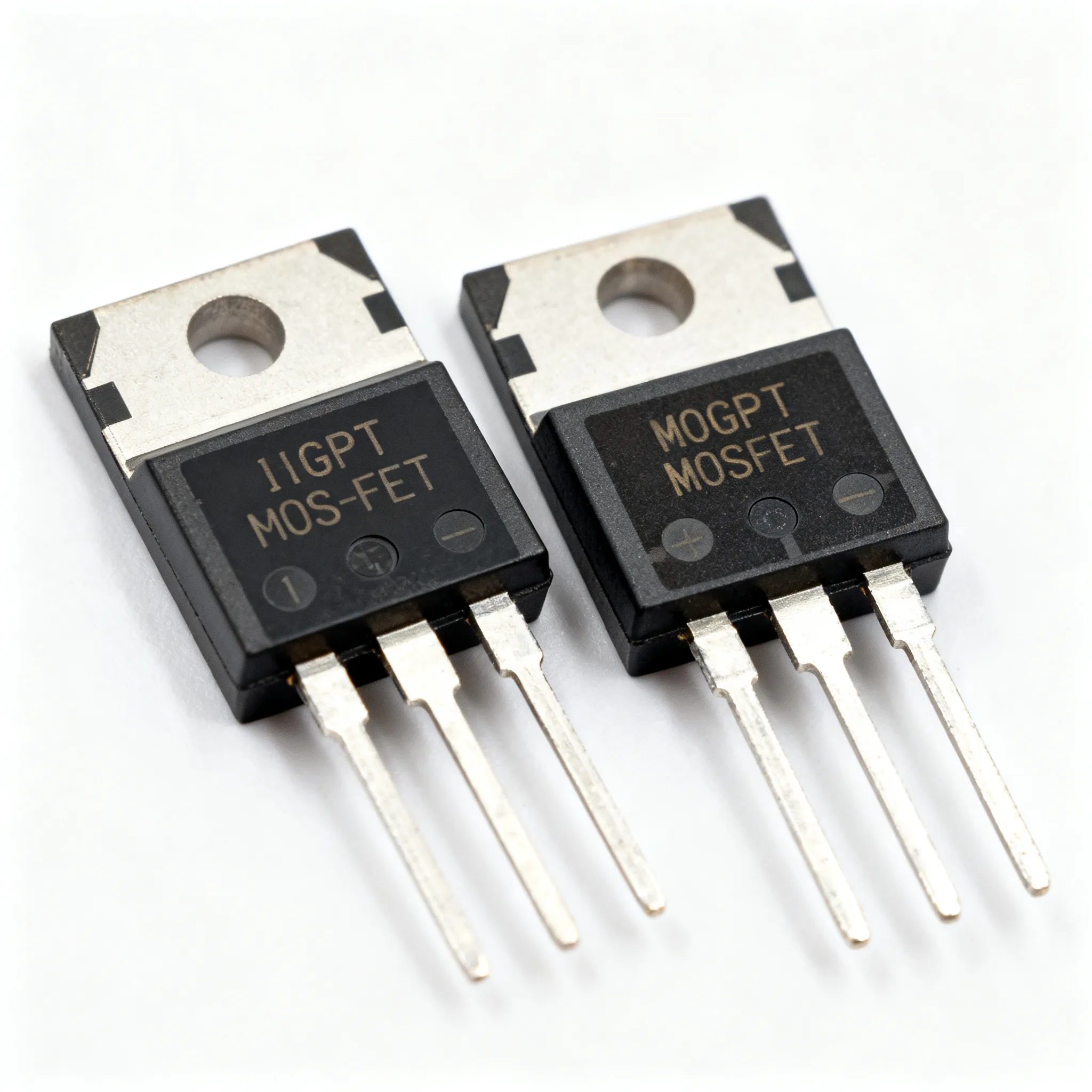
Before you can make a sourcing decision, you need to understand why the two technologies exist in the first place. An IGBT (Insulated Gate Bipolar Transistor) merges a MOSFET’s high‑impedance gate with a bipolar output stage, giving it low conduction losses at high voltage but a “tail current” during turn‑off that racks up switching losses. A power MOSFET, by contrast, is a unipolar device—its switching speed is fast because there are no minority carriers to sweep out, but the on‑resistance RDS(on) increases sharply with voltage rating, making it less attractive above 600V.
These physics translate directly into the frequency‑voltage map that governs power stage design. IC Online’s design considerations guide walks through the electrical, thermal, and mechanical parameters that matter, and the IEEE DataPort dataset of real Si‑IGBT and SiC‑MOSFET specifications from Wolfspeed and Hitachi gives you hard numbers. Use that dataset to sanity‑check the numbers below.
Typical Electrical and Cost Parameters Across Switch Types
| Parameter | Silicon MOSFET (100V, 80A) | Silicon IGBT (650V, 75A) | SiC MOSFET (1200V, 40A) |
|---|---|---|---|
| Typical VDS / VCES | 100 V | 650 V | 1200 V |
| RDS(on) / VCE(sat) at rated current | 3.5 mΩ | 1.7 V (typ.) | 32 mΩ |
| Turn‑on time (tr) | 8 ns | 35 ns | 15 ns |
| Turn‑off time (tf) | 10 ns | 250 ns (tail current) | 12 ns |
| Eon + Eoff at 400V, 20 A | 0.2 mJ | 1.8 mJ | 0.3 mJ |
| Gate charge Qg (typ.) | 80 nC | 120 nC | 60 nC |
| Thermal resistance RthJC (max.) | 0.5 °C/W | 0.18 °C/W | 0.35 °C/W |
| Approx. cost per ampere (1000‑u) | $0.12 | $0.25 | $0.90 |
| Sweet spot frequency | 50 kHz – 500 kHz | 5 kHz – 20 kHz | 50 kHz – 200 kHz |
The numbers reveal the classic trade‑off: for a 48V‑to‑12V DC‑DC converter, the silicon MOSFET wins on cost and switching speed. For a 400V motor drive switching at 8 kHz, the IGBT’s low conduction losses dominate, and the tail current is manageable. At 800V and 100 kHz, only SiC can keep the losses and heat‑sink budget in check—but the per‑ampere cost is still high. In 2026, availability often tilts the decision toward the technology that you can actually get on a reel by the end of the quarter.
The 2026 Sourcing Triangle: IGBT, Silicon MOSFET, and SiC MOSFET Trade‑Offs for Power Stages
The three device families now form a sourcing triangle, each with its own lead‑time profile, price trajectory, and design‑in risk. The IC Online cost‑driven selection blog frames it as a “send RFQ and wait” trap, while the 773 Group supply outlook shows that the tight market spans all three segments. The gate driver market forecast adds another layer: the ecosystem around each technology is expanding, but not uniformly. Here’s how they stack up for a power design engineer in 2026.
Strategic Options Across the Technology Triangle
| Segment / Option | Effect on Procurement | Notes |
|---|---|---|
| Silicon MOSFET (low‑voltage, high‑frequency) | Most commoditized; lead times 16–22 weeks on standard parts. Broad second‑source availability. | Ideal for DC‑DC converters, POL regulators, and battery management. Price erosion continues, but allocation on high‑current (>80A) parts is tightening. |
| Silicon IGBT (600V–1200V, medium‑frequency) | Still the workhorse for motor drives and inverters, but 30‑week lead times persist. Villach capacity offers a glimmer. | Single‑source risk is acute. Multi‑source designs (e.g., Infineon + ON Semi + ST) are essential. Check for compatible gate drivers early. |
| SiC MOSFET (650V–1700V, high‑frequency) | Lead times vary widely (12–26 weeks) depending on source. Prices are falling but still 3–5× silicon IGBT. | Winning 800V EV traction and high‑density AI PSU slots. Demand is pulling capacity away from IGBT lines, indirectly affecting IGBT supply. |
| Hybrid BOM (multi‑sourcing IGBT and SiC) | Increases BOM flexibility but adds design complexity: different gate drive voltages, dead‑time requirements, and thermal management. | Allows a design to survive an allocation shock. The Utmel market analysis confirms that demand is steep across all segments, so flexibility is a hedge. |
The IEEE DataPort dataset provides comparative pricing and loss data that can be fed into your own cost‑of‑ownership model. When you factor in the gate driver, heatsink, and lifetime energy losses, the economic crossover point shifts. For a 3‑phase inverter running at 10 kHz, a 650V IGBT module may still deliver the lowest total cost of ownership, provided you can lock in supply. But if your schedule can’t absorb a 30‑week lead time, a SiC alternative that ships in 18 weeks becomes the pragmatic choice, even at a higher unit cost.
From Datasheet to Purchase Order: A 2026 Procurement Playbook for IGBT and MOSFET Buyers
The selection process in 2026 must start with parametric search, but it can’t end there. Engineers and buyers need to cross‑reference datasheet parameters against real‑world derating, vet second sources, and negotiate allocation agreements before the schematic is frozen. IC Online’s practical guide to power MOSFET datasheets shows you how to interpret RDS(on) at high temperature, gate charge derating, and safe operating area (SOA) curves—all of which matter when you’re comparing a part you can get against one you can’t.
Tip: Don’t just look at the front page of the datasheet. The reverse recovery charge (Qrr) of an IGBT’s co‑packaged diode often determines the commutation loop losses and can hide an extra 15% dissipation that isn’t obvious from the headline VCE(sat) figure.
The 773 Group report highlights a dangerous trend: many power designs were qualified on a single‑source basis during periods of abundant supply. That trap is now costing companies millions in re‑spin effort. The solution is to pre‑qualify at least one alternative pin‑compatible or functionally equivalent device early in the design phase. Use parametric search tools like IC‑Online to compare real‑time stock, lead times, and pricing across multiple franchise distributors. Then lock in allocation agreements with clear volume commitments and penalty clauses.
Actions to Mitigate IGBT and MOSFET Supply Risk in 2026
| Action | When to Use | Trade‑off |
|---|---|---|
| Pre‑qualify a second source for every power switch | During prototype phase, before design freeze. | Adds up to 4 weeks to the qualification schedule; may require minor layout changes for pin‑incompatible parts. |
| Negotiate vendor‑managed inventory (VMI) or bonded stock | When you have a 12‑month rolling forecast and can commit to volume. | Locks up working capital but guarantees supply. Works best with franchise distributors and direct suppliers. |
| Design a common footprint for IGBT and SiC alternatives | For new platforms where the voltage and frequency sit in the crossover zone (600V–900V, 15–50 kHz). | Increased PCB area and possible gate‑drive complexity (bipolar vs. unipolar drive). Requires a modular gate driver approach. |
| Use parametric search with real‑time availability data | At the initial selection stage and again before production release. | Relying on a single distributor’s stock view can be misleading; cross‑check multiple sources, including IC‑Online. |
| Monitor gate driver lead times alongside power devices | Before committing to a power topology. | A driver shortage can stall the entire BOM even if the IGBT or MOSFET is in stock. The gate driver market growth signals tightness ahead. |
The 2026 procurement playbook is not about finding the cheapest transistor; it’s about finding the transistor that will actually be on your factory floor when you need it. By treating the IGBT‑vs‑MOSFET decision as a supply‑chain bet, you can avoid the all‑too‑common scenario where a brilliant electrical design is killed by a 30‑week lead time.
Your Toughest IGBT vs MOSFET Sourcing Questions, Answered by Market Data
Q: At what power level and frequency does the IGBT vs MOSFET crossover make economic sense in 2026?
The economic crossover is still largely pinned to voltage and frequency, not raw power. IGBTs dominate above 600V and below 20 kHz, where conduction losses outweigh switching costs. For a 10 kW motor drive, a 650V IGBT module is typically cheaper per ampere than a 650V SiC MOSFET, but the inventory risk may push you toward a multi‑sourced Si‑MOSFET design if you can’t secure allocation. The IC Online sourcing guide offers a cost‑driven selection framework that factors in lead time and lifetime energy cost, not just bill‑of‑materials price.
Q: How are lead times for 650V IGBTs trending compared to 100V MOSFETs right now?
650V IGBTs from major suppliers still face 30‑week lead times, even with the incremental capacity from Infineon’s Villach expansion (773 Group). 100V silicon MOSFETs are more commoditized and typically run 16–22 weeks. Allocation remains a threat for both, so second‑source qualification is critical. The gap may narrow if automotive demand for low‑voltage MOSFETs in 48V mild‑hybrid systems surges, but for now the IGBT segment is the tighter one.
Q: Should I redesign a proven MOSFET‑based design to an IGBT to hedge against allocation?
Only if the application’s voltage and current sit squarely in the IGBT sweet spot (600V, 10–20 kHz). For low‑voltage, high‑frequency DC‑DC converters, a MOSFET redesign is rarely justified—the switching losses would skyrocket. Instead, qualify multiple MOSFET suppliers and monitor availability trends via IC‑Online’s parametric search. A redesign should be a last resort, not a knee‑jerk reaction to a quarterly allocation hiccup.
Q: What are the most overlooked parameters in MOSFET and IGBT datasheets that buyers should scrutinize?
Thermal resistance RthJC under real mounting conditions, reverse recovery charge Qrr in IGBTs, and gate charge Qg derating at high temperature. RthJC is often quoted for an ideal cold plate, but your actual interface material and mounting pressure can degrade it by 30%. Qrr directly impacts reverse‑recovery losses in hard‑switched legs, and Qg determines the gate driver current requirement—overlook that and you may end up with a driver that can’t keep up. The IC Online practical guide to MOSFET datasheets explains how to interpret these specs for reliable selection and sourcing.
Q: Is SiC replacing IGBTs in EV traction inverters, and how does that affect procurement?
SiC is accelerating in 800V EV platforms for higher efficiency, but IGBTs remain strong in 400V systems and industrial drives. This bifurcation means procurement teams must track both SiC and IGBT lead times. The gate driver market growth (MarkWide Research) serves as a proxy for overall power semiconductor demand, and the IEEE DataPort dataset provides comparative pricing data. If you’re sourcing for a long‑life industrial drive, IGBTs are still a safe bet; for a high‑performance EV inverter, you’ll likely need to dual‑source SiC modules and start building relationships with SiC foundries now.
References & Further Reading
- IGBT vs MOSFET Sourcing: Cost‑Driven Selection Tips for Power Stage Design | IC Online
- MOSFET vs IGBT: Key Considerations for Effective Power Electronics Design | IC Online
- Power Semiconductor Lead Times 2026: How the EV and AI Data Center Boom — 773 GROUP LLC
- MOSFET vs. IGBT: Characteristics, Structure and Market Analysis - Utmel
- Dataset for Power Electronics: SiC‑MOSFET and Si‑IGBT Devices | IEEE DataPort
- MOSFET and IGBT Gate Driver Market Size, Share, and Industry Trends Forecast 2026‑2036 | MarkWide Research
- A Practical Guide to Power MOSFET Datasheet Features and Specifications | IC Online
- IC‑Online – Electronic Component Sourcing Platform
For mixed BOM support and flexible minimum order quantities, browse the latest IGBT and MOSFET inventory on IC‑Online.