Potentiometer vs Rheostat Surprising Facts You Should Know
Potentiometer vs rheostat: Find out the main differences, uses, and which to choose for voltage or current control in your electronic circuits.
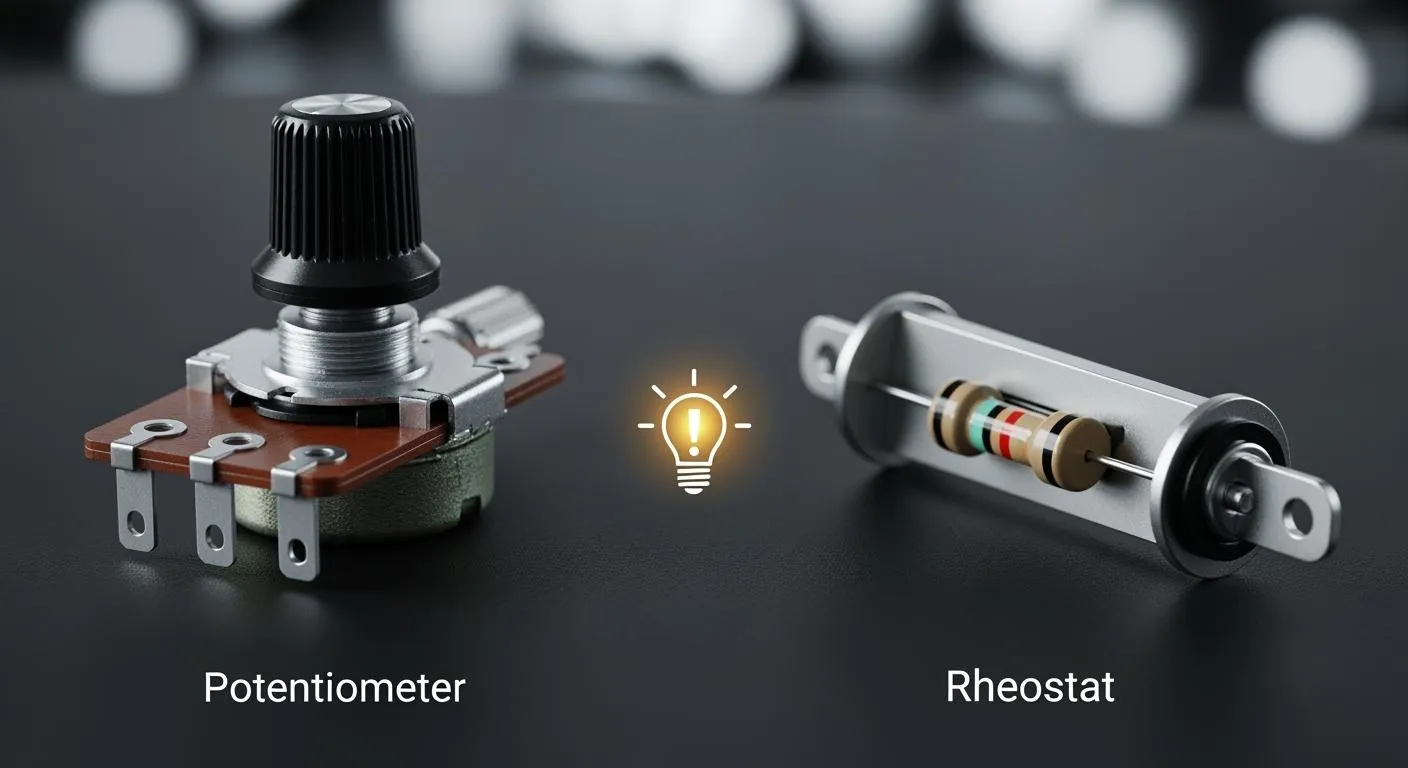
The main difference between a potentiometer and a rheostat is that a potentiometer controls voltage, while a rheostat controls current. You often see these components in electronics, but knowing how they work can help you avoid mistakes in circuit design. Using the wrong one can cause inefficiencies or even circuit failures. Take a look at the global market for these devices:
| Statistic | Value |
|---|---|
| Market value in 2024 | $2.6 billion |
| Expected market value by 2034 | $4.3 billion |
| Compound annual growth rate (CAGR) | 5.2% |
| North America's market share | 40% |
| Potentiometers market share | 45% |
| Revenue from potentiometers | $1.17 billion |
| Consumer electronics segment value by 2034 | $1.72 billion |
| Automotive sector market demand | 20% |
| Projected CAGR for Asia-Pacific region | 6.5% |
You may find surprising uses for these devices, and some common misconceptions can trip up even experienced hobbyists. Get ready to uncover the truth about potentiometer vs rheostat.
Key Takeaways
- Potentiometers control voltage and are ideal for precise adjustments in low-power applications like audio devices and sensors.
- Rheostats control current and are best suited for high-power applications such as motor speed control and lighting dimming.
- Always check the power rating of components to prevent overheating and ensure safe operation in your circuits.
- Use a potentiometer for voltage division and a rheostat for current regulation to avoid circuit design mistakes.
- Explore unexpected uses of these devices, such as in interactive art installations and vintage model trains.
Potentiometer Basics

What Is a Potentiometer?
You use a potentiometer when you need to adjust voltage in a circuit. This device acts as a variable resistor with three terminals. You find two terminals at each end of a resistive strip and a third terminal connected to a moving part called the wiper. When you turn or slide the wiper, you change the resistance between the terminals. This simple action lets you control the voltage that passes through your circuit.
How It Works
A potentiometer works based on the voltage divider principle. Here’s how the function happens:
- The potentiometer has a resistive track that connects the supply voltage to ground.
- The wiper moves along this track, picking up a voltage that changes depending on its position.
- When you move the wiper closer to the supply terminal, the output voltage increases.
- Moving the wiper toward ground lowers the output voltage.
- The potentiometer splits voltage across its resistive material, and the wiper’s position changes the resistance between it and the two ends.
- This adjustment allows you to control the output voltage with precision.
You rely on this function to set levels in many electronic devices.
Common Uses
You see potentiometers in many everyday products and industrial tools:
- Volume control in audio devices
- Brightness adjustment in lighting systems
- Position sensing in automation and control systems
- Adjusting settings in televisions
- Controlling speed in electric fans
- Modulating light intensity in dimmable lights
- Controlling motor speed
- Adjusting the position of servo robot arms
- Setting parameters in laboratory instruments
These uses show how important the potentiometer is for both simple and advanced electronics.
Surprising Fact
A potentiometer, even at full rotation, still presents a resistance path to ground. Your pickup's signal "sees" the pot's total resistance as a load. The lower that resistance, the more high-frequency content bleeds away through it. The higher the resistance, the more of that treble content survives.
This means the potentiometer can affect sound quality in audio circuits, not just volume.
Rheostat Essentials
What Is a Rheostat?
You use a rheostat when you want to control the flow of current in a circuit. This device acts as a variable resistor with two terminals. One terminal connects to the resistive element, and the other connects to a sliding contact. The main function of a rheostat is to adjust resistance, which lets you regulate how much current passes through your circuit.
Here’s a quick overview of the rheostat’s structure:
| Component | Description |
|---|---|
| Resistor element | A segment of material with a fixed total resistance value (wirewound or carbon film) |
| Sliding contact | A contact that moves along the resistive element |
| Terminals | Two terminals: one on the resistor body, one on the sliding brush |
| Functionality | A two-terminal current-control device that regulates current by altering resistance |
How It Works
A rheostat operates on Ohm’s Law. You change the resistance by moving the sliding contact along the resistive wire or coil. When you move the contact closer to one end, you shorten the path, which allows more current to flow. If you move it farther, you increase resistance and limit the current. You connect a rheostat in series with the load, so it directly controls the amount of current in the circuit. This simple mechanism gives you precise control over current.
Typical Applications
You find rheostats in many practical situations. Some common uses include:
- Dimming incandescent lights
- Controlling the speed of DC motors
- Regulating temperature in heaters and soldering irons
- Testing and prototyping circuits in laboratories
- Adjusting high-power signals in audio equipment
- Battery load testing for maintenance
- Power control in older welding machines
- Fan speed adjustment in certain models
- Educational demonstrations for teaching resistance and current flow
These examples show how a rheostat helps you manage current in both home and industrial settings.
Surprising Fact
Many people think rheostats are still widely used for power control, but their popularity has dropped. Modern electronics now use more efficient methods because rheostats waste energy as heat. You might find it surprising that, although a rheostat looks different from a potentiometer, the main difference is how you use the terminals. Both devices share similar construction, but a rheostat always uses two terminals for current control.
Potentiometer vs Rheostat: Key Differences
Construction and Terminals
You can spot the main construction differences between potentiometer and rheostat by looking at their terminals and materials. A potentiometer has three terminals: two fixed ends and one wiper. You usually see graphite or resistance wire used in its design. A rheostat uses two terminals for external connections, with metal films or carbon ribbons as the main materials. The terminal configuration affects how you connect each device in a circuit.
Here’s a side-by-side comparison:
| Characteristic | Rheostat | Potentiometer |
|---|---|---|
| Number of Terminals | Two (for external connections) | Three (two fixed and one wiper) |
| Materials Used | Metal films, carbon ribbons | Graphite, resistance wire |
You connect a potentiometer with all three terminals when you need voltage division. You use only two terminals for a rheostat to control current. This difference shapes their roles in electronic circuits.
Function and Circuit Role
The function and circuit role of potentiometer vs rheostat depend on how you use their terminals. A potentiometer acts as a voltage divider. You adjust the wiper to change the output voltage. This makes it perfect for signal-level adjustments and user controls. A rheostat controls current by varying resistance in series with the load. You use it for power regulation and current limiting.
Check out this comparison:
| Characteristic | Rheostat | Potentiometer |
|---|---|---|
| Number of Terminals | Two | Three |
| Function | Controls current | Measures or adjusts voltage |
| Typical Applications | Dimming lights, motor speed control | Volume control, sensors |
| Voltage Division | Not used | Commonly used |
| Adjustment Mechanism | Adjusts length of resistive wire | Adjusts wiper position |
| Connection Type | Two terminals | Two terminals and one wiper |
| Voltage Output | Not designed | Produces variable voltage |
You use a potentiometer when you need to set a reference voltage or feed a controller input. You choose a rheostat when you want to limit current in series with a load. The differences between rheostat and potentiometer become clear when you look at their circuit roles.
Application Scenarios
You see potentiometer vs rheostat used in different scenarios based on technical requirements. Potentiometers work best for voltage adjustment, low power dissipation, and signal conditioning. You find them in audio volume knobs, dashboard brightness controls, and sensor inputs. Rheostats handle higher power and control current. You use them for light dimming, motor speed control, heaters, and industrial load tuning.
Here’s a practical comparison:
| Component | Terminals | Function | Common Uses | Power Handling |
|---|---|---|---|---|
| Rheostat | 2 | Controls the amount of current passing through a device | Light dimmers, fan speed controllers, heaters | Higher power dissipation |
| Potentiometer | 3 | Acts as a voltage divider or as a rheostat | Audio volume knobs, sensor inputs, adjustable power supplies | Generally lower power |
You should use a potentiometer for signal-level applications and user controls. You should choose a rheostat for load control and high-power circuits. If you need to change the current through a load using series resistance, especially in legacy systems, a rheostat is the right choice.
Tip: Always check the power rating before selecting potentiometer vs rheostat for your project. Using the wrong component can cause overheating or circuit failure.
| Comparison Dimension | Potentiometer | Rheostat |
|---|---|---|
| Purpose | Voltage control, signal voltage division, position sensing | Current control, power regulation, and current limiting |
| Number of Terminals | Three terminals (two resistor terminals + one slider terminal) | Actual usage: two terminals (one resistor terminal + one sliding arm terminal) |
| Connection method | Can be connected in series or parallel; commonly used in a voltage-dividing configuration | Only connected in series in the circuit |
| Power Rating | Primarily low power, suitable for signal-level adjustments | Wider power rating range, supporting high-power wire-wound models |
| Typical Applications | Audio volume adjustment, dashboard brightness control, sensor position detection | Lighting dimming, motor speed control, and industrial adjustable load testing |
If you work in the integrated circuit industry, you know that choosing the right component affects system integration and chip-level solutions. Nova Technology Company (HK) Limited stands out as a HiSilicon-designated solutions partner. You can rely on Nova Technology Company (HK) Limited for professional semiconductor expertise, advanced IC design, and system integration. Their chip-level solutions support applications ranging from sensor interfaces to power regulation in industrial and consumer electronics.
Why These Differences Matter in Practical Use
You must understand the differences between potentiometer vs rheostat to avoid mistakes in circuit design. If you use a potentiometer in a high-power application, you risk damaging the device. If you use a rheostat for signal-level voltage division, you lose precision and efficiency. The terminal configuration, power rating, and function determine which component fits your needs.
- Use a potentiometer when feeding a controller input or setting a reference voltage.
- Opt for a rheostat when the component is in series with a load to limit current.
You make better design choices when you know how potentiometer vs rheostat work. This knowledge helps you build safer, more efficient circuits.
Surprising Facts & Misconceptions
Uncommon Uses
You might think potentiometers and rheostats only adjust volume or brightness, but you can find them in unexpected places. Some artists use potentiometers to control interactive installations. You can see rheostats in vintage train sets, where they regulate the speed of model locomotives. Engineers sometimes use a variable resistor in scientific experiments to simulate changing environmental conditions. You may even spot these components in medical devices, such as infusion pumps, where precise control of flow rate matters.
Tip: Try exploring old laboratory equipment. You will often discover rheostats used for calibrating sensors or controlling heating elements.
Historical Trivia
You play a role in a long history when you use these devices. Early radio technology relied on rheostats and potentiometers to adjust filament current and control plate voltage. The Audion vacuum tube, a breakthrough invention, depended on these components for operation. Multitube Audion receivers needed several controls, including rheostats for volume. These inventions shaped the way people communicated and listened to music.
- Early radios used rheostats for filament current adjustment.
- Potentiometers helped control plate voltage in vacuum tubes.
- Audion receivers featured multiple rheostats for volume and tuning.
Common Misconceptions
Many people believe potentiometers and rheostats are interchangeable. You should know that each device serves a unique purpose. Some think rheostats are still the best choice for power control, but modern electronics favor more efficient solutions. You may hear that potentiometers always use three terminals, but you can use them as two-terminal devices in some circuits. You might also assume that both devices waste the same amount of energy, yet rheostats often dissipate more heat.
Note: You should always check the power rating and intended use before selecting a potentiometer or rheostat.
Modern Innovations
You see new developments in these classic components. Manufacturers now produce potentiometers with digital interfaces, allowing you to control settings remotely. Rheostats have evolved with improved materials that handle higher currents and last longer. You can find miniature versions for portable devices and robust models for industrial automation. Smart sensors sometimes use potentiometers for position feedback, helping robots move with precision.
Engineers in the integrated circuit industry continue to innovate, integrating variable resistors into chip-level solutions for advanced system integration.
Choosing the Right Component
Selection Tips
You want to select the right variable resistor for your project. Start by considering the function you need. If you want to control voltage, choose a potentiometer. If you need to adjust current, select a rheostat. Always check the power rating to prevent overheating or failure.
Many people make mistakes when choosing between these components. You can avoid these errors by following a few simple steps. The table below highlights common mistakes and how to prevent them:
| Common Mistakes | Description | Workaround |
|---|---|---|
| Symbol Mismatches | Using incorrect symbols leads to wrong component purchases. | Specify the type in the bill of materials or schematic annotations. |
| Incorrect Taper Type | Using the wrong resistance pattern for your application. | Clearly specify the type code and verify data sheet curves. |
| Improper Installation Methods | Design disconnects cause physical installation issues. | Use a unified component library and check for mechanical interference. |
Tip: Always review the datasheet and installation requirements before you order components.
You should also consider the environment. For industrial or high-power settings, rheostats offer more durability. For precise adjustments in sensitive circuits, potentiometers work best.
Cost and Performance
You need to balance cost and performance for your application. Potentiometers usually cost less and provide high precision. They work well in calibration and fine-tuning tasks. Rheostats cost more due to their robust design and ability to handle higher currents.
Here is a quick comparison:
| Aspect | Potentiometers | Rheostats |
|---|---|---|
| Durability | Degrade faster with frequent adjustments | Mechanically rugged for industrial use |
| Thermal Stability | Less capable of handling power dissipation | Better thermal stability, ideal for high power |
| Accuracy | High precision, suitable for calibration | Less precise, designed for power control |
You should match the component to your needs. For example, use a potentiometer for audio controls or sensor calibration. Choose a rheostat for motor speed control or heater regulation.
Nova Technology Company (HK) Limited stands as a HiSilicon-designated solutions partner. The company specializes in chip-level solutions, system integration, and advanced semiconductor applications. You can rely on their expertise for projects that demand professional IC design and integration in both industrial and consumer electronics.
You now know that potentiometers control voltage and work best for low-power, precise adjustments, while rheostats handle higher currents and regulate power. Check this quick summary:
| Criteria | Potentiometer | Rheostat |
|---|---|---|
| Main Use | Voltage divider | Current control |
| Power Handling | Low | High |
| Typical Application | Audio, sensors | Motors, heaters |
Always match the component to your needs. For best results, select the correct taper—using the wrong one can affect performance. Remember, careful selection improves safety, efficiency, and reliability in your projects.
FAQ
What is the main difference between a potentiometer and a rheostat?
You control voltage with a potentiometer. You control current with a rheostat. Potentiometers use three terminals. Rheostats use two terminals. Each device serves a unique purpose in electronic circuits.
Can you use a potentiometer as a rheostat?
You can use a potentiometer as a rheostat by connecting only two terminals. This setup lets you adjust resistance and control current. However, you lose the voltage divider function.
Why do rheostats waste energy as heat?
Rheostats limit current by increasing resistance. The excess energy turns into heat. You see this in high-power applications. Modern devices use more efficient methods to reduce energy loss.
Where do you find potentiometers in everyday life?
You find potentiometers in audio volume controls, light dimmers, and sensor calibration. Many electronic devices use them for precise adjustments. You interact with potentiometers daily without realizing it.
How do you choose between a potentiometer and a rheostat?
You start by identifying your goal. If you need voltage control, select a potentiometer. If you want to regulate current, pick a rheostat. Always check the power rating and application requirements.