Exploring the Role of 3 Input NAND Gates in Modern Electronics
A 3 input nand gate forms a core building block in digital electronics. This gate produces a low output only when all three

A 3 input nand gate forms a core building block in digital electronics. This gate produces a low output only when all three inputs are high, making it essential for many logic operations. Engineers value the nand gate for its universal property. One type of gate can create any logical function, unlike AND, OR, or NOT gates. The table below shows how the three-input nand gate compares with other basic gates in digital electronics:
| Aspect | NAND (including 3-input) | Other Basic Gates |
|---|---|---|
| Universality | Can implement any Boolean function alone | Require combinations |
| Gate Type Variety | Single gate type needed | Multiple gate types |
| Implementation Efficiency | May increase gate count, power, complexity | Fewer gates, more types |
| Flexibility | High | Limited when used alone |
| Example IC | 7400 quad 2-input NAND chip | Multiple ICs needed |
Modern integrated circuits rely on nand gates because they simplify design and improve reliability in digital electronics. Everyday devices—from computers to security systems—depend on the flexible operation of the three-input nand gate.
Key Takeaways
- A 3 input NAND gate outputs low only when all three inputs are high, making it a key building block in digital electronics.
- NAND gates are universal, meaning engineers can build any logic function using only NAND gates, simplifying circuit design.
- These gates are made using CMOS technology with transistors arranged to ensure efficient, reliable, and low-power operation.
- 3 input NAND gates appear in many devices like computers, security systems, memory chips, and automation equipment.
- Using 3 input NAND gates reduces component count, saves space, and improves circuit speed, but designers must consider some speed and power limits.
3 Input NAND Gate

Definition
A 3 input nand gate is a digital logic device with three separate inputs and one output. In digital electronics, this gate produces an output that is false only if all its inputs are true. The output is the complement of an AND gate. For three inputs, labeled A, B, and C, the output X follows the Boolean expression X = (A.B.C)'. This means the output is LOW (0) only when every input to the nand gate is HIGH (1). In every other case, the output remains HIGH (1). This property makes the three-input nand gate a fundamental part of digital circuits. The gate acts as an AND gate followed by a NOT gate, so it inverts the result of the AND operation. The three-input gate is often found in integrated circuits, where it helps build more complex logic systems.
Note: The number of inputs distinguishes a 3 input nand from other nand gates. While the basic logic stays the same, the three-input version uses three signals and outputs LOW only when all are HIGH. This design appears in many 14-pin ICs, each containing three such gates.
Universal Gate
The nand gate is known as a universal gate in digital logic. This means engineers can use only nand gates to create any other logic gate or Boolean function. The three-input nand gate shares this property. By combining several nand gates, designers can build NOT, AND, OR, and even more complex circuits. For example, a NOT gate can be made by connecting all three inputs of a 3 input nand to the same signal. An AND gate can be formed by following a nand gate with another configured as a NOT gate. OR gates can be built by inverting the inputs before feeding them into a nand gate. This flexibility allows the three-input nand gate to serve as the foundation for entire digital systems.
- Any Boolean function can be implemented using only nand gates. This includes functions like V = ABC' + (BC)', which would normally require several types of gates. By using Boolean algebra and transformations, engineers can reduce these functions to forms that use only three-input nand gates.
- Designers often use DeMorgan's laws to rewrite expressions so that only nand operations appear. This process allows the construction of complex logic circuits using just one type of gate.
Tip: The universality of the nand gate simplifies circuit design and manufacturing. Using only one type of gate reduces the number of different components needed in a system.
Truth Table
The truth table for a nand gate with three inputs shows how the output changes with different combinations of A, B, and C. The output is HIGH (1) for every combination except when all three inputs are HIGH (1). In that case, the output is LOW (0). This pattern matches the definition of the nand operation.
| A | B | C | Output |
|---|---|---|---|
| 0 | 0 | 0 | 1 |
| 0 | 0 | 1 | 1 |
| 0 | 1 | 0 | 1 |
| 0 | 1 | 1 | 1 |
| 1 | 0 | 0 | 1 |
| 1 | 0 | 1 | 1 |
| 1 | 1 | 0 | 1 |
| 1 | 1 | 1 | 0 |
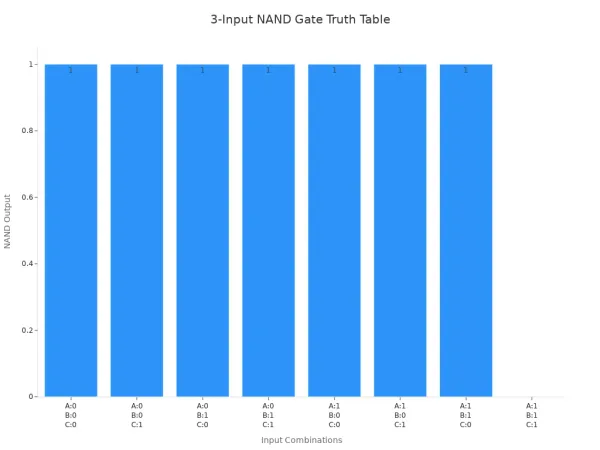
A 3 input nand gate always outputs 1 unless every input to the nand gate is 1. This behavior makes the three-input nand gate useful in many digital circuits. The truth table for a nand gate helps engineers predict how the gate will respond to different signals. This understanding is key when designing reliable electronic systems.
Construction
Transistor-Level
Engineers design a 3 input nand gate at the transistor level using CMOS technology. This approach uses both NMOS and PMOS transistors. In a typical two-input nand gate, the design requires four transistors. Each additional input adds a pair of transistors. For a 3 input nand gate, the circuit uses six transistors in total. Three NMOS transistors connect in series, while three PMOS transistors connect in parallel. This arrangement ensures that the output remains high unless all three inputs are high. When all inputs receive a high signal, the NMOS path conducts, pulling the output low. This structure provides reliable circuit operation and low power consumption. The design also supports high noise immunity, which is important for stable nand gate performance in digital systems.
Note: CMOS construction allows the nand gate to operate efficiently in both small and large-scale integrated circuits.
Integrated Circuits
Manufacturers include 3 input nand gates in many standard integrated circuits. The 74x10 and 74x12 ICs each contain three 3-input nand gates. The 74LVC10ABQ from Nexperia also features three 3-input nand gates, making it suitable for modern digital designs. The CD4023 is a popular CMOS triple 3-input nand gate IC. It offers a wide supply voltage range, high noise immunity, and compatibility with TTL logic levels. Other common ICs include the 74LS10 and 4023B, both of which provide three 3-input nand gates per chip.
| IC Model | Description |
|---|---|
| 74x10 | Contains three 3-input NAND gates |
| 74x12 | Contains three 3-input open-collector NAND gates |
| CD4023 | CMOS triple 3-input NAND gate |
These ICs simplify circuit operation by allowing designers to implement complex logic functions with fewer components. The nand gate remains a key element in digital electronics, supporting everything from simple logic circuits to advanced microprocessors. By using these integrated circuits, engineers achieve efficient, reliable, and scalable nand-based designs.
Three-Input NAND Gate Logic
Boolean Expression
A 3 input nand gate uses a specific Boolean expression to describe its functionality. The expression for this gate is:
Y = NOT (A AND B AND C)
This means the nand gate takes three inputs, labeled A, B, and C. It first performs an AND operation on these inputs. If all three inputs are high, the AND function gives a high result. The nand gate then inverts this result. The output, Y, becomes low only when A, B, and C are all high. In every other case, the output stays high. This simple Boolean expression helps engineers understand the core operation of the nand gate. The gate’s functionality allows it to serve as a building block for many digital circuits. Designers often use this expression to create truth tables and predict circuit behavior.
Tip: The Boolean expression for a 3 input nand gate shows how the gate combines logic and inversion in one device.
Signal Flow
The signal flow inside a 3 input nand gate follows a clear path. Each input signal enters the gate and passes through an internal AND function. The gate checks if all three inputs are high. If so, the AND operation produces a high signal. The nand gate then sends this result to a NOT operation. The NOT operation inverts the signal. As a result, the output drops low only when all three inputs are high. In every other situation, the output remains high. This logical flow defines the operation of nand gate devices. The symbol for a nand gate shows an AND gate with a small circle at the output. This circle stands for the NOT operation. The combination of AND and NOT gives the nand gate its unique functionality.
Engineers rely on this signal flow to design circuits that need specific logic functions. The operation of nand gate circuits remains consistent, making them easy to use in many applications. The clear signal path also helps with troubleshooting and understanding how digital systems work.
Applications of the NAND Gate

The applications of the nand gate extend across nearly every area of digital electronics. Engineers use this versatile logic gate to solve complex problems, simplify circuit design, and improve reliability. The following sections explore how the nand gate supports modern technology in digital circuits, security systems, memory devices, and automation.
Digital Circuits
Digital circuits rely on the nand gate as a fundamental building block. Designers use it to create essential components such as flip-flops, latches, multiplexers, arithmetic circuits, and microprocessors. The universal property of the nand gate allows engineers to implement any Boolean function, making it possible to build entire digital systems using only this gate.
- Flip-flops and latches often use 3-input nand gates to reduce the number of gates required. For example:
- A classic SR latch can be built from two cross-coupled nand gates.
- More complex flip-flops, such as divide-by-2 or edge-triggered types, may require several nand gates, sometimes including 3-input versions to minimize the total gate count.
- The inverting and feedback properties of the nand gate enable stable memory states, which are essential for storing information in digital circuits.
Multiplexers and arithmetic circuits also benefit from the nand gate's ability to combine and process multiple signals efficiently. Microprocessors, the brains of computers, use thousands of nand gates to perform calculations and manage data flow.
Security Systems
Security systems depend on the reliability and flexibility of the nand gate. In light-activated security systems, 3-input nand gates combine signals from sensors to ensure alarms trigger only when all required conditions are met. This approach reduces false alarms and increases system reliability.
| Application Example | How the NAND Gate Works |
|---|---|
| Burglar alarms | Combines door, window, and motion sensor signals; alarm sounds only if all indicate a breach. |
| Light-activated systems | Uses light sensors and other inputs; alarm triggers only when all inputs are high. |
| Freezer warning buzzers | Monitors temperature, door status, and power; buzzer activates if all conditions signal a problem. |
The CMOS implementation of the nand gate ensures low power consumption, which is important for battery-powered security devices. The logic of the nand gate fits perfectly with the need for combined sensor verification, making it a popular choice in modern security applications.
Memory Devices
Memory devices use the nand gate to store and manage data. Flip-flops and latches, which form the basis of memory cells, rely on the unique properties of the nand gate. The gate's ability to maintain stable output states through feedback makes it ideal for storing bits of information.
- NAND-based memory devices, such as flash memory, use large arrays of nand gates to store data efficiently.
- The feedback and inverting features of the nand gate allow memory circuits to retain information until new data is written.
- Designers use 3-input nand gates to simplify circuit layouts and reduce the number of components needed in memory arrays.
The widespread use of the nand gate in memory devices highlights its importance in computers, smartphones, and other digital products.
Automation
Automation systems benefit greatly from the applications of the nand gate. In automatic watering devices, for example, 3-input nand gates process signals from soil moisture sensors, timers, and manual overrides. The gate ensures water flows only when all preset conditions are satisfied, promoting efficient irrigation and water conservation.
- Automatic watering systems use the nand gate to evaluate complex conditions and control water flow.
- Safety devices rely on multi-input nand gates to ensure machinery operates only when all safety conditions are met. For example:
- Safety interlock circuits prevent machines from starting unless all guards are in place.
- Alarm systems trigger only when specific safety switches are activated.
The nand gate's logic reduces the need for multiple two-input gates, simplifying the design of safety and automation circuits.
Common Real-World Applications:
- Burglar alarms
- Light-activated security systems
- Automatic watering devices
- Freezer warning buzzers
- Safety interlock circuits
The versatility and reliability of the nand gate make it a key component in countless applications. Its ability to process multiple inputs and deliver precise logic control ensures safe, efficient, and intelligent operation in modern electronic systems.
Advantages and Limitations
Benefits
The 3 input nand gate offers several important benefits in digital electronics. Engineers often choose this gate for its efficiency and versatility. Here are some key advantages:
- The nand gate has a lower delay than a NOR gate. This means circuits using nand gates can work faster because the logical effort is smaller.
- Nand gates use less silicon area, especially as the number of inputs increases. This makes them more area-efficient in integrated circuits.
- The transistors in a nand gate are usually the same size. This uniformity helps simplify manufacturing and can reduce costs.
- The CMOS nand gate design balances resistance when driving the output high or low. This balance uses the higher mobility of electrons in NMOS transistors, which improves performance.
- Nand gates require fewer components than other logic gates. This makes them smaller and more economical to produce.
- The nand gate is functionally complete. Engineers can build any logic circuit using only nand gates, which simplifies both design and manufacturing.
The nand gate's functionality allows it to serve as the foundation for many digital systems. Its cost-effectiveness and small size make it a popular choice in modern electronics.
Drawbacks
Despite its many advantages, the 3 input nand gate also has some limitations. These drawbacks can affect its use in certain high-speed or complex circuits.
- The delay in a 3 input nand gate increases because the transistors connect in series. P-channel MOSFETs, which have higher resistance, cause longer propagation delays.
- Parasitic capacitances and body effects in MOSFETs can further slow down the gate's performance.
- Adding more inputs to a nand gate requires larger transistors to keep the speed up. This increase is not economical and can raise power consumption.
- Voltage drops across the series transistors can get close to the supply voltage. This limits how many inputs a nand gate can have.
- In CMOS technology, practical nand gates usually have no more than four to six inputs. The 3 input nand gate is a common compromise, but it still faces these challenges.
Designers must consider these limitations when choosing a nand gate for high-speed or large-scale circuits. Understanding both the benefits and drawbacks helps engineers select the right gate for each application.
3-input NAND gates play a vital role in modern electronics. They handle multiple conditions at once, support complex circuit designs, and enable logical negation in intricate systems.
- These gates simplify digital logic, reduce component count, and lower power use.
- Their universality supports applications in FPGAs, memory devices, and AI-driven technologies.
- Designers use them in arithmetic units, multiplexers, and decision-making circuits.
| Aspect | Details |
|---|---|
| Versatility | Universal logic, fewer components, less power |
| Applications | Data centers, mobile devices, automation |
For those interested in deeper learning, simulation platforms and hardware description languages like VHDL offer practical ways to explore 3-input NAND gate designs in real-world systems.
FAQ
What is the main function of a 3 input NAND gate?
A 3 input NAND gate checks three signals. It gives a low output only when all three inputs are high. In every other case, the output stays high.
How can engineers use only NAND gates to build other logic gates?
Engineers connect NAND gates in special ways. For example, they tie all inputs together to make a NOT gate. They combine several NAND gates to create AND or OR gates.
Where do people find 3 input NAND gates in real life?
People find these gates in computers, alarms, and memory chips. They also appear in automation systems and safety devices. Many home electronics use them.
What is the Boolean expression for a 3 input NAND gate?
Y = NOT (A AND B AND C)
This means the output is high unless all three inputs are high.